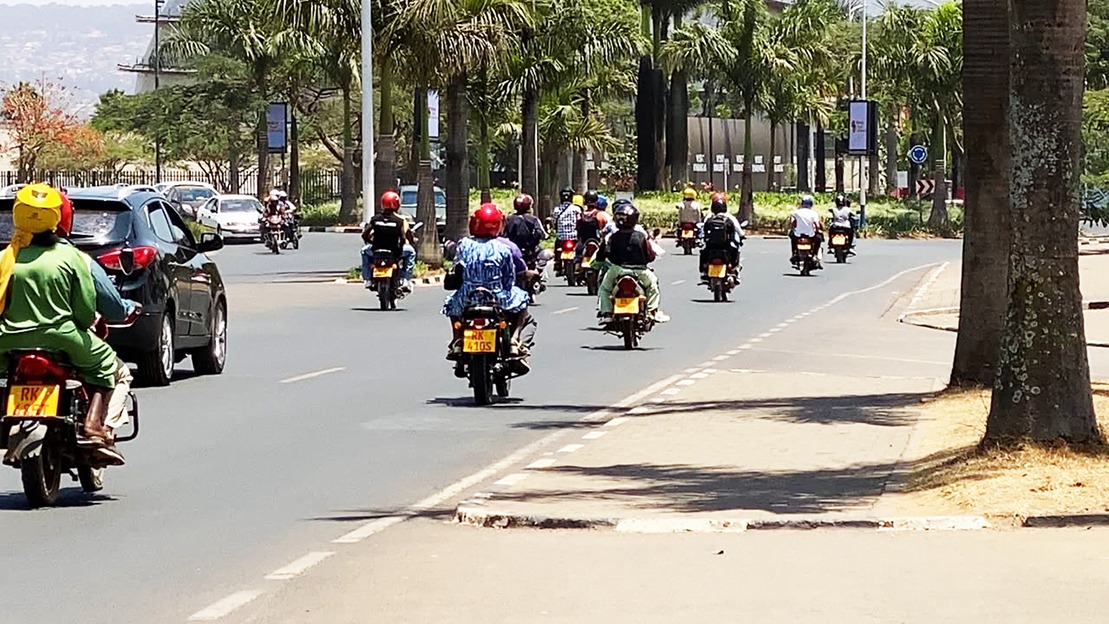
The use of motorcycles for commercial transport has become common in both Rwanda and Ghana.
However, while the practice is legal and regulated in Rwanda, commercial motorcycle transport, popularly known as “Okada”, remains illegal in Ghana.
In Rwanda, the system has built significant public trust, with authorities also promoting the use of electric motorcycles to reduce noise and emissions.
Safety remains a key priority, with the use of safety gear by both operators and passengers strictly enforced.
“The reason for wearing a helmet is that the helmet protects the head. As you can see, there are two helmets: one for me and one for the passenger. A motorcycle is allowed to carry two people—the motorcycle taxi driver and the passenger,” Munezero Theoneste, a motorcycle taxi operator in Kigali, told Citi News.
Violations of traffic regulations attract various sanctions, including fines.
“First, they issue you a ticket. That fine has an amount of 3,000 Rwandan francs per month. If you do not pay it again, another 3,000 Rwandan francs are added until you pay the debt for which they issued you the fine.
“Every month you do not pay, 3,000 Rwandan francs are added to that debt,” another motorcycle taxi operator, Byukusenge Samson, told Citi News.
Passengers are also expected to comply with safety regulations. Daniel, a passenger, said failure to observe the safety measures could result in a passenger being taken into custody for up to 15 days.
Many Rwandans regard motorcycle transport as a convenient option for commuters, citing adherence to traffic regulations and professional conduct among riders.
“We feel safe when we travel with it,” a Rwandan journalist, Elias Sachizima, told Citi News.
Ghana’s situation, however, presents a different picture. Many commercial motorcycle operators, known as Okada riders, operate outside the existing road traffic regulatory framework, raising concerns about safety and road crashes.
Unlike in Rwanda, the use of safety gear and professional standards for commercial motorcycle operators are not consistently enforced in Ghana.
Christopher Amuzu, an Okada rider, told Citi News that although helmets provide protection against head injuries during crashes, many riders and passengers do not wear them.
“Even though the helmet provides safety and prevents head injuries during a crash, many of us don’t usually wear it. Our passengers equally don’t like wearing helmets. Sometimes we offer them helmets, but they reject them, saying it will mess their hair, particularly the women,” he said.
Another Okada rider, Kwaku Antwi, also raised concerns about professionalism among some operators.
“There’s also no sense of professionalism for many of us. Even the way they dress is not encouraging,” he said.
While the government is yet to legalise commercial motorcycle transport, the Okada Riders Association of Ghana (ORAG) says the absence of a formal regulatory framework makes it difficult to enforce safety and professional standards.
Michael Kofi Owusu, National President of ORAG, said operators often struggle to enforce safety measures because the business remains unregulated.
“We can’t ensure strict compliance because the business is not legalised. Sometimes when we approach riders and try admonishing them to observe safety rules and appear professional, they tell us they are not commercial riders because there’s no distinct plate for us,” he said.
Having studied the Rwandan system, ORAG is urging the government to expedite efforts to legalise commercial motorcycle transport in Ghana.
“The Rwandan system is a perfect model that can be adopted in Ghana. It will ensure the safety of riders and passengers and also restore sanity in the system. The government has assured us, and we know the legalisation process is advanced, but we’d be glad if they expedited the process,” the ORAG President added.
By Akwasi Addo
Source: citinewsroom