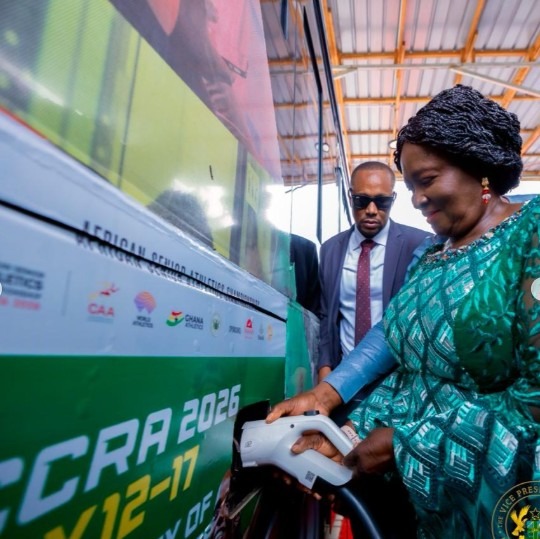
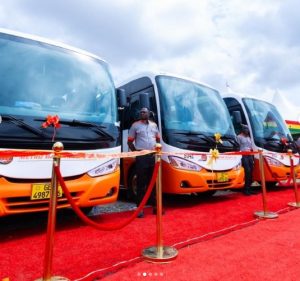
Last week, the Vice President, Naana Jane Opoku-Agyemang inaugurated 100 newly acquired 29-seater buses for Metro Mass Transit Limited (MMTL) as part of government’s efforts to improve public transportation and ease commuting difficulties across the country.
The buses represent the first batch of a planned 300-bus procurement programme intended to strengthen the operational capacity of Metro Mass Transit and provide more reliable transport services nationwide.
Speaking during the commissioning ceremony at the MMTL headquarters on Friday, May 22, 2026, the Vice President said the initiative forms part of government’s RESET agenda aimed at improving infrastructure, creating jobs and stimulating economic activity.
She noted that the buses would support night transport operations, assist shift workers and improve mobility in urban centres where transport challenges remain severe.
According to her, passenger safety, comfort and fuel efficiency were central considerations in the acquisition process. She further explained that route planning would be informed by commuter demand data and public feedback to ensure greater efficiency and responsiveness.
The commissioning of the newly acquired buses by the Vice President marks a significant and commendable step toward addressing the country’s worsening public transport crisis. At a time when millions of commuters continue to endure overcrowded vehicles, endless queues, unreliable transport services and exploitative fare practices, the government’s decision to invest in high-capacity buses deserves recognition.
The Chronicle has consistently argued that our transport system is in urgent need of structural reform. In our previous editorials we highlighted the daily suffering of commuters and the economic damage caused by an inefficient transport network. We also welcomed government’s earlier promise to provide buses for public transport operators as part of broader reforms.
Today, with the arrival and commissioning of the first batch of 100 buses out of the planned 300, government has moved beyond promises to visible action. This deserves commendation. The emphasis on safety, comfort, fuel efficiency and support for night operations shows an understanding of the realities confronting urban commuters and shift workers.
However, while this investment is encouraging, history demands that Ghanaians remain cautiously optimistic. Ghana has witnessed several well-intentioned public transport interventions collapse due to poor maintenance culture, political interference, weak management systems and lack of operational discipline. The concern now is not merely about acquiring buses, but ensuring that these vehicles are used effectively, maintained properly and protected from the cycle of neglect that has crippled similar initiatives in the past.
Indeed, many state transport assets across the country tell a painful story of abandonment. Over the years, buses acquired under various administrations have either broken down prematurely, been parked indefinitely at depots or become unserviceable due to poor maintenance practices.
Metro Mass itself has previously struggled with operational inefficiencies and aging fleets caused largely by delayed servicing, inadequate spare parts management and weak supervision. The once-promising Bus Rapid Transit system, popularly known as Aayalolo, also suffered a sharp decline after years of inconsistent policy direction and neglect of dedicated infrastructure.
It is, therefore, refreshing that Vice President Opoku-Agyemang specifically stressed the importance of “strict maintenance routines” during the commissioning ceremony. That warning must not become another ceremonial statement forgotten after the cameras disappear. Maintenance must become a national priority within public transport administration.
Globally, successful public transport systems survive not because buses are purchased, but because they are maintained through disciplined operational systems. Countries with efficient bus services invest heavily in preventive maintenance schedules, professional fleet management systems, driver accountability mechanisms and dedicated funding for repairs and spare parts. Ghana must adopt the same seriousness.
The newly acquired buses must not be treated as political trophies or merely ceremonial additions to the roads. They were bought for a clear purpose: to improve mobility, reduce commuter suffering, support economic activity and restore dignity to public transportation. They must, therefore, be deployed strategically to the areas where transport pressure is most severe. Routes should indeed be guided by commuter demand data, as government has promised, rather than political considerations or union pressure.
Additionally, government must ensure that these buses operate consistently and reliably. One of the reasons commuters continue to rely heavily on overcrowded trotros is the unreliability of many public transport alternatives. If commuters are unable to trust the availability and punctuality of these new buses, the broader objective of reducing congestion and improving productivity will fail.
Equally important is the issue of discipline and accountability within the system. We have repeatedly raised concerns about the growing indiscipline in Ghana’s transport sector, from arbitrary fare increases to dangerous driving practices. The acquisition of modern buses alone will not solve these problems unless management insists on professionalism among drivers, inspectors and operational staff.
The Chronicle also believes government must avoid the temptation of allowing these buses to deteriorate under politicised appointments and poor administrative oversight. Public transport institutions should be managed professionally, with performance targets, transparent financial systems and independent operational monitoring. We cannot continue spending millions on transport interventions only for assets to collapse after a few years due to negligence.
Furthermore, this investment should form part of a broader national transport transformation agenda. The buses alone cannot solve Accra’s transport nightmare. Government must revisit dedicated bus lanes, revive and modernise the Bus Rapid Transit concept and accelerate plans for integrated transport systems supported by digital ticketing and proper urban planning.
Government has taken an important first step. Now comes the harder task: ensuring that these buses serve the purpose for which they were bought and do not become another symbol of wasted public investment.