Nigerian music icon Tiwa Savage has admitted she has no plans to sign an artist under her wing, citing the stress that comes with managing talents. She disclosed this in an interview with Forbes Africa.
“Everyone always says to me, ‘When are you going to sign an artist?’ I don’t think I have the gift to sign another artist, because artists are stressful… I could just be sleeping, and then I will wake up and my artist is trending for something else,” she said.
However, she expressed her desire to support upcoming musicians in a different way—by creating a music school. “I do have the gift to help, which is why I am trying to do the music school, where you can go and later sign to a label that can actually help you,” she explained.
Beyond personal success, Tiwa Savage highlighted the need for African artists to take control of their art and industry. “We need to own our art, our publishing, our labels,” she stated. “We need to tell our own stories.”
The music icon also cautioned emerging artists against rushing to fame, emphasizing the importance of building a strong foundation before reaching the pinnacle of their careers. The award-winning singer shared insights on the pressures of success and the need for ownership in the music industry.
“Cherish the beginning,” she advised. “A lot of artists rush to the top, but once you are there, you face pressures — streams, concerts, obligations. When you start, you are free to create without limitations. Build a strong foundation, so when opinions come at you, you do not lose yourself.”
She also challenged the notion of seeking validation from foreign markets, urging industry stakeholders to focus on building a self-sufficient music ecosystem.
“Why are we trying to break into another market? We should build our own to be the one others try to break into,” she said. “If we had the right infrastructure, affordable data, and investment, we would not have to chase validation elsewhere.”
The Convener of the International Youth Empowerment Summit and Founder of Brian Amoateng Ministries, Pastor Brian Amoateng, has narrated how he gave up a clubbing lifestyle after hearing a gospel song in a taxi on his way to a nightclub.
He revealed that he was fond of clubbing and found it difficult to quit due to how addictive it had become, despite being a pastor’s child. However, one night, while taking a taxi to a club, everything changed.
According to him, he became emotional upon hearing the gospel song and felt an unusual sensation that altered his mood by the time he arrived at the event.
He disclosed this while speaking to Joy Prime’s Lois Shola Adeyemi on the Changes show, reminiscing about what inspired his decision to venture into ministry.
“Being a church boy, always in church, I knew what church was. So, I remember when I got to Legon, I used to club a lot—almost every day, from Monday to Tuesday. One day, I was going to a nightclub, and I was in a taxi when the driver started playing a gospel song. Something entered me, and I felt like crying, but I still wanted to go to the club just to please my friends.
That night, when I got to the club, I couldn’t dance. Being the ‘Chingy’ that people knew, I didn’t open the dance floor. I got to the club, and something told me to go home. I felt so down. Normally, I would leave the club at 5 a.m. every day, but that day, I left by 2:30 or 3 a.m.,” he said.
Upon returning to his hostel, he cried, feeling that he had lost something valuable and vital—Jesus Christ.
At that defining moment, he made the decision to dedicate himself to the work of God and never return to the club.
As a pastor’s child, he had been living a double life—one in church and another in his everyday routine—a struggle that made him uncomfortable until he realized and accepted his true purpose.
From his experience, he emphasized that God speaks in mysterious ways, and people hear Him differently. Hence, he advised young individuals not to be deceived by movies about how God communicates and to stay focused, embracing every opportunity as it may be from God.
“A lot of people think that God’s voice has to be a deep, bass voice, but sometimes God speaks in mysterious ways. It can come as a still, small voice within you. You can go to church, and the message the preacher delivers might be God speaking to you.”
For this reason, he encourages young people to find a Bible-believing church that can help guide them in their spiritual journey.
“God speaks in so many ways. We should not follow, for instance, the Nollywood style that portrays God’s voice as always being a deep, bass voice,” Pastor Brian Amoateng reiterated.
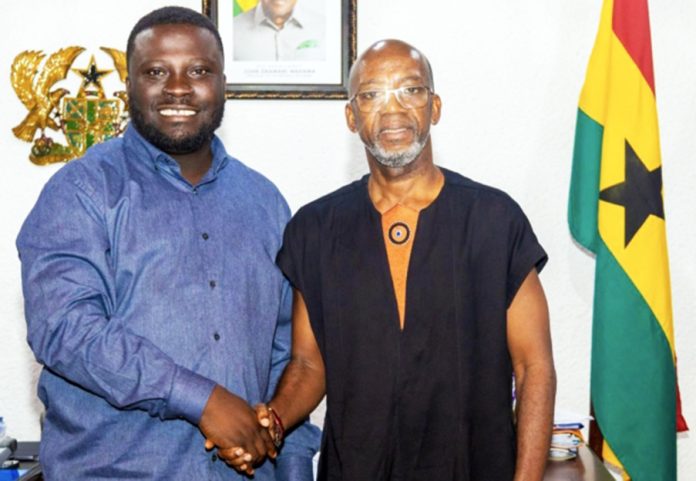
Ashanti Regional Minister, Dr. Frank Amoakohene and Rex Omar
In a concerted effort to advance the proposed National Theatre in Kumasi, Mr. Rex Owusu Marfo, the coordinator of Black Star Experience, paid a working visit to the Ashanti Regional Minister, Dr. Frank Amoakohene.
The meeting, which took place on March 07, 2025, focused on discussing a suitable land allocation for the proposed National Theatre project; a promise made by H.E. John Dramani Mahama in his 2024 Creative Manifesto.
The initiative aligns with broader efforts to decentralise the arts and culture scene, providing a platform for regional talents and fostering cultural expression across the nation.
This development is anticipated to stimulate the creative economy, create job opportunities, and enhance the cultural landscape of the Ashanti Region.
Rex Omar further discussed his proposed project centred around the Lake Bosomtwe enclave; while details of this project are still under wraps, it is expected to be unveiled to the media and the public in due course.
The two projects are expected to boost tourism, create jobs, and promote economic development in the Ashanti Region. This is in relation to the president’s vision to make Ghana the preeminent tourism destination in West Africa, as captured by the NDC Manifesto in line with the Black Star Experience.
Mr. Owusu Marfo, after the deliberatelion, thank the minister for his interest in the creative industry.
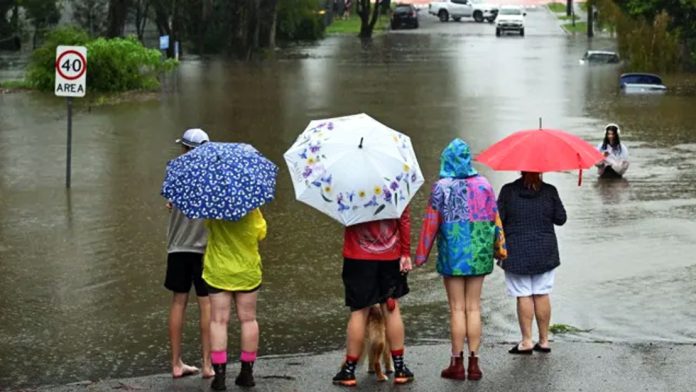
Residents in the Brisbane suburb of Newmarket on their flooded street
Hundreds of thousands of people remain without power in Australia after a cyclone brought wild weather to the east coast.
Communities in southeast Queensland and northern New South Wales (NSW) were beginning the clean-up on Sunday after the storm caused widespread flooding and knocked down power lines and trees.
A 61-year-old man’s body was recovered from floodwaters on Saturday, while in a separate incident, 12 soldiers were taken to hospital after their convoy crashed en route to rescue operations.
The storm had weakened by the time it made landfall near Brisbane on Saturday night, but Prime Minister Anthony Albanese on Sunday warned locals of the continued wild weather and risks from flooding.
“The situation in Queensland and northern New South Wales remains very serious due to flash flooding and heavy winds,” Albanese said.
“Heavy rainfall, damaging wind gusts and coastal surf impacts are expected to continue over coming days.”
Cyclone Alfred had hovered for days off the country’s east coast as a category two cyclone before weakening into a tropical depression on Saturday.
By Sunday evening, emergency services had conducted over a dozen rescues in Queensland and NSW – most involving people trapped by rising waters in their cars or homes. The NSW State Emergency Service reported receiving more than 6,000 calls for help.
Almost 290,000 properties in the affected regions remain without power, and energy companies have warned residents the blackouts could persist for days.
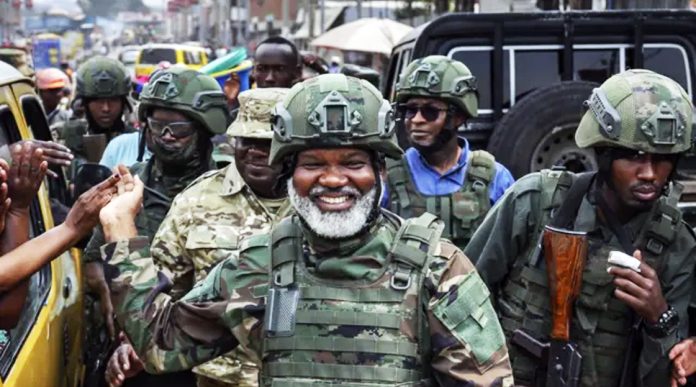
Corneille Nangaa has addressed large rallies in cities captured by the M23
DR Congo offers $5m bounties for rebel leaders
The Democratic Republic of Congo government has offered a reward of $5m (£4m) for help arresting three leaders of a rebel group which has seized much of the east of the country this year.
Corneille Nangaa, a former head of DR Congo’s electoral commission, now leads the Congo River Alliance, which includes the M23 rebel group. He has addressed large rallies in the cities under the group’s control.
The bounty is also on offer for M23 leaders Sultani Makenga and Bertrand Bisimwa.
Last year the three men were prosecuted in absentia by a military court and given death sentences for treason.
A reward of $4m (£3) was also offered for the arrest of two journalists living in exile, and others the government describes as accomplices.
But the chances of anyone being arrested appear slim.
In recent weeks the army has been no match for the Rwandan-backed rebels who have captured large parts of the mineral-rich eastern DR Congo, including the region’s two largest cities – Goma and Bukavu. So President Félix Tshisekedi has instead focused on trying to build international pressure for Rwanda to face sanctions for backing the rebels.
Last year, a report by UN experts said up to 4,000 Rwanda troops were working with the M23 in DR Congo.
Thousands of people have been killed during the fighting and hundreds of thousands left without shelter after fleeing their homes.
The Congolese government is also seeking US support in exchange for access to its minerals.
DR Congo accuses Rwanda of trying to take control of its minerals, which include gold and coltan, used in consumers electronics such as mobile phones and computers.
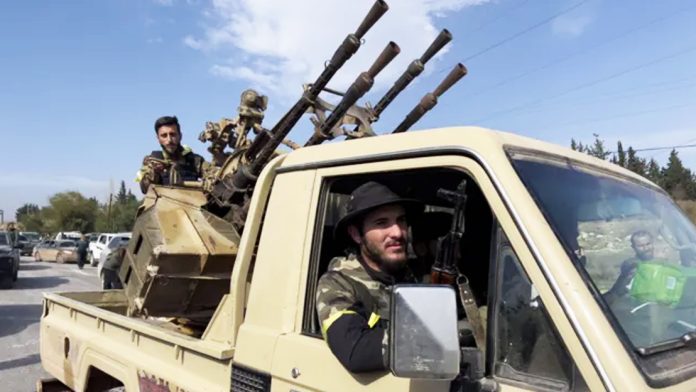
Widespread violence between government supporters and Assad loyalists in Syria
Syria’s leader Ahmed Sharaa has called for peace after days of clashes where Syria security forces allegedly killed hundreds of civilians from the Alawite religious minority.
The UK-based Syrian Observatory for Human Rights (SOHR) – which monitors fighting in Syria – said about 745 civilians were killed in 30 “massacres” targeting Alawites on the west coast on Friday and Saturday.
The BBC has not been able to independently verify the death toll of the escalating violence, believed to be the worst since the fall of the Assad regime.
President Sharaa said: “We must preserve national unity and civil peace as much as possible and… we will be able to live together in this country.”
The number of fighters killed in the past four days brings the total death toll to more than 1,000 people, says the Syrian Observatory. This included about 125 fighters linked to the new Islamist-led government and 148 pro-Assad fighters.
Reuters news agency reported sources in the new Syrian government saying at least 200 of the fighters had been killed.
Speaking from a mosque in Damascus on Sunday, the interim president said “what is currently happening in Syria is within the expected challenges”.
He did not comment directly on accusations that atrocities were being committed by his supporters in the coastal provinces of Latakia and Tartus.
On Sunday, Syrian media reported that fighting between government forces and Assad loyalists had also broken at a gas power plant in Banias, a city about halfway between Latakia and Tartus.
The violence of recent days has been sparked after ambushes on government forces on Thursday. A Syrian defence ministry spokesman described it to the Sana state news agency as “treacherous attacks” against security personnel.
It has since escalated into a wave of clashes between Assad loyalists and government forces.
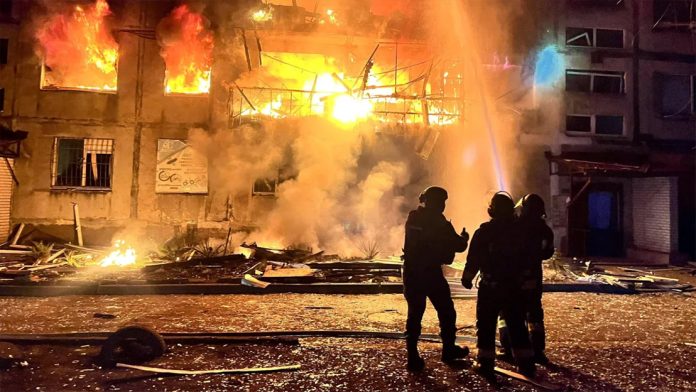
Russian missiles killed at least 23 people in a second night of heavy strikes on Ukraine, a stark toll the Polish Prime Minister described as the result of appeasing “barbarians.”
The attacks come as the Ukrainian war is at a critical point, with the United States having halted military aid and intelligence sharing with Kyiv as part of efforts to pressure it into accepting a peace agreement. The move has left Ukraine even more vulnerable to Russian attacks.
“This is what happens when someone appeases barbarians,” Polish Prime Minister Donald Tusk wrote on X Saturday. “More bombs, more aggression, more victims. Another tragic night in Ukraine.”
Russian strikes on the eastern city of Dobropillia killed 11 people and wounded at least 50 – including seven children, in attacks that Ukrainian President Volodymyr Zelensky said were “deliberately calculated to cause maximum damage.”
“It was one of the most brutal strikes, a combined one,” Zelensky said in his nightly address on Saturday. He described a double strike on Dobropillia, where the second one hit just as rescue workers arrived on scene to attend to the victims of the first.
On Friday, after threatening Russia with sanctions to force through a ceasefire, US President Donald Trump said that his Russian counterpart Vladimir Putin was “doing what anybody else would do” in taking advantage of the current battlefield dynamics.
The White House also has suspended Ukraine’s access to commercial satellite imagery purchased by the US government through the company Maxar, spokespeople for the National Geospatial-Intelligence Agency and Maxar said Friday.
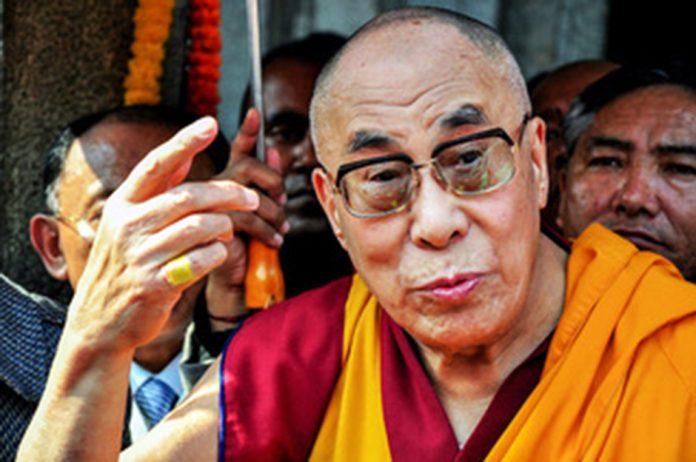
Gold Mercury International, the well-known global governance think tank, has awarded its Gold Mercury Award 2025 to His Holiness, Tenzin Gyatso, the 14th Dalai Lama for advancing a culture of peace, compassion and sustainability.
At a time of rising global tensions, conflict and environmental challenges, this award honours His Holiness’ unwavering leadership in promoting peace, non-violence, wisdom culture, and environmental stewardship.
“Compassion and concern for others are the keys to human survival. They are relevant to anyone, whether believer or non-believer, who wishes to live a happy life,” said Tenzin Gyatso, the Dalai Lama.
Rooted in Buddhist philosophy, His Holiness emphasises reverence for all living beings and the deep interdependence between humanity and nature.
As a global symbol of non-violence and advocate for the rights of the Tibetan people and the protection of their ecological environment, he continues to inspire individuals, communities and leaders to foster a more just, peaceful, equitable, and sustainable world.
His philosophy of peace and compassion are built upon the principle of Universal Responsibility, as reflected in his Four Main Commitments in life: promoting human values, fostering religious harmony, preserving Tibet’s spiritual heritage and environment, and advancing ancient wisdom culture in education.
“His Holiness the 14th Dalai Lama’s profound commitment to non-violence, compassion, a culture of wisdom, and environmental stewardship has profoundly shaped our global consciousness, and is rooted in our ability to achieve inner peace, wholeheartedness, and sincerity. This is why it is so relevant today,” said Nicolas De Santis Cuadra, President of Gold Mercury International.
His Holiness’s work and message of global cooperation also highlight the ecological significance of the Tibetan Plateau—often called the world’s “Third Pole” due to its vast freshwater reserves. As the source of Asia’s major rivers, it holds the largest store of fresh water outside the Arctic and Antarctic, underscoring the urgent need for its protection to ensure the stability of the region and the planet.
The Gold Mercury Award Ceremony will be held in Dharamsala, the home of the Dalai Lama in the Indian Himalayan region, on 31st March 2025, to honour His Holiness in a momentous celebration of his life and legacy.
Founded in 1961, Gold Mercury International is a global governance think tank dedicated to advancing peace and international cooperation.
Past recipients of the Gold Mercury Award include U.S. Presidents Ronald Reagan and Gerald Ford for their diplomatic efforts on nuclear disarmament, President Anwar Sadat of Egypt, Prof. Robert Gallo for discovering the HIV virus as the cause of AIDS and humanitarian organisations like UNICEF and the Red Cross.
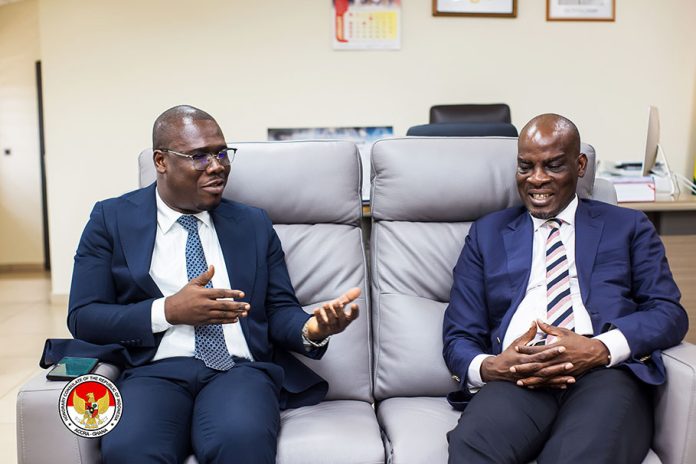
Honorary Consul of the Republic of Indonesia, H.E. Paskal A.B. Rois (right) in a conversation with Hon. Haruna Iddrisu, Minister for Education
The Minister for Education, Haruna Iddrisu, has appealed to the government of the Republic of Indonesia to consider establishing an Islamic University in Ghana.
The Member of Parliament for Tamale South, Haruna Iddrisu, advocated for the project to be situated in the Northern part of the country.
The Education Minister made the call when the Honorary Consul of the Republic of Indonesia, H.E. Paskal A.B. Rois, paid a courtesy call on him in his office in Accra.
He made the point that such an educational facility, beyond further deepening the bilateral and educational relations between Ghana and Indonesia, would also bridge the developmental gap between the north and the southern part of the country.
The minister traced the long-standing bilateral relations between the two sister countries to the eras and efforts of the first Presidents of Ghana and Indonesia, Osagyefo Dr. Kwame Nkrumah and H.E. Achmed Sukarno respectively, who through the Non-Aligned Movement (NAM) cemented the cherished ties between the two giant nations and their peoples.
He was optimistic that the Honorary Consul would continue to work harder through the creation of more and bigger opportunities that would inure to the benefit of the two countries.
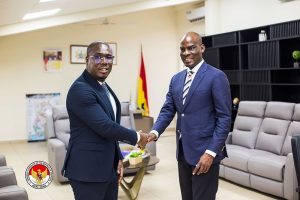
Honorary Consul of the Republic of Indonesia, H.E. Paskal A.B. Rois (right) in a handshake with Hon. Haruna Iddrisu, Minister for Education
The Education Minister noted that such a dedicated Islamic Medical School with emphasis on the Sciences, can be discussed at the appropriate levels of the two countries not only to realize its fullest implementation within the shortest ties frame but also cement the Islamic ties between the Moslem community in Northern Ghana and their counterparts in Indonesia which is predominantly a giant Islamic nation on earth.
According to him, the future of the 21st century is about competencies, skills and knowledge which basically dove-tails into Science, Mathematics and Engineering.
Mr. Idrissu intimated that Ghana still has a deficit of the provision of Medical Doctors particularly for the rural, deprived and under-developed Ghana, adding that such a tertiary institution would lead to a paradigm shift in medical education in the northern part of the country in particular and the country ultimately.
THE VISIT
The working visit of the Honorary Consul was aimed among other things at briefing the Education Minister on the available Indonesian scholarship opportunities, some of which a number of Ghanaian students are already benefiting from.
The Honorary Consul of the Republic of Indonesia in Ghana, H.E. Paskal A.B. Rois congratulated the Minister on his appointment to lead the Education Ministry, adding that as an experienced figure, a renowned law maker and a hardworking politician, he was hopeful that Minister Iddrisu would use his rich experience, expertise and knowledge from previous portfolios held over the period to positively impact the educational sector.
Mr. Rois welcomed the Minister’s suggestion for Indonesia to consider the establishment of an Islamic Medical University in Northern Ghana, assuring that he would take up the issue to its highest level for a positive response from the Indonesian authorities.
Briefing the Minister on the scholarship opportunities in Indonesia, the Honorary Consul informed the Education Minister about the government’s KNB Scholarship which is currently opened in addition to dozens of other different scholarship opportunities from more than thirty (30) other prestigious universities in Indonesia for students of developing countries including Ghana.
Mr. Rois disclosed that more than sixty (60) Ghanaian students are currently pursuing various partially or fully funded undergraduate, masters and doctorate degree programmes in various universities in Indonesia, adding that about six (6) of them have also returned to the country on completion of their two (2) to three (3) year courses of study in Indonesia in the last few years.
The Indonesia Consul said last year, his outfit held some engagements with the Pro and Vice Chancellors of some tertiary institutions in Ghana including; the Ghana Technology University (GTU) in Accra, the University of Education, Winneba (UEW) and the University of Cape Coast (UCC).
According to him, such courtesy calls on him by the Heads of these institutions have opened new chapters in educational relations between these universities in Ghana and Indonesian universities where a Memorandum of Understanding (MOE) would soon be signed for lecturer to lecturer, student to student and other exchange programmes to commence among and between these tertiary institutions particularly between thefaculties and students in Ghana and Indonesia.
Mr. Rois expressed the hope that the Minister would use his good offices as well as skills, knowledge and experience not only to reset the education sector of the country but also further deepen the educational bond between the two countries through the Ministry of Foreign Affairs and Regional Integration.