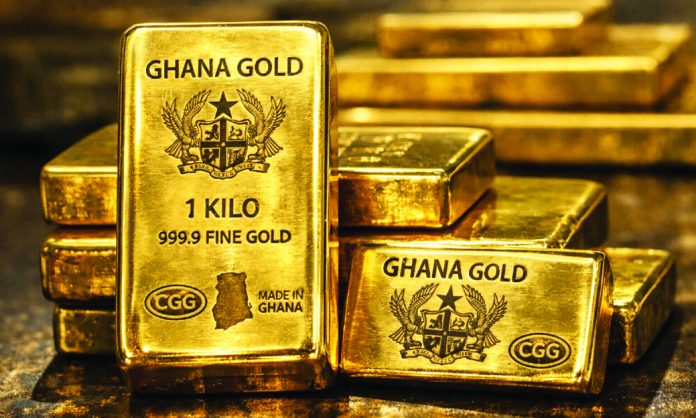
Ghana’s booming gold trade could face unexpected turbulence if the escalating tensions in the Middle East disrupt the country’s heavy reliance on the United Arab Emirates as a key transit and refining hub, policy analyst Bright Simons has warned.
Speaking on Newsfile programme over the weekend, Bright Simons said the unfolding conflict risks exposing a long-standing structural weakness in Ghana’s gold value chain – the lack of traceability in the small-scale mining sector.
According to him, Ghana’s strategy of routing large volumes of gold through the United Arab Emirates and India leaves the country vulnerable to geopolitical shocks that could choke off key trading routes.
“Presently, the strategy is that there are lot of transhipment through the UAE that goes into India,” he said, noting that the arrangement is partly driven by preferential trade links between the two countries. “Now with problems in the Emirates, we are going to have great difficulty.”
Traceability challenge
Bright Simons argued that Ghana’s record gold production – often celebrated by policymakers – masks a deeper constraint: much of the gold produced by the country’s small-scale miners does not meet global traceability standards.
Because of this, he said, Ghana cannot simply divert its exports to alternative markets when disruptions occur.
“The notion that we are producing very large amounts of gold and can sell it anywhere is not correct,” Mr Simons explained.
He said most small-scale gold does not qualify for the “Good Delivery” certification required by the London Bullion Market Association, the global authority that sets standards for the world’s largest bullion markets.
Without verified supply chains, many high-compliance markets are unable to accept the gold, forcing Ghana to rely on destinations where traceability requirements are less stringent.
“That is the reason why we are concentrated in India and the UAE. We are not done with our traceability dynamics within the small-scale sector.”
Liquidity pressure
The policy analyst also noted that Ghana’s domestic gold purchase programme used by the Bank of Ghana to support foreign exchange reserves and stabilise the cedi further complicates the country’s ability to hold or strategically release gold during market shocks.
Because the programme relies on quickly converting gold into dollars to supply the foreign exchange market, the central bank cannot easily stockpile large volumes while waiting for favourable global conditions.
“We needed the liquidity,” Bright Simons said, warning that any disruption to export routes could therefore create short-term pressure on the country’s dollar inflows.
Gold revenues at risk
One of the penalises, Oliver Barker‑Vormawor, a lawyer and civic activist also warned that Ghana’s record gold revenues could face logistical bottlenecks if Middle East trading routes are disrupted.
He noted that roughly 52% of Ghana’s gold production passes through Dubai, where most of it is refined before entering international markets.
“With what is going on within the region, our ability to go through the Dubai route is going to be impacted unless we find other routes,” he said.
The concern is significant because the Bank of Ghana recently reported earning over $10 billion from gold purchases, a key pillar supporting the country’s external reserves.
Oil shock looming
The geopolitical tension could also reverberate through Ghana’s energy market. According to Dr Mahama Tiah Abdul‑Kabiru, MP for Walewale, who was also on the programme, rising global crude prices could quickly translate into higher domestic fuel costs.
Oil prices, he noted, have already surged from about $65 per barrel to around $92, with analysts projecting that they could breach $100 if the conflict intensifies.
“From as low as $65 to the barrel, we have gone to $92 thereabouts. It is a matter of when, not if, prices go to $100 if this war continues,” he said.
Even though Ghana maintains petroleum reserves estimated to last between five and seven weeks, he explained that such buffers only protect against supply disruptions — not price fluctuations in a deregulated market.
Government response
However, the Minister of State for Government Communications, Felix Kwakye Ofosu, downplayed fears that Ghana would struggle to find markets for its gold.
He argued that gold’s universal value ensures it can always attract buyers, especially during global uncertainty when investors typically turn to bullion as a safe-haven asset.
“I don’t think there’s any shortage of markets for gold. Anytime you want to sell gold, you will get an instant market,” he noted
For more news, join The Chronicle Newspaper channel on WhatsApp: https://whatsapp.com/channel/0029VbBSs55E50UqNPvSOm2z