Home Blog Page 785

Mahama’s GoldBod, The Real McCoy! … Ato Forson Says It Has Stopped Chaos In Gold Purchases … Robust And Sustainable Outlook For The Ghana Cedi Expected

0
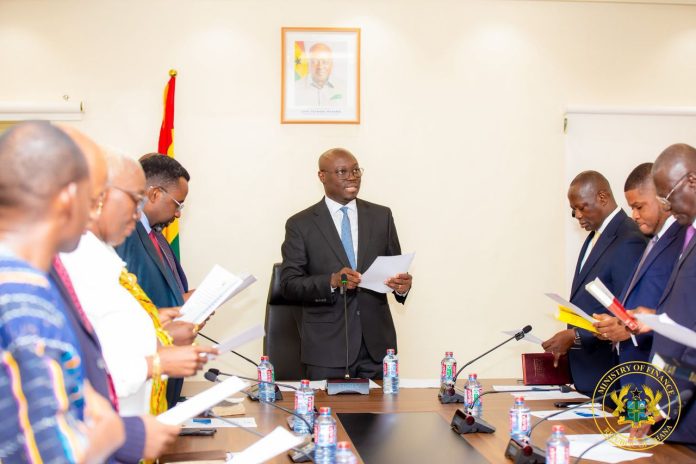
Dr. Cassiel Ato Forson swearing in the Board members

The Finance Minister, Dr. Cassiel Ato Forson, has declared that Ghana has finally put an end to the long-standing confusion and fragmentation in the gold purchasing sector.

He made this assertion during the official inauguration of the Governing Board of the newly established Ghana Gold Board (GoldBod), a state entity tasked with streamlining gold trade in the country.

Addressing the Board and dignitaries at the event, Dr. Forson said: “The erstwhile chaos in Ghana’s gold purchasing sector that prevented the nation from fully benefiting from its gold resources has come to an end.”

According to the Minister, multiple institutions previously engaged in gold trading without coordination, which not only diluted the country’s revenue potential, but also led to widespread gold smuggling and foreign exchange losses.

Among the entities operating simultaneously were the Precious Minerals Marketing Company (PMMC), the Bank of Ghana and the Minerals Income Investment Fund (MIIF), as well as various private aggregators and licensed exporters, both local and foreign.

“The PMMC was initially mandated to purchase and sell gold, but this mandate was not exclusive. The Bank of Ghana also used PMMC and private aggregators for programs such as ‘Gold for Forex,’ ‘Gold for Reserves,’ ‘Gold for Oil,’ and ‘Gold for Cash,’” Dr. Forson elaborated.

He continued, “Even the MIIF, whose primary responsibility was mineral investment, ventured into gold buying and ended up incurring substantial financial losses.”

The situation became further complicated by the activities of individuals with gold buying and export licenses, whose operations often fell outside the bounds of regulation.

This fragmented ecosystem, the Minister said, made it almost impossible for the state to effectively monitor, manage or profit from the country’s abundant gold resources.

“All of this now belongs in the past, because the Ghana GoldBod is now the sole buyer and assayer of gold, with exclusive mandate to grant licenses to engage in the trade of gold from Ghana’s small-scale mining sector,” Dr. Forson emphasised.

He praised the Board and the technical committee that helped bring the vision to life, describing the GoldBod as a “flagship initiative” of President Mahama, intended to ensure currency stability and economic revitalisation through structured gold management.

The Minister revealed that the GoldBod is already playing a significant role in Ghana’s economic turnaround.

“The GoldBod has already begun to fulfill its object and has contributed immensely to the recent stability of the Ghana cedi through gold reserve accumulation,” he noted.

As of May 13, 2025 the Ghana cedi has appreciated by an impressive 16.7% against the US dollar, making it the top-performing global currency year-to-date. This stands in sharp contrast to the 13.4% depreciation experienced over the same period in 2024.

“This rally stems from a robust policy framework, underpinned by synchronised monetary and fiscal measures, as well as a favourable global context,” Dr. Forson said.

He attributed the currency’s performance to collaborative efforts between the Bank of Ghana and the Ministry of Finance, which include stringent monetary policy, aggressive liquidity sterilisation and disciplined fiscal management.

Enhanced inflows from gold, cocoa and remittances have also played a key role, aided by a weakening US dollar on the global market.

Perhaps most telling of the success of the new gold management regime is the improvement in Ghana’s foreign exchange reserves.

“Our foreign exchange reserves at the Bank of Ghana reached a record high in April 2025, surpassing targets set under the IMF-supported programme, ahead of schedule,” Dr. Forson revealed.

He stressed that this development underscores the sustainability of the cedi’s performance and the long-term benefits of the reforms initiated by GoldBod.

Dr. Forson believes that GoldBod’s activities will reshape Ghana’s economic fundamentals, challenging traditional models and opening new frontiers for currency and fiscal management.

“This paradigm shift will challenge traditional models reliant on old patterns, potentially leading to inaccurate projections and missing the true potential of the cedi,” he said.

The Minister assured the public of a robust and sustainable outlook for the Ghana cedi, reaffirming the government’s commitment to building a resilient and prosperous economy.

“Together, let us help to propel His Excellency President John Dramani Mahama’s ongoing reset of Ghana’s economy and our effort to deliver economic prosperity for all Ghanaians,” he concluded.
Torkornoo, 49 Other Judges Received Rent ‘Allawa’ In Error & Refunded The Payment

0
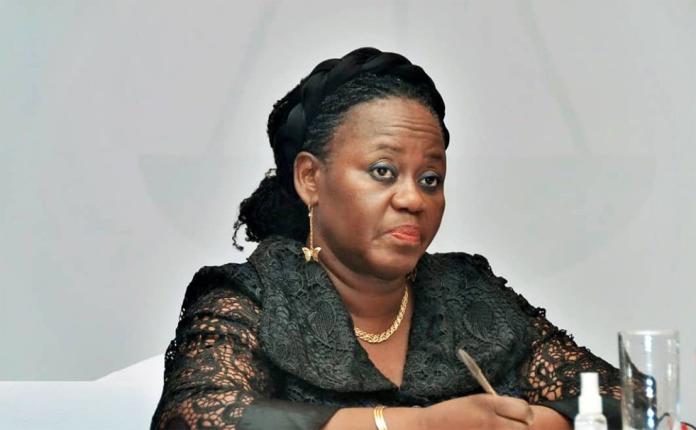
Justice Gertrude Araba Esaaba Sackey Torkornoo

According to Judicial Service records made available to the media, Chief Justice Gertrude Araba Esaaba Sackey Torkornoo and 49 other justices of the superior and lower courts in the country, received an ineligible payment for housing (rent allowance), but when the anomaly was discovered, the affected judges refunded the payments to the judiciary.

Chief Justice Gertrude Araba Esaaba Sackey Torkornoo has been accused of receiving a rent allowance, despite living in her official government property.

However, the fact indicates that these payments were made to her and other judges between 2020 and 2022 when Justice Anin Yeboah (Rtd) was the Chief Justice.

The records

The records also show that payments were an error on the part of the judicial service. Upon drawing the attention of the affected judges, all of them, without exception, refunded the payments to the service.

The accounts also point out that all the judges refunded the tax component and the Judicial Service had to repay the tax components to the judges.

Chief Justice Gertrude Torkornoo was paid GHC152,768.40 tax inclusive. She refunded this amount in full.

However, the service repaid her GHC34,079.10 bringing the amount paid back to the Judicial Service by the Chief Justice to GHC118,689.30.

Other payments

Other judges who also received payments are some of those who have currently been nominated to the Supreme Court by President John Dramani Mahama, pending their vetting and approval by Parliament.

One of them received GHC90,548.46. After refunding, GHC21,218,08 was repaid to the said judge, leaving the total amount refunded at GHC69,330.38.

Justice P. Bright Mensah and Justice Senyo Dzamefe, both of whom President John Dramani Mahama has also nominated for elevation from the Court of Appeal to the Supreme Court, also received these payments.

Some other judges who are currently being promoted to the Supreme Court received                       GHC105,870.40 and GHC94,975.20 respectively, which they later refunded.

Disingenuous attack

“Singling out Chief Justice Gertrude Araba Esaaba Sackey Torkornoo and accusing her of knowingly receiving rent allowance while living in an official residence is disingenuous, ridiculous and an apparent attempt to discredit the Chief Justice of the Republic.

“These claims are a desperate attempt to smear the hard-earned reputation of the Chief Justice, who is probably the cleanest judge in Ghana,” a source at the judicial service familiar with these developments told Asaase News.

“If the claim that the Chief Justice genuinely received these rent allowance payments erred, then all the other 49 justices of the superior courts and judges of the lower courts also erred.

“Any call for the head of the Chief Justice based on this issue should mean that all the other judges who also received such payments should also be removed from office,” the source further stated.

Source: Asaase Radio

Dumsor Is Slowing Down The Economy –Minority

0
Osahen Alexander Afenyo-Markin - Minority Leader

The Minority in Parliament has sounded the alarm over Ghana’s worsening power crisis, known as “dumsor,” warning that persistent outages are crippling businesses and derailing economic growth.

In a press conference held on Monday, 19th May, 2025 members of the Minority Caucus on Parliament’s Energy Committee said the ongoing electricity challenges are undermining the government’s touted 24-hour economy vision.

“Dumsor is slowing down the economy. Businesses are collapsing and the private sector, which is the engine of growth, cannot operate in darkness.

“How can hospitals, agro-processing factories, pharmaceuticals, manufacturing and even the creative industries function around the clock when the lights keep going off?” according to the Minority.

The Minority expressed dismay over recent public statements made by Energy Minister, John Jinapor, particularly his claim that the country had only “2.6 days of fuel” left for power generation.

According to them, such remarks are not only misleading, but damaging to investor confidence.

“Statements like these send panic through a business community still recovering from COVID-19 and global economic shocks. Power is the lifeblood of industry and reckless pronouncements from the Minister are unacceptable,” the group said.

They accused the Minister of engaging in “panic-then-retreat” communication tactics, referencing a similar instance during the President’s swearing-in ceremony when the Minister claimed Ghana had only five hours of fuel left – a claim he later walked back from.

“The Minister must stop frightening Ghanaians and start fixing the problems,” the Minority urged, adding “This is not the time for political theatrics. It is time to stop talking and put the lights on.”

The Minority acknowledged the NDC government’s own challenges with power supply from 2012 to 2016 and that the first Mahama administration left a sector riddled with legacy debts and take-or-pay contracts.

They also pointed out that since 2017 the NPP government had significantly improved the energy sector, ensuring eight years of relatively stable electricity supply.

According to the Caucus, the NPP government added 1,600 MW of power between 2017 and 2024 through projects like the TT2PP, Amandi, Bui Solar and Laura/Kaleo Solar among others. Investments were also made in major transmission infrastructure and access to electricity expanded to 88.85% of the population.

“Yet today, under this same administration, the current generation is witnessing dumsor for the first time – a tragic irony. Their parents suffered through it a decade ago and now it is back,” the Minority stated.

The Caucus laid out a seven-point action plan and demanded immediate intervention from the Energy Minister to resolve the crisis.

Their proposals include;

  1. Resolving fuel supply issues for Independent Power Producers (IPPs)
  2. Renegotiating burdensome take-or-pay contracts
  3. Improving revenue collection and reducing losses at ECG and NEDCO
  4. Fixing the Cash Waterfall Mechanism
  5. Diversifying the energy mix through renewables and local gas optimization
  6. Promoting off-peak industrial consumption
  7. Accelerating the rollout of smart meters


They added that the recent appreciation of the Ghana cedi should be leveraged to recover some of the financial losses in the energy sector.

“Leadership is about solutions, not excuses. We understand the financial constraints, but Ghanaians are paying 14.75% more in tariffs this year – they deserve reliable power in return.”

The MPs warned that the patience of Ghanaians is wearing thin, and the current trajectory could lead to a return to the dark days of prolonged power cuts unless urgent measures are taken.

They concluded by reaffirming that the Minority will continue to hold the government accountable and ensure that Ghanaians are not forced to endure yet another cycle of darkness.

Prestea-Bogoso MCE, MP Caution Blue Water Guards Against Extortion

0
MCE Matthew Ayeh addresing the Blue Guards

 The Municipal Chief Executive (MCE) for Prestea Hunni-Valley, Dr. Matthew Ayeh, has cautioned the Blue Water Guards against using their positions to extort money from miners.
He indicated that the Assembly and the Police Commander would monitor their operations closely and would not hesitate to order the arrest of any Guard who defies their code of ethics.
“You must work as a team and avoid going to unauthorised locations alone. We will support you in identifying additional legal income sources to reduce the temptation of corrupt practices,” he said.
The MCE gave the caution at a community stakeholder gathering to receive 20 Blue Water Guards deployed to the Prestea Bogoso area. Five Water Guards have also been deployed to Aboso.
The Member of Parliament for the area, Robert Wisdom Cudjoe, in addressing the gathering clarified that the deployment of the Guards was not an attempt to collapse mining in the district, but to ensure responsible and sustainable mining practices.
“The Blue Water Guards are here to support those who are registered and mining responsibly. I encourage all unregistered miners to use the right channels to regularise their operations,” he stated.

He also urged the Guards to work diligently to help restore and preserve water bodies in the municipality.
The Western Regional Manager of the Minerals Commission, Mr. Francis Annobil Jnr, explained that the initiative was part of a broader national effort to protect water resources from the destructive effects of illegal mining.
“This task is not for the police, government, military, MCE, MP or the Minerals Commission alone. Everyone, including the small-scale miners association and traditional leaders must be involved,” Mr. Annobil Jnr. stressed.
Mr. Steven Agbo, the Deputy Manager in charge of Community Relations, said the Guards were expected to monitor activities on and around water bodies, report infractions and advice miners.
He stressed that mining must be done more than 100 meters away from water bodies and 500 meters from human settlements.
Mr. Agbo also announced that soldiers would soon be deployed to support the Guards’ operations.

“These guards are not here to intimidate residents. They are here to protect our resources. Let’s all cooperate with them,” he assured.

High interest rates discourage us from accessing credit facilities- business women

0
Madam Agyekum speaking to journalists in Sunyani

  Women engaged in Small-Scale businesses in Sunyani, the Bono Regional capital, on Monday called for government’s intervention to reduce the high interest rates for them to access credit facilities to expand their activities.

The Bank of Ghana raised its benchmark monetary policy rate by 100 basis points to 28 per cent on March 28, 2025, after three consecutive meetings with no changes.

The decision was driven by concerns about the inflation outlook with the nation’s annual consumer inflation.

Speaking in an interview with the Ghana News Agency (GNA) in Sunyani on the implementation of the Post COVID-19 Skills Development and Productivity Enhancement Project (PSDPEP), women traders described the 28 per cent interest rate as high.

The high interest rates make it difficult for many of them to access loans although they needed it to open their economic activities.

The GNA is a beneficiary, and implementer of the government’s PSDPEP project seeks to build health-related skills in higher education, restore livelihoods, strengthen communication and create jobs among the youth and women in the country.

Under the implementation of the African Development Bank (AfDB) $30 million project, $4 million is expected to be given to Small and Medium Enterprises as loans at a reduced rate to enable them to withstand the shock of the pandemic.

However, the women traders said they were unaware about the facility, and expressed worry about the difficulties some of them often went through in accessing loans from some major banks due to lengthy paper works.

“Our problem is the interest rates, as for the loans some of us can easily apply and get”, Madam Agnes Akua Badu, the owner of the “Oman Dehyia” Cosmetics shop at the Sunyani ‘Masommasom’ daily market told the GNA.

“The banks will even deduct some of the small loans you are accessing for processing fees and you can’t even get the amount you want”, she stated.

However, she expressed the hope that with the Ghana cedi’s gain, the government would help to reduce the interest rate.

Mad Ajara Dauda, a popular porridge seller around the Sunyani Penwkasi Traffic Light, said “We access the loans from the banks, we end up using all our profits to pay back the loan and that is impeding the growth of our businesses.”

“If there is a facility like that, then it’s our prayer that the government will come to our aid and support us here too”, she added.

Mad Gloria Agyekum, a dealer in women underwear at the Masommasom market also added that “banks will give you the loan with high interest rate and unfavourable payment agreement. In fact, it is easy to access loans from some private financial institutions, however if they give you GHC20,000 then you must pay about GHC1,200 every week for six months and sales are even poor nowadays”.

Mrs Agyekum added that “we can’t go to the banks because the interest rate there is too much” and called on the government to come to their aid.

From Dennis Peprah, Sunyani

GNA

Prudential Bank CIO calls for domestication of AI tools to reflect African culture

0
Leopold Armah - Prudential Bank

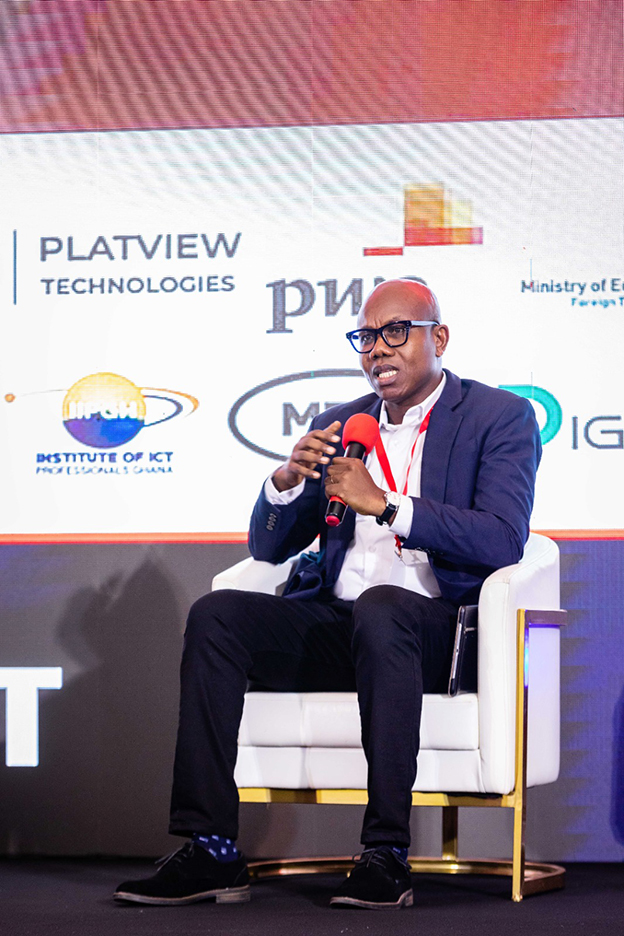
The Chief Information Officer (CIO) at Prudential Bank, Leopold Armah, is calling on technology engineers in Africa and across the developing world to initiate steps toward domesticating Artificial intelligence (AI) technology by gradually developing local use cases considering linguistics and peculiar practices.

He noted that AI, evidently, has moved from experimental to essential, and permeating every area of life, including threat intelligence and cybersecurity in general as such domesticating the tool will facilitate better appreciation of its potential.

Commenting on the topic “AI, Automation and the Future of Threat Intelligence” on the sidelines of the recently held CISO Summit 2025 in Accra, Mr. Armah noted that it is time to simplify, invest and urgently start building capacity at both the individual and corporate levels to make AI relevant to our environment.

“Evidently, AI has moved from experimental to essential. AI and automation are helping us develop the ability to correlate tactics, techniques, and procedures (TTPs) that enable quicker identification of threat actors and simulate attack scenarios. It is critical therefore for developing countries to initiate steps toward domesticating the tool. This will facilitate better appreciation and project the potential of the tool” he said.

Mr. Armah noted that some key benefits of AI and automation in threat intelligence include Speed, where AI and automation can respond to threats much faster than manual intervention, reducing the window of opportunity for attackers; Efficiency, in that automated systems can handle repetitive tasks such as patch management, log analysis, and vulnerability scanning without fatigue; and Consistency, because the two ensure that responses follow a consistent process, reducing human error.

He, however, gave a note of caution saying “while speed, efficiency and consistency are desirable, it’s important to understand that AI and automation are not always perfect and can be prone to errors, especially when the data is not trained based on the expected outputs. As we dive headfirst into this uncharted territory, we need to keep our eyes wide open. It is not just about the potential benefits and drawbacks, but also about how AI is going to continue to mold and reshape the workplace in ways we might not even imagine.”

Mr. Armah advised all to “look beyond excitement (sometimes the anxieties) and rather focus on becoming more conversant with the governing rules, ethical issues and the associated legal framework with data and AI. And where there is little or non-existent, we must initiate steps towards their development.”

He noted that there is the need to, at all times, balance safety and morality against speed and innovation, saying machines could do a great deal, but what they should do is the statement users need to continue addressing.

He dispelled fears that AI and automation are a serious threat to job security at the workplace referencing a quote made by Ray Kurzweil, a notable futurist, as an assurance that human beings will always remain superior to machines. He believes AI will ultimately become our thought partner, not a replacement.

“Ray Kurzweil, a notable futurist says ‘Our technology, our machines are part of our humanity. We create them to extend ourselves and that is what is unique about human beings.’ What readily comes to mind in response to the threat of jobs sentiment is the second part of Kurzweil’s statement, I believe the world will just get better if we nurture and collaborate with machines and technology to solve problems.” he said.

Counselor proposes L.I. to back teachers to instil discipline in students 

0
Mrs. Janet Adu-Poku - Counsellor

Mrs Janet Adu-Poku, the Chief Executive Officer of Wiseup Consult, a guidance and counselling centre targeted at dealing with addictions, struggles and challenges of the youth, has lamented over the spate of indiscipline in the various SHSs, which development requires national effort to address.

Her concerns come at the heels of recent reports of firearms at the SDA SHS in Kumasi and recently at Osei Kyeretwie Secondary School (OKESS) last Wednesday, May 14, 2025, when a locally manufactured firearm was discovered in a student’s belongings during a routine dormitory search by school authorities.

In an interview with Otec FM, a Kumasi-based radio station, Mrs. Adu-Poku disclosed that the state of indiscipline in various secondary schools is overwhelming and keeps scaling up with its high prevalence rate.

According to the CEO, the nation’s educational system has “broken down” due to teachers not having the authority to punish students when they go wayward, adding that teachers are not “revered” anymore while some  Headmasters and mistresses cover up incidents that will tarnish the image of their various schools.

Mrs Adu-Poku further indicated poor parental control, association of bad gangs, pop culture, drug abuse amongst others as some of the factors causing indiscipline in the schools.

She noted that the Counselling Units in schools are micromanaged and not active.

Mrs. Adu-Poku recommended the enhancement of security at the various SHSs by installing CCTV cameras as well as providing a small police post, to beef up security within the school premises. The Counselor further suggested the restoration of parental collaboration with school authorities, as well as passage of a Legislative Instrument (L.I.) to back teachers to enable them to punish students.

Mrs. Janet Adu-Poku urged parents, who own firearms, to secure them and keep them away from the reach of children.

“If you don’t discipline your child, his/her actions will discipline you”, Mrs. Adu-Poku advised parents.

From Oswald Pius Freiku, Kumasi

Atwima Mponua Assembly, Cadres root for Sakina Oforiwaa as DCE

0
Sakina Oforiwaa – 2020 Atwima Mponua NDC PC
Young Cadre executives rooting for Sakina

Members of the Atwima Mponua District Assembly have proposed Madam Sakina Oforiwaa for the consideration of the President, John Dramani Mahama, for the position of the District Chief Executive.

The position of the Concerned Assembly members is explained in the fact that the 37-year-old is preferred to the other two candidates shortlisted by the party for the position.

The proponents, numbering about 40 members from the 56-member Assembly, including the Presiding Member, Prince Nkrumah Boateng, hold the view that Sakina Oforiwaa, a professional Teacher, with management skills, is best qualified to represent the President in the district.

This is based on her role in championing the ideals of the National Democratic Congress (NDC) in the Atwima Mponua Constituency, through team work.

She was a Branch Secretary in the Atwima Mponua Constituency from 2000 to 2008 and served as a Constituency Campaign Team Member and Assembly Member (Government Appointee 2009- 2016), during which period she served on the Finance & Administration Sub-Committee, Social Services Sub-Committee, District Health Implementation and the Environmental Sub-Committee Member.

She was the WESCO TEIN President (2012-2013), the Regional Women’s Wing Communication Member, NDC Ashanti Region (2012 to Date) and the Atwima Mponua Constituency Parliamentary Candidate for the 2020 elections.

Sakina Oforiwaa is a Regional Communication Team Member, Regional Women’s Wing Committee Member and Regional Women’s Wing Financial Committee member from 2023 to Date as well as Constituency Executive Member (2022 to Date), Polling Station Agent 2004 and 2008, NDC Atwima Mponua Constituency (2004 to 2008), besides her teaching career with the Ghana Education Service at Adobewura from 2011 to date.

PM Prince Boateng and colleagues addressing the meeting

Addressing a press conference at Kufuor Camp last Friday to advocate for Sakina’s nomination, Prince Nkrumah Boateng, Presiding Member and Assembly member for Bayerebon Number III, mentioned the role and contributions of Sakina to the growth of the party in the constituency as mind boggling, having personally procured 30 motorbikes at GHC390,000 each for the 2024 campaign.

Sakina Oforiwaa has personally donated GHC500 each for those who contested for the Assembly Member elections in the name of NDC in 2024 and donated GHC2,000 to support the limited registration organised by the Electoral Commission, as well as donating 70 bags of rice to support the feeding of party agents during the 2024 election.

She also complemented the efforts of her husband, as constituency chairman, to donate 100 packs of cutlass to all the branch executives and sponsored the 2020 campaign with four cars.

Other donations included 5,000 litres of fuel for 2020 campaign – GH¢300,000 for 2020 campaign and financing party activities and programmes in the Constituency, as well as printing 4,000 ‘T’ shirts at GH¢200,000 for the 2024 campaign.

He described their idol as development oriented, supportive, affable, and dedicated to inclusive leadership and a unifier who could project the President’s Reset Agenda.

According to the Petitioners, Sakina Oforiwaa is a woman of proven integrity and committed to the cause of development, which qualities have endeared her to traditional authorities, youth groups, civil society organisations and the broader community.

Prince Boateng said the delay in nominating a DCE for the district has stifled development as the year runs into the second quarter with no political leadership in the District, and called on the President to name a nominee, preferably Sakina Oforiwaa, to speed up with the government’s development agenda for the district.

The concerned Assembly members and 40 signatories have since May 9, 2025 petitioned   President Mahama about their collective and unwavering support for Sakina Oforiwaa and to use his prerogative powers to that effect.

He argued that her (Sakina) selection would give meaning to the Affirmative Action Law and the President’s promise to appoint about 30% of his appointees as women.

Meanwhile, executives of the Young Cadres Movement in the Atwima Mponua constituency have also corroborated the position of the 40 Assembly members and pleaded with the President to choose Sakina Oforiwaa to champion the development of the district and further grow the party.

According to the group, Sakina Oforiwaa has been instrumental in the NDC electioneering campaign and sustained ideals of the party at the Local level.

Spokespersons Isaac Ampaabeng (constituency communication director), Richard Dapaah (Co-ordinator) and Kwabena Darko, alias Mayenga (Operations Director) at a separate press conference at Anyinamso mentioned that Sakina Oforiwaa had sacrificed a lot and used her own resources to cater for the wellbeing of party activists.

Ghana Horticulture Expo 2025 to promote 24-Hour Economy

0
Ghana Horticulture Expo 2025

Ghana is poised to unlock the full potential of its fertile land and vibrant entrepreneurial spirit with the launch of the Ghana Horticulture Expo 2025, scheduled for June 11–13, 2025, at the Accra International Conference Center.

This national showcase, under the theme “Unpacking its Role in Agricultural Transformation, Industrialization, and a 24-Hour Economy”, marks a pivotal moment in Ghana’s journey toward a modern, inclusive, and export-driven horticultural sector.

Far more than a trade exhibition, the Expo is a strategic platform aimed at accelerating agribusiness transformation by integrating smallholder farmers, youth, diaspora investors, and high-end technology providers into a seamless and continuous value chain. It is Ghana’s bold declaration to the world: agriculture is not a fallback — it is the future.

From Farm to Global Markets

Horticulture is already a major player in Ghana’s non-traditional export basket, with increasing demand for fresh and processed fruits, vegetables, herbs, and spices in international markets. The Expo will bring together exporters, buyers, processors, and agritech innovators to secure trade deals, deepen investment, and enhance foreign exchange earnings.

“With participation from all 16 regions, this event connects rural producers to global supply chains, ensuring inclusive growth,” said Kwaku Boateng, Vice-President of the Coconut Federation-Ghana, adding “The Expo is a tribute to the farmers, youth, and investors who see agriculture as the foundation of our future.”

Agritech and the Rise of the 24-Hour Economy

At the heart of the Expo lies a vision of continuous productivity—one that transcends the traditional daylight-dependent agricultural cycle. Innovations in cold storage, irrigation, organic processing, packaging, and digital logistics will be featured prominently, revealing how Ghana can run a 24-hour horticultural economy.

These advancements promise to shift the nation from exporting raw produce to processing high-value goods that retain wealth and create jobs within the country. By embracing digitization and supply chain efficiencies, Ghana is laying the groundwork for round-the-clock agricultural operations—feeding both domestic and international markets.

Human Stories Behind the Harvest

Beyond economic indicators and trade deals, the Expo will shine a light on the human side of horticulture.

It is a stage for stories of resilience: a mother tending her land to feed her children, a young entrepreneur breaking into agribusiness, and Diaspora investors returning with capital and hope.

Each stall, panel, and demonstration will reflect a broader narrative – a Ghana rising through agriculture, blending tradition with technology, and rural strength with urban demand.

A National Call to Action

As Ghana seeks to industrialise its agricultural sector and expand its role in global agribusiness, the 2025 Horticulture Expo is both a celebration and a call to action.

It invites policymakers, private sector players, civil society, and international partners to collaborate in building a sustainable, resilient, and profitable horticultural future.

In aligning with Ghana’s development goals, the Expo affirms that agriculture is not merely a sector to be modernized – it is the engine of national transformation.

Margins ID Group Makes Ghana proud in South Africa

0
Moses K Baiden - CEO of Margins Group

Margins ID Group, a leading secure identity provider in Africa, made a significant impact as an exhibitor at the ID4Africa Annual General Meeting (AGM) 2024. The ID4Africa AGM, held from May 21st to 24th, 2024, in Cape Town, South Africa, served as a platform for key stakeholders in identity solutions to connect and collaborate.

Andrew Asamoah -Margins Group

With over three decades of experience in securely connecting identities in Africa, Margins ID Group stands as the only Ghanaian identity company to participate in this conference. The company showcased its innovative solutions, including biometric and facial verification devices, smart cards, and the Ghana card, among others.

The event provided an opportunity for Margins ID Group to network and connect with interested government representatives and private sector leaders across different countries.

These connections are poised to drive secure identity solutions and forge valuable partnerships that align with their shared goals.

The ID4Africa AGM 2024 convened industry leaders and top businesses to share policies, discuss best practices, and set global standards for creating successful identification programs for society. This year’s theme, “Digital Identity as DPI: Fostering Trust and Adoption,” underscored the need for stakeholders to prioritize digital identity development towards seamless social inclusion.

Margins ID Group took this opportunity to exhibit their identity solutions at the ID4Africa 2024 AGM, forging strategic partnerships to further their core mission of securely connecting identities in Africa.

The Ghanaian Chronicle