The Accra Circuit Court, presided over by His Honour Kwabena Kodua Obiri-Yeboah, has sentenced a 52-year-old steel bender, Kojo Senagbe, to six months in hard labour after he pleaded guilty to attacking a 62-year-old man with a machete in what prosecutors say was a violent outburst driven by jealousy.
Senagbe, who initially pleaded not guilty to the charge of causing unlawful harm, changed his plea to guilty on June 24, 2025. In addition to the custodial sentence, he has been ordered to pay a fine of 600 penalty units (equivalent to GH¢7,200) or serve an additional six months in default. He must also compensate the victim with GH¢5,000.
The charge, brought under Section 69 of the Criminal Offences Act, 1960 (Act 29), follows a disturbing assault on May 10, 2025, at Community 14 Annex, Lashibi, in the Greater Accra Region.
Jealousy-Fueled Attack
According to Chief Inspector Belinda Asante, who led the prosecution, the victim, Mr. Oliver Zinto — a 62-year-old retired Togolese ex-serviceman and carpenter — was returning home around 10:30 p.m. when he was ambushed by Senagbe, a neighbor.
Senagbe, lying in wait on a pathway, allegedly ordered Mr. Zinto to stop. When Zinto ignored him and walked on, Senagbe attacked him with a machete, inflicting severe wounds to his scalp, left ear, arm, and back.
Despite the brutal nature of the assault, the victim managed to overpower and disarm his attacker. Bystanders intervened, forcing the accused to flee the scene.
Mr. Zinto was given first aid and later received medical attention after reporting the incident to the Klagon Police. A formal complaint led to the arrest of Senagbe two days later, on May 12.
During police interrogation in the presence of an independent witness, Senagbe confessed to the assault, citing jealousy as his motive. He claimed the victim was “trying to take over” his girlfriend. Police also retrieved the machete used in the attack.
Legal Proceedings and Sentencing
At his initial appearance before Circuit Court 6 on June 6, 2025, Senagbe denied the charge. However, after hearing the facts of the case and considering the evidence presented, the accused changed his plea to guilty during the June 24 hearing.
The court emphasized the seriousness of the offense, describing the attack as “calculated and unprovoked.” In addition to his prison sentence and fines, Senagbe must also pay compensation to the victim to cover his injuries and trauma.
The judge noted that failure to pay the fine or compensation could result in further custodial time.
The Obuasi Tutuka District Minister of the Presbyterian Church, Rev. E.K. Nyarkoh, has warned that Ghana is gradually heading towards doom and that decisive action should be taken immediately to deal with illegal mining issue confronting the country.
“Not until all Ghanaians accept the fact that we are heading towards doom, which requires a radical solution, galamsey remains an albatross hanging on our necks.
Madam Margaret Atobrah (middle) speaking at the Thanksgiving Service
The complex nature of the fight against the canker is the fact that all manner of people like chiefs, pastors, academicians and politicians are involved,” he said.
Speaking at a Thanksgiving Service at the Mt. Olivet Presbyterian Church at Tutuka to round off the 6th Conference of the Church Women Fellowship, Rev. E.K. Nyarkoh insisted illegal mining, which is popularly known as galamsey, is a threat to the very survival of this country and that everyone should put his or her shoulders to the wheel to fight it.
The pastor also criticised the many lifestyles of men. He noted that in most families, single parents abound and this is because the men have failed to act as fathers and women or mothers handle the burden of the entire family.
Rev. Nyarkoh encouraged the men to change for the better by stopping the negative attitudes they exhibit towards their children.
A section of members of the Women’s Fellowship
Madam Margaret Atobrah, President of the Tutuka Obuasi District Presbyterian Church Womens’ Fellowship on her part noted that without proper parental role in the home, children would become deviant and irresponsible and behave negatively.
Madam Atobrah, said the constant smoking of Indian hem and other drugs by the youth could be curtailed if such children had been effectively handled in the home right from their infancy.
She called on parents to endeavour to bring their children closer to them, counsel them and help address some of the emerging challenges that confront children.
Answering a question as to why Father’s Day is not as popular and well patronised as Mother’s Day, the Women’s Fellowship President said invariably most fathers refuse to honour their parental obligations as compared to mothers, who use all their energy and resources to push for the wellbeing of their children hence the recognition.
The Ashanti Regional Police Intelligence Directorate (PID) has made a significant breakthrough in dismantling a criminal syndicate responsible for a series of targeted vehicle thefts across the Kumasi Metropolis.
Gifty Ozurumbam, suspect
DCOP Mr. Emmanuel Teye-Cudjoe, Ashanti Regional Police Commander, at a press briefing in Kumasi explained that over the past few months, his outfit had received numerous reports involving individuals who, after withdrawing large sums of money from financial institutions, were trailed and had their vehicle broken into.
These thefts typically occurred when victims left their vehicles unattended. He disclosed that the perpetrators, often using Toyota Highlander vehicles, gained access to the vehicles using either master keys or forcibly breaking into them.
According to him, investigations had revealed that the syndicate operated in a coordinated manner as one of the suspects would loiter around banking halls and car parks to identify customers withdrawing substantial amounts of money.
Gladys Ibrahim, suspect
He said the individuals would then alert their accomplices, who would trail the victim in their vehicles and strike when an opportunity presented itself. The Regional Commander indicated that on November 15, 2024, a victim on board a Toyota Camry withdrew an amount of GHc 107,000 at the Agricultural Development Bank at Ahodwo roundabout.
The syndicate on board a Toyota Highlander broke into his vehicle and made away with the money at the banks parking lot.
On March 18, 2025 one of their victims withdrew an amount of GHc88,000 from a financial institution and parked his vehicle around Obaa Yaa chop bar, and had the money stolen after the suspects broke into the vehicle.
He stated that on March 19, 2025, another victim after withdrawing an amount of GHc22,000 from the Absa bank – KNUST branch, kept the money in her KIA Sportage private car and parked same at KNUST Hospital Emergency Unit.
The suspect on board same Toyota Highlander broke into the KIA sportage private car and stole the said amount of money.
On March 24, 2025 another victim withdrew an amount of GHc100,000 from Zenith bank- KNUST branch.
He drove to Ayeduase and parked at Afrifa junction stretch where the syndicate broke into the vehicle and stole the money.
It was further revealed that April 9, 2025, a customer of the Suame branch of the GCB Bank went to withdraw an amount of GHc95,000 and kept the money in his Rav 4 and parked at a nearby food joint at Tafo Pankrono where the syndicate using two Toyota highlanders broke into the vehicle and stole the money.
Linus Agwazie, suspect
On June11, 2025 a victim withdrew an amount of GHc85,000 from the National Investment Bank, Suame and headed to Asawase market near the Central mosque, but the syndicate on Toyota Highlander trailed the victim, tampered with the victim’s vehicle and made away with the money.
The Regional Police chief said through sustained intelligence-gathering and surveillance, supported by footage from the intelligence video surveillance (IVS) system monitored at the Police Emergency Command Centre, at the Regional headquarters, two suspect vehicles were identified: A gold-coloured Toyota Highlander with registration number GT 2471-14 and a black Toyota Highlander with registration number GX 7124-12. It was later confirmed that both vehicles bore fake licence plates.
He said on June 19, 2025 at 10:00 a.m., PID operatives successfully arrested three suspects: Russell Ekenze, 29, taxi driver, Francis Friday, 49, politician and Linus Agwazie, 51, trader.
A 6-inch T-shaped metal tool, believed to be used as a master key in the thefts, was recovered from one of the vehicles during the arrest.
According to him, upon interrogation, the suspects confessed to being part of a larger criminal syndicate.
They admitted to carrying out similar thefts at several locations within Kumasi, including Komfo Anokye Teaching Hospital (KATH), Mayanka, Asokwa, Kumasi Central Mosque, Shoprite, Kumasi and Georgia Hotel area. They also identified other members of the syndicate as Cosmas Maduabuchukwu, Ezuchukwu, C.J., D.D. and Le.
William Ofori Atta, suspected Murderer
One of the key suspects, Cosmas Maduabuchukwu, sustained gunshot wounds during an attempt to arrest him and managed to flee. The police have mounted a manhunt for Cosmas Maduabuchukwu and the other accomplices who are still at large.
Intelligence later revealed that he sought refuge at a drinking bar in Kenyase, owned by Gifty Ozurumbam and Gladys Ibrahim.
These two individuals have since been arrested for obstructing police investigations by failing to disclose Cosmas’ whereabouts. Five suspects are currently in police custody and two the vehicles used by the syndicate have been impounded.
He revealed that preliminary findings indicate that all members of the syndicate are Nigerian nationals, with the exception of one suspect, D.D., who is believed to be Ghanaian. Suspects Francis Friday, Linus Agwazie, Russell Ekenze, Gifty Ozurumbam and Gladys Ibrahim have since been arraigned before court today to secure lawful remand in police custody pending further investigations.
Investigations are ongoing to dismantle the entire network and bring all perpetrators to justice.
During questioning, the suspects also confessed to committing similar crimes in parts of Accra. Accordingly, the Command will liaise with the Greater Accra Regional Police to assist in the investigations.
In another development, the Nkawie Divisional Police Command has arrested a suspect in connection with a recent case of robbery and murder.
Suspect William Ofori Atta, 29, was apprehended at Kukuom in the Ahafo Region for his involvement in the robbery and killing of one Emmanuel Kwabena Boakye, 28.
The incident occurred on May 26, 2025, at approximately 12:45 p.m., at the Radiance Filling Station in Mpasatia, Ashanti Region, where the victim was employed.
Following a coordinated investigation led by the Ashanti Regional Cyber Crime Unit, the Kukuom Police, and the Nkawie Divisional Command, the suspect was arrested from his hideout at Kukuom on June 21, 2025, at about 5:30 a.m.
During police interrogation, the suspect admitted to shooting and killing the victim. He is currently in custody and will be arraigned in due course to face justice.
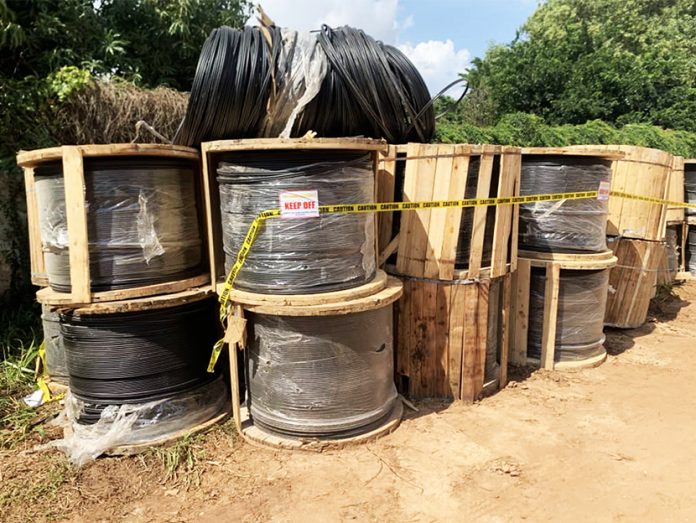
The confiscated ECG cables at the Ashanti Regional Coordinating Council
The mystery surrounding the missing Electricity Company of Ghana (ECG) cables appears far from resolved, as 83 drums of cables believed to belong to the state-owned power distributor have been retrieved from a warehouse at Asokore Mampong.
The discovery, The Chronicle has gathered, followed a tip-off that led operatives of the Ashanti Regional National Security Secretariat to the private storage facility.
The seized cables are currently being kept under heavy guard at the Ashanti Regional Coordinating Council (ARCC). The area has since been sealed off by National Security.
According to official markings and documents sighted by this paper, the cables were manufactured by Zhejiang Kukun Group Co. Ltd. and Kukun Electricals Industry Ltd. The product label reads: Service Cable 2×25 sq mm, Aluminium Standard Conductor, and the consignment was reportedly registered in the name of one Ama Gambrah.
Preliminary investigations by the Secretariat led to the questioning of Madam Gambrah, who was said to be overseeing the items. During interrogation, she claimed the cables belonged to her son, Kwaku Yeboah, a car dealer.
As part of ongoing investigations, National Security has since invited Mr. Yeboah for questioning to assist in clarifying ownership and how the cables ended up in the private warehouse.
The exact circumstances under which the cables, believed to be ECG property, were stored at the facility remain unclear. Authorities are yet to confirm whether the items were misappropriated, diverted, or stolen.
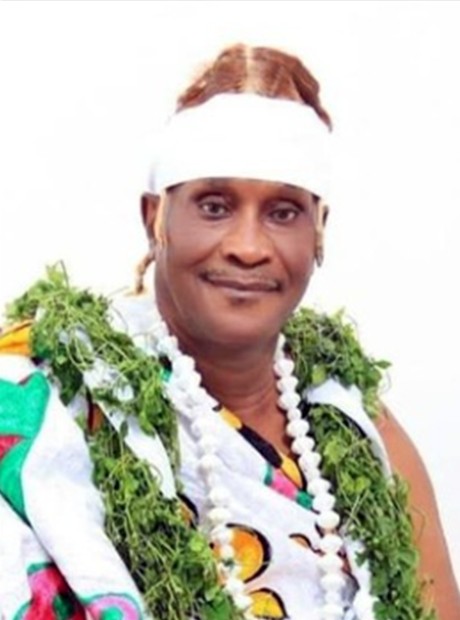
A faction in the Ga Mantse dispute, led by Nii Yaotey Oto Ga II, the Ga Dzasetse, clad in striking red attire, has called on both the National and Greater Accra Regional Houses of Chiefs to respect a unanimous Court of Appeal ruling delivered on June 12, 2025 by immediately restoring the name of Nii Tackie Adama Latse I to the National Register of Chiefs, as the legitimate Ga Mantse.
Addressing a news conference in Accra yesterday, the Ga Paramount Stool Dzase, led by Nii Yaotey Oto Ga II, the Ga Dzasetse, expressed deep concern over what he described as “embarrassing” attempts by the President of the National House of Chiefs, Ogyeahoho Yaw Gyebi II, to appeal the judgment and file a stay of execution – actions the group says contravene both the law and established tradition.
“The National House of Chiefs is not above the law,” Nii Oto Ga II stated firmly. “Article 270(3)(b) of the 1992 Constitution clearly mandates the House to register chiefs and publicly notify their status. We cannot allow this institution to be used to undermine due process and tradition.”
Background to the Dispute
The chieftaincy dispute dates back to the passing of Boni Nii Amugi II in 2004. Following his death, the customary obligation to bury him and install a successor fell to the Dzasetse.
Nii Yaotey Oto Ga II was subsequently installed and in accordance with Ga custom, buried the late King and installed Nii Tackie Adama Latse I as Ga Mantse in 2011.
In 2015, Nii Tackie Adama Latse I was duly gazetted and entered into the National Register of Chiefs, after processes through the Ga Traditional Council and the Regional and National Houses of Chiefs.
However, in October 2017, Kelvin Tackie (Nii Tackie Teiko Tsuru II) was installed as Ga Mantse. Subsequently, Nii Adama Latse’s name was removed from the Register, an act described by the Court as lacking any legal basis.
Court Ruling and Legal Arguments
In its 57-point judgment, the Court of Appeal in Kumasi, presided over by Justices Mensah-Datsa (Mrs), Eric Baah and Kwabena Baiden, dismissed the appeals filed by both the National House of Chiefs and an interested party.
The Court affirmed that the removal of Nii Adama Latse’s name was procedurally flawed, violated Article 23 of the Constitution, and disregarded the Chieftaincy Act (Act 759).
The Court ruled that only death, abdication, destoolment, or a court or judicial committee order could justify such a removal. None of these conditions had been met.
“The Appellants… are advocating chaos and confusion,” the Court ruled, warning that accepting the National House’s argument would erode the integrity of the chieftaincy system.
The Court ordered that Nii Tackie Adama Latse I’s name be reinstated within 14 days and imposed costs of GH₵50,000 jointly against the two appellants.
Nii Oto Ga II questioned whether the decision to appeal was a collective one by the National House of Chiefs or a unilateral move by its President.
He called on the House to immediately withdraw the appeal and comply with the Court of Appeal’s ruling.
“We believe in the rule of law and appeal to the House to honour the decision,” he said, also calling on the Minister for Chieftaincy and Religious Affairs to intervene and uphold peace and justice in the Ga State.
A month ago, The Chronicle lauded the bold and decisive action taken by the Accra Metropolitan Assembly (AMA), under the leadership of Mayor Michael Allotey, to rid the city of Illegal Street trading, particularly in congested areas such as Okaishie, Circle and Kaneshie. At the time, we praised the move as necessary, timely and strategic, especially considering the increasing chaos on our roads and pavements.
Today, we return to this subject to commend the AMA for something even more extraordinary, which is the sustenance of the decongestion action. For the first time in a long while, it appears that Accra’s decongestion exercise has not been reduced to a one-off media event.
One month on, the pavements and roads are still cleared. The return to “factory reset” a sad but familiar cycle where traders flood back into spaces cleared just days before has not happened. This, to us, signals a major shift in both mindset and method.
The Chronicle salutes the AMA for not just talking the talk, but walking the walk. The usual trend following such exercises has been a rapid relapse into disorder, sometimes within days. Traders return, enforcement wanes and the city’s infrastructure descends once again into lawlessness. This time, however, the picture is refreshingly different. There are visible signs that the Assembly has put in place effective monitoring and enforcement mechanisms to maintain the gains made during the initial phase of the operation.
What this demonstrates is that the AMA is not just chasing headlines. It is following through with action and this is precisely why this editorial is important. We believe such sustained efforts deserve not only recognition but also continued public support.
Urban management is not a one-day wonder. It requires consistency, discipline and a coordinated strategy that involves all stakeholders – from the state to traders to transport unions and, crucially the citizens who use these roads and pavements daily.
Mayor Michael Allotey’s approach must be applauded not only for its firmness but also for its foresight. His initial engagement with key stakeholders, including the Ghana Private Road Transport Union (GPRTU), market leaders and security personnel laid a solid foundation for inclusive enforcement. His message that Accra’s streets are not marketplaces was direct and uncompromising, yet the enforcement was carried out in a way that sought to maintain human dignity and respect for livelihoods.
The Chronicle is aware that decongesting Accra is no small feat. It has defeated many before. But this time, there are strong indications that the AMA is committed to long-term change. And that gives us hope. We urge the Assembly to not relent. Now is not the time for complacency. Continuous enforcement, coupled with sustained community engagement, is necessary to prevent a resurgence of the very problems we are trying to solve.
We also call on the AMA to strengthen its support systems for affected traders. Decongestion must go hand-in-hand with relocation and alternative livelihood strategies. Empowering traders with designated spaces that are clean, accessible, and economically viable is key to avoiding future resistance or a boomerang effect.
Furthermore, this success story must not end in Accra. Other assemblies across the country should take a cue from the AMA. The same vision, structure and political will that have yielded results in the capital can be replicated in other urban centres grappling with similar problems.
The Chronicle commends Mayor Allotey and his team for what has been a surprisingly consistent and effective implementation of an initiative that, for once, is not fizzling out after a few days.
A month on, Accra is still decongested and for that, the AMA deserves our collective support. But let us also remember that the journey to a cleaner, safer and more orderly city is a marathon, not a sprint. The real victory lies not in the launch of the exercise but in its permanence and sustainability.
As education systems face the challenge of nurturing critical, adaptable, and globally competent individuals, Ghana’s adoption of the Common Core Programme (CCP) represents a significant step towards transformative learning. The CCP emphasizes skills development over rote memorization, necessitating an evolution in instructional methods. Curriculum integration, which merges knowledge and skills across various subjects, presents an effective approach to achieving this goal.
It does not only promotes deeper understanding and contextual learning but also cultivates the essential 21st-century skills necessary for our students to thrive in a connected world. Supported by contemporary research, curriculum integration is positioned as a crucial framework for ensuring that our educational reforms are relevant, inclusive, and prepared for the future.
Educational Value
Curriculum integration refers to an instructional strategy that combines content, skills, and values across traditional subject boundaries to create impactful learning experiences. Drake and Burns (2004) note that an integrated curriculum enhances critical thinking and fosters lifelong learning by illustrating connections between disciplines. Varsavsky and Anaya (2020) assert that interdisciplinary methods are vital for equipping students to address complex problems collaboratively and creatively. This pedagogical shift is particularly pertinent for our country, which is introducing a curriculum that emphasizes core competencies such as communication, collaboration, personal growth, and digital literacy.
Significance for CCP Implementation
Alignment with Competency Goals
The CCP is designed around essential competencies aimed at holistic development, including problem-solving, innovation, cultural identity, and global citizenship. Curriculum integration supports this framework by encouraging students to think beyond individual subjects. For instance, a theme like “Environmental Sustainability” could encompass Science (ecosystems), Social Studies (community roles), Mathematics (data analysis), and English (advocacy writing), thereby enriching understanding and practical application.
Real-Life Relevance and Application
Integrated learning helps connect academic content with students’ daily experiences. Many learners in Ghana find it challenging to relate what they learn in school to their lives. Through integration, learners can participate in authentic activities that reflect real-world complexities. For example, a sanitation initiative might require that learners investigate health implications (Science), calculate waste volumes (Mathematics), draft proposals (English), and comprehend local governance (Social Studies). This relevance enhances learning and encourages learners to become agents of change in their communities.
Efficiency in Resource-Constrained Environments
With many schools in Ghana facing limitations in resources such as infrastructure, manpower, and materials. Curriculum integration can help maximize these limited assets. A single integrated unit can address objectives from several subjects, enabling teachers to collaborate in planning and delivering content. This approach will promote teamwork among educators and alleviate the burden of an overloaded curriculum for learners.
Inclusivity and Differentiated Learning
Integrated teaching allows for various entry points into learning, accommodating learners with diverse strengths-be it artistic, analytical, kinaesthetic, or verbal. For example, a project on Ghanaian festivals can include drawing, storytelling, music, and historical analysis. This will ensure a more equitable and inclusive learning environment.
Enhanced Assessment Practices
Curriculum integration will facilitate authentic assessment, moving beyond simple memorization to evaluate genuine understanding. learners can be assessed through portfolios, displays, group projects, and community-based tasks, which better reflect their competencies and promote ongoing improvement. This aligns with the CCP’s emphasis on performance-based assessment and the broader assessment reform initiatives of the Ministry of Education.
International Best Practices in Curriculum Integration
Ghana is among many nations pursuing educational transformation through integrated learning. Notable examples include:
Finland: Known for “phenomenon-based learning,” where students examine real-world issues like migration or climate change across disciplines, fostering independence, critical thinking, and relevance.
Singapore: Its curriculum integrates values, skills, and knowledge through thematic and inquiry-based learning, emphasizing flexibility, innovation, and character education within a solid academic framework.
South Africa: Through its Curriculum and Assessment Policy Statement (CAPS), South Africa merges life orientation, environmental studies, and social development to ensure that education meets societal needs while promoting democratic values.
These examples illustrate that integrated curricula can significantly enhance engagement, collaboration, and educational outcomes.
Recommendations for NaCCA and the Ministry of Education
Enhance Teacher Professional Development
Implement continual and intensive training on integrated planning, thematic instruction, and interdisciplinary assessment strategies, as teacher development is crucial for successful implementation.
Create Integrated Teaching Resources
NaCCA should develop model units, thematic schemes, and learner support materials that exemplify integration across CCP subjects, ensuring these resources are culturally relevant and contextually appropriate.
Encourage Cross-Disciplinary Collaboration
Schools should formalize co-planning among Grade levels, allowing Head teachers to allocate time for interdisciplinary teams to collaboratively design and review units.
Align Assessment with Integrated Learning
GES and NaCCA should revise national assessment frameworks to embody integration principles, ensuring ongoing assessment tools recognize creativity, problem-solving, and applied knowledge.
Integrate Community Knowledge
Involve local communities in the curriculum, utilizing elders, artisans, and community leaders as resources to help students connect classroom learning with local wisdom and development goals.
Conclusion
Curriculum integration transcends a mere instructional method; it is a strategic necessity for the future of education in our country. It bridges the gap between knowledge acquisition and competency development. It empowers our learners to be thinkers, doers, and leaders. Insights from Jacobs (2017), Drake and Burns (2004), and Varsavsky and Anaya (2020) highlight that integration promotes intentional learning, deeper engagement, and educational equity. As we advance toward a competency-based curriculum, it is essential for the Ministry of Education and NaCCA to take significant steps in establishing curriculum integration as a national standard. The effectiveness of the CCP and the future of our learners hinges on this initiative.
The Western Region Minister, Joseph Nelson,has noted that a dilapidated western rail lines and challenges in developing rail infrastructure do not only threaten the region’s transportation network, but also hinder community development.
Speaking at a stakeholders development retreat organised by the Minister together with the Western Region Coordinating Council (RCC) and attended by chiefs, businessmen and major stakeholders, Minister Nelson unveiled his vision for the rail sector for the region- a revamped rail sector that is capable to transport bulk goods like bauxite, timber, cocoa and manganese.
This, he observed, would not only boost economic activities, but will also facilitate the transportation of foodstuffs.
Touching on chieftaincy, the Minister appealed to the chiefs to prioritise resolution of chieftaincy disputes. “Nana President, I urge you and fellow chiefs to prioritise peace as development thrives in its presence”.
Minister Nelson told the chiefs that he was concerned about the numerous chieftaincy disputes and conflicts in the region.
The president of Western Regional House of chiefs (WRHC), Nana Kobbina Nketsia V, questioned the logic behind the Boankra port’s rail line extension at the expense of the western rail lines.
The WRHC President who is also the Omanhene of Essikado Traditional Area complained about the numerous promises made by the previous governments to develop the rail sector particularly the western rail line, but they failed to fulful.
“We were promised railway development using oil revenues, but a decade later nothing has materialised. Our city is dying despite having a Port.
“Meanwhile we are building a railway line to Boankra – who initiated this project and why? If we need an inland port why not utilise the Volta Lake”.
According to Nana Kobina Nketsiah, it appears to him that outsiders were planning Ghana’s future using our own resources.
The Boankra project isn’t specifically a rail project, but rather an Integrated Logistics Terminal (Boankra Inland Port) that aims to enhance trade and transportation, increase the movement of goods and services in Ghana and facilitate transit trade with landlocked countries like Burkina Faso, Mali and Niger.
The project also aimed to reduce congestion at Ghana’s seaports, particularly Tema and Takoradi, by providing an alternative logistics hub.
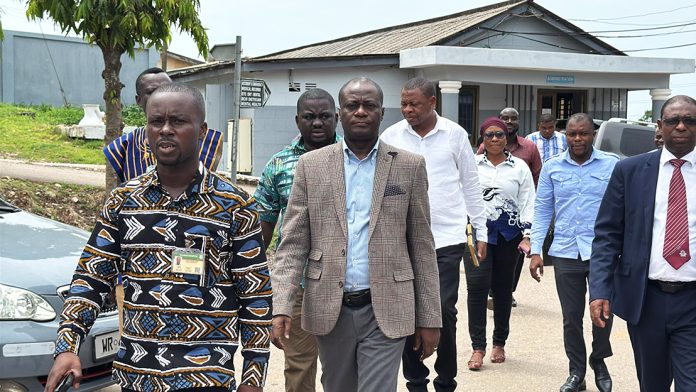
WR Minister Joseph Nelson (middle) together with management of Takoradi hospital inspecting the hospital
The Western Regional Minister, Joseph Nelson, is collaborating with the Takoradi Hospital to repurpose a female ward into a state-of-the-art Intensive Care Unit (ICU) to enhance the region’s critical care capabilities.
Joseph Nelson, who launched the programme as his own initiative said he regretted that a big region like Western region does not have ICU facility.
Takoradi hospital management in a meeting with the WR Minister Nelson
According to him, ICU goes to the heart of health delivery “and so something urgent has to be done and that is the reason why I decided to come to this facility”.
He appealed to corporate institutions, philanthropists to come on board to give the region a befitting state of the art ICU.
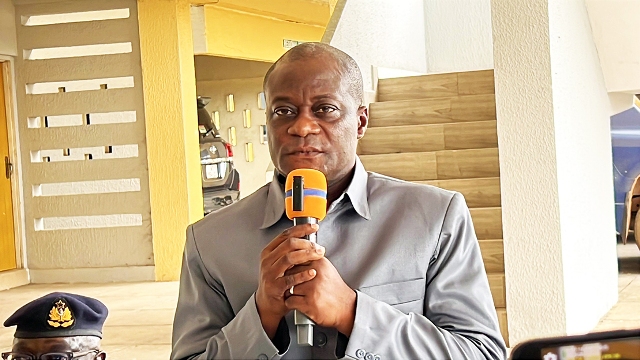
The Medical Superintendent of the Hospital, Dr. George Peprah, welcomed the initiative, noting that the region desperately needed ICU facilities, as patients often have to be referred to Cape Coast, which itself struggles with inadequate facilities.
Five physically challenged persons were among a total of 160 students who have benefitted from the Gold Fields Ghana Foundation (GFGF) scholarship programme for the 2024/25 academic year.
The beneficiaries were drawn from the host communities of Damang and Tarkwa mines and each will receive GHC10,000.00 every academic year for the next four years.
It was a proud moment for parents and guardians as they watched their wards receive the scholarship package catering for their tuition fees, hostel and others.
The scholarship beneficaries
Since the establishment of the Foundation’s scholarship scheme, a total of 3,238 have benefited from it with 498 graduating.
The 2024/25 scholarship package represents an increase in both value awarded and the number of beneficiaries as compared to the previous years. For the second time, females topped the list of the beneficiaries with 52%.
At the presentation of the awards to the beneficiaries, Senior Vice President and Managing Director of Gold Fields, Elliot Twum, indicated that with funding support of $100,000, the Foundation has been able to extend the scholarship programme to the Damang catchment communities as well.
He said the Foundation has been monitoring the scholars by visiting to check on their wellbeing and academic performance in their various institutions.
That aside, the foundation directly interacts with the students to understand the challenges they face, beyond financial opportunity to strengthen the relationship with the leadership of the various institutions.
Prof. Richard Amankw, Vice Chancellor of University of Mines, Tarkwa (UMaT) on his part said scholarship was very important when it comes to academic pursuit.
According to him, a number of students sometimes defer their courses not because they are not good, but due to lack of funds.
With Goldfields Foundation taking over the cost of their education for the next four years, he urged them to dream big and make the company and their families proud.
Prof. K.T. Oduro, Technical Director to the Minister of Education, on his part, said government appreciates the support GFGF had been giving to students in its host communities.
Undoubtedly, the award, he said, had opened opportunities for the recipients to pursue knowledge, develop relevant skills and carve a career path for their future without financial constraints and distractions.
Present at the ceremony were Prof. Elvis Asare-Bediako, Vice Chancellor of UNER, Robert Siaw, Regional Manager, Community Relations, Abdel Razak Yakubu, Executive Secretary, GFGF, amongst a host of others.