Songbird Gyakie has shared how her journey into music began in the most unexpected way, revealing that she never initially planned to pursue it as a career.
Speaking during an interview on 3FM, the artiste reflected on her early years, explaining that her introduction to performing came largely through her mother’s influence at home.
She recalled; “I never imagined I would pursue music as a profession while growing up. My mum used to make me perform at home, even when I didn’t want to. Whenever she had guests over, she would call me to sing. I would pick up a bottle or a lotion as a microphone and perform in front of them. It used to annoy me a bit, but she clearly saw something I didn’t at the time.”
Gyakie also credited her upbringing in a musically inclined household as a major factor in shaping her passion. As the daughter of highlife musician Nana Acheampong, she grew up surrounded by rehearsals, studio sessions, and visiting artistes, which gradually deepened her connection to music.
She said; “Growing up around music made all of us love it. I watched my dad rehearse at home and in the studio, and I saw artistes coming in and out. Even though I was very young, I could tell something special was happening.”
Despite this early exposure, she noted that music did not immediately appear to her as a viable career path. However, her active involvement in entertainment activities during her school years hinted at her future.
She explained; “I think that’s where my love for it started, but I didn’t consider it as a profession. I was the entertainment prefect in secondary school, so I was always involved in creative activities. I just didn’t pay much attention to it until I released my first song.”
According to the singer, the turning point came after the release of her debut track, when the positive feedback from listeners encouraged her to take the craft more seriously.
She added; “The feedback I received made me sit up. People kept saying my voice was unique and the song was good. It felt like they were pointing me towards something important. That’s when I realised I had to take it seriously, and now it has become a business.”
Her story highlights how talent, even when discovered unexpectedly, can evolve into a thriving career with the right support and environment.
At a time when the global film landscape is evolving rapidly, where filmmaking techniques are advancing and box offices are recording massive returns, Ghana continues to circle the same conversation it has had for years: Funding.
It is the most cited problem in the industry. And rightly so. Financing remains a major hurdle, alongside distribution. But over time, funding has become more than just a challenge, it has become a comfortable explanation.
The truth is, funding is not easy anywhere in the world. Even in established industries like Hollywood, filmmakers fight for funding every single day. Projects stall. Scripts are rejected. Investors hesitate. The difference, however, is clear. In those industries, funding is controlled.
Expecting government to solve this challenge may not be the most practical path forward. Across the world, national budgets are structured around priorities such as the economy, healthcare, education, and infrastructure.
If financial resources are limited, then human resources must take centre stage. Ghana is not short of talent. From writers to actors, directors to cinematographers, producers to editors, the industry is filled with individuals capable of producing meaningful and competitive work. Yet one issue continues to undermine that potential, that is disunity.
Collaboration remains one of the most underutilised tools in the industry, and without it, even the most talented individuals will struggle to create at scale. Veteran Ghanaian actor Fred Amugi captured this reality succinctly in a recent interview on GHOne TV:
“Funding is not the problem, disunity is. If we can unite as an industry, the money will come.”
This is a strong statement, that is also revealing. Because beyond the conversations about funding lies a deeper question, whether the industry is structured, aligned, and intentional enough to attract and sustain investment.
If you buy packaged foods, learning how to read and understand food labels can help you make healthier choices. Follow these tips when you are shopping to choose which brand or variety to buy.
Check the ingredient list
You can usually find the ingredient list on the back of packaged food.
Ingredients are listed in order from the largest to the smallest amount. So, if fat, sugar or salt are near the top of the list, the food is unlikely to be a healthy choice.
Sugar and fat are often listed in the ingredient list under different names.
Common names for sugar added to foods are:
corn syrup
dextrose
fructose
glucose
sucrose
maltose
honey
invert sugar
golden syrup
maple syrup
Common names for fat added to foods are:
butter
coconut cream
cream
hydrogenated vegetable fat
lard
margarine
oil
trans fats
triglycerides
vegetable oil.
Eating lots of ultra-processed foods has been linked with an increased risk of health conditions such as diabetes, heart disease and some cancers.
Ultra-processed foods tend to have more than one ingredient that you will never or rarely find in a home kitchen.
Check the nutrition information panel
Most packaged foods must have a nutrition information panel. Some brands may also have product information on their websites.
There are 2 columns on the nutrition information panel. They give you:
the amount of nutrients “per serving”
the amount of nutrients “per 100 g” (or 100 ml if liquid).
Use the 100 g column to compare similar foods and choose healthier products.
Always compare products in the same category, for example, 2 different breads.
Use the 10, 10, 5 rule to choose which product to buy:
less than 10 g of fat
less than 10 g of sugar
more than 5 g of fibre.
You can also think of the 3 Ss — less of these is best:
saturated fat
sugar
You are looking for products that have the least amount of saturated fat, sugar and sodium per 100 g.
The Healthy Food Guide’s supermarket shopping guide gives more information about what to look for on the labels of particular foods.
Practice reading labels at home
Read the labels on the food in your pantry and fridge before you head out to the supermarket. Get an idea of the healthy choices you already have and the foods you need to find a healthier alternative for.
Once you get to know which options are healthy, you will only need to check the labels if you want to try:
a new product
a different brand
a supermarket special you have not tried before.
Using a food labelling app
With the free FoodSwitch app, you can scan the barcodes of packaged foods with your smartphone camera. It then gives you:
nutritional advice that is easy to understand
a list of similar foods that are healthier choices.
Look for health stars on the front of packaged food
Health stars are a quick and easy way for you to choose healthier packaged foods. Health stars rate the nutrition content of packaged food from half a star to 5 stars.
The system is not perfect. It is designed to give more stars to healthier foods. But some foods with ratings of three or more stars are not always healthy choices.
The best way to tell if a food is a healthy choice is to check the nutrition information panel and follow the rest of the advice on this page.
More Tips for Reading Food Labels
Familiarize yourself with your allergen and the foods it often appears in. Food allergens can appear in surprising places and go by less-common names. Knowing your allergen inside and out will improve your sleuthing skills. Here are sometips for avoiding your allergen.
If you are unsure whether a product could have come in contact with your allergen(s), call the manufacturer. Ask them about their ingredients and manufacturing practices.
If you encounter a product that doesn’t have an ingredients list, don’t buy it.
Be extra careful with imported products. Food labeling regulations vary by country. Imported items are supposed to follow FALCPA and other domestic food labeling laws, but occasionally they do not.
A child with a food allergy can start checking food labels as soon as he or she learns to read. Practice at home and when you’re shopping—with help from an adult.
Ghana will partner Rwanda, Zambia and other African countries to pilot a continental digital trade corridor aimed at transforming cross-border transactions and accelerating economic integration, Vice President Prof. Naana Jane Opoku-Agyemang has announced.
Delivering the Presidential Address under the theme, “Shaping Africa’s Integrated Digital Economy” at the 2026 3i Africa Summit in Accra on Wednesday, May 6, 2026, she said the initiative would focus on mobile money interoperability, mutual recognition of digital identity for cross-border verification, and harmonised electronic invoicing systems.
The move, she explained, is part of a broader effort to reposition Africa from fragmented digital progress to a fully integrated continental economy.
“The systems we build will determine whether Africa participates in the global digital economy on her own terms, or operates within frameworks defined elsewhere,” she stated.
The Vice President emphasised that Africa’s economic future would depend on how effectively countries organise themselves to integrate, compete and build at scale, rather than how the continent is perceived globally.
She noted that Ghana’s role as a gateway to Africa must go beyond rhetoric and be measured by the efficiency of its systems, particularly in enabling seamless transactions and business connectivity.
According to her, digital integration has become central to economic sovereignty, with increasing reliance on platforms that enable individuals and businesses to transact, verify identity and operate across borders.
She identified four critical pillars for achieving this integration—payments, identity, regulation and infrastructure.
On payments, she observed that many intra-African transactions are still routed through external systems and denominated in foreign currencies, leading to delays and higher costs. She cited ongoing efforts such as the Pan-African Payment and Settlement System as steps toward reducing such inefficiencies.
On identity, she stressed that millions of Africans remain excluded from formal systems due to lack of reliable digital identification, limiting their participation in cross-border trade.
“Trust begins with identity,” she said, calling for interoperable identity systems across the continent.
Addressing regulation, she noted that fragmented frameworks across countries continue to hinder innovation and increase the cost of doing business, underscoring the need for coordinated policies and shared standards.
She also highlighted infrastructure gaps, pointing out that many Africans remain offline due to high costs and limited access, while the continent still accounts for a small share of global data centre capacity.
“Investment in broadband, cloud infrastructure and digital systems must accompany policy alignment,” she said.
The Vice President expressed optimism about Africa’s prospects, citing its young population and rapid technology adoption as key advantages in shaping the next phase of global digital growth.
She urged governments to move beyond discussions and take practical steps to implement integration across the continent. The summit, hosted by the Bank of Ghana, has brought together policymakers, regulators and industry leaders to chart the future of digital finance in Africa.
Forest hold a slim lead after last week’s opener, but Villa boast a superb home record in Europe, whoever prevails, the aggregate winner will proceed to the final, facing either Braga or Freiburg in Istanbul later this month.
After reaching the Conference League semis in 2024 and the Champions League quarter-finals last season, Aston Villa are aiming to take the next step and make their first continental final in a generation.
Several decades have passed since Villa beat Bayern Munich in the 1982 European Cup decider, and that wait will go on should they fail to overturn a 1-0 deficit on Thursday.
Though Aston Villa have suffered three straight defeats for the first time since 2024, they are grimly clinging on to fifth place and still have Champions League qualification within their grasp.
The omens are good: the Birmingham club have won their last nine European fixtures at Villa Park – also scoring in 31 of the last 32 – and their Basque boss is a proven expert at this level.
Expect another tight contest, as Aston Villa and Nottingham Forest are taking a more cautious approach in Europe: both have kept seven clean sheets so far, including three apiece in the knockout phase.
While Villa started as competition favourites, recent displays suggest they may be running out of gas; meanwhile, Forest have found peak form at just the right time, so East can beat West in this big Midlands showdown.
Credit: sportsmole.co.uk
Can Freiburg overturn a one-goal deficit when they welcome Braga
To reach their first-ever European final, Freiburg must overturn a one-goal deficit when they welcome Braga for the second leg of their Europa League semi-final.
Pau Victor, Braga
Last week’s first leg saw Freiburgfall to a dramatic 2-1 defeat, leaving Braga in control as they chase a first appearance in the competition’s showpiece since 2010–11.
Already out of the running for a top-six finish domestically, Freiburg’s only route into Europe’s elite now lies in winning the Europa League, and Schuster can take confidence from the fact that his team have won their last 10 continental home matches, scoring 28 and conceding just four.
Braga, meanwhile, are closing in on another European qualification spot domestically, currently sitting fourth in the Primeira Liga table and five points clear of fifth, with just two games remaining, following a 1-1 draw with Estoril Praia last weekend.
Freiburg’s strong home record in Europe gives them a platform, but their recent form suggests they may fall just short of the level required to turn this tie around.
Braga, with the advantage in hand, are well placed to manage the game and could do enough to see it out, especially given their experience at this stage of the competition, so a draw appears likely here.
Credit: sportsmole.co.uk
Crystal Palace play host to Shakhtar in Conference League tie
After a 3-1 victory in the first leg of their semi-final last week, Palace are looking to progress through to a European final for the first time in their history.
Yeremy Pino, Crystal Palace
Although Palace can still achieve European qualification for next season through the Premier League, it has become evident that Oliver Glasner is starting to prioritise this competition.
The Austrian selected a strong side for last week’s first-leg success, with Ismaila Sarr, Daichi Kamada and Jorgen Strand Larsen all getting on the scoresheet.
Sarr’s early effort was his eighth in this season’s Conference League, making him the joint-top goalscorer in the competition.
Palace will now attempt to record a fourth successive Selhurst Park clean sheet in the knockout phase, the most recent coming in a 3-0 victory over Fiorentina in the last eight.
As for Shakhtar, they have recorded six wins and two draws from their most recent nine matches in all competitions, their only reverse coming versus Palace.
Although Shakhtar are in a position where they can throw caution to the wind, very few teams travel to Selhurst Park and come away with a two-goal victory. While there will inevitably be some nervy moments for the Eagles, we are backing them to come through one of the biggest matches in their history.
Credit: sportsmole.co.uk
Strasbourg aim to produce a comeback against Rayo Vallecano
RC Strasbourg will be looking to produce another famous European comeback when they host Rayo Vallecano at the Stade de la Meinau on Thursday evening in the second leg of their UEFA Europa Conference League semi-final.
Oscar Valentin, Rayo Vallecano
The French side trail by a single goal from the first leg and will be desperate to overturn that deficit in front of their own supporters, with a place in the club’s first-ever 21st century European final the prize on offer.
Strasbourg did not offer a great deal in the opening leg of this Conference League semi-final, and the French side were fortunate to come away from that first encounter only a goal down, given that they only managed five shots to Vallecano’s 24.
There were few positives to take from the first leg, yet the most significant one is that Strasbourg remain in this tie, and Gary O’Neil’s side will be well aware of what is possible when they perform to their capabilities at the Stade de la Meinau.
The most vivid illustration of what Strasbourg are capable of on home soil came in the quarter-final second leg, when they produced a stunning 4-0 victory over Mainz, having lost 2-0 in Germany.
Domestic form, however, is a concern for O’Neil heading into Thursday’s fixture, with Strasbourg having lost five of their last seven matches across all competitions.
Strasbourg’s home record in this competition and the memory of their stunning Mainz comeback make them dangerous opponents.
Police have raided around 50 homes and other locations, targeting people suspected of involvement in far-right criminal youth groups that have recently emerged in Germany.
Prosecutors said the suspects were believed to be part of two groups, “Jung & Stark” (JS), or Young and Strong, and “Deutsche Jugend Voran” (DJV), which means Forwards German Youth.
No arrests were made in Wednesday’s raids, which took place in 12 states, mainly in the east and south of Germany, including Bavaria, Berlin, Brandenburg and Saxony.
In a statement, federal prosecutors said the raids targeted individuals suspected of organising violence through social media and forming nationwide networks.
“Some of the accused are said to have attacked members of the left-wing scene or people they believed to be paedophiles. In each case, the victims were beaten by several attackers and sustained significant injuries,” prosecutors said.
During their meetings, authorities say, group members have called “for acts of violence against political opponents and against alleged paedophiles”.
Last year one of the leaders of DJV was sentenced to more than three years in prison after a string of violent attacks against political opponents in Berlin.
More than 600 police were involved in Wednesday’s raids.
There is deep concern in Germany about young people being drawn into far-right activity and violence targeting both left-wing figures and LGBT communities.
Oil prices have dropped and global stock markets have risen following reports that the US and Iran are close to a deal to end the war.
Brent crude futures, the global benchmark oil price, fell to $97 (£73) a barrel after the reports before rebounding. The price was over $108 earlier in the day.
The FTSE 100 index of London’s largest public firms and the equivalent German Dax had risen over 2% midway through the trading day while the French Cac 40 was up 3%. Asian stock markets closed up.
The market movements come after news outlet Axios reported that the US believes it is getting close to a one-page document which will end the war and set up more detailed nuclear negotiations.
Oil prices are still much higher than the $70 a barrel they were hovering around before the start of the US-Israel war with Iran, which has caused caused production and transportation of oil in the region to slump.
Central to the conflict is Iran’s threat to attack oil ships crossing the Strait of Hormuz, a narrow waterway south of the country, in response to US-Israeli strikes since 28 February.
About a fifth of global oil and gas shipments usually cross the strait, which has been effectively closed for weeks. Global gas prices have also soared since the conflict began.
On 8 April, the US and Iran agreed a ceasefire, which caused oil prices to slump and stock markets to jump.
However, on Sunday, US President Donald Trump said the US military would guide ships through the Strait of Hormuz, dubbing it “Project Freedom”, leading to a rise in attacks in the strait from both Iran and the US.
Trump then said on social media on Tuesday he would pause the operation “for a short period of time to see whether or not the Agreement can be finalized and signed”.
He added that “Great Progress has been made toward a Complete and Final Agreement with Representatives of Iran”. Trump said the US would continue to block ships transiting to and from Iranian ports, a move designed to put pressure on Iran’s economy.
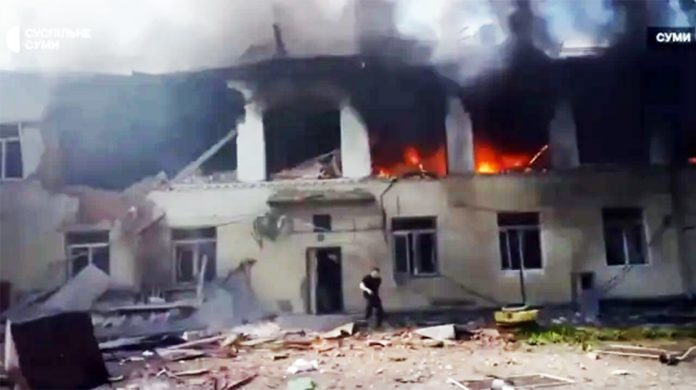
A kindergarten in the Sumy region was hit, local authorities said
Volodymyr Zelensky has accused Russia of breaching a unilateral ceasefire announced by Ukraine by launching a wave of drone attacks on several cities.
The Ukrainian president said Russia had carried out “active hostilities and terrorist shelling”, targeting the front line as well as firing dozens of drones and missiles at civilian areas.
In the Sumy border region, one woman was killed when a kindergarten was hit on Wednesday morning, local authorities said. No children were present at the time.
Earlier this week the two warring sides had announced rival unilateral ceasefires – with no agreement on their terms, length or monitoring.
Moscow was the first to demand a truce on 8 and 9 May to mark Victory Day on Saturday, when commemorations of the Soviet Union’s victory over Nazi Germany are due to be held across the country.
Kyiv followed on by announcing its own open-ended ceasefire from midnight on Tuesday, and that Ukraine would act “symmetrically” from that point on.
On Wednesday morning Zelensky stated that Russia’s choice was “an obvious spurning of a ceasefire and of saving lives”.
Ukraine had “clearly stated that it would act in kind”, he added, and would “decide on our further actions” based on evening reports from its military and intelligence.
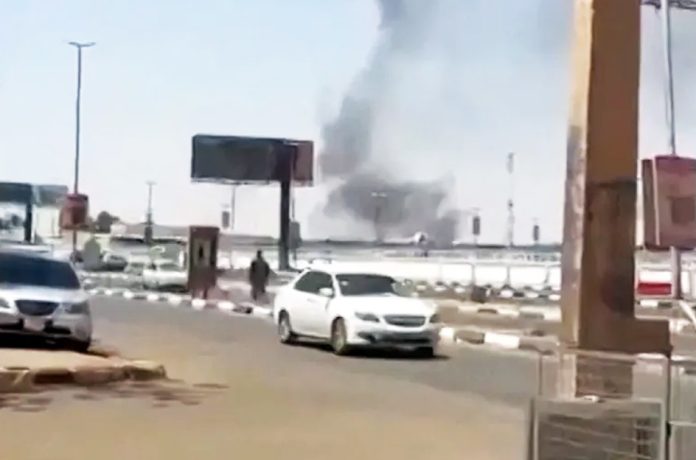
The Sudanese government has accused Ethiopia and the United Arab Emirates of being behind recent drone attacks, including at Khartoum airport.
Military spokesperson Brigadier General Asim Awad Abdelwahab told a news conference on Tuesday that Sudan’s government, which has recalled its ambassador from Ethiopia, had obtained evidence of four drone attacks since March 1 originating from neighbouring Ethiopia’s Bahir Dar airport. It claims the UAE provided the drones used in the attacks.
“What Ethiopia and the UAE have done is direct aggression against Sudan and won’t be met with silence,” Abdelwahab said.
Foreign Minister Mohieddin Salem said that while Khartoum will not initiate attacks against other countries, “whoever attacks us will be met with a response”, and that Sudan was ready to “enter into an open confrontation” with Ethiopia “if it becomes necessary”.
His comments came following a strike on Monday at the airport in Sudan’s capital, Khartoum. Previous attacks have been launched towards the Sudanese states of Kordofan, Blue Nile and White Nile.
A drone attack on Saturday on Omdurman, Sudan’s second-largest city, killed five people travelling on a civilian bus, while another attack the following day in the central Sudan state of Gezira killed relatives of Abu Agla Kaikal, a commander with the Sudan Shield Forces, a group allied with the Sudanese military, who defected from the rival Rapid Support Forces (RSF) earlier in the war.
The Minister of the Federal Capital Territory, Nyesom Wike, has said that he has not endorsed any individual for the 2027 governorship election in Rivers State.
Speaking in Abuja during his monthly media chat on Wednesday, Wike said he cannot endorse anyone until the joint coalition involving members of the Peoples Democratic Party (PDP) and the All Progressives Congress (APC) in the state meets.
“I have not (endorsed anybody) and I cannot endorse somebody until the joint coalition meets,” Wike said during the media chat.
“We have loyalists in PDP, we have loyalists in APC. I have never hidden the fact that everywhere you say rainbow coalition. We have put ourselves together and it is a political strategy because we have somebody we will fight.”
The former Rivers State governor also said that the coalition in the state is not working with Governor Siminalayi Fubara, who is also reportedly eyeing the APC ticket for the 2027 election in the state.
Wike accused the governor of reneging on an agreement reached with members of the Rivers State House of Assembly before President Bola Tinubu, an agreement he said prevented Fubara’s impeachment.
“You know that we and Fubara are not working. So, as politicians, we must strategize, I don’t need to come and unveil our strategy to you.
“The president intervened in the impeachment palava and said ‘hold on, let’s have peace’. And the governor said ‘I am ready for peace, I’m no longer interested in this, I will not do this’.
“The Assembly went and withdrew the impeachment before a president of a country. Now, having withdrawn the impeachment, you are now too smart on what you agreed before the president,” he said.
There has been a prolonged political rift between Wike and Fubara, whom he supported in 2023 to succeed him as governor of Rivers State, over control of political structures in the oil-rich South-South state.
The crisis escalated when lawmakers loyal to the FCT minister—led by Martin Amaewhule—attempted to impeach Fubara.
This development led President Bola Tinubu to suspend Fubara, his deputy Ngozi Odu, and members of the Rivers State House of Assembly in March 2025, following the prolonged political impasse.
Following the suspension, Tinubu appointed and swore in retired Vice Admiral Ibok-Ete Ibas as sole administrator of the state.
After six months, however, the President lifted the emergency rule, allowing Fubara, his deputy, and the lawmakers to return.
The lifting of the emergency rule followed a meeting in June between President Tinubu, Fubara, Wike, Amaewhule, and other lawmakers, which led to a reconciliation of the key political actors in the crisis.