Home Blog Page 386

French court sentences ex-DR Congo rebel and politician to 30 years in jail

0
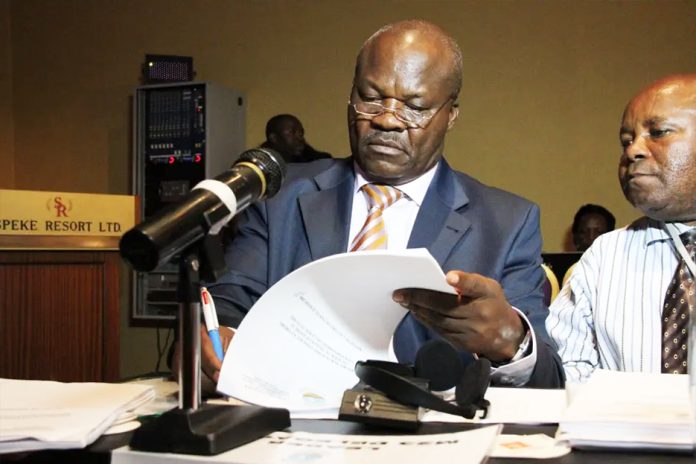
Ex DR Congo rebel Roger Lumbala

A French court has sentenced a former rebel leader and politician from the Democratic Republic of Congo to 30 years in jail after finding him guilty of complicity in crimes against humanity more than two decades ago.

Roger Lumbala headed a rebel movement backed by neighbouring Uganda accused of committing atrocities during a period known as the Second Congo War.

The judge said the 67-year-old was found guilty of ordering or aiding and abetting torture and inhumane crimes, summary executions, rape constituting torture, sexual slavery, forced labour and theft.

Lumbala, who was living in France when he was arrested nearly five years ago, has refused to accept the legitimacy of the court in Paris.

He did not attend the trial, which began last month, though he was in the dock to hear the verdict on Monday.

Lumbala also served as a minister in DR Congo’s transitional government from 2003 to 2005 and later as a member of parliament.

Several years later the Congolese government issued an arrest warrant for him over his alleged support for the M23, a rebel group currently active in the eastern DR Congo, prompting him to flee to France.

The Second Congo War, which raged from 1998-2003, involved nine countries, numerous rebel groups and led to the estimated deaths of between two and five million people.

At the time Lumbala led the Rally of Congolese Democrats and Nationalists (RCD-N), which allegedly carried out atrocities during a campaign between 2002 and 2003 called “Erase the Slate”.

The operation targeted members of the Nande and Bambuti ethnic groups in the north-eastern provinces of Ituri and North Kivu who were accused of supporting a rival militia.

Credit: bbc.com

Ukraine struggling to keep lights on under Russian attack, says energy boss

0
Across Ukraine electricity is being rationed

Ukraine’s biggest private energy provider is living in permanent crisis mode because of Russian attacks on the grid, its chief executive has told the BBC.

Most of Ukraine is suffering from lengthy power cuts as temperatures drop and Maxim Timchenko, whose company DTEK provides power for 5.6 million Ukrainians, says the intensity of strikes has been so frequent “we just don’t have time to recover”.

President Volodymyr Zelensky said on Tuesday that Russia knew the winter cold could become one of its most dangerous weapons.

“Every night Ukrainian parents hold their children in basements and shelters hoping our air defence will hold,” he told the Dutch parliament.

As the fourth anniversary of Russia’s full scale invasion approaches, Maxim Timchenko says Russia has repeatedly targeted DTEK’s energy grid with “waves of drones, cruise and ballistic missiles” and his company has found it difficult to cope.

Tens of thousands of people in the southern city of Odesa have been without electricity for three days this week, following a co-ordinated Russian attack.

Across Ukraine electricity is being rationed – with supplies turned on for a few hours each day.

Many Ukrainians rely on power banks and generators as a back-up, and the sound of generators in the capital is now more constant than the air raid warnings.

Credit: bbc.com

Trump chief of staff Susie Wiles says president ‘has an alcoholic’s personality’

0
President Donald Trump

President Donald Trump’s chief of staff, Susie Wiles, delivered a series of unusually candid and at times unflattering assessments of the president, his second-term agenda and some of his closest allies in a series of wide-ranging interviews with Vanity Fair.

Across more than ten interviews, Wiles spoke about working for Trump, saying the president “has an alcoholic’s personality,” despite being known as a teetotaler. Wiles said Trump governs with “a view that there’s nothing he can’t do. Nothing, zero, nothing.”

“High-functioning alcoholics or alcoholics in general, their personalities are exaggerated when they drink,” she said. “And so I’m a little bit of an expert in big personalities.” The article notes she grew up with an alcoholic father – the legendary sportscaster Pat Summerall.

In the interviews, Wiles notably admitted there “may be an element of” political retribution in the prosecutions against his political opponents.

“I mean, people could think it does look vindictive,” she said in response to a question about the prosecution of former FBI Director James Comey. “I can’t tell you why you shouldn’t think that.”

“I don’t think he wakes up thinking about retribution. But when there’s an opportunity, he will go for it,” she added.

Wiles said she tried to persuade Trump to end his “score settling” within the first 90 days of his second term. That effort failed, she acknowledged, as his push for prosecutions continued, driven in part by the president’s desire for retribution.

Credit: cnn.com

Prang Chief Grateful To leadership of Bono, Bono East Houses of Chiefs

0
Nana Kwadwo Nyarko III - Omanhene of Prang

The Paramount Chief of Prang Traditional area, Nana Kwadwo Nyarko III, has expressed profound appreciation to the leadership and membership of the Bono and Bono East Regional Houses of Chiefs for their support in this year’s Nkyifie Yam Festival of the people of Prang, in the Bono East Region.

The 2025 Nkyifie Yam festival also coincided with the 60th anniversary of the enstoolment of the Prang Omanhene.

Addressing a Traditional Council meeting at Prang, Nana Nyarko commended the two Houses of Chiefs for the role they played in making the festival and the anniversary celebrations successful.

He was full of praise while acknowledging the presence of Oseadeaye Agyeman Badu, Paramount chief of Dormaa and President of the Bono Regional House of Chiefs, Nana Owusu Sakyi, Paramount Chief of Basa Traditional area and President of the Bono East Regional House of Chiefs, as well as Chiefs from all walks of life who graced the occasion.

“Their presence was an indication of peace and unity” he noted and urged them to sustain it to enhance developmental efforts of the people. Nana Kwadwon Nyarko III disclosed that the Chieftaincy institution plays a key role in the development and progress of the nation.

The Prang Omanhene suggested that the chieftaincy institution is used as a tool to resolve all disputes and litigation that tend to adversely affect the development of their respective jurisdictions.

He stressed that truth and justice were essential and must be seen as a guide principle by chiefs in dealing with disputes.

From Oswald P. Freiku, Prang 


For more news, join The Chronicle Newspaper channel on WhatsApp: https://whatsapp.com/channel/0029VbBSs55E50UqNPvSOm2z

Oppong Nkrumah hands over 2 new classroom blocks in Ofoase/Ayirebi

0
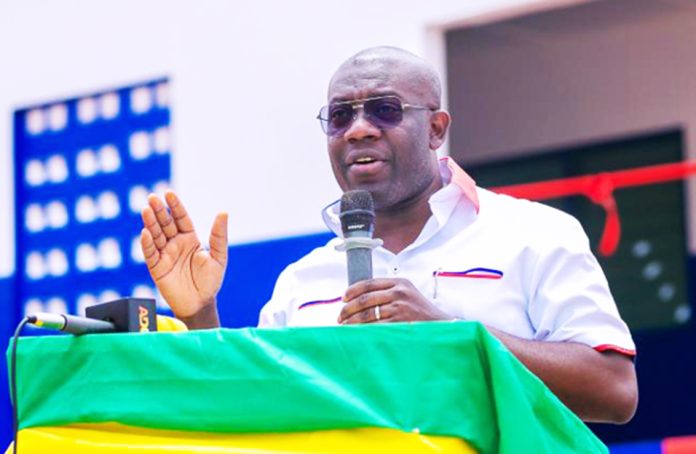
Member of Parliament for Ofoase Ayirebi, Kojo Oppong Nkrumah

The Member of Parliament for Ofoase Ayirebi, Kojo Oppong Nkrumah, has once again demonstrated his commitment to education by handing over two newly constructed six-unit classroom blocks to schools in the constituency.

The projects, undertaken as part of efforts to address infrastructure deficits in basic education, were handed over to Akyem Anyinase Presbyterian Basic School and Akyem Bontodiase Presbyterian Basic School.

The new facilities are expected to significantly improve teaching and learning outcomes, particularly for pupils who had previously studied in overcrowded classrooms and less conducive environments.

The projects initiated and completed by Mr Kojo Oppong-Nkrumah

Each of the classroom blocks consists of six spacious and well-ventilated classrooms designed to provide a more comfortable and learner-friendly atmosphere. Education authorities believe the improved infrastructure will help reduce congestion, enhance teacher effectiveness, and boost pupils’ academic performance.

Speaking at the handing-over ceremony, Kojo Oppong Nkrumah underscored the central role of education in the development agenda of the constituency, stressing that sustained investment in school infrastructure is non-negotiable.

According to him, improving educational facilities is critical to building a strong foundation for future growth.

“Investing in education remains a top priority, because it lays the foundation for sustainable development in the constituency,” the MP said.

“When we create the right environment for teaching and learning, we are directly investing in the future of our children and the long-term progress of our communities.”

He encouraged teachers and pupils to take full advantage of the new facilities to improve academic outcomes and instil a culture of excellence. The MP further assured residents that his office would continue to champion initiatives aimed at raising educational standards across the constituency.

“I urge both teachers and pupils to make good use of these facilities so that together we can achieve better results,” he added, while reaffirming his “continuous commitment to improving educational standards in Ofoase/Ayirebi”.

Traditional leaders, community members, and school authorities who attended the ceremony welcomed the development, describing the projects as timely and impactful.

They noted that the new classroom blocks would ease pressure on existing infrastructure and create a more dignified learning environment for pupils.

Representatives of the beneficiary schools expressed gratitude to the MP for responding to long-standing infrastructure challenges, stating that the classrooms would go a long way in enhancing discipline, attendance, and overall academic performance.

Community leaders also pledged to work with school authorities to ensure proper maintenance of the facilities to guarantee their long-term use.

The commissioning of the two classroom blocks adds to ongoing efforts within the constituency to improve educational infrastructure, as stakeholders continue to push for expanded access to quality education as a driver of social and economic development.


For more news, join The Chronicle Newspaper channel on WhatsApp: https://whatsapp.com/channel/0029VbBSs55E50UqNPvSOm2z


Ways to Warm Up When You’re Feeling Cold

0

Wear Socks to Bed

It may look funny, but it’s better than blue toes! Not only will it help heat your whole body, but warm feet also seem to signal your brain that it’s time to go to sleep. If you just can’t get with this bedtime fashion, walk around in cozy slippers for about an hour before you hit the sack.

Pick Your PJs With Care

Sleep in soft, flexible fabrics. Flannel will keep you cozy, but it still breathes so that you won’t get too hot, or damp from sweat. Silk could be warm, too, but it might not breathe as well. If you’re really cold, long underwear and even a hat, or “nightcap,” can help.

Move Your Body

Go for a walk or a jog. If it’s too cold outside, hit the gym, or just do some jumping jacks, pushups, or other exercises indoors. Not only will it warm you up, it helps build and keep your muscles, which also burn calories and make body heat. If you’re healthy enough for it, vigorous exercise might even raise your core body temperature, at least for a while.

Toss Your Clothes Into the Dryer

Few things may take the chill off more quickly than putting on clothes straight from a toasty tumble. Run them through a short spin just before you get dressed. Your body is usually warmest in the morning, so it’s a good idea to try and hang on to the heat. It won’t last forever, but it will give you a cozy start to the day.

Get Your Calories

Your body needs fuel to burn to keep your core body temperature up, especially when it’s cold outside. Shoot for at least one hot meal a day, and try to eat a variety of fruits, vegetables, and other unprocessed foods.

Get Your Iron and Vitamin B12

Without enough of both, you can get anemia, which means you have too few red blood cells to take oxygen around your body. That could make you feel chilly. Some people don’t get enough B12 from food or don’t absorb it easily. Pregnant women sometimes have lower levels of iron, because their bodies use more than usual. Get B12 in chicken, eggs, or fish. Get iron from poultry, pork, seafood, chickpeas,and green leafy vegetables.

Dress in Layers

A few lighter layers warm you better than a single heavy one. Start with something thin, like thermal underwear that wicks away moisture. Add insulation like a down jacket or wool sweater in the middle. Use a windbreaker as an outer shell. Three layers seem to be a sweet spot, but you can adjust. Just add another layer if you’re still cold and take one off when you’re hot.

Heat Your Mattress

An electric blanket wastes half its heat to the ceiling. It also can bunch up. But a heated mattress pad fits snugly like a sheet. Because it doesn’t move as much, it likely won’t wear out as quickly or easily as a blanket.

Spice Up Your Life

Do you notice a little sweat on your brow when you eat those extra jalapenos at your favorite taco joint? That’s because spicy food literally warms up your body. Nothing wrong with that, unless you have stomach problems like ulcers. In fact, a spicy diet can be good for you. Just don’t overdo it, especially if you notice that you don’t feel well afterward.

Plug In Space Heaters

They can help warm smaller areas. Pick a UL-approved unit that fits your space and purpose. A “convection” type with a fan might be best to heat a whole room. A “radiant” model is better to heat a specific spot. Put it on a level surface away from moving people. Keep pets and children away. Plug electric heaters directly into the wall, and look for a safety switch that turns it off when it’s knocked over.

Shop for the Right Boots

Just because your footwear is insulated doesn’t necessarily mean it’ll keep you warm. Boots that aren’t well sealed from moisture can turn into ice blocks. Look for a high IPX rating. IPX-8 is the highest. It means you could dunk the whole boot in water and your foot would stay dry. And be sure to buy them big enough to fit in some thick wool socks.

Credit: webmd

Feature: The Rising Jihadi Terrorism Threat Across West Africa: A Case For The Re-Examination Of Ghana’s Response Strategies

0
Feature

The rising incidence of jihadi terrorist attacks within the West African sub-region has caused considerable concern to both leaders and the general citizenry within and outside the region. From the marauding band of Boko Haram insurgents in northern Nigeria to the more sophisticated Jama’at Nusrat al-Islam wal-Muslimin (JNIM) and its splinter variations across the Sahel, the progressive expansion and sophistication of these jihadist groups threaten the very foundations of democratic states.

These organizations have unleashed an unprecedented wave of terrorist activities in recent times, posing a serious threat to peace, progress, and development in West Africa, including Ghana. This article examines the jihadi terrorism threat landscape in West Africa, its effects, and the national, regional, and international responses to it. It concludes by highlighting the need to re-examine Ghana’s response strategies in light of the evolving nature, scope, and patterns of jihadi terrorism across the sub-region.

Overview of the Jihadi Terrorism Threat Landscape Terrorism has become a deadly phenomenon that is undermining and altering existing structures underpinning accepted global norms. Various forms of terrorism exist, with differing interests and objectives. Jihadi terrorism is one of the most dangerous forms, thriving on extreme interpretations of Islamic texts to unleash violence, largely in pursuit of political outcomes.

Denounced by mainstream Islamic adherents, these groups operate in the shadows, seeking to achieve their political goals through a distorted Islamic ideology. Although the Sahel remains the primary hotspot of their activities, it is increasingly evident that states along the West African coast are not immune to this scourge, as demonstrated by the first attack on the Ivorian seaside resort city of Grand Bassam in March 2016.

The 2025 West Africa Early Warning Outlook report by the West African Network for Peacebuilding (WANEP) showed a steady rise in terrorism-related and armed attacks in the region, increasing from 1,601 incidents in 2022 to 1,715 in 2023, and surging to 2,197 in 2024.

Except for Ghana, coastal states such as Benin, Côte d’Ivoire, and Togo have experienced a marked increase in attacks targeting civilians and security personnel in their northern regions. This trend is corroborated by the 2025 Global Terrorism Index (GTI), which highlights a growing escalation of terrorist activity across coastal West Africa, particularly in Benin and Togo.

In Togo alone, ten attacks were recorded in 2024, resulting in 52 deaths, representing a sharp increase in fatalities compared to 2023. Meanwhile, Burkina Faso, situated at the intersection of the Sahel and coastal West Africa, was identified by the GTI as the most affected country globally in terms of both attacks and fatalities.

Clearly, the jihadist threat poses a significant challenge that requires collective attention and concerted action, especially in West Africa. While activities of jihadi groups have existed in West Africa for a considerable time, the scope, scale, and potency of their attacks were previously limited.

However, most analysts attribute the upsurge and proliferation of these groups to the precipitous collapse of the Libyan state following the fall of its long-serving leader, Colonel Muammar al Gaddafi, in 2011. With easy access to arms smuggled from Libya, groups with longstanding grievances exploited the weak security architecture across much of West Africa to engage in violent attacks.

Additionally, many states in the region, such as Mali, Burkina Faso, and Niger, have diverse social, political, religious, and economic demographics that provide opportunities for exploitation by jihadist groups. Widening economic inequality and widespread youth unemployment have further created fertile ground for recruitment and radicalization.

The inability of national and regional actors to conclusively resolve lingering political conflicts, coupled with the limited presence of state security in vast areas of many countries, has further enabled jihadist groups to gain footholds. JNIM, in particular, has exploited internal tensions and conflicts to launch attacks and advance its agenda.

The withdrawal of international counterterrorism and stabilization missions, including France’s Operation Barkhane, the Takuba Task Force, and the UN Multidimensional Integrated Stabilization Mission in Mali (MINUSMA), alongside the weakening or collapse of regional frameworks such as the G5 Sahel Joint Force and the Accra Initiative, has heightened concerns about the expansion of jihadist activities across the region.

Effects of Jihadi Terrorism in West Africa While terrorism results in the needless loss of invaluable human lives, it also adversely affects the economic, social, and political governance of states. Economic productivity in affected countries has declined as investors and economic operators lose confidence in the state’s ability to guarantee security. The targeting of Europeans and other Western nationals through kidnapping has severely affected the tourism industry, resulting in substantial revenue losses.

The 2024 Kearney Foreign Direct Investment Confidence Index found that lack of security and rising geopolitical risks were significant factors driving investors toward more stable markets. This reflects the dire state of efforts to improve investment climates and attract foreign direct investment in the region. Another troubling consequence is the disproportionate reallocation of national budgets toward security expenditure at the expense of social intervention programmes. Many already challenged states devote substantial portions of their budgets to military procurement instead of critical social services.

The displacement of populations has led to growing numbers of internally displaced persons and refugees, destabilizing communities and placing additional burdens on governments. Cross-border trade is disrupted, agricultural production declines, and long-term socio-economic consequences multiply. National, Regional, and International Responses to Jihadi Terrorism In response to the threat of jihadist terrorism, various national, regional, and international initiatives have been implemented.

Vulnerable states have adopted counterterrorism strategies and deployed joint security forces to affected areas. Although Ghana has not experienced direct terrorist attacks, it adopted the National Framework for Preventing and Countering Violent Extremism and Terrorism (NAFPCVET) in 2019.

The framework focuses on four pillars: prevent, pre-empt, protect, and respond. It emphasises inter agency cooperation, intelligence sharing through the National Counterterrorism Fusion Centre, community engagement, and addressing root causes such as youth vulnerability and conflict.

Ghana has also deployed Operation Conquered Fist to border areas to deter transnational crime and potential attacks. Regionally, mechanisms such as the G5 Sahel Joint Force, the Multinational Joint Task Force (MNJTF), and the Accra Initiative were established to counter terrorism. The G5 Sahel Joint Force was created in 2017 by Burkina Faso, Chad, Mali, Mauritania, and Niger.

The Accra Initiative, launched the same year, initially included Ghana, Benin, Togo, Côte d’Ivoire, and Burkina Faso, later expanding to Mali and Niger, with Nigeria as an observer. The MNJTF, comprising Cameroon, Chad, Nigeria, Benin, and Niger, was formed to combat Boko Haram in the Lake Chad Basin. At the international level, France’s Operation Barkhane, launched in 2014 and concluded in November 2022, played a central role in supporting national armed forces across the Sahel.

However, except for the MNJTF, most regional and international operations have ceased following military coups in Mali, Burkina Faso, and Niger between 2020 and 2023. This situation has been worsened by the withdrawal of the Alliance of Sahel States from ECOWAS, weakening regional coordination.

The alignment of these states with non-Western partners has further complicated international cooperation. Conclusion and Way Forward While recognizing efforts to confront jihadist terrorism, it is clear that military responses alone are insufficient, especially for Ghana.

A more holistic and long-term strategy is required, addressing economic inequality, unemployment, corruption, poor governance, and non-inclusive policymaking. The government should prioritise vocational skills training for youth, promote tolerance through political and religious leadership, and strengthen constitutional principles of inclusion.

Ghana’s tradition of religious coexistence, intercultural engagement by traditional leaders, inclusive political appointments, conflict resolution mechanisms, and open civic dialogue all serve as critical buffers against radicalization.

Efforts must also focus on resolving internal conflicts, enhancing national dialogue, strengthening media freedom, implementing targeted communication campaigns, developing de-radicalization programmes, and cutting off financial support to jihadist groups.

Indigenous civil society groups such as the Northern Development and Democratic Institute (NDDI), which has a wide network of coverage in Northern Ghana, can play useful roles in this regard. Such a campaign would also require the collaboration of religious and community leaders to succeed. Ultimately, transparent and equitable governance that guarantees freedoms and opportunities remains the most effective defence against extremism.

These measures, collectively implemented, would strengthen Ghana’s resilience and contribute to regional stability across West Africa.

By Ambassador Fawaz Aliu

Why Antoine Semenyo escaped red card in Man United clash

0
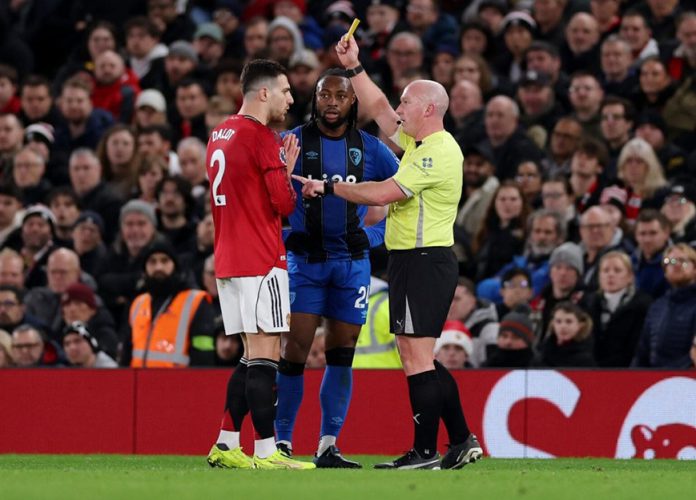
Semenyo escapes red card

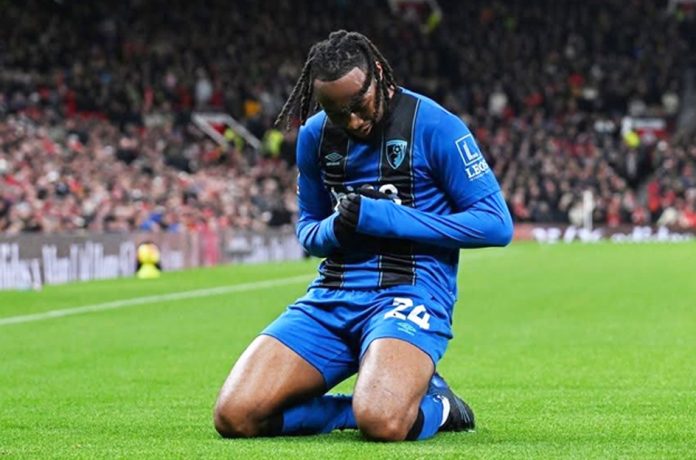
Former Premier League referee Mark Clattenburg has offered a detailed explanation in defence of the decision not to send off Antoine Semenyo during Bournemouth’s dramatic 4-4 draw with Manchester United, amid widespread debate over the incident at Old Trafford.

Semenyo was shown a yellow card after raising his hand towards United defender Diogo Dalot following a foul, a moment that sparked strong reactions from sections of the home support.

Comparisons were quickly drawn with previous incidents where similar actions resulted in red cards.

Clattenburg, however, believes the referee made the correct judgement based on the nature of the contact.

“Antoine Semenyo was issued a yellow card for raising his hand to Diogo Dalot after a foul had been awarded,” Clattenburg said.

“The yellow card was the correct decision as it was a brief touch and not a grasp to the throat, which could have had an element of malice.”

He explained that intent and force are key factors officials consider in such situations.

“If that was the case, it could have upgraded the yellow card to a red card,” he added.

Clattenburg’s assessment aligns with views expressed by other analysts, who noted that while Semenyo took a risk, the contact lacked the severity required for dismissal.

Credit: ghanasoccernet.com

Ghana suffer 1-0 loss against South Africa in international friendly

0
South Africa and Ghana player in a battle for the ball

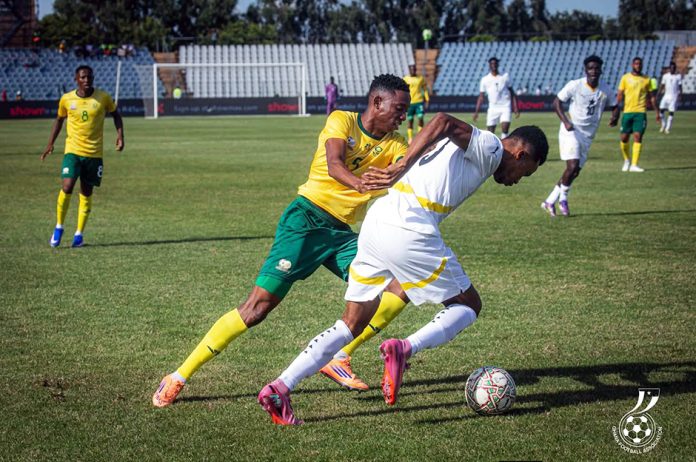
Ghana’s Black Galaxies put up a spirited second-half performance but were edged 1–0 by South Africa’s Bafana Bafana in an international friendly on Tuesday.

Kasim Mingle’s boys conceded in the second half after 57 minutes and were not able to find the back of the net to restore parity.

South Africa used the game as part of preparations for the 2025 Africa Cup of Nations which starts on Sunday.

The Galaxies struggled to gain a foothold in the first half as South Africa controlled possession and dictated the tempo on home soil.

Despite the pressure, Ghana remained compact at the back and went into the break level, with the opening 45 minutes ending goalless.

South Africa made changes at the start of the second half and soon found the breakthrough.

In the 57th minute, Sipho Mbule scored the only goal of the match with a well-struck effort to give Bafana Bafana a deserved lead.

Ghana responded positively after conceding and grew into the game as the second half progressed.

The Black Galaxies created several clear chances and came close to equalising on two occasions, hitting the goalpost twice.

The South African goalkeeper was also called into action, producing a fine save to push a goal-bound effort over the bar.

Despite the late pressure and improved attacking display, Ghana were unable to find the equaliser before the final whistle.

Credit: myjoyonline.com

Man United coach clears air over Antoine Semenyo’s special player comment

0
Antoine Semenyo, Bournemouth

Manchester United manager Rubin Amorim has cleared the air over Antoine Semenyo’s special player comment before the crucial Premier League clash against AFC Bournemouth on Monday night.

Amorim had labelled Semenyo as a special player prior to the high-stake clash at Old Trafford. The Black Stars attacker excelled as Bournemouth held the Red Devils to a 4-4 draw.

Quizzed if he would like to have the Ghanaian international in his squad after labeling him a special player, Amorim said, “No, I didn’t say that for that reason. I think there are many exceptional players in the league.

“What I feel, to sum up, is that they have a top-level coach, a top-level team, I really like that team and I think their best player is a special player.”

The former Bristol City star ended his eight-game goal drought in the Premier League after netting in the thrilling 4-4 stalemate against Manchester United. It was his third consecutive goal against the Red Devils.

Semenyo has been outstanding for Bournemouth in the ongoing Premier League campaign, scoring seven goals and delivering three assists.

As the winter window approaches, the Ghanaian international has emerged as a top transfer target for several European clubs including Liverpool, who view him as a possible replacement for Mohammed Salah.

Credit: ghanasoccernet

The Ghanaian Chronicle