Home Blog Page 360

Is It Safe to Reuse Plastic Water Bottles?

0
Plastic Water Bottles

How Are Plastic Bottles Made?

Plastics are made from oil or natural gas, which are made of molecules called hydrocarbons. When you heat hydrocarbons to very high temperatures, they break down into smaller molecules called monomers. There are many types of hydrocarbon monomers, such as methane, ethane, propane, and butane.

To make plastic, monomers are joined together to make a larger molecule called a polymer. The different types of plastic polymers are made of different combinations of monomers. These polymers are formed into pellets, powders, flakes, or liquids, which are the raw plastic material.

At the bottling factory, the raw plastic is put into a machine that heats it to a high temperature so that it becomes a liquid. The liquid is then injected into a bottle-shaped mold where it hardens.

Plastic Bottles and Bacteria Growth

Plastic bottles can harbor harmful bacteria, which is why most manufacturers recommend you use them only once. In truth, bacterial growth in water bottles is a much bigger concern than chemical leaching.‌ If you need to reuse a plastic water bottle, make sure to wash it properly first. Most plastic water bottles don’t make for easy cleaning, so it can be tricky. But if you must reuse one, it’s best not to skip this step.

Bacterial growth can happen quickly just from the ordinary use of drinking out of the bottle. Even unfinished beverages left at room temperature can have a lot of bacteria growth throughout the day. It’s best to reuse plastic water bottles sparingly and wash them thoroughly because germs spread so quickly.

Additionally, wear and tear on the bottle from reuse can create cracks and scratches in the surface where more bacteria can grow. With that in mind, you might even want to skip plastic bottles and buy a reusable glass or stainless-steel bottle instead.

How to Recycle Water Bottles

If you want to recycle your plastic bottles, first make sure they are clean. Then, put them in your designated blue recycling bin, which holds all your plastic materials, including water bottles. Place the bin curbside before the scheduled pick-up time in your area.

You can also drop off water bottles at specific locations. Check with your municipal office about designated drop-off locations in your area.

Plastic Bottles Recycling Ideas

If you have plastic bottles that you can’t recycle, you don’t have to just toss them in the trash. You can also reuse them.

Here are a few creative ideas for reusing plastic bottles:

  • Cut the top off plastic water bottles to make cups for pens, pencils, and craft supplies.
  • Use coffee creamer bottles to store snacks, sugar, and salt.
  • Cut the top off 2-liter bottles and paint them to make planters for houseplants or herbs.
  • Punch holes in the top of laundry detergent bottles to make a watering can.
  • Cut the handle and side off a milk jug to make a pet pooper scooper or garden trowel.
  • Make a piggy bank out of old plastic bottles.

Water Bottle Recycling Challenges

According to the EPA, only about 9% of all plastic waste is recycled. Consumer plastics — such as soda bottles, water bottles, and milk jugs — have a slightly better rate of recycling at 30%, but there’s still far more we can do.

Some of the challenges of recycling plastic include:

  • Non-recyclable materials that end up in recycling bins, which contaminates the batch and could mess up recycling machines. This may happen when people don’t know what can be recycled so they throw all their plastic in the recycle bin.
  • The price of “virgin” plastic may be lower than the price of recycled plastic, so manufacturers choose virgin plastic to save costs.
  • Some cities or towns don’t have the resources or government support to provide municipal recycling services.
  • Many workers don’t want to work in the recycling industry because it can expose you to chemicals and powerful machines.

To help improve the rate of recycling, buy products that are made of recycled materials, choose alternates to plastic whenever possible, make sure you know what can go in your recycling bin, and try to reuse plastic as much as possible to keep it from going into landfills.

Credit: Webmd

Feature: Protecting Learners, Preserving Trust: The Right Way to Conduct Searches in Schools

0
Wisdom Klu, the writer

Ensuring safety in schools is vital for effective teaching and learning. In our schools, the responsibility for maintaining discipline and safeguarding students falls to teachers and head teachers. However, the practice of searching students or their belongings to ensure safety raises important questions related to legality, ethics, and human dignity.  According to Garner (2019), a search in legal and educational parlance, refers to the intentional examination of individuals, their belongings, or property to discover prohibited or dangerous items.

Searches usually take place when there is suspicion that a student may have contraband, which might include weapons, drugs, stolen items, or prohibited goods such as mobile phones. Nevertheless, these searches must not infringe upon students’ constitutional rights or subject them to embarrassment.

While Ghana seems not to have specific court rulings that delineate the standards for school searches, existing constitutional provisions and credible scholarly research offer a robust framework for determining what constitutes a lawful and ethical search. The article explores the legal, procedural, and human rights aspects of searches in Ghanaian schools and proposes guidelines to conduct searches in schools.

Legal and Policy Framework

The 1992 Constitution of Ghana serves as the paramount authority governing disciplinary actions in schools. Article 15(1) states that “the dignity of all persons shall be inviolable,” while Article 28(1)(d) prohibits any “cruel, inhuman, or degrading treatment” of children. These clauses underscore that any search must honour the personal dignity and privacy of students. Although the Constitution does not provide explicit procedural guidelines for school searches, its focus on fairness and human rights offers essential guidance.

At the policy level, the Ghana Education Service (GES) Code of Conduct for Teachers and Educational Workers (2020) mandates that educators enforce discipline “fairly, reasonably, and professionally.” While the Code does not specify search procedures, its principles require that all student-related actions including inspections must be conducted with professionalism and reasonableness.

Additionally, Korankye-Sakyi, Faakye, and Atupare (2022) assert that the right to education in Ghana is legally enforceable, necessitating that school practices, including searches, align with principles of fairness and respect for rights. Abonyi and Salifu (2023) further illustrate the GES’s ongoing shift towards positive discipline aimed at reducing punitive practices. Collectively, these credible sources provide the constitutional and ethical foundation needed to conduct searches in a lawful and respectful manner.

When to Conduct a Search

Searches in our schools should never be arbitrary; they should only be conducted when there is reasonable suspicion that a student has infringed a school rule or possesses an item that endangers safety. Reasonable suspicion is substantiated by credible observations or reliable information indicating wrongdoing, rather than mere conjecture or bias. For instance, if a teacher sees a student hiding an object that resembles a prohibited item, it establishes reasonable grounds for a search.

In these situations, the aim of the search is preventive rather than punitive, focused on protecting the well-being of the student population instead of humiliating or criminalizing any individual. As noted by Abonyi and Salifu (2023), Ghanaian educational institutions are increasingly adopting disciplinary procedures that prioritize students’ rights. Consequently, searches should be viewed as part of the school’s broader duty of care rather than punitive measures.

Principles Guiding Searches

In the absence of specific case law in Ghana, four key principles derived from constitutional rights, and educational ethics should inform all searches in schools: reasonableness, proportionality, privacy, and documentation.

  • Reasonableness: A search should begin with credible justification. As teachers or administrators we must have reasonable suspicion based on factual observation or reliable information that a student has violated school regulations or possesses restricted items. There is the need to avoid arbitrary or biased searches as they contradict principles of fairness and human dignity.
  • Proportionality: The extent and invasiveness of a search should correspond to the severity of the suspected violation. For instance, while examining a bag or locker may be appropriate when contraband is suspected, a physical search would likely be excessive and potentially degrading. This principle is supported by the Constitution’s protection of human dignity (Article 15).
  • Privacy and Dignity: As school authorities it is important to conduct our searches discreetly, preferably in private, and in the presence of at least two adults one of whom should share the same gender as the student. This approach minimizes embarrassment, safeguards the student, and protects staff from accusations of misconduct. Both the Constitution and the GES Code emphasize respect and care for students.
  • Documentation and Accountability: Every search should be recorded in a logbook. The record must include the justification for the search, the individuals involved, discoveries made, witnesses, and whether parental notification occurred. Documentation promotes transparency, prevents abuse, and serves as evidence of procedural fairness. As pointed out by Abonyi and Salifu (2023), poor recordkeeping can undermine school accountability, making thorough documentation vital.

Procedure for Conducting a Search

A structured approach ensures that searches adhere to ethical and legal standards:

  • Observation and Reporting: A teacher or staff member observes suspicious behaviour or receives credible information and reports it to the head teacher.
  • Assessment: The head teacher assesses the reasonableness of the suspicion.
  • Notification: The student is informed courteously about the search’s rationale and encouraged to cooperate.
  • Conducting the Search: The search is performed discreetly, witnessed by two staff members, and constrained to the suspected item or area.
  • Documentation: The details-justification, participants, and outcomes are recorded immediately.
  • Parental Notification: Parents or guardians are notified as soon as possible regarding the rationale and results of the search.
  • Referral: If illegal items (such as weapons or drugs) are discovered, the matter is reported to the appropriate authorities in accordance with GES and the law.

This procedure would ensure transparency, protect students’ rights, and conform to Ghana’s constitutional and professional educational standards.

Legal Gaps and Need for Reform

Despite clear ethical and constitutional standards, Ghana presently lacks specific court decisions or statutory provisions governing school searches. As a result, the benchmarks for searches depend on the interpretation of constitutional rights, GES codes, and human rights frameworks.

Korankye-Sakyi et al. (2022) emphasize that the lack of legal clarity highlights the necessity for courts and policymakers to explicitly define the parameters of school-based searches. Moreover, there is a need for empirical research into search practices and their impact on student trust and school climate. Future policy and academic efforts should concentrate on establishing comprehensive search guidelines rooted in legal, ethical, and educational psychology principles.

Conclusion

Searches in Ghanaian educational institutions are crucial for ensuring safety and maintaining discipline; however, they must consistently respect students’ constitutional rights. The 1992 Constitution, the GES Code of Conduct, and scholarly research (Abonyi & Salifu, 2023; Korankye-Sakyi et al., 2022) together affirm that lawful searches must be based on reasonable suspicion, proportional in nature, conducted discreetly, and thoroughly documented.

While the absence of judicial precedent presents challenges, these frameworks provide adequate guidance for ethical conduct. By prioritizing fairness, dignity, and accountability in school searches, educators would  reinforce the rule of law and create safer, more humane learning environments. The path forward involves codifying these practices into explicit policies and conducting research to address existing legal gaps. Only then can the principles of school safety coexist harmoniously with students’ rights and human dignity.

 BY Wisdom Koudjo Klu,

wisdomklu@gmail.com

Today’s UEFA World Cup Qualifiers Fixtures & Previews

0
Nick Woltemade, Germany

Germany, Slovakia in a straight shootout for top spot

Germany and Slovakia are involved in a straight shootout for top spot in Group A, with the two teams set to lock horns today, for a crucial 2026 World Cup qualifier.

A win or a draw for Die Mannschaft would see them finish first and advance to next summer’s tournament, but their visitors would snatch top spot if they manage to record a huge victory in Leipzig.

Germany will enter today’s clash off the back of a 2-0 victory over Luxembourg, who are top of Group A on 12 points.

Julian Nagelsmann‘s side are far from comfortable, though, as they are only ahead of second-placed Slovakia on goal difference, with both teams winning four and losing one of their five games in the section.

Germany were beaten 2-0 by Slovakia in their section opener but have since posted four straight wins, twice beating Northern Ireland and Luxembourg, but this will be a tough test.

DFB-Team have won the World Cup on four previous occasions, but they have been knocked out in the group stage in their last two participations in the tournament.

Germany are confirmed in the top two and would qualify for next summer’s World Cup in first if they avoid defeat in this match, but a win for Slovakia would mean that Nagelsmann’s side must enter the playoffs.

Slovakia are also confirmed in the top two, and they will qualify as group winners with a victory over Germany, otherwise the national side will face the playoffs.

Credit: sportsmole.co.uk

Netherlands host Lithuania in their final Group G game

Barring the disaster of all disasters, the Netherlands will earn a direct ticket to the World Cup 2026 tournament when they host Lithuania in their final Group G game today.

Ronald Koeman‘s men are three points clear at the top of the section following Friday’s 1-1 draw with Poland, while their visitors are fighting for the consolation of a fourth-placed finish.

Dutch hopes of automatic qualification for the 2026 World Cup were delayed rather than destroyed on Friday evening, where victory over Poland would have seen Oranje confirm a first-placed finish with a game to spare.

Virgil van Dijk, Netherlands

However, Koeman’s men had to do it the hard way just to secure a share of the spoils in Warsaw, where Jakub Kaminski broke the deadlock with two minutes to go until half time, before Memphis Depay coincidentally levelled matters two minutes into the second half.

Poland’s resolve means that the Netherlands can mathematically still be bumped down to second place on the final day, but for that scenario to occur, a fanciful set of circumstances must unfold given that Koeman’s men are three points clear of the Eagles.

Not only would the Netherlands have to lose to Lithuania at home, Poland would have to make up a 13-strong goal difference in their match with Malta, so Netherlands supporters can surely rest easy ahead of today.

Excluding their penalty-shootout loss to Spain in the UEFA Nations League, Koeman’s men have gone over a year without suffering defeat in any competition.

Credit: sportsmole.co.uk

Malta need a miracle against Poland

Needing a miracle in Malta to qualify automatically for World Cup 2026Poland head to the National Stadium in Ta’ Qali for their final Group G fixture today.

The Eagles remain three points behind the Netherlands following Friday’s 1-1 draw, while their hosts have already been eliminated from contention.

Robert Lewandowski, Poland

Winning in Warsaw would have blown Group G wide open for Poland on Friday night, when the Eagles found themselves three points adrift of the Netherlands both before and after kickoff, having had to settle for a 1-1 draw against Ronald Koeman’s men.

Poland’s stalemate with Oranje has almost certainly just delayed the Netherlands’ advancement to North America, as not only are Jan Urban‘s men three points behind in second place, they also boast a significantly inferior goal difference of +6 compared to the leaders’ +19.

As a result, Poland will only overtake the Netherlands and finish first if they beat Malta, if Koeman’s side suffer a shock home loss to Lithuania, and if there is a 13-goal swing in their favour on Monday – a surely impossible set of circumstances.

However, as Urban’s men are also four points better off than Finland, they will advance to the playoffs at the very worst, and a five-game unbeaten run in all tournaments at least gives the visitors a solid foundation to build on in 2026.

While Poland’s World Cup journey will continue regardless of what happens on tonight, minnows Malta have already been condemned to their fate and are still yearning for a first-ever appearance at a major international tournament.

Credit: sportsmole.co.uk

Montenegro welcome Croatia in Group L

Montenegro will welcome Croatia to the Podgorica City Stadium today for their final Group L fixture in the UEFA World Cup 2026 qualifiers.

The hosts are hoping to end a difficult campaign on a positive note, while the already-qualified visitors look to round off their dominant run in style.

Montenegro’s World Cup qualifying campaign has been defined by inconsistency and defensive fragility, with the hosts currently sitting fourth in the standings.

Luka Modrić, Croatia

They have amassed nine points from three victories and four defeats, but their concerning goal difference of minus eight, with six scored and 14 conceded highlighting the defensive issues that have repeatedly cost them points.

Home form at Podgorica has offered some encouragement, with Montenegro winning two of their three qualifiers on home soil.

Montenegro enter this fixture after a morale-boosting 2-1 comeback win away to Gibraltar, a result that brought some relief after a largely disappointing qualifying campaign.

Croatia, meanwhile, have been the dominant force in the group, remaining unbeaten with six wins and one draw from seven matches.

With 19 points, they became the 30th nation to secure their ticket to the 2026 finals – their seventh World Cup appearance.

Croatia have been dominant throughout this qualifying cycle and possess far greater quality in every area of the pitch.

While Montenegro’s home advantage may help them stay competitive early on, Dalic’s side should ultimately have too much firepower and control, making a comfortable away victory the most likely outcome.

Credit: sportsmole.co.uk

FIXTURES

Group A

Germany 19:45 Slovakia

Northern Ireland 19:45 Luxembourg

Group G

Malta 19:45 Poland

Netherlands v19:45 Lithuania

Group L

Czech Republic 19:45 Gibraltar

Montenegro 19:45 Croatia


GPL RESULTS

0
Ball

Swedru All Blacks 0-0 Hearts of Oak

Bechem United 2-0 Samartex

Berekum Chelsea 2-1 Nations FC

Bibiani Gold Stars 1-0 Karela

Dreams 1-0 Hohoe United

Eleven Wonders 1-2 Medeama

Heart of Lions 2-0Young Apostles

Holy Stars 2-2Vision

Asante Kotoko 1-1 Aduana

All Blacks, Hearts share the spoil at swedru 

0
Swedru All Blacks vs Hearts of Oak

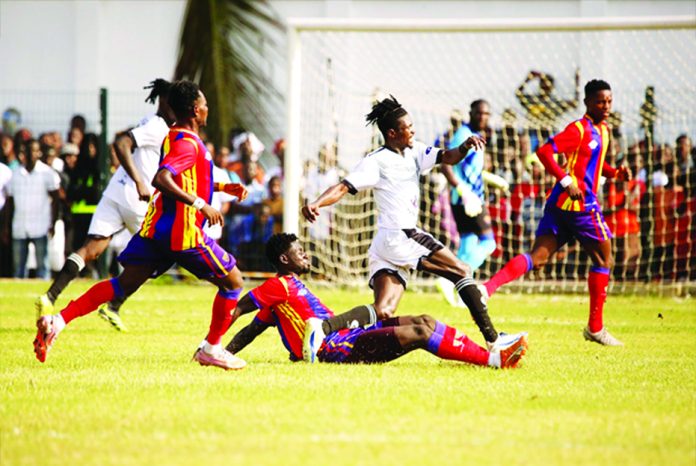
Swedru All Blacks saw their winless streak stretch to four games after being held to a frustrating 0-0 draw by Hearts of Oak in a pulsating Premier League matchday 10 match at the Swedru Sports Stadium on Saturday afternoon.

The Premier League returnees, determined to reverse their poor run of form, delivered one of their most spirited and commanding performances of the season.

Hearts of Oak, still recovering from the emotional setback of their Super Clash defeat to Asante Kotoko, struggled to find rhythm and were second-best for long spells.

However, their defensive discipline ensured they avoided back-to-back defeats.

All Blacks failed to convert their dominance into a winning goal and have now managed just one victory in their last eight fixtures.

Even so, the draw maintains their strong home record and offers a glimmer of encouragement in a difficult period.

Credit: ghanafa.org

Bibiani Gold Stars edge out Karela

0
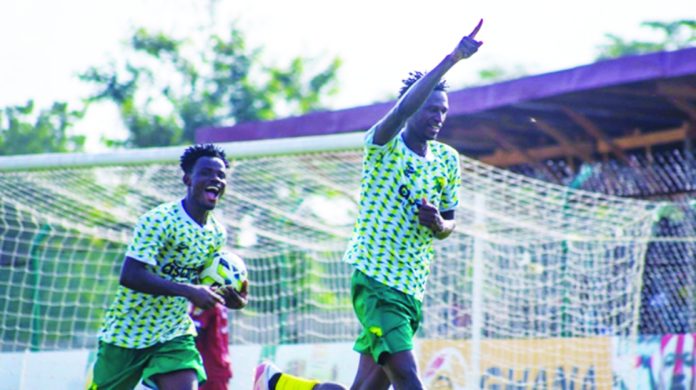
Razack Sanou celebrating the lone goal

Bibiani Gold Stars returned to winning ways with a hard-fought 1–0 victory over Karela United in their Ghana Premier League Round 10 clash at Dun’s Park on Sunday.

Razack Sanou decided the contest in the 38th minute, guiding home the only goal of the afternoon.

The strike is the Burkinabe forward’s first since joining the reigning league champions, offering a timely boost to their campaign after an uneven start to the season.

GoldStars controlled large portions of the first half and were rewarded when Sanou scored to put the hosts ahead.

Karela attempted to respond after the break, pushing for an equaliser, but ‘Gye Nyame’ lads kept their defensive shape intact and managed the game well in the closing stages.

The result moves them to 16 points in 7th after nine matches, keeping them within reach of the league’s top group.

Karela, meanwhile, remain on 11 points in 9th after a frustrating afternoon that saw them struggle to break through a disciplined home side.

GoldStars now shift focus to a difficult away fixture against Nations FC while Karela return to Tamale, where they will host Basake Holy Stars in their next league outing, aiming to bounce back immediately from this narrow defeat.

Credit: myjoyonline

Bechem United secure hard fought win over Samartex

0
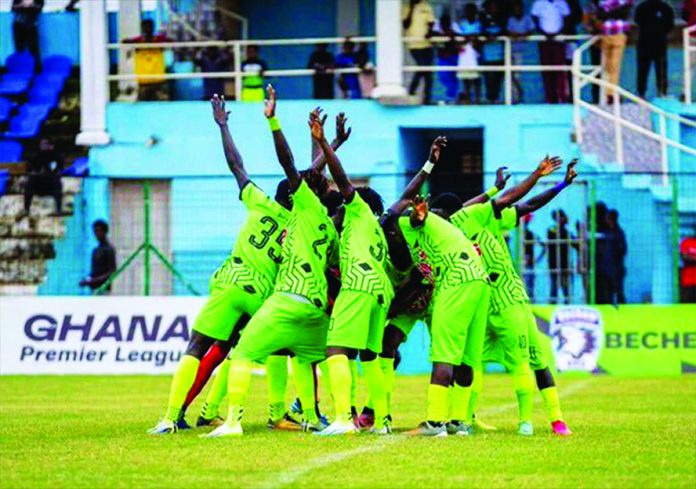
Bechem United players before kickoff

Bechem United secured hard-fought 2-0 win over FC Samartex 1996 to climb out of the relegation zone in their matchday 10 clash at the Nana Fosu Gyeabour Park. 

Brace hero, Emmanuel Abban, netted in either half to end his team’s three-match winless streak. It was also ‘the Hunters’ second victory of the campaign after a difficult start.

The hosts raced into an early lead after Abban scored just three minutes into the game and held on to their narrow lead at half time.

The enterprising winger netted his second on 83 minutes to seal a crucial victory for Bechem United, who move a point above the relegation zone.

‘The Hunters’ will look to build on this victory when they travel to Madeama for their next match.

For Samartex, this was their second defeat of the campaign and their hopes of securing their first away win were dashed by a resilient Bechem United side.

The Timber Giants drop to 7th position in the league standings on 16 points after failing to make it back-to-back wins.

Christopher Ennin and his charges will aim for a positive response when they host Asante Kotoko at the Nsenkyire Sports Arena for their Match Week 11 encounter.

Credit: ghanasoccernet.com

Government to Begin Construction of New Sports Stadia in 2026 –Ato Forson

0
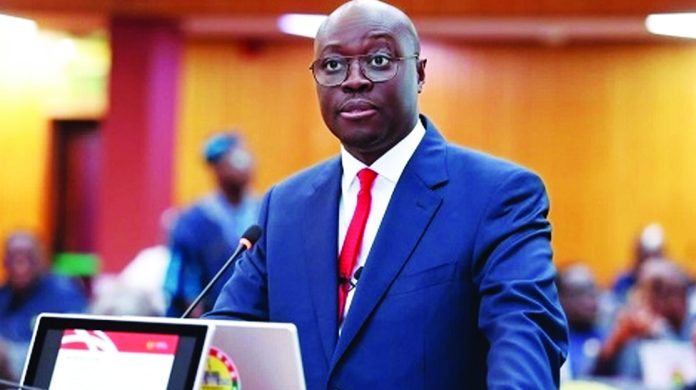
Dr Cassiel Ato Forson, Minister for Finance

The Minister for Finance, Dr Cassiel Ato Forson, has announced a major new sports infrastructure initiative, revealing that government will begin the construction of modern sports stadiums in selected regions starting in 2026.
The announcement was made last Thursday during the presentation of the 2026 Budget Statement on the floor of Parliament.

In his address, the finance minister emphasised the critical role sports continues to play in shaping the nation’s identity and strengthening unity among citizens. He described sports as a powerful force that brings Ghanaians together, while nurturing the potential of the youth for national development.

“Mr. Speaker, sports remain one of Ghana’s greatest unifying forces and a powerful driver of youth development, community pride and national identity,” he stated.
Dr Ato Forson lamented the long-standing lack of adequate sporting facilities across several regions, despite the country’s strong sporting culture.

He pointed out that newly created regions still do not have standard sports stadiums to support talent development. He stressed that this gap must be addressed if Ghana is to fully harness its vast reservoir of athletic potential.

To that end, the Minister disclosed that the government is committed to changing the narrative. “Mr. Speaker, beginning 2026, Government will commence the construction of modern sports stadia in 3 out of the 8 regions without sport stadium,” he announced.
According to him, this forms part of a broader plan by the Mahama administration to expand sports infrastructure nationwide.

The Minister further explained that the new stadiums will serve multiple purposes. Beyond hosting sporting events, they will provide safe and well-equipped spaces for young athletes to train and refine their skills.

He noted that such facilities will also help attract sports tourism, boost local economies, and serve as training hubs for both regional and national teams. These developments, he added, will strengthen Ghana’s competitiveness in various sporting disciplines.

The finance minister made it clear that government’s vision for sports development extends beyond football. While acknowledging football’s massive popularity in Ghana, he stressed the need to support other sporting disciplines such as athletics, volleyball, boxing and moresports that have contributed significantly to Ghana’s reputation over decades.
According to him, the new infrastructure will be designed to accommodate multiple disciplines, ensuring that no talent is left behind.

The Minister concluded by commending the Black Stars for their qualification to the upcoming FIFA World Cup, which will, for the first time be jointly hosted by the United States, Canada and Mexico.

He praised the team’s resilience and commitment, stating that their achievements continue to inspire hope, pride and unity across the country.
Dr Ato Forson reaffirmed government’s commitment to investing in sports as a pathway to youth empowerment, national unity and sustainable development, signaling a new era for Ghana’s sports landscape.

By Jesse Otoo

Police Arrest Murder Suspect at Kibi

0

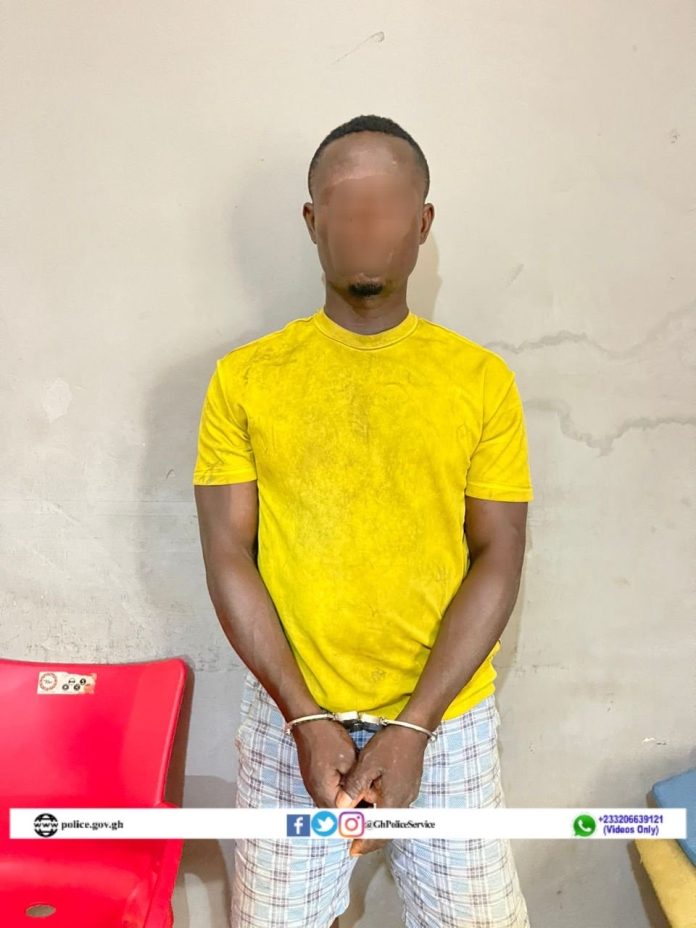
The Eastern South Regional Police Command has arrested Kwame Arhin, also known as Abompe, a 37-year-old carpenter, in connection with the murder of a man at Kibi Newtown. The arrest was made on Sunday, November 16, 2025, at a bush near Kibi Presbyterian College of Education, according to a statement issued by the police.

The statement said police received a distress call on Saturday, November 15, reporting the killing near the Kibi Court Complex. Teams of detectives, including the Crime Scene Management unit, were deployed to investigate.

At the scene, officers recovered the body of Jonas Baah Sarpong, a security guard at Kibi Presbyterian College of Education. Preliminary investigations suggest that a misunderstanding between Sarpong and Arhin led the suspect to slash the victim’s throat with a cutlass before fleeing.

The body was initially deposited at Kibi Government Hospital morgue and later transferred to the Police Hospital in Accra for preservation and autopsy.

The police statement said the suspect is currently in custody and will be processed for court as investigations continue.

Recruitment into police and others: no centre will screen more that 1,000 a day- Muntaka

0
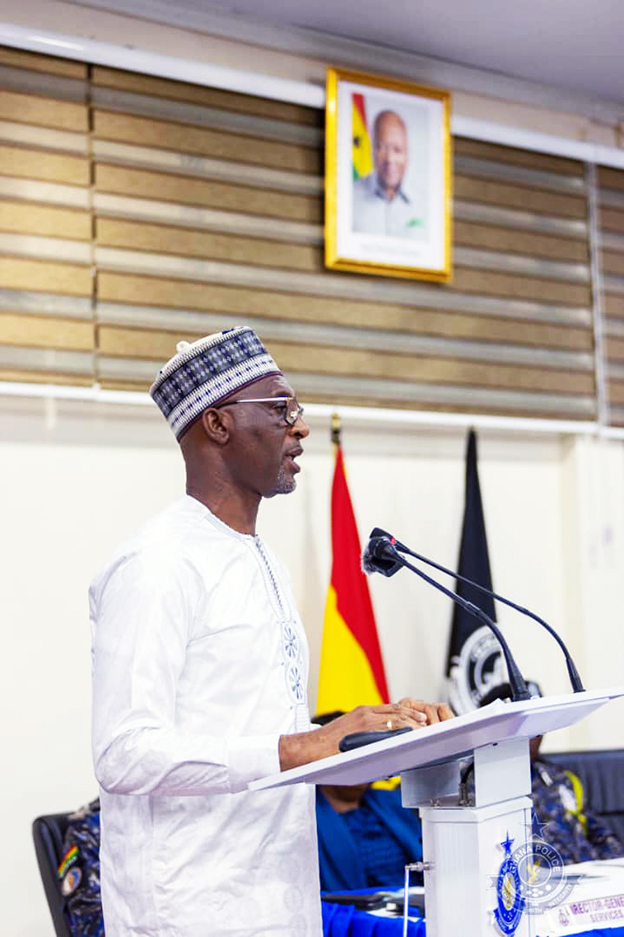
Alhaji Muntaka Mubarack addressing the regional commanders

Minister of Interior Muntaka Mohammed-Mubarak has unveiled contingency measures that place a firm numerical cap on screening activities and introduce logistical safeguards.

In blunt terms, the Minister declared: “We don’t want any centre to try to screen more than 1,000 a day.”

He continued: “We would rather prefer to use 10 days in doing a screening than to say that you want to finish it in two days, and therefore try to create a problem.”
The new regime being instituted includes:
• Each recruitment centre will be limited to 500–1,000 candidates per day, regardless of size or capacity, to avoid overcrowding and the associated risks of stampede, disease transmission and chaos.
• Multiple entry gates, clearly designated screening tables and time-slots will be used to manage flow. Even large complexes with 40 gates must adhere to the cap.
• Applicants will be more comfortable: waiting areas with chairs, canopy cover, water distribution (with the partnership of the Ghana Prison Service) and shade will be provided so that candidates are not simply herded and left standing outdoors.
• Screening days for different services will be deliberately staggered. For example, in one region the police may screen 3,000, prisons 500, immigration 300, others 200 thus avoiding a mega-centre handling all services in a crush.

He rejected the idea that Ghana could simply open its recruitment portals permanently to eliminate back-log.

“There’s no way they do it that way, where you do it all year round,” he said, arguing that training capacity, established posts and resources set hard limits.

Also addressing portal operations, the Minister admitted that although the total number of recruits to be absorbed is unknown at the outset, the application window remains open beyond the training target to allow for attrition and filtering through medicals, physical fitness and body-selection. “I may give 30,000, the scrutiny may show only 8,000 qualify,” he explained.

The heavy focus on screening numbers and flow-control reflects a recognition that the El-Wak tragedy was at least partly tied to uncontrolled crowds, weak logistics and inadequate facilities. While this overhaul is welcome, critics may ask how effectively the reforms will be implemented across all 16 regions and whether the timelines and resources match the ambition.

The Ghanaian Chronicle