A Kumasi-based private legal practitioner, Kwasi Afrifa Esquire, has filed a writ to invoke the original jurisdiction of the Apex Court against the General Legal Council (GLC). He is seeking a declaration for a true and proper interpretation of Article 19, Clause 14 of the 1992 Constitution Rule 11(3) of the Legal Profession (Disciplinary Committee) Rules, 2020 (L.I. 2424), which empowers the Chairman of the Disciplinary Committee to determine the maximum number of witnesses a party may call during an enquiry into a complaint of professional misconduct against a lawyer is inconsistent with and in contravention of his fundamental human right to a fair trial guaranteed, and protected by the provisions of Article 19 of the 1992 Constitution.
The writ filed on May 4, 2022 on behalf of his good self as a Ghanaian citizen as provided for in Articles 2 (1) and 19 of the Constitution, also seeks a declaration upon a true and proper interpretation of Article 19, Clause 14 of the 1992 Constitution Rule 15 (1) of the Legal Profession (Disciplinary Committee) Rules, 2020 (L. I. 2424) which requires that an enquiry into a complaint of professional misconduct against a lawyer to be held in camera is inconsistent with and in contravention of plaintiff’s fundamental human rights especially when the matter raised in the complaint are of fundamental public interest and importance.
Lawyer Afrifa also stated that of Article 19, Clause 14 of the 1992 Constitution, Rule 15 (2) which gives discretion to a panel of the Disciplinary Committee of the General Legal Council to decide to hold a enquiry in public is inconsistent with and in contravention of the law which prescribes public morality, public safety or public order as the only grounds for holding the proceedings of any adjudicating authority otherwise than in public which is not applicable in the plaintiff’s trial before the GLC.
He also sought a declaration that of Article 19, of the 1992 Constitution Rule 18of the Legal Profession (Disciplinary Committee) Rules, 2020 (L. I. 2424) which provides that a legal action in court in relation to a complaint before the Disciplinary Committee panel of the GLC shall not prelude the Disciplinary panel from conducting the enquiry which is the subject matter of the legal action in court is inconsistent with the 1992 Constitution of Ghana.
The plaintiff is further seeking a declaration of the Supreme Court that the proceedings and decisions in respect of the complaint lodged by one Ogyeedom Obrenu Kwesi Atta VI against him before the GLC are null, void and of no effect and ought to be set aside. Consequently, the plaintiff has called for an order of injunction restraining the GLC and its Disciplinary Committee panel, officials, representatives and all those claiming to be acting on their behest from continuing to hear the said complaint against him pending the final determination of the suit at the Supreme Court.
The plaintiff, has been charged with nine counts of professional misconduct by the Disciplinary Committee of the General Legal Council which had had established a prima facie case against the Kumasi-based legal luminary.
The charges came at the heels of the infamous US$5 million bribery allegation against the Chief Justice, His Lordship Kwasi Anin Yeboah by the plaintiff last year in response to a petition filed at the General Legal Council (GLC) by Ogyeedom Obranu Kwesi Atta IV, his former client.
The Committee, after reading the respective written documents of the parties (Ogyeedom and Afrifa) and upon listening to them orally, charged the lawyer with nine counts of professional misconduct which does not include the complaint made by the chief. Meanwhile, in spite drawing its attention the pendency of the writ at the Supreme Court, the GLC proceeded to hear the complaint on May 10, 2022.
The Ministry of National Security has, according to a story we have carried on our front page today, written to the various religious organisations in the country to enhance security at their places of worship. The advice follows recent terrorist attacks in Burkina Faso and Togo, which resulted in the deaths of some soldiers.
“It would be recalled that in 2013, al-Shabab militants attacked the Westgate Mall in Nairobi, leading to the death of about 60 people, including the late Prof Kofi Awoonor, a revered Ghanaian poet and author.
“While the Ministry of National Security is collaborating with the relevant state security and intelligence agencies to institute measures to avert terrorist attacks in the country, your outfit is urged to enhance security, especially in areas where mass gatherings are conducted. These measures may include, but not limited to, the installation of Close Circuit Television (CCTV) cameras at designated places of worship, and engage the services of approved private security guards among others,” the Ministry indicated in the letter to the religious groups.
The Chronicle commends the Ministry for the step it has taken, because security, in our opinion, is a shared responsibility. It is not only the security agencies which must protect the nation – individuals and groups also have roles to play. But, as Col. Festus Aboagye, a retired military officer, has advised, the Ministry of National Security should not end with the letters it has sent to the religious bodies.
It should constantly be educating the churches and mosques on how to identify a potential terrorist and measures to take to get the person arrested. The advice for these churches and mosques to install Close Circuit Television cameras in the places of worship is a good idea, but if these worshippers do not care about who is sitting next to them, the terrorists will come and accomplish their aims and then run away from the country.
It is alleged that the man who wanted to assassinate then President Mahama in church was spotted and arrested because of his demeanour whilst the service was going on. The big question is: how many Christians or Moslems have the expertise to detect some of these criminals? This is the reason why The Chronicle thinks constant education of the masses is the answer to this potential threat around us.
Definitely, Mr. Kan Dapaah and his lieutenants are not sitting idle – they have put all the needed security measures in place, but a criminal will always be a step ahead, and that is why we again agree with Col. Festus Aboagye that all trucks, especially those carrying charcoal should be thoroughly checked to see if they are not carrying guns.
The Chronicle is aware that the police in particular have, on a number of occasions, arrested criminals who tried to hide guns in the engine of their cars and other secret places. We, therefore,
have confidence in the various security agencies that they would not disappoint the state when comes to intelligence that would lead to arrest of the terrorists before they even make the attempt to attack us.
Naa Lamle Orleans-Lindsay, Head of the Legal Division of GIPC
The Ghana Investment Promotion Centre (GIPC) has given a lead to a possible review of some of the laws underpinning its establishment and operations for effective facilitation of businesses into the country.
Currently, the GIPC is hoping that the law regulating technology transfer into Ghana, thus Legislative Instrument (L.I.) 1547 is reviewed. The GIPC has forwarded the draft document for review to Cabinet and Parliament for consideration and approval.
The Head of the Legal Division of GIPC, Naa Lamle Orleans-Lindsay, disclosed this during a presentation at the 2nd Media Orientation Workshop, 2022 edition, held in Accra last week Thursday.
She said the move to seek a review of the law on technology transfer was because the L.I. 1547 had become obsolete, as it had been in existence since 1992. According to her, the dynamics of doing business had rapidly changed since the law was introduced in 1992, hence, the review would enable the L.I. to reflect current and best practices.
“The GIPC itself is looking at a review of its law and this law contains provisions of TTA (Technology Transfer Agreement), the Act itself, and the regulations seeking to improve it and make it compliant with best practices, so that it is useful to local companies and foreign companies seek to provide services to local companies.
“We have had extensive stakeholder engagements with the private and public sector over the past couple of years. We have put together a draft document and we are seeking to have this document obtain Cabinet approval [and] that is where we are at the moment,’ she said.
Mrs. Orleans-Lindsay explained that the GIPC is mandated to register, keep records and monitor all technology transfer agreements in the country and these responsibilities are governed by the GIPC Act 2013, Act 865, and the Technology Transfer Regulations 1992, L.1.1547.
Nonetheless, she added that technology transfer must meet certain standards, thus services to be provided must not be easily and freely available in Ghana, local staff must be trained in the services offered by the TTA as per a Training Schedule, and Ghana law must govern the interpretation of the TTA, taxes on royalties must be borne by the Transferor. “Failure to register a technology transfer agreement with the GIPC is a breach of GIPC Act 2013, Act 865 and L. I 154 liable to a summary conviction,” she urged.
Mrs. Orleans-Lindsay further stated that the Centre is working closely with the Bank of Ghana and the Ghana Revenue Authority to ensure compliance with technology transfer legislation as well as close collaboration with other stakeholders to ensure compliance by companies with Act 865 and L.I. 1547
The Deputy Chief Executive Officer of GIPC, Yaw Amoateng Afriyie GIPC added that the Centre is poised to attract the needed investments into critical sectors such as healthcare, agriculture, tourism, housing, transport, extractives, infrastructure, aquaculture, technology, and services of the economy. So far, 6, 000 businesses are captured in the GIPC database, but about half the number in the last two years had renewed their licenses with the Centre.
The purpose of this year’s media engagement was to educate the media on the registration and compliance requirements of GIPC, including monitoring, renewals, exemptions, quotations, TTAs, Bilateral Investment Treaties, and Aftercare Service division.
The Power Planning Technical Committee (PPTC), the body responsible for the drafting of the 2022 Electricity Supply Plan, has stated that contrary to the claims by the National Democratic Congress (NDC) Member of Parliament (MP) and Ranking Member of the Mines and Energy Committee, John Jinapor, that ‘dumsor’ was imminent, there was no such risk.
The PPTC, set up by the Energy Minister to, among others, develop planning reports for Ghana’s power system, made this point in a statement issued on Friday 13th May 2022, and signed by its Chairman, Ing. Frank Otchere, in reaction to an earlier claim by Mr. Jinapor on May 9, 2022 on a number of issues pertaining to the power sector.
Reacting specifically to Mr. John Jinapor’s claim that “the existing generation capacities will not be adequate to serve the projected demand with 18% reserve margins for any of the planning years,” on which basis he predicted the imminent return of ‘dumsor’, the committee explained that according to the 2022 Electricity Plan (ESP), the country had a total installed generation capacity of 5,265.1 mega watts (mw), with dependable capacity standing at 4,706mw.
With a projected annual peak demand going up to 4,793mw in 2026, the Committee stated that it was obvious that both the installed capacity and dependable capacity were in excess of peak demand, and, therefore, there could not be imminent ‘dumsor’ as was portrayed.
Explaining further, the Committee stated that ‘dumsor’ only occured when the actual demand was higher than what the system was able to generate, and clarified that the additional demand recommended in its report was only required to provide as extra capacity to serve as reserve.
The Committee further clarified that in recommending further generation capacity between 2023 and 2027 (a total of 822 mw), this only referred to a sensitivity analysis on capacity requirement in the event that the Bui Hydro Plant was able to run only on two units, instead of three during the peak period. “This situation is rare, and was analysed only as a sensitivity scenario in the unlikely event of such a situation,” the statement said.
Gas Supply
On the claim by Mr. Jinapor that the report negates the argument of Ghana having excess gas leading to capacity payments, the statement rebuts that with a claim that the recommendation of the ESP 2022 for arrangements to increase gas supply did not imply procuring new gas facilities. Rather the statement said it was only alerting that demand is growing and therefore there was the need to make arrangements to increase volumes of gas supplied from the existing gas facilities.
In conclusion, the statement reiterates that there is no imminent dumsor as has been alleged and further, that there is capacity available to increase gas supply for extra generation in Ghana, “Accordingly, the issues quoted cannot be cited to discredit the assertion of excess capacity on the Ghana power system.”
In their quest to eliminate Neglected Tropical Diseases (NTDs) by 2030, stakeholders last Friday, conveyed a meeting to validate the country’s sustainability plan to ending the NTDs.
Schistosomiasis, Onchocerciasis, Lymphatic Filariasis, Trachoma and soil-transmitted Helminthes are the five main diseases that constitute the NTDs.
According to reports from the Neglected Tropical Disease Program (NTDP), every region in Ghana have people living with at least one of the aforementioned diseases.
The NTDP identifies the lack of good drinking water, poverty and other developmental issues as the causes of the diseases and advocates that government’s developmental programs should not only be centered in the cities, but in rural communities, where these diseases are prevalent.
The group admitted that Ghana has made progress in reducing the prevalence rate, but said more can be done to eliminate them completely.
It established that some key Ministries, such as Education, Sanitation and Water Resources and Local Government can play key roles in the elimination process.
With regards to the Education Ministry, stakeholders noted that a return to de-worming of school children would go a long way to help reduce the disease to its barest minimum.
For the Sanitation and Local Government ministries, it was established that if these two ministries dedicate portions of their budgets to constructing WASH facilities such as toilet and good drinking water, it will go a long way to help reduce the rate of infection.
Therefore, the program, which was held at the Ministry of Health (MoH) in Accra was aimed at building consensus on the interventions and the implementation of the sustainability plan.
One key purpose was to examine how NTDs services can be integrated into the national health care delivery system.
It also considered how NTDs can be a priority area in government policies, planning and budgetary considerations. The stakeholders again perused how other ministries or sectors can play active roles in the elimination of the diseases.
Some institutions which contributed to the discussions included the MoH, Ghana Health Service (GHS), the World Health Organisation (WHO) and United State Agency for International Development (USAID).
At the end of the over two hours of deliberations, a communiqué, which was endorsed by the Ministers of Health, Education, Sanitation and Water Resources, as well as the Local Government and Rural Development, on the way forward in eliminating the diseases was presented by Dr Hafiz Adam Taher, Chairman, Inter-Country Coordination Committee, NTD.
He indicated that the stakeholders have agreed that the NTDP works closely with other health programs such as the National Health Insurance Scheme and Livelihood Empowerment Against Poverty program to explore how to mainstream NTDs into their services.
He also stated that there will be a crunch meeting among the signatories of the communiqué, in addition to the Agricultural Ministry for a deeper consultation on how their respective ministries can factor in NTDs in their budgets and programs.
Lastly, Dr Taher said the stakeholders made a commitment to continue to call on drug donation partners to support the implementation of the sustainability plan.
On her part, Ambassador for NTD and Chairman for the occasion Dr Joyce Aryee called on all the stakeholders to ensure that the plan is followed in order to eliminate the diseases completely. She proposed a yearly valuation of the plans to ensure effective implementation.
To the donor partners, Dr Aryee said that partnership is what moves the world so she advocates for deeper relationships with commitments that will see to the elimination of the diseases.
The Deputy Minister of Health, Mr Mahama Asei Seini, expressed his delight at the fact that other relevant ministries have been factored in the implementation process.
He called on the stakeholders to also learn best practice in other countries and replicate same in Ghana to ensure that the goal of eliminating NTDs by 2030 is achieved.
Madam Zohra Bolsara, the USAID Health Office Director in Ghana congratulated the NTD stakeholders for putting together the sustainability plan.
She described the plan as a significant milestone since it will provide sustainable, equitable and quality health services to all Ghanaians when carried out well.
She said USAID shares in the country’s vision of getting rid of NTDs so the U.S Government will continue to support the country, as it has been doing since 2007.
The National Council of the NPP, which is the second highest decision making body of the Party, at its meeting held on 12th May, 2022, approved Rules and Regulations to guide the conduct of the Party’s Regional Annual Delegates Conference, which shall, among other things, elect Regional Executive Officers of the Party between May 27 and May 29, 2022.
The Council also reviewed the conduct of the just ended Constituency Annual Delegates Conference of the Party which was held between April 28 and May 2, 2022, across the country. The records are to the effect that only 10 Constituency Elections are outstanding out of the 275 Constituencies. The Alternative Dispute Resolution Committee, working in close collaboration with the National Party, is working hard to resolve the issues in these outstanding Constituencies.
EXTENSION OF THE MANDATE OF CONSTITUENCY EXECUTIVES IN ASSIN NORTH, JOMORO AND SAVELUGU
Following the review of the Constituency Executives Elections, the National Council, having regard to the peculiar nature of Assin North, Jomoro and Savelugu Constituencies, where the Party is challenging the 2020 Parliamentary Elections Results in court, affirmed the Party’s decision to temporary suspend the conduct of Constituency Executives Elections in these three Constituencies until further notice.
Dan Botwe and Simon Osei Mensah
The National Council thereupon decided, pursuant to Article 10(3)(1) of the Party Constitution, and considering the exigencies of the situation at hand, to extend the mandate of the current Constituency Executives in these three Constituencies (i.e. Assin North, Jomoro and Savelugu) to enable the Constituency Executives participate in the impending Regional and Annual Delegates Conference of the Party, until otherwise communicated by the Party having regard to developments in court with respect to the election petitions.
ELECTION OF ASSISTANT REGIONAL SECRETARIES
The National Council also ratified the proposal from the National Executive Committee to correct the wording of Article 9(2), by deleting “Deputy Regional Secretary”, which was inadvertently included to the list of appointive positions at the Regional Executive Committee level during the last constitutional amendment on 17th December, 2017.
Equally, the exact description of the position has been corrected to read “Assistant Regional Secretary”, instead of “Deputy Regional Secretary”. The correction of this clerical error is to reflect the actual position of the Constitution of the Party, to the effect that the said position has always been an elective position.
RULES AND REGULATIONS FOR THE CONDUCT OF REGIONAL EXECUTIVES ELECTIONS
With reference to Article 9(27)(e) of the NPP Constitution which provides that, the Party’s Regional Annual Delegates Conference shall meet to elect Regional Officers, as well as Article 18 on Guidelines for the operations of the Party at all levels, the Party’s National Council, has, at its meeting on May 12, 2022, fashioned out the following Rules and Regulations for the conduct of the Party’s Regional Annual Delegates Conference, to elect Regional Executives.
1) The Regional Elections shall be conducted at a Regional Annual Delegates Conference to be held from Friday 27th May, 2022 to Sunday 29th May, 2022, across the country.
2) Pursuant to Section17(2) of the Political Parties Law, Act 574, which provides that the election of National, Regional and Constituency Officers of every political party shall be conducted under the supervision of the Electoral Commission, the constituency elections shall be supervised by the Electoral Commission of Ghana.
3) All the processes leading to the elections and other related activities shall be organized and superintended over by a Regional Elections Committee, to be constituted as follows:
Two (2) National Representatives, appointed by the National Steering Committee (one of whom shall be the Chair and the other as the Secretary);
Chairman of the Regional Council of Elders;
iii. Chairman of the Regional Council of Patrons;
One (1) Representative appointed by the Regional Executive Committee (preferably a Minister of Deputy, Government Appointee, MMDCE, a former MP or a former MMDCE – provided that he or she is not a Candidate in the elections);
Chairperson of the Regional Parliamentary Caucus or his Representative;
The Dean of the MMDCEs in the Region or his Representative;
vii. Regional Research and Elections officer
viii. Regional I.T. Coordinator
An Elderly Woman appointed by the Regional Executive Committee
4) Pursuant to Rule 4(i) above, the Party has appointed the following persons as National Steering Committee Representatives on the Regional Elections Committee in the following regions:
ü Ashanti Region: Hon. Simon Osei Mensah (Chairman) & Hon. Henry KwabenaKokofi (Secretary)
ü Eastern Region: Mr. AmpemDarko (Chairman) & Hon. O.B. Amoah (Secretary)
ü Central Region: Hon. OforiAsiamah (Chairman) & Hon. Sara Naana Arthur (Secretary)
ü Upper East Region: Joseph NyanibaKwayaja (Chairman) &HajiaAyishetuYussif (Secretary)
ü Upper West Region: Seth BawumiaBoyoyo (Chairman) &MujeebKele (Secretary)
ü Northern Region: Hon. Amin Anta (Chairman) & Elvis Botah (Secretary)
üOti Region: Daniel Denteh (Chairman) & AttahAnane (Secretary)
ü Volta Region: KudjohAttah (Chairman) & Richard Ahiabga (Secretary)
ü Western Region: Mr. A. E. Amoah (Chairman) & Hon. KojoAcquah (Secretary)
ü Western North Region: Dr.Owusu Mensah (Chairman) & Kingsley Agyei Manu (Secretary)
ü North East Region: Emmanuel Attafuah-Danso (Chairman) & (Secretary)
ü Savana Region :Micheal Omari Wadie (Chairman) &PerpertualLomokie (Secretary)
ü Bono Region: KwabenaOppong (Chairman) &Sah Joachim (Secretary)
üAhafo Region: Samuel Adjei (Chairman) & William Frimpong (Secretary)
ü Bono East Region: Nana ObiriBoahen (Chairman) &Hon AduGyan (Secretary)
5) The Regional Elections Committee shall determine the Venue for the conduct of the elections.
6) Per Article 9 (25), delegates to the Regional Annual Delegates Conference shall include:
All Members of the regional Executive Committee
All Members of Parliament in the Region
Members of the Constituency Executive Committees
All Regional Representative of National Council
Ten (10) Members of the Council of Elders in the Region
One (1) TESCON member from each recognized tertiary institution in the Region
Ten (10) Patrons in the Region; and,
Any Founding Member(s) from the Region who is a signatory to the registration documents of the Party at the Electoral Commission.
7) The presence of at least one-third (1/3) of the delegates of the Constituency shall be necessary to constitute a quorum of the Conference.
8) The Regional Executives Elections shall be conducted in accordance with the following schedules:
Opening and Closing of Nominations – 15th – 17th May, 2022
Vetting of Aspirants – 18th – 20th May, 2022
iii. Hearing of Appeals – 22nd – 23rd May, 2022
(by National Appeals Committee)
Printing of Electoral Materials – 25th – 27th May, 2022
Elections – 27th – 29th May, 2022
Disqualified or aggrieved Aspirants may petition the National Appeals Committee for redress from 22nd to 23rd May, 2022, whose decision shall be communicated on May 25, 2022.
The National Appeals Committee is constituted as follows:
Hon. Dan Botwe – Chairman
Hon. Rev. S. K. Boafo – Member
Dr. Clifford Braimah – Member
Ms. Joyce OpokuBoateng – Member
Mr. KwadwoAfari – Member
IddiMuhayu-Deen – Member & Secretary
Nomination Forms can be acquired from the Regional Elections Committee or downloaded from the Party’s website, (newpatrioticparty.org) and all social media accounts of the Party, for FREE. However, upon submission of completed Nomination Forms to the Elections Committee, an Applicant shall be required to pay to the Committee, a Filing Fee of Five Thousand Ghana Cedis (GHc 5,000) for the Chairperson position; and Two Thousand Ghana Cedis (GHc 2,000) for all other positions.
A prospective Aspirant shall be a Registered Voter and a Member of the Party in the Region he/she seeks to contest.
A prospective Aspirant shall be an active and known Member of the Party in good standing for at least two years in the Region he/she seeks to contest.
No member of the Regional Elections Committee shall be eligible to contest in the Regional Executives Elections.
Electoral Area Coordinators, Polling Station Executives, Constituency Executives, MMDCEs, Ministers of State, and Deputy Ministers of State, who are desirous of contesting in the Regional Elections shall first resign their positions.
For identification purposes, delegates/voters shall use their Party Membership Identity (ID) Card, but where same is unavailable, National Voters ID will be admitted for the purpose of voting.
The Regional Album shall be used as the register for the conduct of the elections
Positions to be contested for include:
The Regional Chairperson
The 1st Regional Vice Chairperson
The 2nd Regional Vice Chairperson
The Regional Secretary
The Assistant Regional Secretary
The Regional Treasurer
The Regional Organizer
The Regional Women Organizer
The Regional Youth Organizer, and,
Regional Nasara Coordinator.
Any Member of the Party or Aspirant who feels aggrieved at any point in the process SHALL exhaust ALL available internal resolution mechanisms in accordance with Article 4 of the Party Constitution and the decision of the National Appeals Committee on the matter shall be final and binding.
The Party is counting on the usual cooperation of all members in the conduct of these internal elections in the interest of the Party.
Dr. Owusu Afriyie-Akoto, Alhaji Mahamudu Bawumia and Alan Kyerematen
If you are an ardent political observer, the results of the just ended polling station and constituency elections of the ruling New Patriotic Party (NPP) should be of immense interest to you. The party incumbent is focused on breaking the eight-year cycle, a feat which is uncharacteristic of national elections in Ghana.
Leading to this vision, there has been a silent contest for the kingship of the NPP – The race to become Presidential Candidate by key names in President Akufo Addo’s government.
Personalities such as the Vice-President, Alhaji Mahamudu Bawumia, Trade Minister, John Alan
Kyerematen, Agric Minister, Hon. Dr. Owusu Afriyie Akoto, former Energy Minister, Boakye
Agyarko and recently, MP for Assin North, Hon. Kennedy Agyapong have been tipped as frontrunners.
These are the top 5 names for the flagbearership of the New Patriotic Party for the 2024 elections.
However, to make this dream a reality, they have to go through a rigorous process of securing the nomination of the flagbearership from delegates of the party (members at the grassroot level) made up of executives from the polling stations, at electoral areas and the constituency level.
With this background, it’s easy to picture the contest between the Vice President and Trade
Minister since the former has been the number 2 man in Ghana since 2016 and the latter has been a three-time contender for the job since 2008. Both men have also effectively delivered on their individual mandates with clear results.
The Vice President is credited with digitising all government services across all sectors with the most recent being the successful introduction of the Ghana card. Hon. Alan Kyerematen also boasts of the successful implementation of government’s 1D1F across Ghana, establishment of VW and Toyota Vehicle Assembly plants in Ghana among others.
Interestingly, at the base of the party, the polling station executives seem to have a different person in mind for the job despite the winning streaks of the seemingly top 2 contenders. Recent electoral results coming out of the ground are painting a different picture.
There have been huge surprises. Candidates supported by the two main contenders have not made the needed impact as expected. In the Northern Region, the home sector of Dr. Bawumia,the results have been nothing short of a surprise. Candidates he supported for positions within the constituencies failed to garner enough votes to win their respective portfolios.
Below is a summary of the results, verified by a team of independent researchers following the
NPP’s internal constituency elections.
These are the results are pending the outcome of Yendi, Savelugu and Nanton constituency elections.
From the above, the surprise has been Dr. Owusu Afriyie Akoto. In what has been described as the “Akoto Factor”, the Agric Minister has emerged as the “people’s choice” in the Northern
Region. The “Akoto Factor” has been responsible for the electoral defeats of all the other candidates.
Out of 150 contested positions, Akoto-sponsored candidates won 64 representing 42% of total valid votes cast. This was followed by Dr. Mahamudu Bawumia whose team clinched 39 positions representing 26% of the valid votes cast.
Team Alan Kyerematen held 30 positions representing 20% of valid votes followed by team
Boakye Agyarko with the least representation of 17 positions representing 12% of valid votes cast.
Our research team has also verified that the “Akoto Factor” has taken all the remaining regions by storm and Dr Owusu Afriyie Akoto is leading at the grassroots level as the preferred candidate to lead the NPP as its Presidential Candidate.
The Article is by a Political Researcher based in Ghana.
Naa Prof Edmund Nminyem Delle, Paramount Chief of Nandom
Some Sub-Divisional and Divisional Chiefs of Nandom
The Paramount Chief of Nandom, Naa Prof Edmund Nminyem Delle, has urged chiefs and queenmothers in the area to remain united and support him to change Nandom to become the positive focus of the country.
“It is only when we are a united front that people would be prepared to help us. This is the beginning of great things to come, but they will never come if we don’t come together as one, so that people will not hear of Nandom in the negative way again,” he charged.
Naa Prof Delle encouraged the chiefs and queenmothers to stand up for the development of the Municipality, as he was prepared to sacrifice for the survival of a peaceful Nandom.
The Founder and Chief Executive Officer of Rabito Clinic Limited, Naa Prof Edmund Nminyem Delle, made this know at the maiden Traditional Council General Meeting of the Nandom Traditional area last Thursday.
The meeting was attended by 116 chiefs and queenmothers, which comprises 27 Divisional Chiefs, 57 sub Divisional Chiefs, 25 Queenmothers, the Wala Chief, Wangara Chief, Zabarima Naa, Sissala Chief, Fulani Chief, Mossi and Dagomba Chief, and assure them of his commitment to enhance peace and unity for the growth and development of the Nandom Paramountcy.
The CEO of Rabito Clinic said his motto is for peace and urge women in the area to champion the course of peace and need to include women in his governance system for development in the area.
The Chief of Guo, Naa Gonyang Gayiele IV, advised the Nandom Paramount Chief to collaborate with the Lambussie Paramount Chief to solve the land dispute that had existed between the two communities to prevent conflict.
“If you can open some diplomatic conversation with the Lambussie Naa to solve the issue… They have stopped us that we can’t farm. That is where we eke out a living. If it is not tackled and this thing continues, it can even come out to be an open conflict.”
The Chief of Guo further indicated that a traditional council should be established purposely for meetings, conferences and receiving visitors.
Naa Gonyang Gayiele IV appealed to the new Nandom Paramount Chief to intervene for the increment in their allowance of GH¢50, which had been in areas for some months now.
Naa Derry Naalukuu Nicholas Yagr II, Tokuu Naa, appealed for a government hospital and a bank to be established in Nandom to enhance the development of the area.
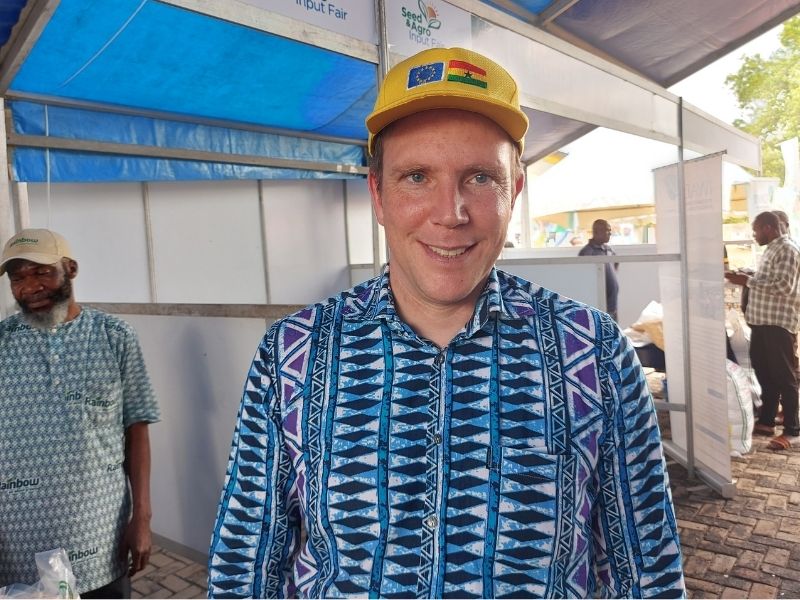
The Deputy Head of Mission, European Union Delegation to Ghana Mr Pieter Smidt Van Gelder
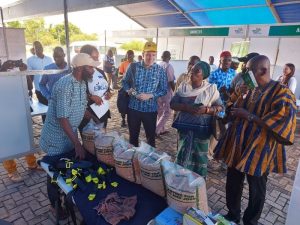
European Union Delegation going through some crops being displayed
The Deputy Head of Mission of the European Union Delegation to Ghana, Mr. Pieter Smidt Van Gelder, has said 2,739 women and youth had benefited from the Inputs Resolving Fund, one of the projects under the EU Ghana Agricultural Programme (EUGAP), representing 66% women and 8% youth in 2021.
Speaking at the 2022 Seed and Agro Inputs Fair at Wa in the Upper West Region, Mr. Van Gelder indicated that 800 metric tonnes (mt) of certified seeds were produced in 2021, including 38mt of foundation seeds in collaboration with the Plant Protection and Regulatory Service Directorate of the Ministry of Food and Agriculture (MoFA).
According to him, since 2017, 61,000 farmers had benefited from the EUGAP, and it had recorded an average increase in yield of 87%. Adding that, the EUGAP supplemented the support they received from the government initiative such as Planting for Food and Jobs.
The Deputy Head of Mission of the EU delegation to Ghana further noted that in partnering the MOFA, the EUGAP had dedicated a financial contribution of Euros 132 million, equivalent to GH¢1,088 million. This, he said, was the largest ongoing programme financed by the European Union in Ghana.
“The EUGAP seeks to increase agricultural productivity, protect natural resources, combat climate change, improve access to markets, support to access finance, and provide the most needed infrastructure such as irrigation, farms and feeder roads.”
The Municipal Coordinating Director, Madam Fati Kore, opined that seeds formed the central part of a farmer’s life and small-scale farmers had selected seeds from their crops for the next season, and their knowledge had been accumulated over generations, and nobody was in a an a better position than they were to choose seeds that were adapted to their particular conditions.
She further noted that the two-day Seed and Agro Inputs Fair would bring together farmers, seed companies, and agro-inputs dealers to acquire from each other seeds, knowledge, and network ahead of the coming planting season.
On her part, the Secretary to the Unity and Progressive Women Rice Farmers Association, Madam Fati Sansun, said the 2022 Seeds and Agro Inputs Fair had given the platform to learn new ideas, network and sell their products to other people, and believed more of such platforms would boost agribusiness in the Northern part of Ghana.
Mayor Sam Pyne breaks the ground to the admiration of chiefs, officials of KMA and construction firm
Joseph Otoo, CEO of Abba Investments Ltd.
The Mayor of Kumasi, Samuel Pyne, has cut the sod for the commencement of the Santasi Market Redevelopment Project.
The project, being pre-financed by Abba Investment Limited, the contractor, is expected to be completed within 24 months.
The proposed modern market, which would be fitted with solar power, would comprise other facilities, including a Fire Post, Polices Station, Crèche, Pharmacy and a 20-seater toilet facility.
Mayor Pyne noted that governance was a shared responsibility, and stressed the need for satellite markets in the Metropolis to enhance the Rapid Transport Service under the Sustainability Urban Mobility Programme (SUMP).
He urged the traders to cooperate with the construction company to enable it execute the project within schedule.
Madam Juliana Nsiah, Estate Officer of the Kumasi Metropolitan Assembly (KMA), disclosed that all the requisite data of the traders had been captured, and that registration of the traders currently occupying the facility had been completed.
According to her, a mop up exercise would be done to ensure that all traders were duly registered to ensure equitable distribution of space at the facility upon completion.
She said an exhibition of the registered traders would be done to ensure a smooth relocation of the traders.
Mr. Joseph Kojo Otoo, Chief Executive Officer of the Abba Industries, said the work would begin as soon as the traders and market women had been relocated, and gave the assurance that with the cooperation of the traders and other stakeholders, the project could be completed in 18 months.
Nana Sei Atta II, Otumfuo’s Sasamohene, and Nana Amoako Kesse, Santasihene, witnessed the sod cutting ceremony of the project.
Also at the ceremony were Mr. Yaw Owusu, KMA Metro Works Engineer, Samuel Amankwah, Chairman of the Nhyiaeso Sub-Metro Council and Assembly Member for Santasi, and James Nana Prempeh, Assembly Member for Fankyenebra Electoral Area.