The Deputy Minister for Information, Fatimatu Abubakar, has charged state agencies to partner the Information Services Department (ISD) and give the latter more opportunities to serve especially on public awareness campaigns.
“The ISD has the capacity to get the messages to the ground convincingly through its numerous campaigns. It is the reason why we need to give them more,” she said.
The Deputy Minister was addressing a program to sensitise ISD staff on the Electronic Transfer Levy (E-levy) in Kumasi on Monday, 16th May, 2022.
The program is aimed at empowering the ISD officers to embark on public education campaigns to sensitise Ghanaians on the importance of the levy.
Madame Fatimatu Abubakar said just as the department has done well with other sensitisation campaigns, government expects that it will devote much attention and resources to the E-levy campaign and help get the message down to the citizens in rural communities.
“Our expectation is that after this exercise, many Ghanaians will understand the essence of contributing to the E-levy and as such revenue mobilisation for developments to benefit all,” she added.
She, however, advised the officers to make good use of the opportunity and not disappoint the Ministry of Information and government.
The exercise was organised by the Ghana Revenue Authority in collaboration with the Ministry of Finance.
Deputy Minister of Finance and MP for Atiwa East, Abena Osei Asare, on her part stressed the importance of the E-levy, adding that government is hoping to use the levy to boost revenue generation for developments.
“It will help us broaden the tax base to include a large portion of the population who are eligible to pay taxes,” she said.
The Acting Director of the ISD, David Owusu Amoah, charged his officers to take this task as a test case to deliver and get the message to the people in the appropriate language.
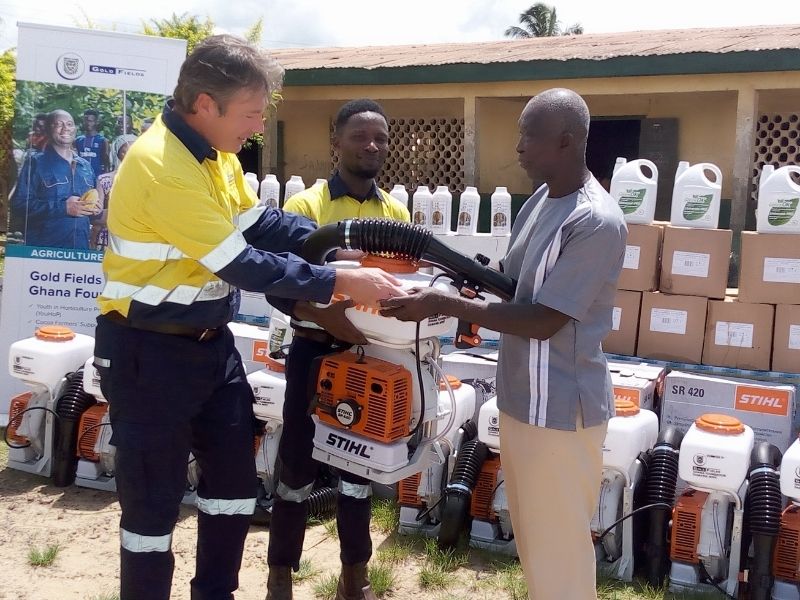
Michiel van der Merwe, Ag Vice President Operations handing over Mist blower to a beneficiary farmer
The agrochemicals line up for the farmers
Despite the global challenges with the supply of agrochemicals, the Aboso Gold Mine Limited (AGL), in collaboration with the Gold Fields Foundation, has provided 407 liquid Green OK fertilisers, 90 mist blowers, and 900 ‘Akate’ insecticide to over 600 cocoa farmers in its catchment communities.
Each host community received six of the mist blower machines to be used by all cocoa farmers within the area. Also 36% of the beneficiaries of the free fertilisers, Akate insecticide, and mist blower machines were women.
The free supply of the agrochemicals was a renewal of an annual programme by the Mine, in consultation with the Damang Mine Consultative Framers Association (DMCFA). Dubbed ‘Cocoa Farmers Support Scheme’, a total of $80,000.00 was being expended on this year’s support programme, with an estimated $265,000 already expended since the start of the programme in 2018.
Welcoming the farmers to the programme, the Acting General Manager of AGL, Catherine Kuupol Kuutor, pointed out that apart from the free implements, each of the nine catchment communities would receive a minimum of six machines to be used by all cocoa farmers within the area, and not just the beneficiaries of the programme.
This approach, according to the Acting General Manager, was to encourage co-operative farming and farmers’ interdependence on technical knowledge.
Ms Kuupol Kuutor said a detailed user agreement was being prepared under the guidance of the District Office of the Cocoa Health & Extension Division of Cocoa Board (COCOBOD) to manage the mist blowers.
This, she said, would be modeled after the government’s mass spraying and spraying gang structure to ensure proper use and maintenance of the machines.
The Municipal Chief Framer, Nana Thomas Boakye, on his part, said the agrochemical given freely to the farmers was an indication that the host communities were enjoying the social intervention programmes being undertaken by the mine.
He further said the farmers have had a good relationship with the mine.
The Municipal Chief Executive, Isaac Drasmani, applauded the mine for the annual cocoa support scheme.
The Acting Vice President, Operations of AGL, Michiel Van der Merwe, applauded the contribution of farmers to national development and gave the assurance that the mine would co-operate with the farmers.
BACKGROUND
The AGL, through the Gold Fields Ghana Foundation, has been supporting cocoa farmers in the catchment areas of the mine with free cocoa inputs since 2018.
This initiative was conceived after the government of Ghana reformed its policy towards cocoa production -distributing free and subsidised fertilisers.
The basic objective of the programme is to select and support 120 cocoa farmers annually with the needed inputs to boost annual cocoa production of beneficiary farmers by at least 3%.
The initiative is also meant to help sustain employment in the area of cocoa production and establish the fact that mining can co-exist with farming.
Since inception of the programme, over 600 cocoa farmers with a combined farm size of 1200 acres have benefitted. Each beneficiary farmer receives support for three consecutive years before exiting the programme. The second batch of beneficiaries selected in the year 2019 exited last year. This has made room for an addition of a new batch of 120 farmers this year.
In 2021, new inputs including insecticides and fungicides were introduced and added to the fertilisers for distribution to beneficiary farmers.
This was upon request by the leadership of the Damang Mine Consultative Framers Association. This year, the scheme saw a total of 600 cocoa farmers benefit from free fertilisers, Akate insecticide and many others.
Present at this year’s cocoa support programme were Nana Kwabena Amponsah, Chief of Bosumtwi, Nana Akua Ayaa, Queenmother of Amoanda, Nana Ama Saara, Queenmother of Subri, and Nana Adjoa Kyerekuah, Queenmother of Kuduakrom.
Others were some elected Assembly Members, including George Nyersor, Member for Aboso, Anthony Owusu, Member for Damang, Isaac Kumi, and Member for Subri amongst many others.
The fight against mining in our water bodies appears to be far from over, considering the extent of destruction and pollution being caused to River Tano most particularly, a source of water for the people of Samreboi in Amenfi West of the Western Region.
An indigenous large scale mining company (name withheld) working in the area is said to have caused, not only destruction to cocoa trees dotted along the river by cutting down large hectares of farms to pave way for mining activities, but also succeeded in polluting the river by discharging ‘washing’ waste into it.
Information available to this reporter indicates that considering the extent of damage done by the said mining company to cocoa farms and the river, opinion leaders, including traditional leaders in the area, made a report to the Chairman of the Municipal Security Council (MUSEC).
The MUSEC, led by its Chairman who is also the Municipal Chief Executive, Lord Nana Tanoh, raided the mine with a joint military and police team to seize excavators and other equipment belonging to the company, and closed it down.
Speaking in a telephone interview, the MCE confirmed the raid, but was quick to add that there was no evidence that the pollution of the river could be traced to the said indigenous mining firm.
Distancing the mining company from the pollution of the river, the MUSEC Chairman told this reporter that the said mine had been closed down over a month ago as a result they could not be behind the destruction.
He further told this reporter that, he, together with a team, had realised that the pollution of River Tano in Samreboi could be traced to Sefwi Wiawso. Meaning, the pollution had its source in Wiawso coming down to Samreboi.
In that direction, he had taken pictures and forwarded them to the Regional Minister.
In that direction, MCE Tanoh said the closure of the mine had nothing to do with pollution of the river, but as a result of issues it had with the Mineral Commission.
A source at the Mineral Commission confirmed to this reporter that an indigenous large scale mine operating in the area had been closed down. The source explained that the Commission closed down the company because it realised that it did not have a mining operating permit, albeit it had a lease.
The mine, according to our information, was undertaking mining exploration in the area, yet was mining secretly, that apart, the local indigenous firm did not have a mining operating plan, neither had the said mining operating plan been approved by the Commission.
But speaking in a telephone interview, a former elected Assembly Member and now a government appointee of the Amenfi West Municipal Assembly, Ofosu Asare, told this reporter the indigenous large scale mine could not be distanced from the pollution.
According to him, the indigenous company had three sites in Atala, Datano and Ohiampenipa, where it was carrying out mining, further adding that the three sites were all close to the river near large tracts of cocoa farms.
The government appointee continued that the indigenous mine was led by two Ghanaians and a Chinese.
He said the mine forcibly took over large tracts of cocoa farms from farmers, after offering them a pittance in exchange.
According to him, though the cocoa farmers were against exchanging their farms for mining, they had no other option.
This was because the ring leaders behind the mine claimed to have the backing of ‘strong men up there’ and whether they (farmers) accepted the pittance offered them in exchange for their farms or not, they would cut down their trees.
“So, in order to lose your farm without getting anything, you only have to accept the pittance offered by the ring leaders in exchange for your cocoa farms.”
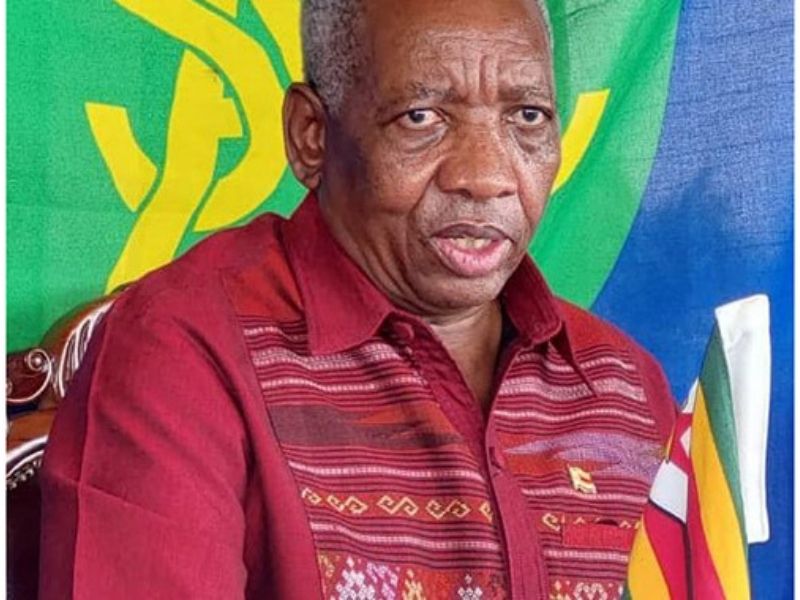
H.E. Kufa E. Chinoza, Zimbabwean Ambassador to Ghana
The Zimbabwean Ambassador to Ghana, H.E. Kufa E. Chinoza, over the weekend, paid a courtesy call on the Minister of Food and Agriculture, Dr. Owusu Afriyie Akoto, to hold discussions on how the Ministry can collaborate with them to strengthen bilateral relations between the two countries through investment opportunities in the Agricultural sector.
The meeting was an opportunity for the Agric Minister to formally meet with the Ambassador since he arrived in Ghana during the pandemic, since Ghana and Zimbabwe have very good relations which stem from many years ago.
Dr. Takemore Chagomoka, the Regional Manager for Seed Co. West & Central Africa, who led the delegation during the interaction, said obtaining hybrid seeds for crop production is a challenge in the agricultural sector as such they would like to commence local production in Ghana.
He explained that the Seed Co. is a company that develops and markets certified crop seeds, mainly hybrid maize seed, in addition to wheat, soya bean, barley, sorghum and groundnut seeds. Having worked in the seed business in Africa for 8 decades, they will like to extend operations in Ghana’’.
In further talks with the West & Central Africa Regional Manager, Dr. Takemore Chagomoka, revealed that they chose Ghana due to its peaceful environment and movement of logistics.
For the past four (4) years, they have continuously delivered on time; there is a high demand for their product; they invest and support Ghanaian policies and their model is suitable for the environment.
Minister of Food and Agriculture, Dr. Owusu Afriyie Akoto, in reaction said “I am fully aware of a research partnership with Seed Co. in the past which has merited crop production in Ghana’’.
According to the Minister, the government flagship programme, Planting for Food and Jobs (PFJ) marketing infrastructure has necessitated the establishment of 80 warehouses.
He said the set up of the Grain Development Authority, therefore, will ensure the maintenance and addition of more warehouses for storage of cereals and grains.
“And so will Seed Co.’s petition to solidify bilateral relations in the Agricultural sector. We will work together to build more infrastructure and ultimately ensure food security.
Also, it will be a clear case of Africans supporting Africans. My ministry is ever ready to support our farmers and invest in them through the provision of inputs, fertilizer and extension services’’ he added.
‘’This project will contribute significantly to the sector by creating employment, transferring knowledge and skills to farmers in Ghana, and eventually turning them into outgrowers’’.
Dr. Owusu Afriyie Akoto explained that the Agric ministry will support this initiative through the accessibility of land to help the smallholder farmers and increase the exportation of hybrid seeds.
Meanwhile, the Seed Co. is currently working on a model farm on 240ha of land at the Kpong Left Bank and has high hopes of increasing it to 10000 ha, as the company is interested in growing the seeds here rather than importing them into the country.
They have also planned to use smallholder farmers in Ghana on the farms and eventually employ their services as out-growers.
Additionally, the demand for hybrid seeds is high and farmers are expecting to double yield with the seeds.
SeedCo as the name implies is an authentic African seed company with branches in over 17 African countries. It was established in 1940 and registered in Ghana in 2017 with the main goal of improving the Agricultural sector.
They develop and market certified crop seeds, mainly hybrid maize seeds, in addition to wheat, soya bean, barley, sorghum, and groundnut seeds.
Globally, they produce over 60,000 metric tonnes of maize. They have successfully implemented their company module in these countries and would want to achieve similar in Ghana by extending their operations in terms of land acquisition.
In the interim, they produce hybrid seeds for Ghanaian farmers and provide extension services. They produce the “Gyimidi” maize variety which yields 12 metric tonnes per hectare (ha).
A high-powered delegation from the Ghana Armed Forces Medical Services, led by Brigadier General Ernest C. Saka, the outgoing Director-General of Medical Services, have paid a courtesy call on the National Health Insurance Authority (NHIA) Chief Executive, Dr. Bernard Okoe, Boye and his Executive Management team.
The meeting was to officially introduce the top hierarchy of the Ghana Armed Forces Medical Services to the new NHIA Chief Executive and the Executive Management.
Dr. Okoe Boye seized the opportunity to affirm his goal to make the NHIS very visible and accessible to its stakeholders. He underscored his determination to ensure that the service delivery of the Scheme will be acceptable to members and other stakeholders alike.
He posited the need to partner with all key stakeholders to find innovative solutions to address the persistent challenges of the irregular flow of funds into the National Health Insurance Fund (NHIF). He hoped that a more predictable way of receiving inflows from the government will be welcome to reduce operational challenges for service providers.
Dr. Okoe Boye also stressed the importance of injecting efficiency in the NHIS claims vetting and processing regime, making it watertight to reduce leakages.
To address this, he solicited for the 37 Military Hospital to integrate the hospital’s systems with the NHIS electronic claims system. “It is our desire to scale up the use of electronic claims (e-claims) among all our service providers this year”, he said.
Brig. General Saka, on his part, thanked the management of the NHIS for a great working relationship in the past and prayed for an even better partnership going forward. He admitted that NHIS funds form a significant part of the internally generated funds (IGF) used to run the hospital and, therefore, timely receipt of same would positively impact health service delivery for military personnel and their dependents, as well as the public who visit that facility.
He used the occasion to introduce Brigadier-General Raymond K. Ewusi, who is taking over as the Director General of Medical Services.
Also in attendance was the Deputy Chief Executive for Admin / HR, Mrs. Yaa Pokuaa Baiden, Deputy Chief Executive, Operations, Mrs. Vivian Addo-Cobbiah, the Deputy Chief Executive, Finance & Investments, Mr. Francis Owusu and the Head of Corporate Affairs, Mr. Oswald Essuah-Mensah.
The Minister of Gender, Children and Social Protection (MOGCSP), Sarah Adwoa Safo, has deserted her duty post since late last year.
The last time she was seen executing public function was the day the majority side approved the controversial 2022 budget, after which the House went on recess.
It must be put on record that the appointing authority, according to a letter, had permitted her leave as Minister for Gender, Children and Social Protection.
Weeks later, another letter emerged announcing an extension of her leave, even at a time the public had begun expressing concern over the lack of substantive minister at such a critical sector.
The Ministry is mandated to co-ordinate and ensure gender equality and equity, promote the survival, social protection and development of children, the vulnerable and persons with disability, and integrate fulfillment of their rights, empowerment and full participation into national development.
The mandate of the ministry places it at a very sensitive position in the structure of governance, as its tentacles spread to cover every nook and cranny of the country.
It is, therefore, not a pleasant sight to behold that for about half a year, such an important ministry is under a caretaker minister, who is already burdened with another ministry.
It is public knowledge that from time immemorial, when substantive ministers are incapable of performing their functions, a caretaker minister is appointed, mostly from amongst the other ministers of the government.
However, we believe that it should not take long like we are witnessing now, to have a replacement especially at a ministry with loads of responsibilities. The reason remains that one person running two ministries is a herculean task and the earlier something is done about the situation the better.
We are alarmed at the precedent being set, considering the kind of politics Ghanaians do, perfectly fitting a quotation from George Orwell’sallegorical novel, Animal Farm that “all animals are equal but some are more equal than others.”
We are yet to be convinced that the MOGCSP, for about six months, cannot have its own minister to run the affairs of the ministry, because one person is on leave. Is it for lack of qualified individuals?
In our opinion, regardless of the justification to render the MOGCSP as the bonafide heritage of one person, the government has opened the floodgate for others to follow the example. In future, the Adwoa Safo case would become a classical reference point in similar instances.
We do not think such a development is healthy for the growth of the said ministry, the image of the government and we do not think it boosts the morale of party faithful, especially those with the qualification and capacity to be appointed as ministers, but have not found favor with the appointing authority.
As we speak, caterers under the government’s School Feeding Programme are contemplating to stop cooking for our children in public schools, as prices of foodstuffs are skyrocketing. The school feeding programme is under the MOGCSP.
The caterers had expressed displeasure with the minister, Sarah Adwoa Safo for ignoring their plight. We will not downplay the influence of a minister over his or her ministry, especially during crisis period. It is for this reason that we commend the government for meeting the caterers yesterday, even in her absence, but it also does not negate our point that the government should come clear on the issue of a substantive minister for the MOGCSP.
The government should explain to the taxpayer, whose levies are being used to pay the minister, who has been on leave for about six months, why the sector should wait for her to return to post from her rather perpetual leave.
Perhaps, every politician, whose prayer is to find favor with an appointing authority, needs the grace of Adwoa Safo to safeguard their appointment.
Board members of the Bono Twi project and members of Bono East Traditional Council
The former Member of Parliament for Dormaa East in the Bono Region, Mr. Kwasi Sabi, has said that Bono Twi was the mother dialect of the Akan Language, but it was unfortunate that the dialect had not yet been documented, hence, the need for stakeholders to deepen efforts at documenting it.
Mr. Sabi made the call when executives of the Bono Twi Project paid a courtesy call on the Bono East Regional House of Chiefs to highlight the need to officially document Bono Twi for academic purposes, posterity sake, and the culture of the Bono people.
The Bono Twi Project seeks to officially document the Bono dialect for academic purposes, save it from extinction, and preserve the identity of the Bono people to make Bonoman known to the world, and to enhance advocacy.
The Project has been duly registered at the Registrar General’s Department, with a certificate of incorporation. Mr. Sabi said since Nananom (the chiefs) were custodians of the land, it was imperative to bring them on board to support the initiative.
On behalf of Nananom, the Omanhene of Yeji and President of the Bono East Regional Houses of Chiefs, Pimapim Yaw Kagbrese V, embraced the initiative and said “It is good news,” and also described it as very laudable and more precious or valuable than gold, and pledged their full support for the project. They, however, raised concerns about the linguistic survey, since there were small nuances or variations of the Bono dialect.
The Founder, Coordinator and Organiser for the Bono Twi Project, Mr. Kwaku Ansu Gyeabour, said a linguistic field survey (Orthography) had been conducted on the project, and added that the Ghana Bible Society, which was doing the Bono Twi Bible translation, had done field surveys on the Bono dialects.
THE BONO PEOPLE
Mr. Ansu Gyeabour pointed out that the Bono people were Akan Piesie or Akandifo, explaining that Bono was the genesis and cradle of Akans and the Akan civilisation.
According to him, Bono was one of the largest tribes of the large Akan ethnic group, and were matrilineal people. Bonos speak Bono Twi of the Akan Language, with more than three million native speakers, both in Ghana and la Côte d’Ivoire.
The Bono Kingdom, which was established around the 12th or 13th Century, was the first centralised Akan Kingdom, with Bono Manso as its capital, where most Akans migrated from to their present settlements or locations.
“The Bono dialect or Twi is normally considered or tagged as the mother tongue of the Akan Language,” he stressed.
THE BOARD
The Bono Twi Project board is chaired by Hon. Williams Kwasi Sabi with Pastor R.R. Yeboah as the Vice Chairman. Other members include Nana Asamoah Kumtwie, Nsesresuhene, Oboaman Bofotia Boamponsem, Krontihene of Sunyani, Nana Akosua Kumi Sasraku Sradaa, Adontehemaa of Aboabo Number 4 and Rev. Isaac Boahen.
The rest are Mr. Kwaku Ansu Gyeabour, founder, coordinator and organizer for the project and Mr. Kwadwo Sakyi Akomeah, the Public Relations Officer (PRO).
Rev. Isaac Boahen of the Ghana Bible Society, expressed optimism that with the field work done so far by the society on the Bono Twi Bible Translation with their orthography, the project will succeed.
The youth of Nkoranza are demanding justice for the late Donkor
The youth of Nkoranza in the Bono East Region are up in arms against the Nkoranza Divisional Police Commander of the Ghana Police Service in the town over the death of one of their colleagues, Albert Donkor (Balusu). The youth took to the streets to demonstrate amidst the burning car tyres, blocked the roads in the evening during a blackout as part of their ‘Where is Albert Donkor?’ and ‘Nkoranza Youth demand Justice for Albert’ campaign. It took the Ankobeahene of the Nkoranza Traditional Council, Oheneba Agyei Baffoe, to intervene and calm the youth. The leaders of the youth of Nkoranza were later invited by some persons who claimed to have been sent to Nkoranza by the Inspector General of Police (IGP), Dr. George Akuffo Dampare, after he was informed by the Bono East Regional Police Commander, DCOP Moses Asabagna Atibillah, of the grievances of the youth. This was followed by another meeting at the Ankobeahene’s residence, which comprised of the youth of Nkoranza, the Ankobeahene, Bono East Regional Minister, the Municipal Chief Executive, Regional Police Commander, Nkoranza Divisional Police Commander and the District Police Commander. Led by Nana Nyarko Ababio (Paa Prince) the youth presented their grievances to the aforementioned personalities. Basically, they want the whereabouts of their colleague known, and those who killed him brought to justice. The Bono East Regional Police Commander, DCOP Moses Asabagna Atibillah, apologised on behalf of the Police Service for the mistake and demise of Donkor. He appealed to the youth to remain calm as he submits his report to the IGP for the necessary action. The Bono East Regional Minister, Mr. Kwasi Adu Gyan, expressed his sympathies with the youth following the death of their colleague and pleaded with them to be patient and allow due process to work. He assured them that the authorities would do all within their means to retrieve the body of the late Donkor. BACKGROUND Albert Donkor, popularly known as Balusu, was a bulky young man and a native of Nkoranza in the Bono East Region He was a businessman who used to sell footwear in front of the MTN office opposite the Ghana Commercial Bank on the Nkoranza-Ejura road and was a resident of Kasardjan, a suburb of Nkoranza. In April this year, the late Donkor was traveling from Dromankese to Nkoranza when he encountered an armed robbery scene and spotted a policeman who he identified, during which his laptop was snatched by the robbers. On his return to Nkoranza on April 24, the late Donkor is said to have told his friends at Roof Top, a nightclub in the town off the Ejura road, that some policemen were involved in the recent robberies in Nkoranza and its environs. One of his friends blew his cover and reported him to the policemen involved in the robberies. Following that, the late Donkor was picked up from his house by some policemen at about 2am on April 25, 2022. The police told his mother to report to the police station later that morning, because her son was a suspect in a robbery case. Reports were rife that the police sent Donkor to a location on the Nkoranza-Kintampo road, where they shot him dead. Later in the morning when Donkor’s mother visited the police station, she was told her son had been sent to Techiman for further investigation. The mother followed up to the Techiman Police Headquarters, where she was told no one with the name Albert Donkor had been brought to them from Nkoranza. Reports indicated that the police kept tossing the mother for about three weeks, during which period the police allegedly sent the corpse to the Techiman Morgue, but it was rejected, since there was no family member present. The body was, therefore, returned to Kintampo where reports suggest it was being kept at a secret location. It was on May 12 that rumours circulated in Nkoranza that Donkor had been killed by the Nkoranza South Police, and that he was no more in their custody as people thought was the case. Following these rumours, the youth formed the “Justice For Albert Donkor Movement,” led by Nana Adjei Baffoe (Romeo), Ohene-Gyan Emmanuel (Diamond) and Effah Baffoe Jnr (Sketches), who released a statement seeking the whereabouts of their colleague Donkor which led to the “Where is Albert Donkor campaign.”
Rapper Amerado has come under scads of attacks after his latest single ‘Obia boa’ surfaced online.
In the song which brags about Amerado’s rap prowess, the Rapper who has missed the Rapper of the year award at the VGMA on two occasions mentioned that “from the East, West, North and South, there is no Rapper who comes close to Amerado because this is my time.”
In the song, the repeated use of ‘Mic’ has suggested to many that Amerado was talking about Sarkodie whose real name is Michael Owusu Addo, shortened as ‘Mic.’ This has made many posit that he was throwing shades at Sarkodie.
Unhappy Amerado has warned those pitching him against Sarkodie to put an end to the sly innuendos.
In a post on his social media pages, Amerado questioned where he shaded Sarkodie in his ‘Obiaa Boa’ song.
He added that they should put respect on Sarkodie’s name as he does.
“It’s time you guys stop pitching me against our legends just for click baits. Listen to #ObiaaBoa again and tell me where I shaded Sarkodie. Put respect on his name like I do,” Amerado stated.
Denning Edem Hotor, professionally known as Edem has disclosed why he stopped smoking weed.
Speaking on this subject for the first time, the award-winning Artiste who hosted the just ended Vodafone Ghana Music Awards (VGMA) said he realised that weed was not his thing after he smoked just a little and entered the studio for the first time.
Edem further revealed that when he was in the studio recording the said song,it sounded so great and on point until the next morning.
He revealed that when he finally woke up the next morning and decided to play the supposed nice song he thought he had recorded the previous night he smoked weed, he realised that he has recorded total rubbish.
Edem added that the song he recorded when he was high is actually the worst song he has recorded ever since he became a musician.
This experience made Edem stay away rom weed for good because he realised it is not for him.