Home Blog Page 2837

Rains on mass destruction in Accra

0
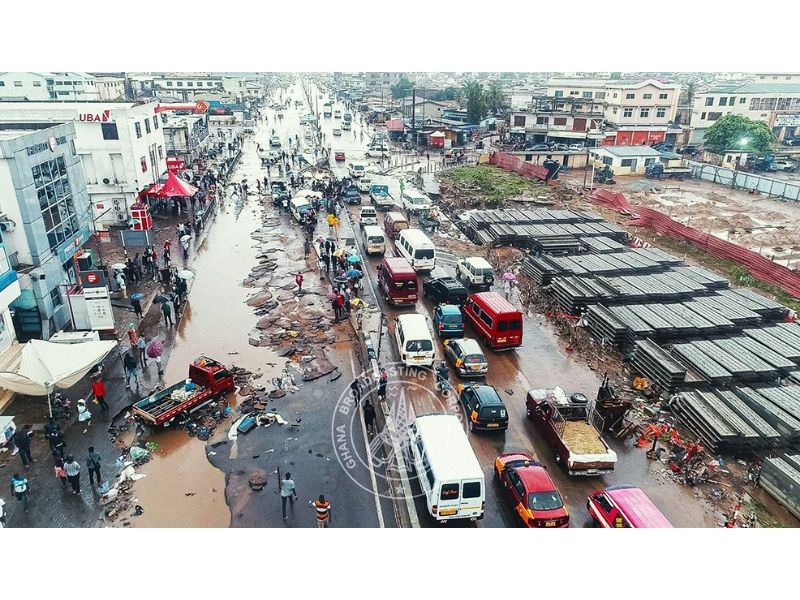
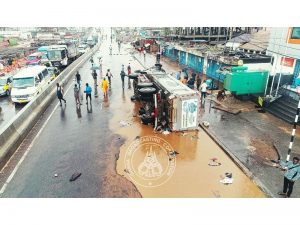
An aerial view of destruction at some parts of the capital after the heavy downpour
An aerial view of parts of the capital after the heavy downpour

There are barrels of tears and degrees of destructions anytime rains visit the country, particularly, the capital, Accra.

This year was not spared, as misery and grief have decorated the faces of victims of the recent floods. From the weekend through to yesterday, many companies and individuals are still counting their loses, amidst being rendered homeless.

The emotions cannot be described, as one victim posted on her Facebook page that she had lost everything to the flood after “15 years of my hustle at Circle,” Abena Kumaa posted with emojis of tears.

Abena, a single parent, is not the only victim. One Rich Kweku called for financial help to relocate from his flood-prone abode.

A tour through some streets of Accra showed that the rains have exposed the haphazard planning of the city, which is aimed at becoming one of the cleanest on the continent of Africa.

Even before the vision materialises, the recent rains have washed off some hardened bitumen on the streets, in parts of the capital. At one of the popular lorry stations in Kaneshie, the destruction by the rain was as though an earthquake had occurred.

Motorists could not use the Beyeeman Junction, Graphic Road and the Kaneshie Mpamprom, Traffic Light Road, as they were inundated by the heavy downpour.

At the State Transport Company (STC), buses and other wares swam in the flood. Every part of the company was taken over by flood, a situation which made it extremely impossible for work to go on as at noon yesterday.
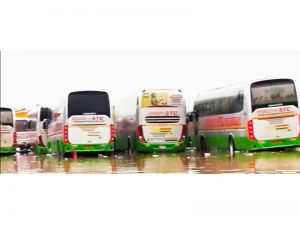
STC swimming in water after the rains

During our tour of the city yesterday, this reporter discovered that some trees had fallen, with one at the Ako Adjei Interchange blocking traffic on the Liberation Road, heading towards the Ridge roundabout, to join the Castle road or the John Evans Atta-Mills high street.

Videos went viral on social media of the vast destruction. One sad video sighted by The Chronicle was a moving vehicle whose direction was changed by the flood and later got drowned, with no help on sight.

Public Alert
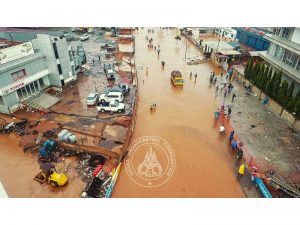
An aerial view of parts of the capital after the heavy downpour

The Ghana Police Service in the early hours of yesterday urged the public, especially those in Accra and Tema environs, to be cautious due to the downpour, which had started from the previous night through yesterday morning.

They advised school authorities and parents to pay extra attention to children who were already in school and those who were still trying to make their way to school.

However, they said that Police patrol teams had been deployed and were on the ground to ensure the safety of all.

3 More Rains

Meanwhile, the Ghana Meteorological Agency (GMet) has predicted that three more heavy rains will hit the southern part of the country before the end of June.

According to the agency, the phenomenon is likely to occur because the peak of the rainy season is approaching.

“When we look at climatology and the forecast that we released for the March, April, May, and June season, it looks like we have on average 3 more such incidents to occur,” Principal Meteorologist of the GMet, Nana Kofi Opoku, said on Accra based Joy FM yesterday.

He explained that the phenomenon is one that occurs at the peak of the (raining) season.

“At the peak of the season for the southern part of the country, especially in the month of June an average of three major rainfall incidents such as what happened on Saturday occur. So, on average, we are expecting about three,” he stressed.
Ghana must collectively fight against terrorism & violent extremism -Gov

0
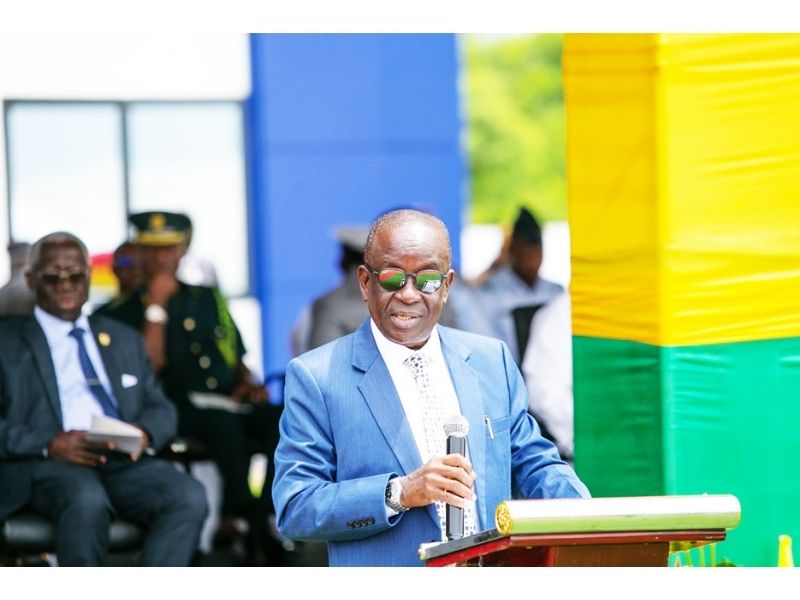
Mr Albert Kan-Dapaah- Minister for National Security addressing the gathering
Mr Kojo Oppong Nkrumah- Information Minister speaking at the ceremony

Government has made a passionate appeal to citizens to get involved in the fight against terrorism and violent extremism. It follows the increasing terror attacks and worrisome intelligence reports in neighboring countries.

The West African Region has in recent weeks been inundated with attacks by extremist elements, some of which have occurred as close as 50 kilometres from Ghana’s northern frontiers. Within the first quarter of 2022, out of the 346 terrorist attacks in various African countries, 49 per cent of them have occurred in the West African sub-region.

As recently as May 11th, 2022 in Togo, about 15 assailants and 8 military personnel were killed during a terrorist attack.

This has prompted government to put its security and intelligence agencies on heightened alert and at the same time, bringing Ghanaians on board as part of a whole-of-government and a whole-of-society approach to mitigating security threats that confront the state.

Edward Kweku Asomani, Deputy National Security Coordinator

As part of measure to rally stakeholders on the matter a campaign dubbed “See something, Say something” was launched in Accra on Tuesday 24th May 2022.

The campaign is aimed at mobilising and providing persons in the jurisdiction with more security education and deepen engagement with the Ghanaian public in line with contemporary security practices to counter acts of terrorism and violent extremism.

Addressing the launching ceremony at the Ministry of National Security, Senior Presidential Advisor, Yaw Osafo Maafo made a rallying call on Ghanaians to put aside all their differences and collectively help to fight these acts that threaten the country’s stability and peaceful atmosphere.

“We as Ghanaians, regardless of our ethnic, religious and political differences have a collective duty to protect our state against terrorism and violent extremism. We know that the terrorist groups, wherever they succeeded exploited ethnic, religious and political loopholes to unleash terror on people. If we are together, we are stronger.

“Cognizance of this fact, and with the benefit of examples of neighboring countries where terrorism have rendered them nearly ungovernable, we must put our differences aside and confront this threats with unity of purpose,” he added. The campaign is spearheaded by the National Security Ministry in partnership with the Ministry of Information.

On his part, the Minister for National Security, Albert Kan-Dapaah said it is expected that through the campaign and further education, the Ministry will highlight the challenges in the sub-region regarding terrorism and other activities that threatens the security of the country and at the same time help increase awareness for such activities.

Minister for Information, Kojo Oppong Nkrumah remarked that despite the robustness of the country’s security apparatus, it has become prudent in line with contemporary security practices that government involves Ghanaians in maintaining the peaceful atmosphere in the country and safeguarding territorial integrity of Ghana.

He charged the Media to support the government in educating the public and citizens on the importance of the campaign by dedicating airtime for that purposes

He underscored the need for us to come together as one people and fight the common enemy noting that “if we will be successful in combating the threats that we face, we need a total organization of our people to recognize first of all those risks, be alert and to play their parts in protecting our motherland.

He encouraged any person who notices anything unusual about the security situation of his immediate environment to inform the various agencies by dialing 999 (toll free) or report the issue using any of the security agencies phone numbers or social media handles.


NPA educates drivers on petroleum pricing

0
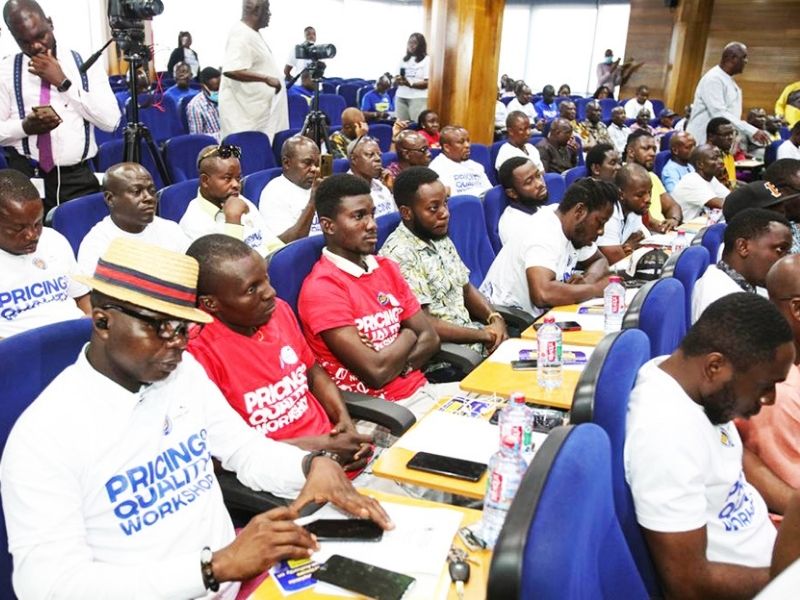
Drivers who attended the workshop
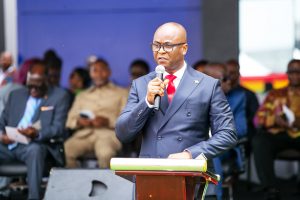
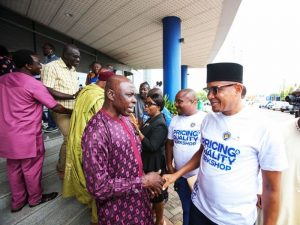
Dr Mustapha Hamid interacting with the drivers

The National Petroleum Authority (NPA) has held a day’s sensitisation workshop for commercial drivers aimed at equipping them with the requisite knowledge on petroleum pricing and quality.

The day’s event comes on the back of the recent continuous hike in petroleum prices on the global market due to the rippling effect of the Russia-Ukraine war.

Opening the forum, the Chief Executive Officer of the NPA, Dr Mustapha Abdul-Hamid, said the government has instituted a number of measures to ensure adequate supply of petroleum products to the market.

“I have seen the video of mates actually in fisticuffs with passengers, you are upset about petroleum price increases and so on, all of those things came to our attention and it is as result of a lack of knowledge on how we arrive at these petroleum prices,” he said.

“So that you understand that, petroleum prices don’t go up and down depending on the mood of President Akufo-Addo or they don’t go up and down depending on the mood of the Chief Executive of the National Petroleum Authority.

“It is important for us all as Ghanaians to understand how all these come about, because now we all listen to radio and we can see that there is a worldwide crisis, there is crisis in Britain, there is crisis in America, I am sure most of you are shocked that America is now airlifting baby food from Germany, ” he added.

Head of Economic Regulation at the National Petroleum Authority, Abass Tasunti took the participants through the dynamics and what goes into petroleum pricing in Ghana.

He emphasised that government has put in place a number of measures to ensure the country does not experience shortage of petroleum products, which is being experienced in oil producing countries like Nigeria.

Tasunti mentioned the recent reduction of fuel margins, collaboration with the Oil marketing Companies (OMC) and intervention of the Bank of Ghana in the forex market has helped in dealing with the situation.

Some participants described the forum as beneficial and enlightening.

“This meeting is an eye opener for us, we will go back and share the knowledge with our colleagues and return to further dialogue with the NPA,” one of the participants said.

They, however, called on the NPA to step up effort in dealing with adulterated fuel from some filling stations in the country.


Woman sells personal car to buy sanitary pads for female students

0
Nana Adutwumoah receiving a carton of sanitary pads from the Director of Melcom Group of Companies. With them are Mr Avenorgbo (3rd right) and staff from Guinness Ghana Breweries PLC

Nana Ama Adutwumoah, the founder of Touching the Lives of Girls Foundation (TLGF) said she had to sell off her car in 2020 to buy sanitary pads for female students in some second-cycle schools.

That was after she had realized that most female students in their early puberty stages in most schools in the Greater Accra Region absent themselves or sometimes quit school when they start their menstruation. This is because they do not know how to hygienically take care of themselves or do not have money to buy sanitary pads.

Nana Ama Adutwumoah realized the phenomenon during her visit to some of the first-and second-cycle schools in the region to educate the girl-child on the best way of taking care of themselves during menstruation.

She explained that while some female students used fabric cloth, foam or tissue, others use hand sanitiser or corn cobs instead of hygienic sanitary pads, which their parents could hardly afford for them.

She said her personal experience while growing up and the adverse medical effect she had had to endure from her inability to use hygienic menstrual pads informed her to form the TLGF in 2015 to visit schools in the country and to sensitise the girl-child on the need to use sanitary pads.

“And it was during my national tour of the schools when I realised that I needed to sell my car in 2020 to buy sanitary pads for distribution to these girls in the schools.

“I thought they (girls) had to have enough for the number of days they menstruated monthly to protect them against certain preventable diseases associated with the use of unhygienic sanitary pads.

“Additionally, these girls would not regularly absent themselves from school or in some cases, drop out of school as a result of their parents’ inability to be buying them hygienic sanitary pads monthly,” Nana Ama Adutwumoah explained at Melcom, Achimota branch, where the company donated 180 cartons of sanitary pads and drinks for distribution to girls in their puberty in five regions.

The gesture, which formed part of Meclom Care Foundation’s corporate social responsibility, would be distributed to schools in the Eastern, Central, Volta, Western and Ashanti Regions, with the latter hosting this year’s Ghana’s World Menstrual Hygiene Day, Friday.

That would be followed by seminars in some selected schools in the same regions, which Guinness Ghana Breweries PLC has agreed to join hands with Melcom Care Foundation to support TLGF to hold.

Nana Adutwumoah expressed her enormous gratitude to Melcom for the huge gesture that Godwin Avenorgbo, Group Director of Communications, Melcom Group Companies, said would not be the last.

With about 4.5 million girls in school from the basic to the second cycle and about 560,788 in the public SHS and 41,514 in the private SHS, Mr Avenorgbo said his outfit would not relent in supporting such projects that have the backing of former President John Agyekum Kufuor and Lady Julia Osei Tutu, both patrons of TLGF, and Nana Adutwumoah whose sacrifices have kept the foundation going.

Melcom Care Foundation has, over the years, supported laudable projects and assisted displaced Ghanaians in some parts of the country and to Mr Avenorgbo, Melcom would do more.

Historian Deflates Dormaahene’s ‘Historical Facts’

0
O. B. Sarfo-Kantanka alias Teacher Kantanka - Monarchical Historian

A monarchical historian in Kumasi, Osei Bonsu Sarfo-Kantanka, alias Professor, has said President Akufo-Addo’s applause to the Dormaahene as a good historian is in bad taste.

According to the history teacher, Dormaahene Osagyefo Oseadeyo Agyemang Badu II spews out inaccurate, incorrect, false and untrue history.

Teacher Kantanka’s position is in obvious reaction to President Nana Addo Dankwa Akufo-Addo’s commendation of the Dormaahene’s vast knowledge in history, for which reason he (President) advised the Dormaahene to codify chieftaincy lineage.

The President said he was impressed with the recent outdooring of the Kwahu State Book, which detailed the lineage of the area and believes if other traditional authorities emulate what the Kwahus have done, it would help curb chieftaincy disputes in the country.

“So now I leave it to you. I know you are versed in history. Nana Dormaahene, your history goes far. We hear. Those about Asante and the rest, we hear all of them. If you bring that idea for us to replicate (what has been done in Kwahu), it will help all of us for peace to decorate chieftaincy,” he reportedly said.

The occasion was when Osagyefo Oseadeyo Agyemang Badu II as President of the Bono Regional House of Chiefs and his entourage called on the President at the Jubilee House last week Wednesday to congratulate him for his re-election.

But the Kumasi-based monarchical historian, speaking on Opemsuo radio in Kumasi on Monday, said the Dormaahene is not conversant with the tradition, culture and history and that his (Dormaahene’s) history is inaccurate, incorrect, false and  untrue, hence the distortions by

him of late.

Teacher Kantanka, as he is commonly called said he suspects that the president might have a hidden motive in encouraging the Dormaahene to continue with his invectives against Asantehene and distortions of Asante history and spite the people of Asante.

Teacher Kantanka, who is also the Organiser of the Asante Kotoko Society, comprising about 23 Asante youth groups, said it is unfortunate that the president could applause the Dormaahene the way he did. He stressed that though a Nana Akufo-Addo fan, he cannot sacrifice Asante for the love of the President.

“I love Nana Addo but I cannot sacrifice Asante for him”, he stressed in reaction to the President’s praises of the Dormaahene.

Editorial: NADMO must be proactive in disaster management

0
Editorial

The usual heavy downpour of rains in the southern part of the country has started in earnest and wreaking havoc. With its accompanying concomitant effects, the perennial flooding in parts of the country, particularly in Accra, has been devastating, to say the least.

Several people have become victims of the devastating floods with accompanying destruction of properties.

However, we could perhaps take solace in the fact that unlike some experiences in the past, no human casualty has been recorded in the present flooding in Accra.

Natural occurrences such as the impact of climate change has not just affected the rainfall pattern in the country but has also led to prolonged flooding with dire consequences.

Unfortunately, human activities, including indiscriminate dumping of waste and building on water ways among others, have become largely accountable for the threat we face whenever there is a heavy downpour.

Though the other causes are quite enormous, they are widely known and this explains why The Chronicle finds it extremely difficult to understand why a common solution to the Accra floods cannot be found once and for all.

In all of these, there is one major concern about the role of the National Disaster  Management Organisation “NADMO” in the wake of the floods.

As an institution, NADMO seeks to enhance the capacity of society to prevent and manage disasters and to improve the livelihood of the poor and vulnerable in rural communities.

It is also expected of NADMO to develop the capacity of communities to respond effectively to disasters and improve their livelihood through social mobilisation.

Additionally, it seeks to manage disasters by co-ordinating the resources of government institutions and non-governmental agencies.

NADMO does these through effective disaster management, social mobilisation and employment generation.

Seemingly, NADMO does not appear to be doing enough in areas of sensitisation, public education and building the capacity of staff and stakeholders.

Additionally, NADMO equally does not seem to have done enough in Promoting Disaster Risk Reduction (DRR) and public awareness creation in the wake of the perennial flooding

We, at the Chronicle, have become increasingly alarmed about this situation because it does not portray the institution as a more proactive one that helps to prevent disasters as far as flooding in the city is concerned.

For instance, the Ghana Meteorological Agency issues daily alert regarding rainfall in the country but the alert does not receive corresponding educative action from the NADMO.

We are currently in the raining season and per the GMA alert, there could be more rains ahead.

Meanwhile, some people are still living in flood prone areas under the pretext that God would save them when the devastating flooding approaches.

Others are living in dilapidated buildings that have become death traps that could collapse and lead to the possible loss of human lives, especially as the rainfall is peaking now.

In our view, NADMO must have a comprehensive education to breakdown the weather alerts to the citizenry.

The organisation must also be able use appropriate legal means to evict citizens who are dangerously residing in dilapidated buildings to avert any foreseeable calamity.

Through this, we believe that it would be playing its effective role of aiding in disaster prevention rather than to wait for the disasters to occur before they would move in with buckets and blankets.

Kintampo South MP donates 249 pieces of furniture to schools

0
The furniture

The District Chief Executive for Kintampo South in the Bono East region, Mr. Opoku Nyame, has handed over 249 school furniture to the District Director of Ghana Education.

The presentation was made on behalf of Mr. Alexander Gyan, Member of Parliament for Kintampo South, who through the GETFund donated the said furniture to the directorate.

Mr. Nyame, during the short presentation, noted that the Member of Parliament took that giant step aimed at reducing the number of students who sit on the floor to write in basic schools within the district.

He said the presentation was the first batch of furniture that was to be presented to ease the problem of inadequate school furniture within the district, adding that the second batch was soon to follow.

He promised that the District Assembly would be working hand in hand with the Member of Parliament to procure more school furniture to meet the needs of the district and charged the Director of Education to distribute the furniture on need basis and maintain them to last longer.

The school furniture donated includes; 14 teacher’s tables, 2 head teacher’s tables, 5 book shelves, 42 general chairs for staff, 90 dual desks for lower primary, 90 dual desk for upper primary, 4 library tables, 1 cabinet and a notice board.

Boakye Tromo Girls’ dormitory commissioned

0
Tano North Municipal Chief Executive, Ernest Kwarteng (2nd r) commissioning the dormitory
The dormitory

The Tano North Municipal Chief Executive, Mr Ernest Kwarteng, has commissioned a girls’ dormitory block for the Boakye Tromo Senior Technical High School in Duayaw Nkwanta in the Ahafo Region.

Addressing the gathering, the MCE stated that the infrastructure is part of government’s agenda to promote free and quality education in the country.

He further reiterated the government’s commitment to ensuring that the Free Senior High School policy continues to be a success and thus encouraged the people gathered to support the government’s vision to educate every child of school going age.

The MCE called on the management of the school to keep the building in good shape because authorities will be conducting inspections from time to time. Nananom, Board Chairman, Headmaster and staff of the school, expressed their profound gratitude to the government for the kind gesture.

The MCE was joined by Nananom, Municipal Coordinating Director, heads of the various Departments and other distinguished personalities.

Banda Islamic School shines at Girls in ICT competition

0
The award winners and the minister for Communications and Digitalization, Ursula Owusu-Ekuful

A student from the Banda Islamic School in the Banda District of the Bono region emerged the best in the Girls in ICT competition held in the region for young females.

Fourteen-year-old Hawao Omoro beat 99 other students to emerge the overall best in the regional competition which was keenly contested among the participating schools in the twelve districts of the region.

Hawao Omoro took home GHC3,000 cash prize, a laptop and the establishment of an ultramodern Computer Laboratory for the school, and other personal rewards from the Minister for Communications and Digitalization, Ursula Owusu-Ekuful.

Other special awards were given to five outstanding performers in the training process. Apart from the reward for the best one hundred students, the best twenty schools will benefit from the establishment of ICT laboratories to enable the schools to scale up e-learning.

Minister for Communications and Digitalization, Ursula Owusu-Ekuful urged the winner to continue pursuing the interest she has in Science and ICT.

Certificates were presented to all one thousand girls who participated in the training programme and the one hundred teachers and coordinators.

The Girls in ICT seeks to introduce girls and young women to ICT, expose them to opportunities existing in the ICT sector, inspire them to embrace ICT and studies in Science, Technology, Engineering and Mathematics (STEM), raise awareness amongst them and ultimately get them to pursue careers in these fields, as the whole world migrates to increased use of digital platforms.

“We need to develop and grow the digital literacy skills of our children for them to become solution providers and innovators able to use technology to solve socio-economic problems. We are hopeful that in time, their innovative solutions will not only have national application but also meet global demand. Our strategy is to catch them young to inculcate the ICT spirit in them,” the minister said.

Hawao Omoro expressed her gratitude to the ministry of communications and sponsors for the initiative. She disclosed that her dream of becoming a nurse in future will be enhanced with the basic ICT skills acquired from the programme.

GIPC trains exporters to achieve $25.3bn non-traditional exports target

0
GIPC

The Ghana Export Promotion Authority (GEPA) is holding a-five-day training in export marketing fundamentals for exporters to help meet the non-traditional exports target of $25.3 billion in the next 10 years.

The workshop aims to support the export community to acquire managerial, technical and trade capacity as well as understand the current global export trends to give Ghana a competitive edge.

Mr Albert Kassim Diwura, the Deputy Chief Executive Officer of GEPA, speaking at the opening session, said the Authority was scaling up its marketing training programmes for exporters to enhance capacity and ensure they met required standards in the global market.

This would allow the GEPA to attain the needed growth and boost non-traditional exports. “It is a strategic pillar in our national export development strategy that we build the capacity of our exporters to deliver on our mandate,” he said.

This will be done through the expansion of exporters production to produce enough to feed the market.

“So, what we are saying is that let’s broaden the base. Let’s see how best we can have what we want to export and then the second pillar talks about the enabling environment and the standards,” Mr Diwura said.

“We also build the capacity of the stakeholders such that when they go out there, they can compete favourably with the rest of their counterparts in the world,” he said.

Mr Diwura said the training was in line with the National Export Development Strategy, which aims to boost NTEs exports to $25.3 billion in the next 10 years.

He said the ability to achieve the target rested on the various stakeholders, including the Standards Authority, the Foods and Drugs Authority and the exporters. He urged the trainees to build network and not to compete unnecessary among themselves so they could tap into others’ expertise to boost trade.

“We are discouraging them from competing with one another because we have come of age and we need to take advantage of the export market.

“Instead of competing among ourselves let us collaborate to be able to meet the expectations of the export market. For us it is better to collaborate and share proceeds than losing the opportunity,” he said. He said the Ghana Export School was always ready to develop training modules to meet the needs of product associations and identified groups of persons.

GNA

The Ghanaian Chronicle