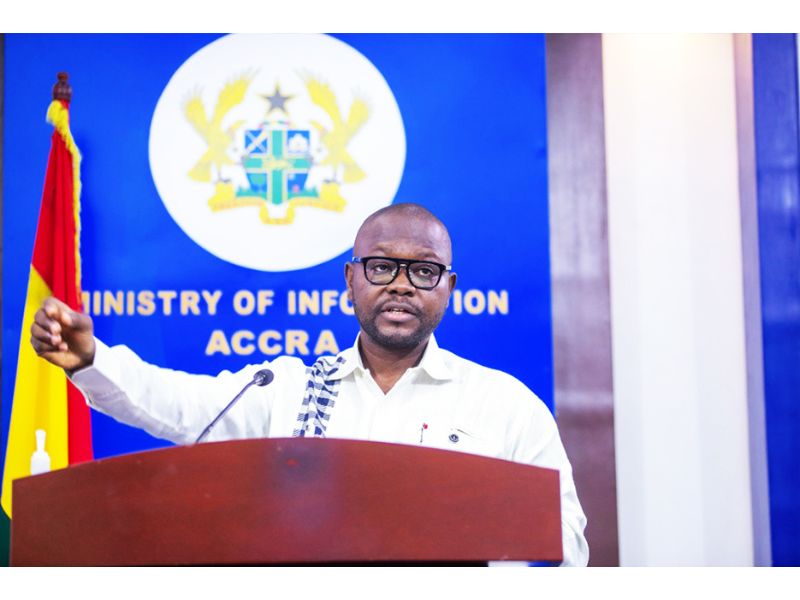
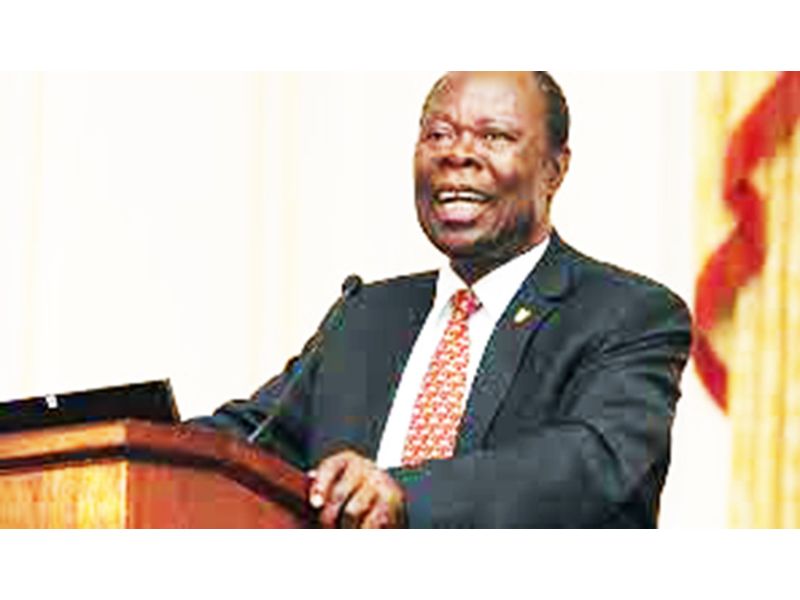
Mr Francis Asenso-Boakye answering a question at the press conference
Mr Asenso Boakye addressing the journalists
In order to protect lives and properties that are usually lost through perennial flooding in the country’s capital, government has developed the Flood Early Warning System (FEWS).
This was announced by the Minister for Works and Housing, Mr Francis Asenso-Boakye, at a press conference organised by the Ministry of Information in Accra yesterday.
The FEWS, which will be in operation by the end of next year, will ensure that advance notices are given to flood-prone communities, towns and cities to enable them take precautions.
“…Moreover, the design of a Flood Early Warning System for Accra has been completed …People in vulnerable communities will have the benefit of advance notice of floods, so they can take steps to protect lives,” Minister Asenso-Boakye said.
The Chronicle reporter asking the minister a question
The System has been designed to operate in a Pull and Push format. The Pull system will require individuals to download an application onto their mobile phones and get access to issues concerning floods, while the push system will involve the central operators sending key messages to individuals.
The Minister noted that the system is part of the Greater Accra Resilient and Integrated Development (GARID) Project, which is intended to improve flood risk management and solid waste management in the Odaw River Basin of the Greater Accra Region and improve access to basic infrastructure and services in the targeted communities within the Odaw River Basin.
He again noted that it is part of the many other interventions the government is putting in place to salvage flood issues in the capital and beyond.
He took time to outline some other initiatives the government is working on to curb floods in the capital and other flood prone areas in the country.
Fatimatu Abubakar, Deputy Minister for Information
According to him, a total of 35km of drains were constructed as a result of the 2018 and 2020 National Flood Control project and mentioned some of the beneficiary communities as; Madina Mayehot and Weija GICCEL in the Greater Accra region.
Kasoa Iron City and Kosoa Obom City are some of the places in the Central region that benefited from the project, while the people of Kwesimitsim were the ones that benefited from a drainage project in the Western region.
The Bantama Legislator also noted that climate change is one of the factors that causes floods and in order to mitigate them, the government has ensured that drainage infrastructures that are being put up in the country are flood-resilient.
Minister Asenso-Boakye also observed that the habit of building on waterways and the dumping of refuse in gutters are other contributing factors to floods.
He noted that to solve this issue, Metropolitan, Municipal and District Chief Executives (MMDCEs) have been tasked to ensure that obstructions to the free flow of water, as well as developments along water ways are removed immediately.
“MMDAs must strictly enforce the planning laws and punish officials who flout the planning laws in our bid to protect lives and livelihood”.
Aside floods, Mr Asenso-Boakye also noted that coastal erosion has been a headache to some coastal communities in the country and hence took time to touch on some projects that the government has put in place to savage the situation.
“Over the years, coastal areas have remained vulnerable to coastal erosion and this risk is exacerbated by the potential rise in sea level.
“Accordingly, government has considered the protection of the country’s coastline as very critical to our development. Government has implemented several coastal protection projects to safeguard the lives and livelihoods of people living in coastal communities.”
He made mention of the Komenda, New Takoradi, Aboadze, Cape Coast, Anomabu, Ningo Prampram coastal protection projects, which are at various stages of completion, and assured that government will complete them in order to protect the lives of people living in coastal areas.
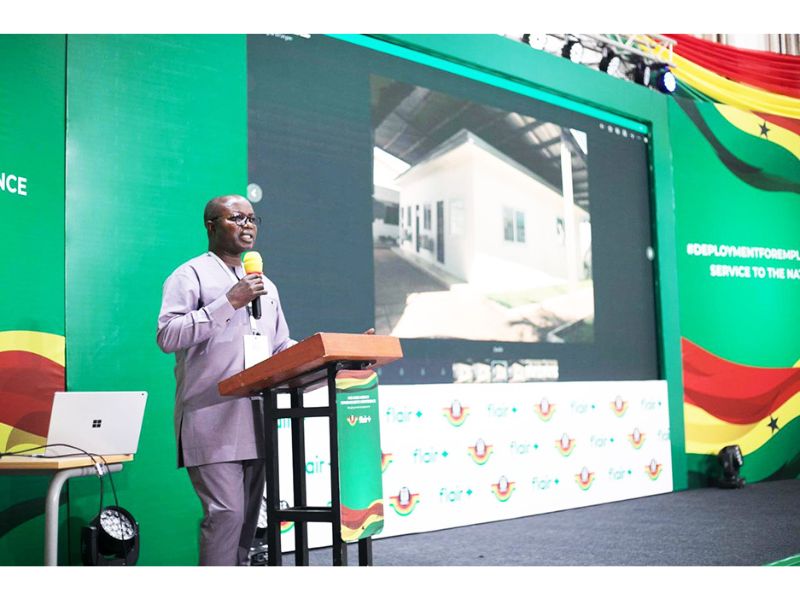
Mr Osei Assibey Antwi addressing the stakeholder meeting
The personalities that attended the stakeholder meeting
As part of its determination to ensure that more national service personnel acquire employable skills to be gainfully employed or establish their own enterprises to reduce the unemployment rate, the National Service Scheme has introduced an online portal called “Flair”.
Flair is an employability platform, which also offers user agencies the opportunity to make request for graduates with specific skills or training to undertake national service at their end.
The portal also offers stakeholders the opportunity to benefit from skill matching information, which include course of study or profession and serves as data base that provides information on both national service personnel and user agencies.
The Executive Directors of the NSS, Mr Osei Assibey Antwi, announced this at a user agency stakeholder meeting at the Cedi Conference Hall, University of Ghana, Accra.
The day’s conference attracted representatives of over 1,000 private companies and enterprises that use national service personnel which was on the theme, “Partnership for Efficient Service Delivery”.
Already, similar workshops have been organised for all tertiary educational institutions across the country on the new vision and the platform.
Mr Osei Assibey described the user agencies as formidable partners of the national service scheme in attaining the vision of “Deployment for Employment.”
The National Service Scheme recently launched its new vision of “Deployment for Employment”, away from the previous mandate of just deploying personnel.
It has also held discussions with the Ghana Employers Association and the Association Ghana Industries on its new vision.
Mr Osei Assibey noted that the NSS had decided to work assiduously with user agencies and other partners to ensure that the one-year period for the national service was used judiciously to provide top-up training for the graduates.
This, he explained, was to ensure that service personnel who undertake their service at other organisations gained skills that would make them employable while the NSS also through its numerous modules was offering skills to many others.
“The shift in paradigm from purely deploying personnel for a year to an agency that offers permanent employment opportunities, as well as provide entrepreneurial and employment skills for the youth has become necessary due to the increasing unemployment rate,” Mr Osei Assibey Antwi, has announced.
He explained that the new move was aimed at repositioning the scheme to retain some of its personnel after their national service and also to ensure that those who went out to the world of work were capable and ready to create their own companies, employ others and or fit and ready to be employed.
Modules
Mr Osei Assibey mentioned some of the modules designed by the NSS to incubate national service personnel into global entrepreneurs to include ‘NSS-Ghana Tourism Authority Support programme, construction (housing) of real estate and public facilities; agriculture and NSS-Techlab partnership to design computer application system;
He said, henceforth, the over 30,000 national service personnel who would be posted to teach at all educational levels would be given at least a month’s training and was of the strong conviction that by the time they entered the classroom, they would have provisional teaching license.
“There is a law in this country which frowns on teaching without pedagogic training, we have linked up with National Teaching Council (NTC), which is developing the curriculum that would be used for the short training,” he explained.
Aside the training, he said the NSS was partnering with T-Tel for funding to support the NTC to organise the training, adding that the NSS was arranging for funding to provide a 14-month online training that would give the personnel a professional diploma certificate in teaching.
In a speech read on his behalf, a Deputy Minister of Education, Rev. John Ntim Fordjour said for the private sector, turnaround time was important and also abhor bureaucracies that dissipate time and resources, “so for the National Service Secretariat to introduce such a portal is commendable”.
He said the NSS has moved a step ahead as an effective public sector agency to provide the private sector the required support so that they would be in a better stead to ensure a stronger collaboration that would address their needs and that of the teeming Ghanaian youth.
The fourth defence witness (DW4) in a cocoa trial, Ambassador Daniel Ohene Agyekum, says Dr. Stephen Kwabena Opuni did not commit any fraud while heading the Ghana Cocoa Board (COCOBOD) as the Chief Executive Officer (CEO).
He said Dr. Opuni (A1), who, together with businessman Seidu Agongo (A2) and his company, Agricult Ghana Limited (A3), had been accused of 27 crimes, including defrauding by false pretences, wilfully causing financial loss to the state, money laundering, corruption of public official, and contravention of the Public Procurement Act, worked consistently with the policies of the Board.
Ambassador Ohene Agyekum, a former Board Chairman of COCOBOD, told the Criminal Division ‘1’ of the Accra High Court that there was no instance that Dr. Opuni influenced the procurement process to benefit Seidu Agongo and his company, supplier of Lithovit Liquid Fertiliser.
He added that there was also no instance, as the court had been made to believe, when Seidu Agongo and his company were assisted by Dr. Opuni to perpetrate fraud on COCOBOD in the selling Lithovit Liquid Fertiliser to COCOBOD.
DW4 told the court, presided over by Justice Clemence Honyenuga, on Friday: “With all due respect, my reaction would be, where are all these coming from? A1 during my term of office did not, certainly not perpetrate any fraud. My lord, the Chief Executive of the management of COCOBOD, and with my little knowledge of corporate responsibility, whatever he did was consistent with the policies of the Board.”
Ambassador Ohene Agyekum, under cross-examination by counsel for A2 and A3, Nutifafa Nutsukpi, holding brief for Benson Nutsukpi, said Dr. Opuni could not influence the decision of the Board and the Entity Tender Committee (ETC), because the Board based its decisions on the advice of experts.
The witness also said he doubted whether the University of Ghana Chemistry Department really tested Lithovit Liquid Fertiliser, since he was not aware of any scientific report to that effect, particularly an agrochemical that was tested in a classroom and a conclusion drawn on same.
Excerpts of questions and answers:
Q. Now sir, you told the court at the last sitting that you attended all the meetings of the Entity Tender Committee?
A. That is so my lord.
Q. And you took the court through the process of deliberations and decision-making process of the Entity Tender Committee?
A. That is correct.
Q. Sir, please tell the honourable court whether there are any decisions of the Entity Tender Committee that had been influenced in any way whatsoever by the second and third accused persons.
A. My short answer is that decisions are arrived at due to the process which existed when I was the Chairman of the Board. We were not, and absolutely not, influenced by the second and third accused persons whatsoever.
Q. Sir, would you remember some of the persons you served with on the Entity Tender Committee?
A. Yes, if my memory serves me right, because it has been quite a time. I can’t remember all the names. There was institutional representation, which means that there was a representative of the Attorney-General’s Department; I believe her name was Mrs. Isakah. There was also I believe one Mr. Dodoo who also served on the Entity Tender Committee. I’m not able to recollect any of the other names. We were about seven or nine in number.
Q. In your evidence-in-chief, I’m referring to your witness statement, Exhibits L and M, paragraph 16?
A. Yes my lord, I did refer to Exhibits L and M, which are captured.
Q. Now sir, Exhibit L, dated February 11, 2014, is a letter addressed to the Secretary of Cabinet. Is that correct sir?
A. Correct.
Q. And Exhibit M, dated February 13, 2014, is also a letter from COCOBOD addressed to the Honourable Minister for Finance. Is that correct sir?
A. Correct.
Q. Sir, if you will kindly turn to the 2nd pages of Exhibits L and M, you will see on the tables of those pages, you have the following fertilisers listed; Asasera, Cocoa Master, Cocoa Feed, Sidaco 10:10:10, Sidaco 60:20, and Lithovit. Is that correct sir?
A. What I read here is absolutely correct sir.
Q. And sir, if you take a look at Exhibit N; on the 2nd page of Exhibit N, you will see that the same Asasera, Cocoa Master, Cocoa Feed, Sidaco 10:10:10, Sidaco 60:20, and Lithovit are also listed on the 2nd page of Exhibit N?
A. Correct.
Q. Now Exhibit N is the letter from COCOBOD to PPA seeking approval to sole-source the fertilisers we have just referred to on the 2nd page of Exhibit N. That is correct sir?
A. That is correct.
Q. Please take a look at Exhibit V shown to you now. It is a letter from the PPA to Ghana Cocoa Board dated March 15, 2014, granting COCOBOD approval to sole source Asasera, Cocoa Master, Cocoa Feed, Sidaco 10:10:10, Sidaco 60:20, and Lithovit Liquid Fertiliser. Is that correct sir?
A. That is correct, and that is in accordance with the procedures that I talked about in my previous statement.
Q. Now sir, these fertilisers types contained in Exhibits L, M, N and V were selected by experts of the CODAPEC/HITECH Unit at the time. Is that correct?
A. That is correct my lord. As I tried to explain in my evidence-in-chief, it is the CODAPEC and HITECH which determine the procedures, the quantities and types of fertilisers for every cocoa season.
Q. Now sir, at the ETC’s 54th meeting held in the Board Room of the Cocoa House on March 4, 2014, Asasera, Cocoa Master, Cocoa Feed, Sidaco 10:10:10, Sidaco 60:20, and Lithovit Liquid Fertiliser were approved by the ETC for the CODAPEC/HITECH programme for the 2013/2014 cocoa season. Is that correct?
A. It is correct so far as I can recollect.
Q. Sir, these fertilisers types that were approved by the Board, the ETC, and for the purchase by COCOBOD for the 2013/14 cocoa season were in no way determined by any suppliers of the fertilisers?
A. That is absolutely correct. They were in no way determined by any of the suppliers of the fertilisers.
Q. And sir again, by the policy of the Board that you chaired at the time, all those fertilisers that were bought for CODAPEC/HITECH programme were distributed to the farmers for free. That is correct?
A. That is correct, and if I may add further, the decision to provide fertilisers free of charge was for a very good reason, and as a cocoa farmer’s son and lived with all the difficulties and challenges faced by the cocoa farmers, together with my Board and Entity members, we sincerely believe that providing these items, as well as constructing good accessible roads within the cocoa farming areas was the right thing to do.
Q. Now sir again, on February 8, 2015, the ETC, at its 17th Emergency Meeting held in the Board room of the Cocoa House, approved for the purchase of COCOBOD the following fertilisers: Cocoa Feed, Asasera, Fert Agra Caco, Elite Organic Fertilizer, Lithovit liquid fertilizer and Sidaco Liquid fertilizer (Balance). That is correct?
A. My lord in all sincerity, I don’t have the documents you are referring to.
Q. Now sir, to your recollection, in all of the meetings of the ETC, the members were aware of the goods or services that they were granting COCOBOD approval to procure. Is that correct?
A. That is correct my lord.
Q. Now, what would be your reaction to the 7th prosecution witness who told the court that the ETC did not know what they were approving when they granted the approval to COCOBOD to procure the Lithovit Liquid Fertiliser?
A. My Lord, my immediate reaction would be that piece of evidence is tantamount to insulting the intelligence of the members of the ETC. We knew what we were about. My lord, with all due respect, we were not a bunch of ignoramuses. Even if we were not experts, we were literate enough, knowledgeable enough, and intelligent enough to read and appreciate the distinction between a solid material and liquid material. And in this particular case, through a technical presentation by the experts from CRIG, we clearly understood both the liquid or granular or solid fertilisers that we approved.
Q. Now sir, the court found that Lithovit Liquid Fertiliser, which the Board of COCOBOD and the ETC, all of which you have chaired, had approved and, which COCOBOD bought, was worthless and that the state has received no value for the Lithovit Liquid Fertiliser. What might be your reaction to these findings by the court sir?
A. With all due respect, with emphasis, I find the court findings rather strange to me.
Q. Why would you say so?
A. My Lord, my reason is as follows; 1. As a Board Chairman, I was very much aware that there was a unit within the COCOBOD, which I referred to in my earlier submission, that is to say, CHED. I’m very much aware that that Division was responsible for the monitoring of how the fertilisers and other agrochemicals were applied in the fields and that there was, or there should be such a report by CHED at COCOBOD. I’m aware of my passion for the cocoa farmer, and the farming industry as a whole, that CHED trains the cocoa farmers on the proper application of the fertilisers. And so, my lord, I’m saying that there should be such a report that concluded that Lithovit Liquid Fertiliser was defective.
Q. Sir, how did you get to know about this CHED report?
A. Because of some of the things that went on; some of them were not discussed formally. In an informal way, and because of my passion, I will go and ask questions from those in charge of the programme. In any case, it was the policy of the Board that you don’t similarly purchase fertilisers and distribute them to farmers and subsequently fold your arms and not try to find out whether a particular fertiliser is effective or not. It may be of interest to the court that we also had a representative of the Cocoa Farmers Association, I believe his name was Nana Damoah. I believe he is from the Brong Ahafo Region… so my lord occasionally we share information in terms of the benefits of the programmes and implementations of the policies that we, as a Board, have adopted.
Q. Now, from your experience of chairing the Board and the ETC from January 2014 to January 2017, how easy was it for an individual to gain the procurement or otherwise rig the procurement process for the benefit of a particular product or a particular supplier?
A. That is absolutely impossible. I can’t imagine. It is inconceivable that any particular individual can or could influence the choice or decision to award a contract in favour of that particular person. It is simply impossible, and it could not happen under my watch during my time.
Q. Sir, what would be your reaction to the finding of the court in its rulings on the submission of no case that A2 and 3 were assisted by A1 to perpetrate fraud on COCOBOD by selling the Lithovit Liquid Fertiliser to COCOBOD?
A. With all due respect, my reaction would be where all these are coming from? A1 during my term of office did not, certainly not perpetrate any fraud. My lord, the CE of the management of COCOBOD and with my little knowledge of corporate responsibility, whatever he did was consistent with the policies of the Board.
Q. Now sir, as far as you are aware, and based on your experience as chairman of both the Baird and the ETC at the time, did A1 ever influence the procurement process to benefit A2 and A3?
A. My Lord, I can say as far as I am aware, A1 never acted in a way that could have influenced the decision of either the Board or the ETC. In my poor capacity at both the board and the ETC, such a thing never happened.
Q. Now sir, it is also in evidence in this court from the prosecution witness from the University of Ghana that when they tested the Lithovit Liquid Fertiliser, it had barely any properties that would make it effective. During your turner as the Chairman were you aware of any test that was carried on the Lithovit that came with a similar conclusion?
A. My short answer is no. I was not made aware of any such scientific test.
Q. Sir, since you have left office have you become aware of any test carried out that cast any doubt on the efficiency of Lithovit Liquid Fertiliser that your Board had procured for cocoa farmers?
A. No I was not aware of any such report. I want to conclude, if you can conduct scientific research in a classroom and you draw a conclusion, such as it was drawn by the University Ghana professor, then I would state it was certainly not the same Lithovit Liquid Fertiliser that the Board purchased and provided the farmers free of charge.
Counsel: My lord, that would be all for the witness.
Cross-examination by Chief State Attorney Evelyn Keelson.
Q. Ambassador Ohene Agyekum.
A. Yes.
Q. You were the Board Chair of the Cocoa Board between January 2014 and January 2017?
A. That is correct.
Q. Can you tell the court your professional background?
A. My lord. that would be a very long story.
Q. Make it brief.
A. I joined the Ghana Foreign Service many years ago, and for the most part, I served as a professional diplomat until I retired in 1983. My lord, that sums up my professional background.
Court: The case is adjourned to June 24 at10:00am.
The Good Book has many scriptures for humanity to live decently. One of such scriptures is Deuteronomy 24:14-15, where it is written: “You shall not oppress a hired servant who is poor and needy, whether he is one of your brothers or one of the sojourners who are in your land within your towns. You shall give him his wages on the same day, before the sun sets (for he is poor and counts on it), lest he cry against you to the Lord, and you be guilty of sin.”
The above scripture is authoritative and underscores the urgency in paying any one who renders an agreed service to you. The Chronicle would like to add that there cannot be any crime committed if someone decides to forfeit what is due him after rendering a service. That’s the person’s conviction.
In January 2021, Parliament approved the Prof. Baidu Ntiamoah Committee’s report, recommending emoluments for the Executive, Judiciary and Legislature. The Committee’s report also made provisions for the spouses of the President and Vice President to be paid salaries.
The decision to formalise the payment of salaries to the First and Second Ladies gained massive attention on traditional and social media, with many expressing angst against the idea.
In response, the First Lady, Rebecca Akufo-Addo, refunded an amount of GH¢899,097.84 paid to her as allowance from the year 2017, and further declined any allowances in the future.
The First Lady stressed that she only received that which existed and [was] attached to her status, albeit informally.
Following the gesture, the Second Lady, Mrs. Samira Bawumia, refunded an amount of GH¢887, 482 to the State and pledged to continue to deliver humanitarian interventions and initiatives in the areas of health, education and economic empowerment.
The Chronicle recalls that in the above scenarios, both the First and Second Ladies decided to refund allowances paid to them and reject future payments following public outcry against the decision to formalise their allowances and/or salaries.
Fast forward to 2022 and Togbe Afede XIV, Agbogbomefia of the Asogli State, President of Asogli Traditional Area and former President of the National House of Chiefs, does a master stroke.
The Chief felt, though legally, he is entitled to GH¢365,392.57 as ex-gratia for services rendered to the country as a Council of State member for four years, though morally he thought otherwise.
The Chronicle is particularly struck by the reason the respected traditional ruler assigned for rejecting the huge amount – that he was undeserving of the amount, considering that he offered his services on a part-time basis, especially as he received a monthly salary and was entitled to other privileges.
The Chronicle would have thought that the entire population would have applauded Togbe Afede for the historic deed of returning to the State what was legally due him. Togbe Afede believes serving on the Council of State is a privilege and not an avenue to demand compensation. He is convinced the work of the Council of State does not merit ex-gratia.
He has not instructed any past or current member of the Council of State to refund or reject their ex-gratia. What he has only done is set a golden example for fellow Ghanaians to emulate, if they wish to save the country some Ghana Cedis.
The total of GH¢8.76 million paid as ex-gratia to the members of the Council of State for their four years of service could do a lot for the whole country.
GH¢8.76 can build 12 six-unit classroom blocks at a cost of GH¢700,000 each. The same amount can procure 87,600 desks at GH¢100 each and save 226,542 pupils from learning on the bare floor.
Again the amount can provide 4,171 beds to deal with Ghana’s no-bed syndrome in public hospitals. It can give life to 604 pre-mature babies in need of incubators, sold at GH¢14,500 each.
However, since the payment of the ex gratia is legally supported by the constitution, The Chronicle can only wish that there will be more Togbe Afedes who will let go of their ex-gratia to the state, to take care of very pressing issues. Perhaps where The Chronicle might disagree with Togbe is when he said that the extra payment was inappropriate. In our humble view this statement might have slurred the dignity of the other honourable members who took the money, which is backed by the constitution.
Legalities may not always be morally right. So just like Rebecca and Samira did last year which we captioned ‘Mongyi Mo Sika’, to wit ‘take your money’, in the July 14, 2021 edition of The Chronicle, Togbe Afede says Ghana should take his ex-gratia and we thank him for that gesture.
The Renovated classroom block at Atasemanso RC primary school
Inside the “Beautiful Minds Kids library” at Atasemanso RC primary school
Bridge-To-Africa Connection (BTAC), a USA nonprofit making organisation, has since 2016, adopted, rehabilitated and equipped eight government schools at the Primary and Junior High School (JHS) levels in the Ashanti Region with the help of great partnerships and a circle of supporters of about 756 visitors to Ghana occasionally to help.
The beneficiary schools are New Kokobriko in Abidjan Nkwanta (Bosomtwe District) and Feyiase R/C Primary School, both in the Bosomtwe District; Hemang M/A JHS and Hemang R/C Primary in the Afigya Kwabre South District.
The rest are the State Experimental Basic 1 and 2, Atasemanso R/C Primary, and Atasemanso M/A JHS in the Kumasi Metropolis.
Mad. Dawn admiring an awardee in the Top Play role of the “Unlimited possibilities” programme
At the New Kokobiriko Primary School, BTAC installed a borehole, completed a new 10- room block classroom and a new six-stall toilet facility, outfitted 10 classrooms, and provided 200 seated desks, besides providing a breakfast and lunch programme for nursery to class one for 200 children daily.
The BTAC has also installed a borehole and water elements to provide an endless flow of water for the students of Feyiase Primary and JHS.
The non-governmental organisation (NGO) has also renovated all the classrooms and school blocks of the Hemang M/A JHS, and provided each of the six classrooms with 30 seated desks.
The Hemang R/C Primary has had its 12 classrooms renovated and provided with over 250 seated desks, including special round table desks for the kindergarten classes.
SHS students collect school materials for school
The State Experimental Basic 1 and 2 schools have benefitted from the construction of a new 12-stall toilet facility, and the renovation of a four-room block classroom facility and teachers’ lounge, with the provision of 250 seated desks in six classrooms by the BTAC with the help of its developing partners.
The BTAC has also provided the Atasemanso R/C Primary School with a state-of-the-art library, christened “Beautiful Minds Kids Library”, as well as providing over 500 seated desks and the roofing of a four classroom block with the help of Freelance Ghanaian Volgger Wode Maya.
It has also renovated a four classroom block and provided 108 seated desks for the Atasemanso M/A JHS with the assistance of Dr. Donta Morrison and friends.
The BTAC has renovated the Kindergarten (KG) classroom and the bathrooms of Mampong Bunuso and provided “Boots on the Ground” donated primarily by IBWPPI, one of BTAC’s partners, to help the IBWPPI Women Empowerment Group in the village where the women farmers who are taught how to be self sufficient.
The BTAC has a Sistah Cycle Programme, under which girls are taught to manage their menstrual cycle and take care of their bodies, with over 1,500 girls receiving menstrual kits to partake in this Sistah Cycle programme.
Bridge-To-Africa Connection also serves 294 children, primarily in the Ashanti Region, with an initial figure of 12 children in 2016.
With the support of its circle of friends, notably 12-year-old Khloe Kares and Wode Maya, BTAC supports students from KG to Senior High School (SHS) to stay in school by providing clothing, school supplies and hygiene products.
Currently, BTAC is sponsoring the SHS education of 24 students (eight in 2021 and 16 this year) at GH¢3,500 per student in addition to the provision of books and materials.
Madam Dawn Sutherland, alias Adwoa, BTAC’s Executive Director’s passion for the development of Africa, which informed her relocation to Ghana as her second home, explained her tireless efforts to promote education and empower the girl-child and women.
As Dawn was given opportunities to gain higher education, so was her desire for the youth to have an appreciable level of education, hence, her mission “Changing one life, one person at a time,” under the Unlimited Possibilities programme.
A true lover of culture and art, she devotes time in the building and developing a cultural center at her residence at Atasemanso in Kumasi where she has an Arts Collection.
In September last year, Bridge-To-Africa Connections (BTAC) organized a four-week Creative Arts Learning Summer and Talent Mentorship Training programme in Kumasi at the first ever Akatamanso Arts Festival for about 113 school children between the ages of 7 and 17 which training programme was facilitated by Artivist Project of USA.
Following the Creative Arts Learning Summer and Talent Mentorship Training programme in Kumasi, two young artists, out of selected five, Priscilla Bengha and Akram Awudu, both 13-year-old class six pupils of the Atasemanso Roman Catholic Primary School, participated in an art contest in Los Angeles, California, in the USA, and emerged winners, receiving a $100 gift from Noahs Ark Publishing Service, which published the artwork of the winners in a book: “Kids draw Through COVID-19: United Africa Speaks.”
Bridge-To-Africa Connection (BTAC) is dedicated to investing in education and health in Ghana and Africa through development partners of African Americans in the Diaspora.
It was founded by Madam Dawn Sutherland when she relocated from Los Angeles in the USA in 2014 to Kumasi and hit the ground running to empower women and girls and promote education to change lives.
Madam Dawn told Ashanti File that “To date BTAC and its circle of friends have donated over $3Million in real money and supplies to Ghana”.
The Kumasi Metropolitan Assembly (KMA) is in the final stages of implementing the African Smart Towns Network (ASTon) project being funded by the Agence Française de Developpement (AFD).
Kumasi is one of 12 cities in Africa privileged to implement the project which focuses on using digitisation to manage internally generated revenue.
The KMA is piloting the project at the Nhyiaeso Town Council and Sub-Metro Council levels with the demarcation of revenue collection zones, valuation of properties and correct identification of businesses, as well as building the capacity of revenue collectors and field officers.
As a result, the Assembly has organised a Town Hall Meeting at Atasemanso to explain the project to chiefs, landlords, business owners and stakeholders to solicit support of their constituents for the project.
The KMA Chief Executive, Sam Pyne, addressing the forum last Wednesday, emphasised that digitisation was the answer to most of the challenges in the area of revenue mobilisation, hence, the need to adopt the 100,000 Euros intervention by the AFD.
He said after a careful study of the project, which proposed the use of smart technology in the management and operations of cities, the KMA decided to focus on the Electronic-Tax option which digitised revenue mobilisation.
The Mayor said a comprehensive data base of all properties and their values with commercial and residential demarcations had been established for the proper tax management to maximise revenue collection to sustain digital revenue mobilsation which was a requirement of the ASTon project.
Mr. Pyne, however, assured the participants that the doors of the KMA were always open to members of the public seeking enhanced explanations regarding policies and programmes being rolled out in the metropolis.
Meanwhile, the Queenmother of Atasemanso, Nana Afia Konadu, has appealed to the KMA to consider a better drainage system for the local market which was affected by flooding when it rained. She also called on the KMA to help redesign the Community Centre to meet the social needs of the community.
Officials of the Bank commissioning the new branch
Access Bank has commissioned a new Agency Banking network at the Accra Technical University (ATU) in Accra. This is in line with the Bank’s vision of becoming the world’s most respected African Bank through strategic expansion and retail dominance.
Through this expansion drive, Access Bank has brought banking operations close to the doorsteps of the student community and surrounding vicinity. The ATU Agency brings to five, the number of the Bank’s Agency networks and the fourth of its physical presence in tertiary institutions.
Sharing his remarks ahead of the event, Managing Director of Access Bank Ghana, Olumide Olatunji, intimated that the launch of the ATU Agency will further deepen the Bank’s financial inclusion agenda and play a facilitating role in improving the banking experience of students on campus. He said this will grow the businesses of Small and Medium Enterprises and impact their financial lifestyle.
In a short ceremony at the Accra Technical University on Friday, the Executive Director for Retail and Digital Banking Pearl Nkrumah noted that banking is not only about where one does a transaction but the experiences that come with the transactions. She said Access Bank Ghana offers that unique experience customers need through the provision of innovative banking solutions.
“This is another opportunity to bring best-in-class banking products and services to the doorsteps of students right here on your campus and indeed, the public. Over the past thirteen years, Access Bank has brought innovation to banking and the financial sector. Our range of specialised products, including those targeted at the youth among other groups, clearly show that we are a Bank to reckon with for customers’ financial solutions”.
She explained that the Bank’s expansion drive is in line with its mission of becoming the world’s most respected African Bank “As a Bank, we are pursuing our vision of becoming the world’s most respected African Bank, offering the best financial solutions. This ambitious vision comes with a lot of responsibility. It comes with a lot of hard work and commitment on our part as a Bank to ensure that our cherished customers get the best value from us. This expansion means that students of this great Institution will enjoy the benefits of having a physical banking experience right here; the experience will not be different for customers in this vicinity” Pearl noted.
Gracing the occasion, the Vice Chancellor of the Accra Technical University, Professor Samuel Nii Odai shared his excitement at the opening of the new banking facility. He said Access Bank has remained committed to its promise of establishing a physical presence at the university. He revealed that, many banks were contacted to help solve the problem of fee collection, but Access Bank has been one of the banks that responded to the call. He was optimistic that students will take the opportunity to open personal accounts and begin their future banking experience with Access Bank.
The Chief Operations Officer of Access Bank Ade Ologun was hopeful that the entire ATU community will take advantage of the facility. “We have brought the bouquet of all our unique banking products and services right here to you. It is our hope that you will take advantage of the presence of our Bank here to explore the “beyond banking” world Access Bank offers.
Operating from 54 business locations across the country, Access Bank continues to build solid long-term relationships with customers based on trust, digital innovations, good customer service and transparency. The Bank has over the years developed a deep understanding of its customers, delivering excellent services and empowering them to achieve more through financial education.
Madam Owusu Banahene addressing the Catholic church synod in Sunyani
Bishops and priests of the Catholic church at the synod
The Bono Regional Minister, Madam Justina Owusu-Banahene, has called on religious bodies to inculcate in the younger generation the nation’s socio-cultural values, and virtues of love, respect and truthfulness.
“If our churches and other religious bodies instil in the younger generation the social and cultural values, as well as virtues, of love, respect and truthfulness, it would help to fill and shape them well to become complete and responsible adults to take up [the] leadership of the country,” she said.
Madam Owusu-Banahene gave the advice during the opening session of the four-day Episcopal Conference phase of the Synod on Synodality of the Catholic Church in Sunyani.
The Synod was on the theme: ”For a Synodal Church: Communion, Participation and Mission,” and attended by Catholic bishops and priests across the country.
Madam Owusu Banahene emphasised that the youth remained the future leaders of the country, and, therefore, needed to be guided in life and the decision-making process.
“Let me emphasise that our youth of today remain the leaders of the country tomorrow and for that reason they need the guidance from us to enable them make the right decisions in life,” she said.
CHURCH CONTRIBUTION TO DEVELOPMENT
The Regional Minister commended the contribution of the Catholic Church toward the development of the nation.
“I would like to emphasise that the Catholic Church has in the past, reliably partnered with successive governments in building a better nation and improving the socio-economic livelihoods of the people,” she said.
The Minister noted that the Catholic Church had, apart from the spiritual growth of its members, made several interventions in the infrastructural growth of the country.
“Aside from the spiritual growth of members, the church’s several interventions, including the provision of schools, scholarships, health facilities, water and sanitation, relief services and micro-credit to vulnerable people, especially women and youth in the country have not gone unnoticed and, therefore, deserved commendation,” Madam Owusu-Banahene said.
GOVERNMENT APPRECIATION
According to the Regional Minister, “The government appreciates the role churches and some religious bodies have played and continue to play in the socio-economic development of the country.”
Madam Owusu Banahene underscored the need for the Synod to deliberate and find strategies to solidify the country’s security against the growing threat of terrorism within the West African Sub-region.
She noted that terrorism is a threat to the peace of the sub-region and appealed to the church to partner the government and security agencies to intensify public sensitisation and education on terrorism and extremism by embracing the “See Something, Say Something campaign.”
Archbishop Charles Gabriel Palmer-Buckle is a well-known clergyman and prelate of the Holy Roman Catholic Church. He was ordained a priest on Sunday December 12, 1976 and was consecrated a bishop on Wednesday January 6, 1993 and installed archbishop on Saturday May 28, 2005.
Lately Most Rev. Charles Palmer-Buckle had twice appeared in the news and in my opinion today, I thought I should share my comments.
Firstly, the Roman prelate, advised H.E. President Nana Akufo Addo, to review the Free SHS policy. This very harmless advice rather incited the ever-spiteful Kevin Taylor to spew uncultured and uncouth language at the archbishop, someone who is more knowledgeable and experienced than this self-acclaimed Ghanaian journalist, who has gone on self-imposed exile in the United States.
The words Kevin used cannot be repeated in a decent paper like the Ghanaian Chronicle, and to me all I can say to his family especially his parents is that they did their best and also that their home is not the only good home that wayward children come from.
Kevin’s problem, and no one seems to understand him, was that Archbishop Palmer-Buckle, made the same suggestion, Ex-President Mahama did, which he supported very much, however in the case of the archbishop, he did not make it in 2020, when Mahama, did. And this called for foul language. I only hope, Kevin’s children will not adopt this kind of hare-brained kind of life of their father’s.
The next thing that came out about Archbishop Charles Palmer-Buckle was a letter he authored, in which he suspended one Rev. Fr. Robert A.K. Oduro from the ministry of the holy priesthood.
From the reasons given by the archbishop, the priest in question had violated his vow of obedience to his bishop. This is a very serious offense that any priest can commit. It is like a minister or any government appointee flatly disobeying orders from the president.
The reason for Fr. Oduro’s suspension was that he had set up an unauthorised prayer camp and even though he was invited for discussions and even visited on site for deliberations on his prayer camp, he flatly ignored his bishop.
Some comments on social media on this issue especially against the archbishop clearly shows that lots of people do not understand how the Catholic Church operates. The most decent attack on the archbishop was that he is not the owner of the Holy Spirit and that Fr. Oduro could apply for retirement and concentrate on his Jesus’ ministry.
The Holy Catholic Church of which the Holy Roman Catholic Church is one and in fact the largest, has been through lots of experiences these almost two thousand odd years. Events throughout her history have guided the Church in taking up certain decisions that would maintain some orderliness in its mission to win souls for Christ. Since the Holy Trinity is a God of Orderliness, the Holy Spirit which blows within the Church, requires some form of decorum and nothing that will create confusion.
Setting up a prayer camp without authorisation, and there are authorised Catholic prayer camps across the country, means the priest wanted to operate without supervision of the Church, represented by the archbishop. It also means that he has some hidden agenda which he may want to promote under the guise of a Catholic priest. Nothing stopped him from applying to his bishop to set up a prayer camp and to wait patiently to be granted permission.
We all know what mostly transpire in such camps: healing and deliverance, prophecies and what have you. One essential thing especially to the Catholic Church is to test the spirit behind such activities.
The Catholic Church had faced such challenges before and one such person who threw the whole community of guard, for over forty years, making almost everyone believe she was working with the Holy Spirit when in fact she was a devil’s saint was Sister Magdalena of the Cross (1487-1560).
Before she was five, she started seeing visions and was almost always in church praying. Before age ten she performed her first miraculous healing and things kept happening with almost the whole of Christendom, believing she was indeed a living saint. Only a few people like St, Ignatius of Loyola and St. John of Avila would not be fooled.
It was in 1543, during a long ailment that it was detected that Sr. Magdalene of the Cross was actually operating under the influence of demons. During her exorcism she admitted having a forty-year pact with Satan. She repented and gave her life to Christ.
The important missing element which allowed for the ongoing demonic deceptions in the life of Sr. Magdalena was the absence of a priest spiritual director to guide and discern her alleged mystical gifts and supernatural graces. Obedience is the “litmus test” of the Church, and it seems that Sr. Magdalena was never subjected to obedience to a spiritual director.
To curb such occasions of fake mystics, the Church would suspend that particular clergy or religious to test the spirit. The great mystic of modern times, St. Padre Pio of San Giovanni Rotondo was suspended from saying mass publicly or even meeting people for over ten years. He passed the test and was allowed back to continue his public service to the faithful and today he has been canonised a saint.
Without such measures, the Catholic Church could become like a circus and no one would know who are the good and genuine priests. Today, we have some men of God doing things that are very alien to the mind of Jesus Christ, like sleeping with junior pastors’ wives, bathing women in public, giving out lotto numbers, etc., etc.
A Catholic Priest, who cannot obey his Bishop, even if that bishop, himself is a problem, cannot obey the Church. Pride and disobedience are the signs of the evil one. Pride brought the fall of Lucifer and disobedience, the fall of Adam and Eve.
What Archbishop Charles Palmer-Buckle did was right. It is more essential to maintain the sanctity of the Catholic Church at all times, after all, generally, Catholic priests are the most holy in the Christendom and filled with the Holy Spirit.
Archbishop Palmer-Buckle needs support in prayers as a shepherd of the faithful.
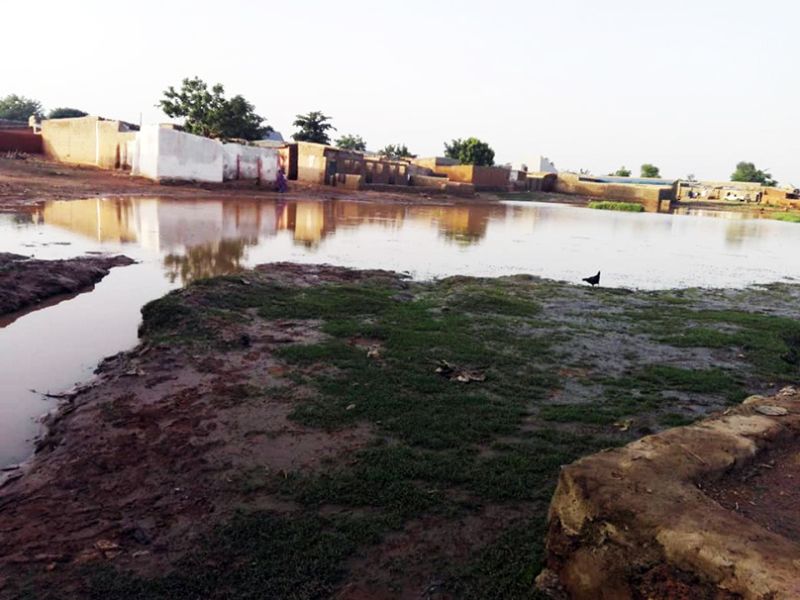
Two women lost their lives and over 30 houses were reportedly destroyed as a result of heavy rainstorm that occured on Saturday in Kankara Local Government Area of Katsina State.
According to an information officer at the council area, Abdulkarim Sani, one of the women died when the walls of her building collapsed and fell upon her. The deceased, he said had since been buried according to Islamic rites.
Sani also noted that Nasarawa and Matsiga communities were the worst-hit by the rainstorm which fell at different intervals between Saturday and Sunday..
Local authorities were still trying to determine the extent of damage to humans, homes and farmlands as at time of this report.
The State Emergency Management Agency (SEMA) were yet to issue any statement or respond to inquiries on the incident.