Home Blog Page 2719

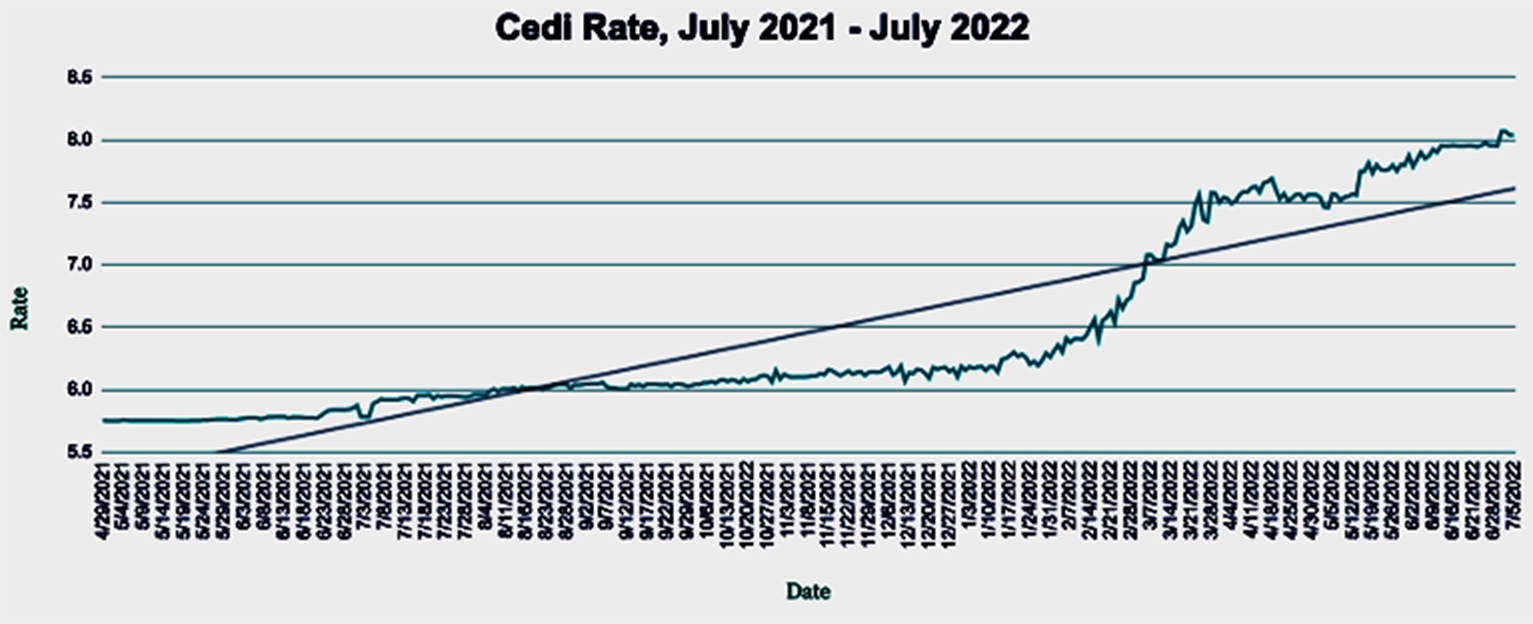
Cedi sinks to record low after IMF loan request

0
Cedi

The Cedi weakened to a fresh low against the dollar this week, depreciating to 8.04 from 7.95 at last week’s close. Amid mass protests over soaring inflation and its weakening currency, Ghana late last week reversed its decision to refrain from requesting international financial aid. The country is seeking as much as $1.5bn from the IMF to shore up its finances and regain access to global capital markets. At the same time, the government is considering offering fuel coupons to transportation companies to reduce the impact of fuel price inflation on food costs. Despite the potential for an IMF deal, we expect the Cedi to depreciate further given the economic challenges the country faces.

Relief initiatives taking shape to ease food and debt
As the supply-chain disruption caused by Russia’s war in Ukraine continues, international relief packages for Africa are starting to take shape. USAID this week pledged a $30m package to support Zambian food exports to East African countries to help ease the impact of soaring food prices. Meanwhile, Paris-based think tank Finance for Development Lab has launched the African Liquidity and Stability Mechanism to help shield African countries from the impact of volatile commodity prices and provide debt relief. The mechanism will be funded by African countries, donors and proceeds from rich countries rerouting their allocations of the IMF’s special drawing rights to African countries, in alignment with the Liquidity and Sustainability Facility initiative from the United Nations Economic Commission for Africa. Such assistance combined with plans from Turkey, the US and others to release trapped grain from Ukraine, signal some gradual relief for Africa’s struggling economies.
Naira

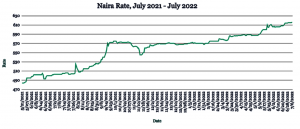
Naira dips to fresh dollar low 
The Naira dipped to a fresh low against the dollar this week, trading at 616 from 615 at last week’s close. The Nigerian National Petroleum Corporation said it will officially transition to a commercial entity by July 19 as part of a plan to increase operational efficiency and attract local and foreign investment. Meantime, the EU has pledged about $1.3bn of funding to Nigeria to help it diversify away from fossil fuels and reduce climate change vulnerability. The funding will cover 57 projects across the country focused on averting deforestation, desertification and a waste-to-energy initiative. In the near term, we expect further depreciation given increased dollar demand in a tight FX market.

Naira

Rand at 2-year low on loadshedding and risk retreat
The Rand slumped to its weakest level against the dollar since the start of the pandemic, trading at 16.55 from 16.45 at last week’s close amid global risk-off sentiment and domestic power shortages. Concerns that Europe is heading for recession exacerbated the retreat from risk assets, while ongoing loadshedding by South Africa’s power company Eskom is driving speculation of a ratings downgrade, with a negative impact for the country’s strained economy. Given these pressures, we expect the Rand to continue trading around this level in the week ahead.
Egypt

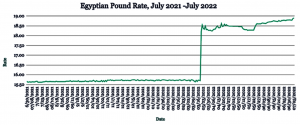
Egyptian Pound weaker as investors seek haven assets
The Pound weakened against the dollar this week, trading at 18.89 from 18.80 at last week’s close as investors seek haven currencies and higher interest rates in the US. Egypt’s government said it will borrow EGP818bn in the local market through the issuance of treasury bills and bonds during the second half of the year to finance its budget deficit. The government is seeking to reduce the budget deficit to 6.1% of GDP this year, from a gap as high as 12.5% in 2016, as part of a plan to bring debt levels towards 84% of GDP and make the country less reliant on international financing. We expect the Pound to trade at a similar levels in coming days.
Kenya

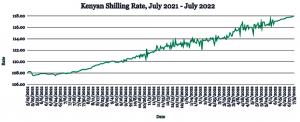
Kenyan Shilling hits new low as inflation climbs
The Shilling weakened to another record dollar low this week, depreciating to 117.95/118.15 from 117.70/117.90 at last week’s close. Kenya’s central bank said annual inflation jumped to 7.9% in June from 7.1% in May due to increases in food and energy prices. Food inflation has been exacerbated by unfavourable weather conditions and increased transport costs owing to higher oil prices fuelled by Russia’s war in Ukraine. With August’s presidential election approaching, we expect political uncertainty to further destabilise the Shilling in the near term.

Uganda

Ugandan Shilling strengthens after emergency rate hike
The Shilling appreciated to its strongest level against the dollar since May, trading at 3715 from 3744 at last week’s close. Those gains came after the Bank of Uganda raised its benchmark interest rate by 100 basis points to 8.5% during an emergency meeting this week, adding to the 100bp hike last month. The move is aimed at countering inflation and supporting the currency, which has shed more than 5% of its value against the dollar since the start of the year. Uganda’s interest rate is now at its highest level since near the start of the pandemic. We expect the Shilling to strengthen further.
Tanza

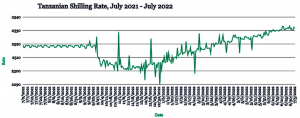
Risk-off sentiment to weaken Tanzanian Shilling
The Shilling held steady against the dollar this week, trading at 2332, in line with last week’s close. Tanzanians have been feeling pain at the pumps despite the introduction of a fuel subsidy at the start of June, with petrol prices rising more than 7% over the past month to TZS3220. Given those domestic economic strains and the broader risk-off sentiment, we expect the Shilling to weaken against the dollar in the week ahead.

Credit: www.azafinance.com 

Lithovit Liquid Fertiliser was among agrochemicals approved by CRIG -Witness

0
Court Complex

A former Cocoa Health and Extension Division (CHED) officer, Samuel Tsatsu Adigreh, says Lithovit Liquid Fertiliser was among the list of agrochemicals approved by the Cocoa Research Institute of Ghana (CRIG).
He said CRIG, in addition to the approval of the agrochemical, sent a team of scientists to assess the effects of the chemical on the field.
According to him, although CHED worked with feedback from CRIG, it did not receive any negative recommendations on the use of Lithovit Liquid Fertiliser after a field inspection.
Mr. Adigreh told the Accra Criminal High Court on Wednesday, July 6, 2022, during cross-examination that the Ghana Cocoa Board’s (COCOBOD) official report, written by the CHED management team, acknowledged the efficacy of Lithovit Liquid Fertiliser.
He said the CHED management team admitted in its report that farmers were showering praises on the chemical for improving their yields.
Mr. Adigreh added that he witnessed the effectiveness of Lithovit Liquid Fertiliser on cocoa trees in 2014/2015 when it was introduced in the Assin Fosu District to farmers.
He maintained that farmers who used Lithovit Fertiliser before it was halted in 2017 by COCOBOD were constantly demanding the agrochemical.
But the Chief State Attorney, Evelyn Keelson, cross-examining him doubted his claim and said: “I am putting it to you that your testimony on Lithovit Liquid Fertiliser and the agitation from farmers on that fertiliser is not supported by the records.”
According to Mrs. Keelson, Mr. Adigreh, who is testifying on behalf of COCOBOD’s former Chief Executive (CE), Dr. Stephen Kwabena Opuni, did not have an idea of any report from CRIG recommending Lithovit Folia Fertiliser to the Board.
She added that Mr. Adringra did not know the chemical composition and formulation of the Lithovit Fertiliser.
Nevertheless, the witness reiterated that there was no negative recommendation from CRIG to CHED to show that there was something wrong in the usage of Lithovit.
He further stated that he was not a scientist, but a technical staff who ascertain an effectiveness of the agrochemical through observations.
Dr. Opuni is standing trial on some 27 counts in the suppliers of Lithovit Liquid Fertiliser with Seidu Agongo and Agricult Ghana Limited.
The following are the excerpts of proceedings:
Q. Between 2006 and May 2015 when you worked at Assin Fosu you were a junior officer. Is that not so?
A. It is not fully true. I was a junior officer up to 2012, and I had a promotion as a Technical Officer, which is a senior position.
Q. You only became a District Cocoa Offence when you were transferred to Adabokrom?
A. That is correct.
Q. Whiles you were a District Cocoa Officer in Adabokrom no Lithovit Liquid Fertiliser was distributed to farmers in Adabokrom. Is that correct?
A. No my lord. Lithovit Liquid Fertiliser was distributed to farmers at Adabokrom, but there were settler farmers from the Brong Ahafo Region who had farmed in the Brong Ahafo Region as well as in the Adabokrom District, and those farmers always requested from me to make requisition to the CODAPEC Secretariat to supply us with the Lithovit as well.
Q. In your very short stay at Assin Fosu after the introduction of Lithovit Liquid Fertiliser, you did not observe any yields. Is that not so?
A. My lord, Lithovit Liquid Fertiliser was introduced at Assin Fosu in 2014/15, and for our operation some farmers had Lithovit in September 2014 and others had it from February 2015, therefore, from that period till April 2015, I observed the performance of Lithovit, as well as other agrochemical supplies to our farmers. This was why when the CHED management team came I was in a position to take them around for inspection on our operations.
Q. I am putting it to you that from your own evidence before this honourable court you only observed flashy leaves, pods, cherelles; that’s all you observed.
Q. My lord, those are the results of the application of the fertiliser. It gives flashy leaves which results into the tree bearing flowers; the flowers grow into cherelles, and the cherelles within three to four months grow into pods. This explains why I said some farmers applied the Lithovit, from September when it was distributed to them, and, therefore, if I did not go to the field I wouldn’t have observed these things.
Q. I am putting it to you that from the evidence of Samuel Torbi, who is a farmer at Assin Fosu, Lithovit Liquid Fertiliser was introduced in Assin Fosu in the 2015/16 Cocoa Season?
A. This is not true. Just as I said, some farmers had Lithovit in 2014, whiles others started getting Lithoivt from 2015. As such, it could be that Samuel Torbi had his in 2015, and not [was] among those who had it in 2014. This is because there were other liquid fertilisers like Lifet A and Sidalco already in the system before Lithovit was introduced.
Q. I am further putting it to you that Lithovit Liquid Fertiliser was introduced in Assin Fosu in February 2016, by which time you were not in Assin Fosu?
A. This is not correct my Lord. I said earlier that my management team came to Assin Fosu in April 2015. I accompanied them to the field; they inspects our files, operations, including the spraying of Lithovit and other agrochemicals, and at the end of the tour, they put their observation into [a] report, of which they reported on [the] effect of Lithovit on the field. This, therefore, confirms my testimony that Lithovit was introduced in [the] 2014/15 season.
Q. You claim in your evidence-in-chief that you trained the farmers on how to apply the Lithovit Liquid Fertiliser. Can you describe to the court the Lithovit Liquid Fertiliser you claim you saw?
A. The Lithovit I saw was in a one litre container with a green cap and grey in colour. When you open the container, you smell a sharp scent [at] once, and this product, if you are not able to use all the same day, the following day you will feel a scent like urine. And on the container you have Agricult on it.
Q. Can you tell the court what else is on the container, apart from the Agricult?
A. For me, the most important thing that I deem necessary to know on the container is the dosage. This is the most important thing to me as the technical officer. The other descriptions I can’t tell.
Q. I am putting it to you that the most important prescription on the fertiliser is the method of application and the rate of application?
A. That is what I mentioned earlier. The dosage is the same as rate of application, and being a liquid fertiliser, just like the Sidalco and Lifet A, the method of application is not different.
Q. I am putting it to you that you do not know the method of application and the application rate inscribed on the fertiliser, because you did not handle it?
A. My Lord, the application rate is 30ml, and I trained farmers on how to mix liquid fertiliser with water for application, and this [is] not being different from other liquid fertiliser most farmers who have been trained in the use of liquid fertilisers, so do not need any further training than knowing the dosage. But this notwithstanding, some farmers who happen to be first time users of this liquid fertiliser were taken though the method of application.
Q. Tell the court how much water is required for the 30ml of fertiliser you mentioned?
A. 15 litres of water to 30ml of the chemical. That is when one is using the hand sprayer. We use the hand sprayer for younger cocoa in spraying, and use the mist blower for the mature crops.
Q. I am putting it to you that from the label on the Lithovit Liquid Fertiliser the mist blower is not used by users to apply the fertiliser on the cocoa tree?
A. My Lord, each and every one of us here knows the nature of cocoa tree. A standard mature cocoa tree is about 7 feet, whereas most farmers who do not prune their farm have their height of cocoa more than 10 feet, and no farmer can use the hand sprayer to spray trees of sun height. Therefore, the fact that the manufacturer did not indicate that mist blower should be used it is common knowledge to us the technical staff that [the] mist blower is the appropriate equipment to use for mature cocoa farms.
Q. I am putting it to you that the manufacturer indicated on the fertiliser that the knapsack sprayer was to be used in the application of the fertiliser, because it was not meant for mature cocoa?
A. That is not true. It is meant for both matured and young cocoa, just like the other liquid fertiliser. That is how come we applied it on matures cocoa, and every farmer sings praises of its efficacy.
Q. You do not know the chemical composition and formulation of the Lithovit Liquid Fertiliser. Is that not so?
A. My Lord, just as you asked me the other time, I am not a scientist. I am just a technical staff, and what I feel is most important to me to know about any chemical is the rate of application and how it should be applied.
Q. You do not know the nature and composition of the Lithovit Fertiliser which Agricult, through Agongo, submitted to CRIG for testing?
A. I am here testifying on Lithovit Liquid Fertiliser. That is what was supplied to CHED for distribution to farmers, and it is among the list of agrochemicals approved by CRIG, which is the scientific wing of COCOBOD. They approved the chemical just like other agrochemicals supplied to us. It is not my responsibility to know the process it had gone through. We are the end users.
Q. You do not have an idea of any report from CRIG recommending Lithovit Foliar Fertiliser to COCOBOD. Is that not so?
A. My Lord, I earlier said Lithovit Liquid Fertiliser is among the list of CRIG-agrochemicals sent to us. Additionally, in the course of our operations in the field, CRIG staff do come to inspect the effects of chemicals we are using, and, if any, give a feedback on it, and therefore since on their visit no negative recommendation about Lithovit came from them to us indicating that there is nothing wrong about its usage.
Q. I am putting it to you that there is no report from CRIG that Lithovit Liquid Fertiliser was rated and approved by them?
A. I said CHED management team came for inspection. COCOBOD does not do anything in a vacuum. The CODAPEC/HITEC Secretariat I know will submit its request to COCOBOD on the type of agrochemicals to procure before funds are released for its purchase for farmers. As such, the Secretariat cannot recommend any chemical that they do not know anything about.
Q. I am putting it to you that Lithovit Liquid Fertiliser is what you know, because that was what COCOBOD purchased for farmers. Is that not so?
A. Lithovit Liquid Fertiliser is the only Lithovit Fertiliser I know.
Q. You did not appear before the Dr. Adu-Ampomah Committee set up by COCOBOD in 2017. Is that not so?
A. Yes, my Lord. I even don’t know there was any committee set up by COCOBOD.
Q. So you have no idea what that committee was looking for.
A. My Lord, my being here is to testify on the efficacy of Lithovit Liquid Fertiliser that farmers used and are clamouring for more to be supplied to them, and which my CHED management team also, in the course of their tour visit, testified that it is very effective and the demand for it from farmers as compared to other liquid fertilisers was higher.
Q. I am putting it to you that as you sit here, you have no capacity whatsoever to comment on the finding and conclusions contained in the Adu-Ampomah Committee report, let alone challenge it?
A. My Lord, I earlier said that I did not know that there was any Dr. Ady-Ampomah Committee. How then do I speak to a committee that I know nothing of? So I haven’t spoken on any committee findings, but rather on my own observations of the Lithovit Liquid Fertiliser, the reports from the farmers, my CHED management team report. This is what I have spoken of.
Q. I am further putting it to you that you have no capacity to comment on the findings of the University of Ghana report on Lithovit Liquid Fertiliser, because you are not a scientist?
A. My Lord, I remember I said I was not there when the said Lithovit Fertiliser was tested by the University of Ghana. What I said was that having seen the efficacy of the Lithovit Liquid Fertiliser which was being used by farmers, and which my CHED management came to inspect its performance in the field, then it cannot be the same Lithovit Fertiliser that COCOBOD supplied to our farmers. I am not a scientist to know the efficacy of a chemical. I can observe and see what an efficient or inefficient chemical is.
Q. You do not have a single official report that you issued on the supposed efficacy of Lithovit Liquid Fertiliser whiles you were a District Officer. Is that not so?
A. My Lord, just as you said earlier, while at Assin Fosu where the Lithovit Liquid Fertiliser was used, I wasn’t a District Officer. I came back to meet a large quantity in store, and my predecessor said there was a directive from our head office putting a restriction on its usage, and who am I, a common District Cocoa Officer, to write a report to my bosses.
Q. I am putting it to you that, as a whole District Cocoa Officer you do not even have a single official report on the supposed agitations by your farmers, either in Adabokrom or Assin Fosu, on your return against the withdrawal of Lithovit Liquid Fertiliser. You have nothing official to show for that.
A. Who am I to write against a decision taken by my employer, therefore, a law abiding employee as I am there was nothing I can report.
Q. I am putting it to you that your testimony before this court on the supposed efficacy of Lithovit Liquid Fertiliser, and the agitation of farmers for that fertiliser, is not supported by the record at COCOBOD.
A. In COCOBOD’s ordinal report written by CHED management team, they acknowledged the efficacy of Lithoivt Liquid Fertiliser, and they admitted that farmers were showering praises on the chemical, and in my own capacity as a Field Supervisor, I saw its performance. Again, there are a lot of farmers who testified that by using Lithovit Liquid Fertiliser it increases their yield, out of which some of them said they put up their building or bought their personal vehicles.
Q. I am putting it to you that there is no report on the supposed efficacy of Lithovit Liquid Fertiliser by any particular CHED official.
A. My Lord, I said I chanced to read teh management team report at Adabokrom, and therefore believe that that report would be at the Head Office.
Q. Tell the court who wrote this supposed report.
A. It is a report put down as a report by CHED management team. That is what I know. This CHED management team comprised of the Executive Director, Deputy Executive Director – Monitoring and Evaluation, technical officers accompanied by the Regional Managers, and, therefore, I cannot tell which of the members wrote the report.
Q. I am putting it to you that your testimony before this court on the supposed efficacy of Lithovit Liquid Fertiliser is largely based on what you claim you heard from supposed farmers, and not on what you saw?
A. My Lord, that is not true. Just as I said severally, I was a Field Supervisor at Assin Fosu before promoted to head the district at Adabokrom. At Assin Fosu, I inspected some farms where Lithovit was applied and had my on observations as such my testimony here is not based on only what farmers told me.
Q. And that is why you told the court on Monday in your testimony that you have no records of yield to show for the supposed efficacy of Lithovit Liquid Fertiliser.
A. My Lord, in terms of compiling the yield for the district, it is not CHED’s mandate. This is the responsibility of Quality Control Company (QCC). We only contact them if there is a request by Head Office or any NGO approaches us for it. It is, therefore, not strange that as I sit here I cannot mention any yield records of my district.
The court adjourned re-examination of the witness to yesterday July 7, and the continuation of the evidence of another witness.

Let’s tackle hardship in Ghana before building cathedral -MzVee

1
MzVee

Ghanaian Singer, MzVee has added her voice to hardship in Ghana and the building of national cathedral by the current NPP government

According to the ‘Sherriff’ hitmaker, prices of commodities and services have been sky-rocketing these past years, citing how much she fills her car tank for.

“I was filling my tank for about GHc300 but now I fill it for close to GHc700 so yeah it’s hard in Ghana,” she said. Speaking on the newly introduced electronic levy, MzVee said ” I don’t have a good take on E-Levy because I feel like it’s a double taxation situation.”

She details that; “everything has been increased” and added that she now have to pay over a hundred per cent of the price she used to buy fuel for her car compared to some few years ago.

Speaking on other matters of national concern, MzVee said it will be better for the government to focus on solving the elementary issues the country is facing before it builds a cathedral.

“I think there are basic things we should look at before we think about building a national cathedral in this country. I feel like for every five minutes there is a church, so why don’t we focus on fixing street lights, fixing potholes basic things like that before we think about one big church for God,” the 10-Thirty album composer intimated.

In the interview with Pulse GH which is available to The Chronicle, MzVee ended; “hardship has definitely increased in Ghana. I think Ghana is part of the top 5 countries since the Ukraine and Russia war that is like going through it”.

Rocky Dawuni blasts African leaders

0
Rocky Dawuni

Two-time Grammy nominated musician and activist Rocky Dawuni hasgone hard on African leaders in a latest post on social media.

The attacking of African leaders by the Ghanaian music legend comes at a time when most African countries are struggling due to economic mismanagement, usually attributed to corruption and corrupt practices of those at the helm of affairs.

Taking to his verified Facebook page, the Grammy Awards nominated musician argued that those who betray the trust of Africa must bow their heads in shame.

In the post, Rocky Dawuni wrote:

“Any socio-economic argument that is built on mortgaging the future of the youth and assets of the coming generations for immediate subsistence is fundamentally flawed. May those who betray the trust of Africa and its people for personal gain bow down in shame.”

Rocky Dawuni is a Ghanaian singer, songwriter and record producer who performed his signature ‘Afro Roots’ sound, which is a mixture of Reggae, Afrobeat, Highlife and Soul music. He currently lives between Ghana and Los Angeles, USA.

Over the last few years, Rocky’s music and electric live performances have attracted thousands to his concerts.

Rocky has performed around the world at most of the big stages for World and Reggae music events.

Rocky’s recent performances include the 18,000 strong ‘We Day’ event in Toronto, Canada alongside Somalian superstar K’Naan at the Air Canada Center for ‘Free The Children.’

US Rapper Diddy expresses interest in Black Sherif

0
Black Sherif and Diddy

The latest to express interest in ‘Kwaku The Traveler’ hitmaker, Black Sherif, as his brand is growing around the world is US Rapper cum businessman, Sean Diddy Combs popularly known as P. Diddy.

This was made known in an interview on Hitz FM by African-American private jet dealer, Kelvin Mensah. Mr. Mensah who is popularly known as PJKEV revealed that American Rapper Sean Combs reached out to Black Sherif, expressing his interest in working with him.

PJKEV further revealed that ‘I’m coming home’ crooner reach out to Black Sherif through him, that is why he is privy to it.

PJKEV said he had to contact Black Sherif on Instagram to relay the information about the interest from Diddy and his team but he can’t say much about the update.

Explaining why he doesn’t have much information on how far the negotiations have gone, PJKEV said he is no longer interested in the music business.

According to him, he just linked the two Artistes and went his way.

Black Sherif is gradually building an enviable brand around the world as international Artistes and brands keep expressing interest in him. He broke through the music scene with the ‘First Sermon’ and ‘Second Sermon.’ His ‘Kwaku the Traveler’ single further gave him an international breakthrough.

Kobby Kyei’s Artist Vibe Africa airs on GhOne TV

0
A flyer with details of the show

The much-awaited entertainment show, Artist Vibe Africa (AVA), put together by renowned social media influencer and blogger, Kobby Kyei has begun airing on GhOne Television this and every Saturday, at 2:30pm.

In an interview with this reporter, the initiator, who is also the host, Kobby Kyei, indicated the show is intended to have a conversation with people in the creative arts industry.

According to him, the show does not center on one aspect of the creative arts sector (musicians), but broadly touches photographers, painters and all others in the creative arts industry.

He stressed that the overall goal of the show, Artist Vibe Africa, which shows on Saturdays at 2:30pm on GhOne TV, is to help promote creative works, while pushing tourism to another pedestal.

“The show seeks to interview everybody under the creative arts umbrella. I created this show to bridge local and global partnership, especially for those in the diaspora who want to push their creative works in Africa.

“This show is for them, as well as those in the creative space locally who wants to promote their works. We are not looking at only musician. We are looking at photographers, painters, those in sculpture and more,” he said.

Artist Vibe Africa was premiered last Saturday on GhOne TV, having popular Reggae/Dancehall Artiste, Livingstone Etse Satekla, known in show business as Stonebowy, as the first guest.

Aside from interviewing artistes in the country, the show seeks to bring the diaspora to the motherland, giving that the channel airing is on DSTV, GOTV and MultiTV, making it available for majority of Africa countries to watch.

Kobby Kyei is confident that players in the industry will be able to reach larger audience through the show, and as such, has called on corporate Ghana to come on board as partners or sponsors.

“I want the government through the Tourism Ministry to come on board to sponsor. One thing I want to say to corporate Ghana is that creative industry is very key as a lot of people admire so corporate Ghana should invest and they won’t regret. Please come and sponsor Artist Vibe Africa,” he concluded.

With the vision to help African artist in the diaspora bring their works to this continent, AVA is schedule to embark on a Europe Production Tour this July and August.

Boris Johnson quits as Tory leader, What happens next

0
Prime Minister Boris Johnson (left) announcing his resignation


Who will be the next resident of No 10 Downing Stree

Boris Johnson has now confirmed he is resigning as Prime Minister after finally admitting defeat following the mass exodus from his Government.

He has announced his exit from Number 10 after a dramatic 48-hour period in which a torrent of ministers resigned. Here is what happens next:

 An interim PM will be named – could it be Boris Johnson?

The timetable for a Conservative leadership contest is expected to result in a successor being in place for the party’s conference in October.

But Mr Johnson is intending to stay in No 10 until the process is complete. And this  has raised the prospect of Mr Johnson remaining as Prime Minister for a number of weeks yet while a leadership contest takes place.

But, following the events of the last 48 hours, he is already facing pushback against this plan.

Who will be the next resident of No 10 Downing Street

 If not Boris, then who?

Dominic Raab, as Deputy Prime Minister, would appear to be the obvious choice to take over from Mr Johnson for an interim period while a permanent replacement is chosen.

He already has experience of being at the helm after he deputised for Mr Johnson when the PM was in intensive care with Covid.

There are already calls for Mr Raab to take over from Mr Johnson as swiftly as possible.

 Will Boris go to see the Queen?

If someone other than Mr Johnson is handed the reins of power on an interim basis, this would need to be done formally. Mr Johnson would go to Buckingham Palace to officially resign as Prime Minister in front of the Queen. He would then recommend his successor – whether that be Mr Raab on an interim basis or someone else. But, if Mr Johnson is allowed to stay on for a few more weeks while a new Tory leader is chosen, he would not need to make a trip to the Palace until later this summer.

 Tory leadership contest begins

Mr Johnson’s resignation has fired the starting gun on a Tory leadership contest, with some contenders having already been jostling for weeks. A Conservative leadership election takes place in two stages, with a timescale for each announced by the 1922 Committee.

It begins by candidates putting their own names forward. All Tory MPs then vote in a series of rounds  to whittle down the candidates.

In the first two rounds, the candidates who don’t meet a certain threshold of votes are eliminated.

For all subsequent ballots, the candidate who comes last is eliminated, until there are only two candidates remaining.

In the second stage of the leadership contest, the wider Tory party membership is balloted to choose between the final two candidates.

How long will it take to choose a new Tory leader?

Due to the circumstances, the Conservative Party is likely to want a swift contest. But the requirement for leadership hustings ahead of a ballot of the wider Tory membership means it is still set to take a number of weeks.

In 2019, the contest began with the opening of nominations on 10th June. Mr Johnson was then named the eventual victor almost six weeks later on 23rd July.

 Who will replace Boris Johnson

Conservative leadership race is already under way, with a number of MPs publicly declaring that they want to be the next leader or that they are seriously considering running.

A clear heir-apparent has yet to emerge. Here we set out the potential successors;

Ben Wallace

The defence secretary jumped to the fore as the bookies’ favourite, prompted by a YouGov poll that showed he was the first choice of among Conservative party members who were asked over the course of Tuesday and Wednesday who they would want to see as the next leader. Wallace has also been at the top of ConservativeHome polls of members’ favourite cabinet ministers on account of his handling of the war in Ukraine and the evacuation from Afghanistan.

Until now he has had a relatively low public profile, but Tory MPs say his popularity may have begun to make him consider a bid.

Rishi Sunak

The former chancellor’s leadership hopes were badly dented earlier this year but he may have re-energised his leadership hopes by his bold move on Tuesday to quit the cabinet. Long-regarded as a favourite to replace Johnson, Sunak’s profile took a hit from Partygate – he received a fixed-penalty notice – and from the potentially more damaging controversy over his family’s financial affairs. That episode sent his popularity plummeting after he had built a strong public profile.

Penny Mordaunt

The former defence secretary rocketed to the fore on Tuesday evening with bookmakers Coral installing her as the favourite to replace Johnson. However, amid a torrent of resignations over the past 48 hours, her decision to remain as international trade minister has raised eyebrows. In an apparent move to deflect criticism, Mordaunt broke her silence on Thursday morning to tweet that Wallace was “absolutely correct” when he said that “the public would not forgive us if we left these offices of state empty”.

Liz Truss

The foreign secretary was quick out of the traps to declare her support for Johnson after the departures of Javid and Sunak. She was in fourth place – with a considerable gap between her and Wallace – in this week’s YouGov poll of who Tory party members want to see as their new leader. The move to get behind Johnson was seen as an attempt to shore up potential support from other Johnson loyalists. Truss remains a frontrunner. She has been busy burnishing her public profile with Instagram shots and channelling Margaret Thatcher by wearing a headscarf while driving a tank.

Jeremy Hunt

Despite long enjoying a profile as the bookies’ favourite to replace Johnson, the man who beat him in the last Tory leadership election, the former health secretary’s odds have lengthened. He has frequently been talked about as the “safe pair of hands” replacement for Johnson, but in the wake of the moves by Javid and Sunak, a lack of boldness on the part of Hunt may now be more apparent than ever.

Nadhim Zahawi

The Tory MP, a multi-millionaire married father-of-three, went from being Boris Johnson’s saviour to his assassin in the space of a day amid claims he has been secretly preparing his leadership campaign for months with the help of the PM’s own election guru. Mr Zahawi joined other former loyalists at No 10 in trying to persuade Mr Johnson to quit. He is now one of the favourites to replace Boris Johnson.

Glee in Russia, sadness in Ukraine as Boris quits

Boris Johnson’s downfall has been met with delight and ridicule in Moscow. Russian foreign ministry spokesman Maria Zakharova told reporters Mr Johnson had been “hit by a boomerang launched by himself”, adding that the moral of the story was “do not seek to destroy Russia”.

But Ukraine struck the opposite tone: the presidency thanked the politician for his support in “the most difficult of times”, according to news agency AFP.

Credit: bbc.com

Home remedies for Ringworm

0
Ringworm

Read on to discover 11 natural treatments for fungal infections, such as ringworm:

  1. Garlic

Garlic paste may be used as a topical treatment, although no studies have been conducted on its use.

Garlic is often used to treat infection. Although there are no studies that examine the effects of garlic on ringworm, it has proven effective Trusted Source for other types of fungi, including CandidaTorulopsisTrichophyton, and Cryptococcus.

To use garlic as a treatment, make a paste of crushed garlic cloves by blending the garlic with some olive or coconut oil. Apply a thin layer of paste to the affected skin and cover with gauze. Leave in place for up to 2 hours before rinsing. Repeat twice daily until symptoms resolve.

If the garlic paste causes stinging, swelling, or redness, rinse off immediately and do not reapply.

  1. Soapy water

To prevent ringworm from spreading or infecting other areas of the body, keep the skin as clean as possible. To do this, rinse the infection with soap and warm water once or twice daily. Be sure to dry the skin fully, as fungus thrives in moist areas.

Always clean the skin in this way before using any of the other home remedies listed below. Before using any of the following substances on the ringworm patches, a person should apply a small amount to a healthy area of skin to ensure they do not have a sensitivity or allergy to the treatment.

  1. Apple cider vinegar

Apple cider vinegar has demonstrated Trusted Source antifungal properties against Candida, another fungal infection.

To treat ringworm with apple cider vinegar, soak a cotton wool pad in the undiluted vinegar and wipe it on the affected area. Repeat up to 3 times daily.

  1. Aloe vera

Aloe vera contains six antiseptic agents that, according to research Trusted Source, exhibit antifungal, antibacterial, and antiviral activities.

Apply the gel from an aloe vera plant onto the ringworm patch three or four times daily. The gel also has cooling properties, so it may soothe itchy and swollen skin.

  1. Coconut oil

Certain fatty acids found in coconut oil may kill fungal cells by damaging their cell membranes.

Some research suggests that coconut oil may be an effective remedy for people with mild to moderate skin infections. Use it to treat ringworm by applying liquid coconut oil to the skin three times per day.

Also, people can use coconut oil as a moisturizing lotion, which may be an effective way to prevent future ringworm infections.

  1. Grapefruit seed extract

Anecdotal evidence suggests that grapefruit seed extract may treat fungal infections. To treat ringworm, proponents recommend mixing 1 drop of grapefruit seed extract with a tablespoon of water and applying to the skin twice daily.

  1. Turmeric

Turmeric is a popular spice with anti-inflammatory properties. A part of turmeric known as curcumin is believed to be responsible for the spice’s health benefits. Numerous studies Trusted Source detail its extensive antimicrobial abilities.

Consume turmeric as a tea or add it to meals to reap its benefits. For topical applications, mix it with a small amount of water or coconut oil until it forms a paste and apply this to the skin. Leave it to dry before wiping off.

Be aware that turmeric may stain lighter skin a yellow color, but this will fade within a few days.

  1. Powdered licorice

estLicorice powder can be used to make a paste with antiviral and antimicrobial properties.

A frequently used herb in traditional Chinese medicine, licorice demonstrates antiviral, antimicrobial, and anti-inflammatory properties.

It is also used as a home remedy for ringworm and other fungal infections. For best results, mix 3 tablespoons of powdered licorice root into a cup of water.

Bring this mixture to a boil, then reduce heat and simmer for 10 minutes. Once the liquid has cooled, it should form a paste.

Apply this to the ringworm patch twice a day, allowing it to sit for at least 10 minutes each time before wiping or rinsing off.

  1. Tea tree oil

Native Australians have used tea tree oil as a remedy Trusted Source for many bacterial and fungal skin conditions for almost a century. Today, tea tree oil is both popular and effective in treating ringworm.

Make a 2 percent dilution of tea tree oil by mixing 12 drops of the essential oil with 1 ounce of cold-pressed carrier oil, such as coconut oil. Apply this to the skin three times daily.

Those who do not have sensitive skin may be able to apply the tea tree oil directly to the affected skin without diluting it first.

  1. Oil of oregano

Oil of oregano that is made from wild oregano (Origanum vulgare) contains two strong antifungal called thymol and carvacrol.

Some research Trusted Source has shown that oil of oregano can stop the growth of the fungus Candida albicans. Always dilute oil of oregano with carrier oil before use. Apply the oil to the affected area up to three times daily.

Note that the majority of oil of oregano on the market contains common oregano (Origanum marjoram) rather than wild oregano.

  1. Lemongrass oil

Lemongrass essential oil has been shown to reduce the activity of several types of fungus. To use lemongrass oil for ringworm, mix it with carrier oil, and apply it to the skin twice daily with a cotton ball.

Source: medicalnewstoday.com

Stop frustrating our members-TEWU warns CHASS

0
Mr Mark Dankyira Korankye, General Secretary, TEWU

The Teachers and Educational Workers’ Union (TEWU) has warned some members of the Conference of Heads of Assisted Secondary Schools (CHASS) to desist from intimidating its members to work despite the strike.

“Information reaching us is that some members of the Conference of Heads of Assisted Secondary Schools (CHASS), are intimidating our non-teaching staff, especially the kitchen staff and forcing them to remain at work,” the Union said.

A statement signed by Mr Mark Dankyira Korankye, the General Secretary of the Union to the Ghana News Agency described the actions of CHASS members as very unfortunate

“We are by this medium also telling all the non-Teaching staff to withdraw from all services and stay at home until they hear from us,” it said.

The Union requested the Director-General of the Ghana Education Service to call CHASS to order and asked them to refrain from the threats and intimidations “as we all seek the appropriate response from Government on our request.”.

“We, in the leadership of the Union, do not want to have any confrontations with anybody as far as this Industrial Action is concerned.

“No teacher is being forced and threatened to remain in the classroom, so we do not see why the non-teaching staff are being treated this way,” he said.

Four Unions in education on Monday July 4, 2022, embarked on an Industrial action to cover their Cost- of -Living Allowance.

The Unions are Ghana National Association of Teachers, National Association of Graduate Teachers, TEWU and Coalition of Concerned Teachers.

GNA

Opposition To Doing A Great Work For The Lord

0
Dr. Joyce Rosalind Aryee, Executive Director, Salt and Light Ministries

Then the peoples around them set out to discourage the people of Judah and make them afraid to go on building. They bribed officials to work against them and frustrate their plans during the entire reign of Cyrus king of Persia and down to the reign of Darius king of Persia. – Ezra 4:4-5

INTRODUCTION

Accomplishing any large task is tiring. There are always pressures that foster discouragement – the task seems impossible, it can never be finished, or too many factors are working against us. The only cure for fatigue or discouragement is focusing on God’s purposes. Nehemiah reminded the workers of their calling, their goal, and God’s protection. If we are overwhelmed by an assignment, tired and discouraged, let’s remember God’s purpose for our lives and His special purpose for the project.

NEHEMIAH 4:1-23

When Sanballat heard that we were rebuilding the wall, he became angry and was greatly incensed. He ridiculed the Jews, and in the presence of his associates and the army of Samaria, he said, “What are those feeble Jews doing? Will they restore their wall? Will they offer sacrifices? Will they finish in a day? Can they bring the stones back to life from those heaps of rubble—burned as they are?”

Tobiah the Ammonite, who was at his side, said, “What they are building—even a fox climbing up on it would break down their wall of stones!”

Hear us, our God, for we are despised. Turn their insults back on their own heads. Give them over as plunder in a land of captivity. Do not cover up their guilt or blot out their sins from your sight, for they have thrown insults in the face of the builders.

So we rebuilt the wall till all of it reached half its height, for the people worked with all their heart.

But when Sanballat, Tobiah, the Arabs, the Ammonites and the people of Ashdod heard that the repairs to Jerusalem’s walls had gone ahead and that the gaps were being closed, they were very angry. They all plotted together to come and fight against Jerusalem and stir up trouble against it. But we prayed to our God and posted a guard day and night to meet this threat.

Meanwhile, the people in Judah said, “The strength of the laborers is giving out, and there is so much rubble that we cannot rebuild the wall.”

Also our enemies said, “Before they know it or see us, we will be right there among them and will kill them and put an end to the work.”

Then the Jews who lived near them came and told us ten times over, “Wherever you turn, they will attack us.”

Therefore I stationed some of the people behind the lowest points of the wall at the exposed places, posting them by families, with their swords, spears and bows. After I looked things over, I stood up and said to the nobles, the officials and the rest of the people, “Don’t be afraid of them. Remember the Lord, who is great and awesome, and fight for your families, your sons and your daughters, your wives and your homes.”

When our enemies heard that we were aware of their plot and that God had frustrated it, we all returned to the wall, each to our own work.

From that day on, half of my men did the work, while the other half were equipped with spears, shields, bows and armor. The officers posted themselves behind all the people of Judah who were building the wall. Those who carried materials did their work with one hand and held a weapon in the other, and each of the builders wore his sword at his side as he worked. But the man who sounded the trumpet stayed with me.

Then I said to the nobles, the officials and the rest of the people, “The work is extensive and spread out, and we are widely separated from each other along the wall. Wherever you hear the sound of the trumpet, join us there. Our God will fight for us!”

So we continued the work with half the men holding spears, from the first light of dawn till the stars came out. At that time I also said to the people, “Have every man and his helper stay inside Jerusalem at night, so they can serve us as guards by night and as workers by day.” Neither I nor my brothers nor my men nor the guards with me took off our clothes; each had his weapon, even when he went for water.


FURTHER OPPOSITION TO THE REBUILDING – Nehemiah 6:1-14

When word came to Sanballat, Tobiah, Geshem the Arab and the rest of our enemies that I had rebuilt the wall and not a gap was left in it—though up to that time I had not set the doors in the gates— Sanballat and Geshem sent me this message: “Come, let us meet together in one of the villages on the plain of Ono.”

But they were scheming to harm me; so I sent messengers to them with this reply: “I am carrying on a great project and cannot go down. Why should the work stop while I leave it and go down to you?” Four times they sent me the same message, and each time I gave them the same answer.

Then, the fifth time, Sanballat sent his aide to me with the same message, and in his hand was an unsealed letter in which was written:

“It is reported among the nations—and Geshem says it is true—that you and the Jews are plotting to revolt, and therefore you are building the wall. Moreover, according to these reports you are about to become their king and have even appointed prophets to make this proclamation about you in Jerusalem: ‘There is a king in Judah!’ Now this report will get back to the king; so come, let us meet together.”

I sent him this reply: “Nothing like what you are saying is happening; you are just making it up out of your head.”

They were all trying to frighten us, thinking, “Their hands will get too weak for the work, and it will not be completed.”

But I prayed, “Now strengthen my hands.”

One day I went to the house of Shemaiah son of Delaiah, the son of Mehetabel, who was shut in at his home. He said, “Let us meet in the house of God, inside the temple, and let us close the temple doors, because men are coming to kill you—by night they are coming to kill you.”

But I said, “Should a man like me run away? Or should someone like me go into the temple to save his life? I will not go!” I realized that God had not sent him, but that he had prophesied against me because Tobiah and Sanballat had hired him. He had been hired to intimidate me so that I would commit a sin by doing this, and then they would give me a bad name to discredit me.

Remember Tobiah and Sanballat, my God, because of what they have done; remember also the prophet Noadiah and how she and the rest of the prophets have been trying to intimidate me. 

THE COMPLETION OF THE WALL – Nehemiah 6:15-19

 So the wall was completed on the twenty-fifth of Elul, in fifty-two days.

When all our enemies heard about this, all the surrounding nations were afraid and lost their self-confidence, because they realized that this work had been done with the help of our God.

Also, in those days the nobles of Judah were sending many letters to Tobiah, and replies from Tobiah kept coming to them. For many in Judah were under oath to him, since he was son-in-law to Shekaniah son of Arah, and his son Jehohanan had married the daughter of Meshullam son of Berekiah. Moreover, they kept reporting to me his good deeds and then telling him what I said. And Tobiah sent letters to intimidate me.

 CONCLUSION

When opposition builds up against us or God’s work, it is tempting to pray, ‘God, get me out of this situation.’ But Nehemiah prayed for strength. He showed tremendous determination and character to remain steadfast in his responsibility. When we pray for strength, God always answers.

 Stay blessed!

 Please continue to join us on Asempa 94.7 FM – Sunday 5.30 am., Sunny 88.7 FM – Tuesdays 5:30 am; and YFM 107.9 – Sundays 6.30am; for our Radio Bible Study as well as Sunny FM 88.7 FM every Sunday at 3:30 pm. for Hymn and their Stories.

The Ghanaian Chronicle