Home Blog Page 2698

Feature: Inadequate Educational Facilities; Our Unending Challenge

0
Yaw Osei Adutwum, Minister for Education

Education they say is the key to success. Is the success being seen? Is the education giving out proper? Education is the act or process of imparting or acquiring general knowledge, developing the powers of reasoning and judgment, and generally of preparing oneself or others intellectually for mature life.  It is also where a person develops skills essential to daily living,

Learns social norms, develops judgment and reasoning, and learns how to discern right from wrong.

The importance of education in our lives goes far beyond what we can read in a textbook. Education also provides children with knowledge such as how to produce artwork and make music. Education allows us to analyse what’s in front of us, and even learn from our mistakes

People with higher education and varied experience are more likely to get high-paying, expert jobs. Studying hard throughout school and studies shows that one will not be afraid of hard work and will be able to fulfill goals. Employers see this as a huge advantage as they all prefer a responsible and knowledgeable workforce. Once one graduate, he or she can start searching for jobs that will give them the opportunity to practice what they’ve learnt and, at the same time, secures sufficient pay for their needs.

Ghana had the opportunity to showcase to the world its preparedness to manage its own affairs through home grown Human Resources after the independence. The evidence of our own capacity to man our sectors has been a product of educational system, bearing such fruits as other countries within the African region coming into Ghana to study. This enviable position of Ghana has witnessed praises and kept it as benchmark for education within the West African sub-region for a long time.

Yet, Doryumu a town located at the Shia-Osudoku district in the Greater Accra Region lacks good educational system. There are two government schools and other private schools. Most of the people in the community can’t afford the private schools.

The government school’s building is in a bad state to the extent that when it rains children might have to go home. These buildings have no doors and windows.

As a result, most young people in the community have no education. This has led to early marriage among young girls in the community. When parents are not able to afford their ward’s fees, they then drop out, then get a husband then marry.

The Assembly Member of the community, Jacob Boatey, recently said financial problem has been the major thing that doesn’t make children go to school. He says before Covid-19 they planned to organise a program which will bring all the people in the community that has been successful together and organise a fundraising for the children and build the government schools but couldn’t come on.

Some basic schools in the district are understaffed due to newly posted teachers rejecting their posting as a result of the bad road network and inadequate accommodation facilities.

The peculiar nature of the district –whereby the various communities are scattered makes it very difficult for teachers to accept postings due to underlying factors such as poor road networks and challenges in seeking decent accommodation.

This education gap shows how children from the poorest communities are missing opportunities to learn and grow into productive, happy adults. Because the children from the poorest households are not building the skills they need to learn, they face poorer education outcomes and remain trapped in the poverty cycle.

Education has always proven to be a very important tool for development in any country. In Ghana, however, although the government has taken steps to ensure the realizations of quality education, there is still a lot of work to be done as the Ghanaian educational sector is facing several challenges, especially in rural areas.

As many other rural villages experience their own obstacles in the educational sector. Without looking at the management side, the basic facilities for children to access the education are very poor and deplorable. Lack of school building and its facilities, lack of human resources to fill the minimum criteria of the school, long-distance between homes and school, lack of books/resources, library facilities, computer lab, etc. have turned out to be the obstacles for communities in rural areas in Ghana.

Most of the existing schools are not well maintained, therefore, the buildings are not safe enough for children and teachers to conduct the teaching and learning process. Some of the schools have no room for the basic school components to manage the resources and its facilities. The distance between school and home is also a challenge.

The departure from quality in the above initiatives is the lack of inadequate corresponding systems to ensure students are equipped with the skills, knowledge acquisition, in the first instance, making room for mass enrollment requires the requisite space to accommodate the students. When classrooms are limited or admissions are greater than classrooms space, the obvious outcomes will be poorly trained students as a result of mismatch the students teacher ratio and overcrowded classrooms.

The school environment is usually not conducive to learning. Classes are overcrowded, water and sanitation facilities are inadequate and trained teachers and school books are in short supply. The poor quality of education is reflected in students’ results. Children living with disabilities face even more challenges and adolescent girls are often denied the chance to complete secondary education.

Regardless of the country, good school facilities help determine the success of students and the effectiveness of a teacher’s lesson. However, with tight budgets and staff costs, the condition of school facilities is often further down the list of priorities.

Studies show that school facilities have an impact on the overall school experience of students and teachers. More studies are beginning to highlight the full impact of a well-equipped learning environment. In turn, school governors and heads have a clearer understanding of the benefits and are giving more attention to the issue.

With the will of the school managers, and the continuing improvements and innovations of school facilities, the learning environment is more interactive and conducive. With good facilities, teachers will be better prepared to adapt to the changing education requirements of their students for the job market.

Many parents often do not consider the quality of school facilities as a factor in choosing a school for their children, looking only at exam rates. Good equipment and facilities are part of a school’s holistic approach to improving the learning environment and balancing academics with other important non-curriculum activities, whether science lab facilities or sports equipment. When a school invests in facilities, the benefits to the school go far beyond the initial capital costs.

Hindatu Adamu, GIJ

Mbappe scores late winner as PSG edge Nice

0
PSG are unbeaten in 18 Ligue 1 matches

Kylian Mbappe scored a late winner as Paris St-Germain beat Nice to climb back to the top of the Ligue 1 table. Lionel Messi’s excellent 20-yard free-kick, which left Kasper Schmeichel rooted to the spot, gave the French champions the lead.

Gaetan Laborde pounced from close range with his first Nice goal to give the visitors a surprise leveller. But substitute Mbappe struck in the 83rd minute to seal PSG’s seventh win in a row in all competitions.

The French striker, who replaced Hugo Ekitike just before the hour mark, slotted in from Nordi Mukiele’s cutback.

PSG are yet to lose since Christophe Galtier, who managed Nice last season, replaced Mauricio Pochettino as boss in the summer.

They go top with eight wins and a draw from nine games. Marseille, who drop to second, are also unbeaten with seven wins and two draws.

Credit: bbc.com

Milan beat Empoli in dramatic fashion

0
AC Milan players jubilate

Elsewhere, AC Milan rose to third in the table with three goals coming in the final five minutes of their 3-1 win at Empoli.

The champions were leading 1-0 going into injury time after Ante Rebic broke the deadlock in the 79th minute.

Nedim Bajrami netted an equaliser for Empoli in the 92nd minute only for Fode Ballo-Toure to restore Milan’s lead two minutes later.

And Rafeal Leao added a third right before the full-time whistle as Milan eased to their fifth league win of the season.

Milan sit level on points with second-placed Atalanta and three points behind league leaders Napoli, who extended their lead at the top of Serie A with a 3-1 win at home to Torino on Saturday.

Credit: bbc.com

Smalling heads winner as Roma beat Inter

0
Chris Smalling has scored two goals for Roma this season

Chris Smalling headed a 78th-minute winner as Roma came from behind to beat Inter Milan at the San Siro and jump to fourth in the Serie A table.

Smalling rose highest to nod in Lorenzo Pellegrini’s free-kick and ensure Roma beat their rivals for the first time since February 2017.

Federico Dimarco had opened the scoring for Inter after 30 minutes.

But the visitors were level nine minutes later through Paulo Dybala’s volley from an acute angle.

Roma’s win saw them go to within four points of leaders Napoli, while Inter remain in seventh, eight points off the top having lost four of their eight Serie A matches so far this season.

Inter had had the better of the game’s chances overall. Hakan Çalhanoglu hit the bar from a free-kick in the 62nd minute, while former Roma striker Eden Dzeko had thought he had opened the scoring in the 11th minute only for his strike to be ruled out by VAR.

Credit: bbc.com

Gallagher return to haunt Crystal Palace as Chelsea win

0
Palace felt Thiago Silva should have been sent off for a deliberate handball

Conor Gallagher returned to Selhurst Park to haunt Crystal Palace with a stunning late winner to give Graham Potter a controversial first victory as Chelsea boss. Gallagher, whose impressive form for Palace last season earned him his England debut, was introduced by Potter in the 76th minute for Kai Havertz.

And with the game seemingly petering out for a draw, the 22-year-old midfielder nutmegged Jean-Philippe Mateta before curling a shot into Vicente Guaita’s top corner.

Pierre-Emerick Aubameyang also scored his first Chelsea goal on his Premier League return after Odsonne Edouard had poked Palace into an early lead.

However, there was controversy surrounding Aubameyang’s goal as it was set up by Thiago Silva, who Palace felt should have been sent off for a deliberate handball which denied Jordan Ayew a possible goalscoring opportunity.

Credit: bbc.com

Arsenal beat Tottenham in North London derby to stay top

0
Gabriel Jesus taps in for Arsenal to score

Arsenal manager Mikel Arteta says his players are “hungry” for more after they maintained their position at the Premier League summit by overpowering north London rivals Tottenham in an outstanding display at Emirates Stadium.

His side were superior throughout and Spurs’ cause was not helped by Emerson Royal’s red card for a second-half foul on Gabriel Martinelli.

Arsenal made a fast start and took a deserved lead when Thomas Partey side-footed a precise finish into the top corner from 25 yards after 20 minutes.

Spurs were handed a lifeline before the break when Gabriel’s foul on Richarlison gave Harry Kane the opportunity to score his 14th goal in 18 derby games and his 100th goal away from home in the Premier League from the penalty spot.

Arsenal were gifted the lead once again when Spurs keeper Hugo Lloris fumbled badly to allow Gabriel Jesus to score four minutes after the break.

Conte was attempting to make three changes when Granit Xhaka effectively ended the contest with a low finish past Lloris from inside the area.

Credit: bbc.com

Haaland, Foden hat-tricks sink United in Manchester derby

0
Erling Haaland has scored his third home hat-trick in a row

Manchester City’s Erling Haaland became the first player to score three successive Premier League home hat-tricks as Manchester United were humiliated in the derby at Etihad Stadium.

Phil Foden also scored a treble as City closed the gap on pace-setters Arsenal to one point. This was a brutal reality check for United after their recent improvement, as the reigning Premier League champions ran riot to illustrate the gulf in class between the teams.

City’s lightning start was rewarded when Foden swept home Bernardo Silva’s cross after eight minutes before Haaland inevitably joined the action with a header from a corner 11 minutes before half-time.

As United subsided, Haaland slid in a third then turned provider to set up a simple finish for Foden before the break.

United’s new signing Antony struck a superb goal from 25 yards to pull one back but it only provoked City to up the tempo again, Haaland thumping home his third and then again setting up Foden for City’s sixth.

Anthony Martial’s late goal for United was greeted in near silence, as was his added-time penalty.

Credit: bbc.com

Ofori-Atta Assures Ghanaians, Financial sector will be protected in the IMF negotiations 

0
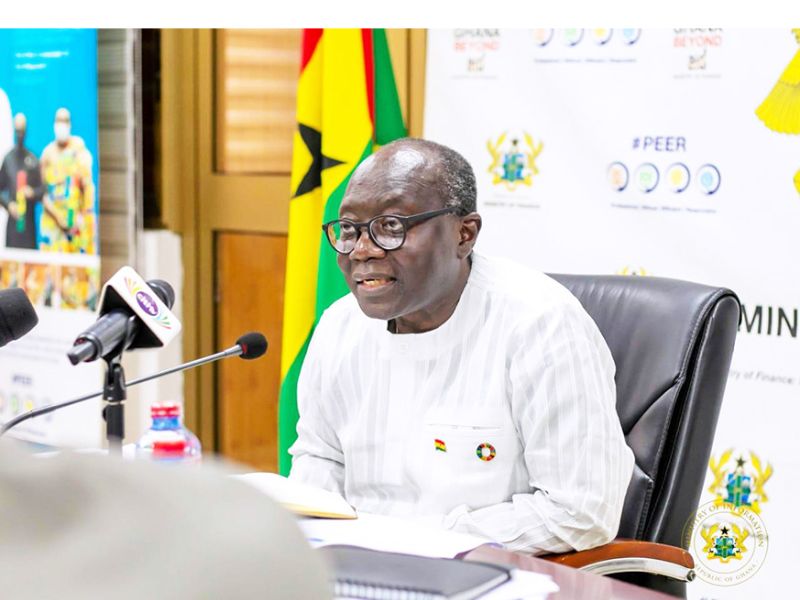
Mr. Ken Ofori-Attah, Finance Minister

The government has assured Ghanaians that the financial sector of the country will be protected in the negotiation with the International Monetary Fund (IMF) for economic support.

According to the Finance Minister Ken Ofori-Atta the country needs a viable domestic financial system to support its development programme, and will do everything possible to protect the sector.


“Therefore, everything must and will be done to protect our financial sector and there must be room for a win-win conversation through extensive stakeholder engagement, with both our domestic and external investors,” Ken Ofori-Atta stated, whilst addressing a news conference in Accra yesterday.


This assurance has allayed public fears that the IMF programme being negotiated by the government will cripple the financial sector, especially the banks.

According to Mr. Ofori-Atta, a five-member Committee, consisting of prominent financial service professionals will lead to extensive stakeholder engagements across all the key segments of the financial sector.


These engagements will add to ongoing activities with Civil Society Organisations (CSOs), social partners (labour unions, employers and FBOs), academia, industry professionals and the leadership of Parliament, with the minister assuring that “government shall continue to actively engage all stakeholders in a clear and transparent manner, as we seek to fast-track the IMF negotiation process.”


IMF PROGRAMME IN BUDGET

The media were informed that the government and the IMF on Monday, September 26, 2022, began formal negotiations for a Fund-supported programme and that discussions will cover a period of 10 days.

The Finance Minister said the negotiations with IMF, which started on Monday, this week, will be fast-tracked to ensure that key aspects of the programme are reflected in the 2023 Annual Budget Statement.

“Government is committed to ensuring that a comprehensive package is negotiated with the aim of restoring and sustaining macroeconomic stability, ensuring durable and inclusive growth, and promoting social protection,” he remarked.


7-PILLAR PROGRAMME

The reporters were told that the IMF programme hinged on seven pillars – debt sustainability; fiscal consolidation; strengthening monetary and exchange rate policies; and building strong financial institutions.

The rest are Macro-Critical Structural Reforms; Maintaining Peace and Security; and Economic Growth and Transformation.

Meanwhile, the government said it has not reached any agreement with the Fund on the parameters of any debt operations, “as we are in the process of completing the debt sustainability analysis.”


Read the Finance Minister’s full statement on pages 8 and 9.

Ghana will still rely on fossil fuel for a while -Veep

0
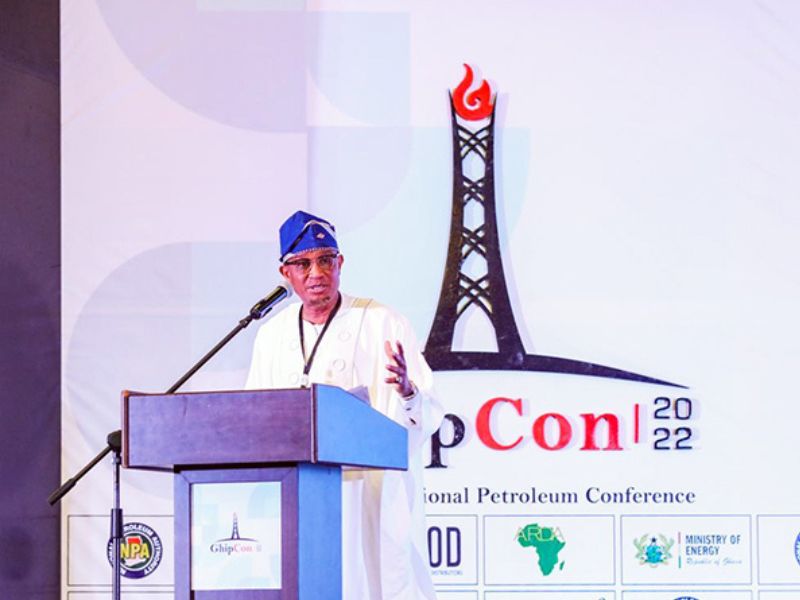
Dr Mustapha Abdul-Hamid, CE, NPA
Mr Anibor Kragha, CE, ADRA

The Vice President, Dr Mahamadu Bawumia, has indicated that though Ghana wants to contribute to reducing emissions, fossil fuel will be part of the country’s energy mix in the short term, while steps are put in place to rope in renewable energy in the long term.

According to the Vice President, government is indeed committed to achieving the net zero carbon emissions by 2070, but steps must be taken to accelerate the production and utilisation of Ghana’s oil and gas reserves, hence the decision to use fossil in the short time.

“…What this means is that even though we want to contribute to reducing emissions, we are of the view that a balance must be struck and maintained in the context of our social, economic and environmental requirements.

“So fossil fuels, particularly natural gas, will continue to be part of Ghana’s energy mix in the short term, whilst strategies will be put in place to increase the share of renewable energy in the mix, from medium to long term,” the Vice President said.

Mr Bawumia was speaking at the 5th edition of the Ghana International Petroleum Conference (GhIPCon), held under the theme: “Energy Transition in the African Petroleum Downstream Context: Prospects, Challenges and the Way Forward.”

Petroleum downstream industry players at the conference

The program, which commenced yesterday and will end on Friday, September 30, 2022 has the overall objective of focusing on the readiness of Africa’s petroleum downstream on transitioning.

Ghana is set to transition from the use of fossil fuel to renewable energy by 2070.

Government has in response to this target set up the National Energy Transition Committee (NETC), which aim is to develop a national energy transition policy.

The NETC is expected to set up national objectives and targets for the energy transition and prescribe policies and measures for achieving these targets.

It will, in addition, assess the benefits, risks and costs of the global energy transition and determine risks mitigation measures, along with cross-cutting issues that must be addressed.

Despite these measures by government, the Vice President explained at yesterday’s conference that in the quest to transition, a balance must be stuck and maintained in the context of Ghana’s social, economic and environmental requirements.

“…We ought to be forward thinking in a rapidly changing world, not only in terms of energy transition, but in terms of all aspects of the energy-mix”, he said and questioned how industry players intend to insulate the energy sector from global economic shocks, especially, considering how the Russia-Ukraine war has affected the energy sector in the last few months.

He, therefore, called on industry players at the conference to use the opportunity to deliberate on how governments in the West Africa region can  fully participate in the energy transition process, while remaining faithful to the needs and aspirations of their citizens.

He appealed to the NPA to ensure that it implements the recommendations that will be reached and not leave it on the shelves to gather dust.

The Chief Executive of the National Petroleum Authority (NPA), Mr Mustapha Hamid, on his part said that the Authority is committed to reducing the emissions from the energy products. This has culminated in the reduction of sulphur content in transport and industrial fuels from a maximum of 5000ppm to a maximum of 50ppm, as well as the implementation of the Cylinder Recirculation Model policy.

He, however, admitted that there will be pressure on government’s spending in the country’s quest to transition from fossil to renewable energy because government would still have to ensure that the diversification process meets global needs. He, therefore, called on all industry players to intensify their efforts in the transitioning process.

“The reality of fulfilling the energy transition commitment is that there will be further pressure on government spending to ensure that our diversification process meets global needs. It is, therefore, imperative that we intensify our efforts,” the NPA boss said.

The Minister for Energy, Mr Matthew Opoku Prempeh, who had a speech read on his behalf also said that Ghana remains committed both to an energy transition agenda and the development of its petroleum industry including the downstream sector and believes that the way forward is “to strike an important and fair balance between the two, without compromising our determination to maximize the benefits we need for our industrialization.”

Other industry players who spoke at the event were the Chief Executive, Africa Refiners & Distributors Association (ADRA), Mr Anibor Kragha, CEO, Chamber of Bulk Oil Distributors (CBOD) and others.


Honyenuga, others retire from judiciary

0
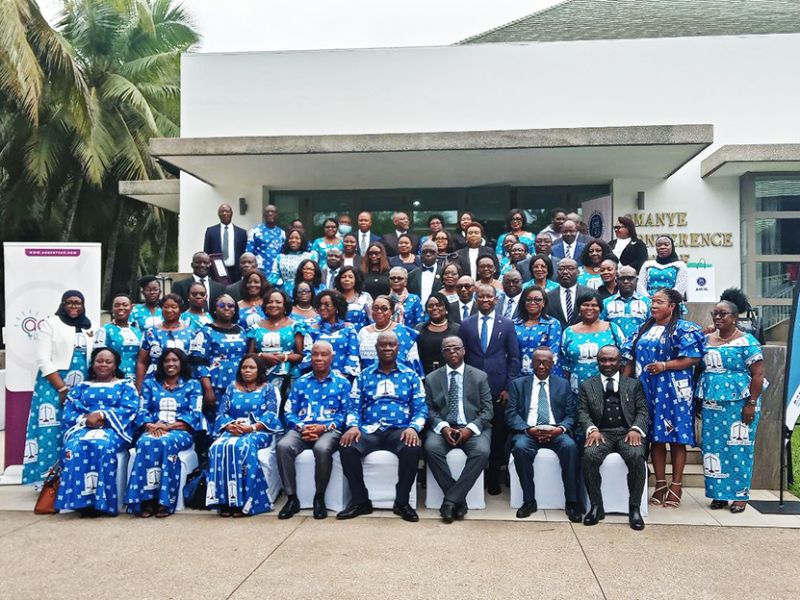
The retired judges in group photograph with the Chief Justice

The Association of Magistrates and Judges of Ghana (AMJG) has bid two justices of the Supreme Court – Agnes Dordzie and Justice Clemence Honyenuga – and ten others of the lower courts farewell after many years of service.

The Association sent off the retiring members amid cheering, acknowledgements, and presentation of plagues and envelopes at their annual conference held in Accra yesterday, under the theme: “Maintaining the Integrity of the Judiciary amidst the challenges of Democratic rights and Freedom.”

The retirement of the judges was announced by the AMJG President, Justice Henry A. Kwofie, while reading his address to welcome the members to the Conference.

He said the justices of the High Court going on retirement were Irene Charity Larbie and Merley Wood of the Court of Appeal, Fred Awuah, Nathaniel Osam, Rebecca Sittle, and Cecilia Donchebe.

The rest are Robert Agleze, Anthony Abiri Abebrese, Korkor Owusu Achaw and Seth Alafa of the Circuit and the District courts.

Justice Kwofie told the members that the package presented to the retiring judges this year had been increased, and that the decision was also based on the number of years they had severed and contributed to the Association.

According to him, the pervious practice where long serving members were bracketed with those who had served as judges and paid dues only for a short term, were unfair, adding, “We have also increased the amount paid to members in the event of bereavement.”

His Lordship Justice Anin Yeboah also announced to the members that the event was the last he would be attending as the Chief Justice of the Republic of Ghana, and thanked them for their contribution for justice delivery in the country.

He urged the members of the Association to use the occasion as an opportunity to take stock of their performances over the year, and identify where they fell short and strategise to secure the future and perform better.

Infrastructure development

Although Justice Kwofie was thankful for the infrastructural development being undertaken by the government, the he decried the deplorable state of the Cape Coast Court Complex, which urgently needed fixing, as well as the Wa Court Complex, which had also been abandoned.

Being particular about the Cape Coast Court Complex, he said: “I had the opportunity to visit one of my colleagues who works in the building this year in June, when it happened to be raining and although I am aware the court was in [a] deplorable state, I was shocked by what I saw; bowls and pans in various corners where the water was dripping to the judge’s office and [the] court room.

“It was definitely unacceptable, and no matter how determined you are to work [in] such an environment, [it] is not conducive to hard work. Something seriously needs to be done urgently about the Cape Coast Court Complex,” he lamented.

He noted that building more across the country requires an increase in the budget of the Judiciary to enable it purchase the materials the Association members needed to discharge their duties.

The Chief Justice gave an assurance that the government had not turned a blind eye on the deplorable conditions of the Cape Coast Court Complex and others that needed renovation, and that something was being done about them.

“We know that the working conditions of some of you, especially in the semi-urban areas are disappointing. We are working to improve the situation. We are investing more resources and refurbishing more court infrastructure including accommodation while we construct new ones,” he assured.

He added that the Service was making efforts to improve the application of technology to the work in the court rooms, and that they were equally working to acquire funding the World Bank for the expansion of the E-Justice system.

The Ghanaian Chronicle