Home Blog Page 2660

Son on target as South Korea beat Cameroon

0
Son Heung-min header earned South Korea victory

Son Heung-min’s first-half header earned South Korea victory over Cameroon in a friendly in Seoul on Tuesday. The 30-year-old nodded home a rebound in the 35th minute after Kim Jin-Su’s strike was parried by Indomitable Lions keeper Andre Onana.

The Central African nation, who fell 2-0 to Uzbekistan on Friday, have now suffered two defeats in their final warm-ups prior to naming their World Cup squad.

Coach Rigobert Song named a strong side against the Asians in the South Korean capital, but Nicolas Moumi Ngamaleu’s ambitious long-range effort was just wide midway through the first half.

Exciting Hwang In-Beom and Kim Jin-Su both went close for Korea, before the latter broke free on the left to unleash a strike that was clawed away by Onana only to sit up nicely for Son’s powerful header.

Cameroon, who fielded Brentford’s Bryan Mbeumo throughout, had missed chances through Olivier Ntcham, Martin Hongla, and Pierre Kunde, while Léandre Tawamba saw his stoppage-time effort saved.

The five-time African champions, who begin their World Cup campaign against Switzerland and are also grouped with Brazil and Serbia in Group G at the finals, will host Jamaica in a friendly in Yaounde on 9 November before leaving for Qatar, according to Song.

Ghana defeats 139th ranked Nicaragua in Spain

0
Black Stars team that faced Nicaragua

Ghana shrugged off last Friday’s defeat to Brazil to record a narrow victory over less fancied Nicaragua in a second friendly match on Tuesday evening. The Black Stars, despite a total dominance over the 139th ranked side, managed to put only one goal past them, to claim a 1-0 win at the Estadio Francisco Artés Carrasco in Lorca, Spain.

Otto Addo made a couple of changes to the team that suffered the 3-0 loss to Brazil in France last Friday, with Southampton defender Mohammed Salisu and Athletic Bilbao forward Inaki Williams getting their first starts.

Skipper Andre Ayew and his brother Jordan Ayew were made to start the game from the bench.

Richard Ofori was preferred in goal to Joseph Wollacott for the first time in a long time.

Germany-born forward Ransford-Yeboah Königsdörffer was brought in the second half to mark his debut after replacing the goal scorer Issahaku.

The Black Stars thoroughly dominated the entire first half of the match as the Nicaraguans failed to register an attempt on goal, which made Ofori have a free day.

Red Star Belgrade star Bukari came through with Ghana’s first attempt around the 18th minute after being put through beautifully by Gideon Mensah, but his effort was saved by goalkeeper Douglas Forvis.

Moments later, Mohammed Kudus had an opportunity to put Ghana ahead, but his effort after dribbling past about four defenders went wide.

Black Stars finally got the breakthrough in the 35th minute through youngster Abdul Fatawu Issahaku, who scored his very first senior goal. Issahaku’s powerful curled shot from inside the box took a slight deflection to beat Forvis in goal for the Central Americans.

Kudus found the back of the net nine minutes after restart, but it didn’t count as it was ruled offside.

Williams came close to getting his first goal in Ghana shirt in the 71st minute after receiving a nice cross from Mensah, which he failed to connect.

Kudus had only the goalkeeper to beat to double the advantage for the Black Stars few minutes later, but he failed to get the ball at the back of the net, as Forvis made another save.

Ghana came close again in the 89th minute with substitute Antoine Semenyo’s shot from close range, which forced another save from Forvis.

Ghana play Switzerland in their last preparatory game in November, a week before their first match at the World Cup against Portugal.

Credit: ghanasoccernet.com

Tribal Politics Rocks NDC; Ashanti chair says hate campaign are being waged against him because he is Fanti

0
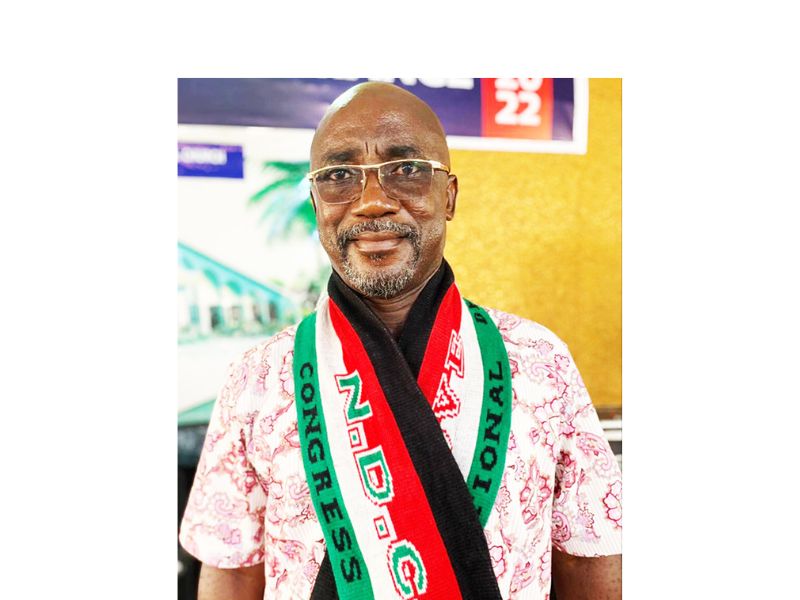
Enoch Amoako-Nsiah, former Ashanti Regional Security Coordinator, NDC Regional chair aspirant and Dr. Samuel Sarpong – Committee Chairman
Johnny Osei Kofi – Secretary to the Committee, former Deputy Chief of Staff and Nana Kwesi Andrews, Ashanti Regional NDC Chairman

The embattled Ashanti Regional Chairman of the National Democratic Congress (NDC), Augustine Nana Kwesi Andrews, says hate campaigns are being waged against him because  Ashanti Council of Elders of the party, who are generally indigenous Ashantis are not comfortable that he, a Fanti, and his secretary, an Ewe, who are settlers should lead the party in the region.

Speaking in an interview with The Chronicle in Kumasi, chairman Andrews said had done nothing wrong yet a seven member Fact Finding Committee had issued a report making a series of allegations against him and his secretary, Kwame Zu.

He described the report as useless and baseless since it has no credibility. This is because the membership of the committee have their own individual biases against him and the Regional Secretary, besides the Council of Elders had no locus to form the committee in the first place.

The chairman, who was reacting to The Chronicle publication last week, said the duo (chairman and secretary) were at post and had not been indicted because they were not aware of any such report.

He indicated that he had been advised against appearing before the Committee by both the National Chairman and the General Secretary of the party, but decided to avail himself out of respect for the members.

According to Nana Kwesi, as he is simply called, he has not been served with a copy of the said report, let alone been briefed about its details, five months after the Committee had completed its so-called findings.

Days after the declaration of the 2020 election results by the Electoral Commission (EC), the former Ashanti Regional Security Co-ordinator, Mr. Enoch Amoako-Nsiah in an interaction with some media men alleged that some NDC Regional Executives compromised their positions to the detriment of their own party’s interest.

He maintained that some of the figures announced by the EC in the Ashanti region were doctored in favour of the NPP and, therefore, did not represent the true reflection of the results. Some members of the party in the region held the view that the poor performance of the party might have been due to the fact that NDC as a party was not able to put its house in order to collate its own results before the declaration of official results by the EC.

Mr. Amoako-Nsiah indicated in his encounter with the press men that, he was of the opinion that some of the Regional Executives might have sold out the fortunes of the party to their political opponents.

These allegations called for the appointment of the 7-member fact finding Committee by the Ashanti Regional Council of Elders. However, the Committee made recommendations without any evidence of the allegations by Amoako-Nsiah.

Nana Kwesi believed the development is an agenda to dent their image in the run up of the party’s upcoming Regional elections and saw it as part of a grand scheme by his opponents to frustrate his re-election bid at the impending elections.

The embattled Regional party chairman revealed that he was aware of a hate campaign that had been initiated against the backdrop that the Ashanti Council of Elders, who are generally indigenous Asantes, are not comfortable that both the Regional Chairman (Fante) and Secretary (Ewe) are settlers and believe his woes are as a result of political witch-hunting, tribalism and mere hatred.

He said the report of the Committee was to settle personal scores, as the Secretary to the committee had openly indicated he was against him (Nana Kwesi) and that the Committee was doing the bidding of interested parties in impending elections.

While the chairman of the Committee is vying for the Vice Presidential slot, Yaw Owusu Obimpeh, a former Regional chairman of the party is staging a comeback as the regional chairman, with Enoch Amoako-Nsiah, the prime accuser, also eyeing the Regional chairmanship slot of the party.

But Nana Kwesi has deflated the claim by the committee that he was incompetent and questioned who else could perform better after he had increased votes from 493,000 in 2016 to 653,000 in 2020 – representing 26.1% and worked to secure four parliamentary seats from three for the party.

Meanwhile, The Chronicle has gathered that “The Ashanti Project -Ashanti for Asantes” has been initiated by the Ashanti Caucus of the NDC to compel the Regional Chairman to step aside for an indigenous Ashanti to take over, while an Ashanti indigene is elected as the Regional Secretary.

While the proposed “The Ashanti Project” is allegedly being spearheaded by party gurus in the region, others such as Madam Betty Mould Iddrisu and Dr. Agyemang Mensah are opposed to this tribal bigotry and onslaught against chairman.

3 families battle over severed head of Badu Bonsoe

0
The severed head of Baidoe Bonsoe, Ahanta King

Three families and two persons in Ahanta in the Western Region are claiming ownership of the severed head of Otumfuo Badu Bonsoe II, the Ahanta Chief who was decapitated by the Dutch in 1838.

The three families are the Ahamanza Royal Family, Anona Royal Family of Busua, and Mmevile Royal Ackade Family, and two other persons.

The families claim that the beheaded Chief was a member of their linage and as such, reserved the right to have access to the head and that it be regarded as royal.

To give credence to their claim, the three have consequently filed a formal petition before the Ahanta Traditional Council (ATC), awaiting a determination.

But, even before the determination of the petition, the battle for recognition as royals of the beheaded Chief appears to have taken an ugly side, as one of the families – the Anona Royal Family of Busua – reportedly attempted to take over the Palace of the Ahanta Traditional Council last Friday.

Information available to The Chronicle indicated that the family allegedly tried to invade the Palace with a group of macho men, and it took the intervention of some royals from the Tradition Council to repel the riot.

Although the Secretary to the Ebusuapayin of Royal Anona Family of Busua denied the allegation in a telephone interview with the paper, the case is currently before the Agona Nkwanta Police Station.

He said they went to the Palace to present a judgement secured in their favour, which recognises the family as the Ebusua of the Paramount Chief.

The Secretary explained that a judgement given by a Sekondi High Court recognised one Nana Kwasi Bediako as the Ebusuapayin of Ahanta, but the children of the Paramount Chief are resisting the court’s decision, as well as creating a misunderstanding.

Even though the alleged judgement, sighted by this reporter, made no mention of their claim, the Secretary still maintains his stance.

Meanwhile, information available to this reporter indicates that following the petition filed by the three separate families, the Palace has directed a Standing Committee of eminent personalities to look into the matter.

A member of the Standing Committee, who spoke to this reporter on condition of anonymity, confirmed the information, and disclosed that the committee was yet to be constituted.

According to the member, following the important nature of the petition, the committee was considering inviting a lawyer, judge, and some chiefs to constitute its membership.

He added that the Standing Committee had met the petitioners and informed them that it would come up with a fee to cater for the work of the eminent committee.

The deep throat member of the Standing Committee stressed that two of the petitioners, particularly the Royal Anona Family, led by one Kwasi Bediako, had rejected the fee.

When Ebusuapayin Kwasi Bediako was contacted on phone, he confirmed that rejection of the budget proposed by the Standing Committee, because he did not see why, as a royal, he should honour a fee budget for a petition to be determined.

Mr. Bediako said he was ready to appear before the Committee to show evidence that the late Otumfuo Bonsoe was of his blood line, but not ready to pay a dime for the committee’s work.

“I own Ahanta land as Ebusuapayin, and my subjects cannot charge me for a work they may be doing for me,” he charged.

Doe Adjaho calls for inclusive review of Free SHS

0
Edward Doe Adjaho, former Speaker of the Parliament of Ghana

The Speaker of the 6th Parliament, Rt. Hon. Edward Doe Adjaho, has called for an all-inclusive review of the government’s pro-poor policy, the Free Senior High School (SHS).

The former Speaker is advocating for the stakeholders’ conference on the sustainability, and revitalisation, as well as to re-examine the calibre of SHS products the country needed and deserved.

Mr. Adjaho said it was becoming increasingly clear that the time had come to review the current implementation of the programme, to enable the country come together and fix challenges confronting the system.

He outlined some of these challenges as congestion, lack of teaching and learning materials, funding, poor dinning conditions, acute shortages of food supplies, and double track among others.

The former Speaker of Parliament, who was speaking at the 60th Anniversary launch and sod-cutting ceremony for an ultra-modern digital resource centre for the Frankadua D/A Junior High School (JHS) in the Asuogyaman District of the Eastern Region, said: “As a country, we cannot pretend that all was well in the educational sector of the country, and we need to sit up,” he stressed.

Mr. Adjaho continued that lack of infrastructural expansion and deteriorating facilities could not be said to be the best educational system needed for the growth of the country.

He stressed that it was important to be mindful not to be interested only in mass production of SHS graduates without considering quality, and hoped that there would be an educational system that would foster national cohesion, by giving equal opportunities to the urban and rural students to develop their talents without discrimination.

Touching on the theme “Digital Literacy; A tool for National Development,” the former Speaker of Parliament noted that for the occasion it was apt, in view of the importance of digital education that had become necessary as a result of COVID-19, which, he said, had altered the way of life of Ghanaians.

He observed that digital transformation had totally revolutionised the educational landscape and concepts such as virtual learning, e-learning, remote-learning and blended learning were no longer considered novel, but crucial to the education of students.

Mr. Adjaho said a recent study published under the title ‘Digital Transformation in the Age of COVID-19,’ revealed that shortly after the outbreak of the pandemic, internet traffic increased by 60 per cent, and became more beneficial to only those who had access.

He stressed that the United Nations International Children Education Fund (UNICEF) warned that some 616 million students remained affected by full or partial school closures due to the COVID-19 destructions in Africa.

The Asuogyaman District Director of Education, Mrs. Augustina Adjoa Owusu, lauded the Frankadua D/A JHS for its high performance over the years, in terms of academics, stressing that it was one of the best public basic schools in the District.

Mrs. Owusu said the Directorate was proud of the teachers and non-teaching staff, the School Management Committee, and the Parent Teacher Association (PTA) for maintaining high academic standards over the years, which was difficult to achieve in many public basic schools.

She further appealed to parents to continue to support their wards, and asked students to learn hard to justify the investment the government and their parents were making.

The Headmaster of the Frankadua JHS, Mr. Harrison Mompi, thanked the Old Students Association of the school for their continued support and gave the assurance that the teachers were committed to their work, a reason for which the school continued to perform creditable at the Basic Entrance Certificate Examination.

Yaw Obimpeh stages comeback for Ashanti NDC chairmanship slot

0
Yaw Owusu Obimpeh - Aspiring NDC Regional chairman

The Ashanti region chairmanship race of the opposition National Democratic Congress (NDC) promises to be keen when nominations open in November.

Mr Yaw Owusu Obimpeh, a former Regional chairman of the party has declared his intention to wrestle the position from the incumbent, Augustus Nana Kwesi Andrews.

At a meeting with the media in Kumasi last Saturday, Obimpeh said he is coming back to ensure that the NDC wins the 2024 general elections to champion total development, especially in the Ashanti region.

The aspirant, who is claiming credit for building the regional party office during his tenure says his decision is premised on the abysmal performance of the Nana Addo Dankwah Akufo-Addo led government.

Mr Obimpeh noted that former President John Dramani Mahama had made the NDC more attractive compared to the NPP, in terms of good governance.

According to him, Ghanaians experienced a lot of developments under an NDC government, hence the need for a united force and to ensure victory at the 2024 elections and rescue the ailing economy.

He claims he is tried and tested and expressed the hope to win the chairmanship race.

The former party chairman pledged to work with everybody in the party, irrespective of one’s tribe or religious denominations, as well as strengthen the party’s structures to empower the branch executives.

He also promised to ensure that the remaining constituencies have their own  permanent offices when re-elected as the Ashanti regional chairman of the NDC.

Editorial: RTI: More education to ensure compliance

0
Editorial

Access to information by the public is a right that has been guaranteed under Article 21(1)(f) of the 1992 Constitution.

The Constitution states under the aforementioned article that: “All persons shall have the right to information, subject to such qualifications and laws as are necessary in a democratic society.”

But, Ghana did not enjoy that right until March 2019, when the Right to Information (RTI) Act was promulgated into law by Parliament, received President assent on May 21, and became effective in January 2020.

Prior to the passage of the law, seekers, especially the media, had barrages of problems with providers like public institutions, since they were not willing to give out information.

We, therefore, held the view that the passage of the RTI law would make the request for information easier, but that was not so. In fact, the notion of getting information in a faster way was what threw information seekers, especially the media, into celebration when the law was passed.

Little did we know that the law was coming with its own caveats, chief among them being the fees to be charged for information given out. The issue with fees has already landed information seekers and givers in court. One of such issues involved the Fourth Estate, a subsidiary of the Media Foundation for West Africa, and the Minerals Commission.

The Commission requested the Fourth Estate to pay a whopping $1,000 before it could release information that was being sought. The Fourth Estate obviously saw the request as unreasonable and proceeded to court to get justice.

Thankfully, we may soon see an end to this issue of fees, since Parliament has now approved the fees to be charged, with regards to access to information.

In accordance with the Fees and Charges (Miscellaneous Provisions) Act, 2022, persons seeking information are expected to pay 0.27 pesewas for every photocopy of A4 size information.

The Executive Secretary of the RTI Commission has already said that the approval of the fees would provide clarity on issues relating to, and we hopes that such would be the case since it would go a long way to ease the pressure on our already crowded courts.

But, if we are to really achieve this, then those at the information giving end, especially our public institutions, should be abreast with this law so that it would be strictly adhered to accordingly.

We are saying this, because even when it comes to the giving out of information, some institutions are still reluctant, because they are not even privy to the provisions of the law, even though the government, civil society organisations, and non-governmental organisations have invested in training people on the provisions of the law.

Ghana is touted as the ‘Beacon of Democracy in Africa’, because we have been able to uphold some tenets of democracy, including peaceful elections and transfer of power from one government to the other over the years.

The Right to Information is also another tenet of democracy we must adhere to, if we still want to maintain our position on the democratic league table.

Influence of broken homes on children’s behaviors

0
Feature

There have been a lot of instances of broken homes, divorced spouses, and single parents in the country. The moment these partners decide to split ways, the toll falls on the children in diverse ways one cannot imagine.

When a couple decides to end their relationship, undoubtedly it affects them, but what is worse is it affecting the child’s psychological health.

This child, who knows little to no idea of what is happening, results in it having a traumatic effect on their personality, often leading to depression and eventually suicide attempts, as they find it hard to accept the bitter reality that their parents no more live together.

Additionally, some older children may show very little emotional reaction to their parent’s divorce, which may not be developmentally beneficial, because they showing little emotional response actually means they are bottling up their negative feelings.

This suppression makes it difficult for therapists to help the child. A friend confided in me about a time he actually attempted to take his own life when he was denied the chance to pay visits to the other parent.

This could have gone really bad, I’m therefore thankful to him every day for not taking that step but choosing to hold on to life.

Children from broken homes, the males especially tend to become abusive partners themselves if the parent’s marriage was an abusive one before the split up.

They have witnessed their fathers being abusive towards their mothers, though some males vow never to raise their hand on a woman, others too decide to stand in the shoes of their fathers and replicate what they grew up seeing.

The ladies are not exempted from this influence. Those who witnessed their mothers being violent towards their fathers are more likely to be abusive toward their partners but those who witnessed their fathers abusing their mothers have vowed not to be vulnerable for any man to have his way with them.

International women like Selena Gomez, Rihanna and Demi Lovato, the men are not exempted, there is Justin Bieber and famous “Captain Jack Sparrow” Johnny Depp and when we come back home, we have our very own D-Black and the dancehall artiste, Shatta Wale who have all made names for themselves despite their past which they didn’t let control their future.

Peer influence also results from broken homes or single parenting. The child may escape into the community and find solace in his or her peer group.

Away from home, they may affiliate with a delinquent group and eventually drift into stealing, robbery, drugs, teenage pregnancy in the case of girls, celibacy, alcohol abuse, bullying and others.

Broken homes can also bring out slowed academic development in children. The emotional stress of a divorce alone can be enough to stunt the child’s academic progress, but the lifestyle changes of a broken family can contribute to poor educational outcomes, this can stem from instability in the home, inadequate financial resources and inconsistent routines.

I’m reminded of a colleague student who when asked why she was in school, her answer was quite intriguing, “I’m studying so hard to prove to my father that he leaving did not determine my future”.

With the younger kids, it is even more torturing for them. Imagine they seeing their friends being picked up from school by both parents and he is always picked up by one parent, he might lose concentration thinking about this.

Socially, children act out their distress about their broken family by acting aggressive and tending to experience anxiety which can make it difficult for them to seek positive social interactions and engage in developmentally beneficial activities such as teen sports.

They might even develop a cynical attitude toward relationships and harbor feelings of mistrust, both toward their parents and potential romantic partners.

Nightmares usually occur as a result of something happening in our lives, which is our brain’s way of adjusting, coping to changes in our lives. That’s why divorce, memories of the separation, living in a new home, these can all trigger nightmares. Unfortunately, kids tend to suffer more nightmares than adults. Though kids may not have a whole lot of worries in our lives but they have vivid imaginations.

Parents must therefore take into consideration the toll their actions can have on the child before doing things they do.

By Wilhelmina Love Abanonave

Ghanaians are not demanding accountability from the extractive sector -Dr. Manteaw

0
Participants at the Ghana Extractive Industries Transparency Initiative (GHEITI) event

The Co-Chairman of the Ghana Extractive Industries Transparency Initiative (GHEITI), Dr. Steve Manteaw, has expressed worry over Ghanaians not demanding accountability from the extractive sector of the economy, despite information made available to the public.

He also noted that the GHEITI hinged on two areas, namely transparency and accountability. According to him, EITI had been able to establish transparency at the sector, but, however, bemoaned that with the numerous information made available to Ghanaians about the extractive sector, they do not demand accountability.

Manteaw argues that, per the EITI framework, it was supposed to furnish Ghanaians with information which would enable the citizenry to use the information to demand accountability from the authorities, but this had not materialised.

He said: “We have not quite managed to achieve accountability.”

According to him, the EITI theory of change presupposes that when the citizens are armed with information, they would then use the information to demand accountability from duty bearers.

To the Co-Chairman of GHEITI, this meant that the theory of change that says that transparency would begat accountability needed to be re-examined.

Steve Manteaw made these assertions at a stakeholder dissemination workshop held by the Ghana EITI reports on mining and oil/gas in Kumasi recently, under the auspices of the Ministry of Finance (MoF), and the GHEITI, in collaboration with the Deutsche Gesellschaft fur International Zusammenarbeit (GIZ).

The EITI is an initiative which involves the reconciliation of payments by the extractive industries, and receipts by the government with the ultimate aim of promoting transparency and accountability.

The event, which was attended by stakeholder in the extractive sector, sought to create the required public awareness, generate interest, and debate on the issues raised in the 2019 Report of the GHEITI. It also aimed at paving the way for stakeholder engagements on the EITI report, as requested by the EITI Standards.

According to the GHEITI 2019 Report, Ghana accrued a total of interest from her oil royalties in 2020 amounted to US$666.39, contributing to 7% of government domestic revenue for that year.

These royalties, it noted, were accrued from Carried and Participating Interest (CAPI), Corporate Income Taxes (CIT), and Surface Rentals, adding that a total of 3,711 employees were engaged in the upstream petroleum sector, out of which 500 were expatriates, with 3,211 being Ghanaians, curbing unemployment in Ghana.

In 2021, crude oil export receipts amounted to US$3.95 billion, compared to US$2.91 billion in 2020, due to higher prices, despite a decline in the volume exported.

Manteaw has, therefore, noted that there may be a need for other intervention actions to ensure that Ghana was able to render critical and very necessary transitions.

In an address which was delivered by Alhaji Bashiru Razak on behalf of the Chief Director and Chair of the Ghana Extractive Industries Transparency Initiative, the contribution of the upstream oil and gas sector to energy generation in Ghana could not be overemphasised, adding that the gas produced was supplied for domestic power generation.

He said: “In 2020, a total of 88,515.58 million Standard Cubic Feet (MMscf) of Associated Gas and Non-Associated Gas produced from Jubilee, TEN and SGN fields were supplied to various thermal plants in Ghana for domestic power generation.

A total of 580,034.37 MMSCF has, so far, been produced from 2014 to 2020, most of which has been utilised for domestic power generation in Ghana, some flared, and others re-injected.”

On the mining sector, he disclosed that in 2020, the sector contributed approximately 41 percent of total exports earnings, with 14 percent of total tax revenues, and 5.5 percent of Ghana’s Gross Domestic Product (GDP).

He indicated that gold took a giant lead among the minerals which were exported from Ghana: “Gold contributes over 90% of Ghana’s total mineral exports and makes up 49% of the country’s total export value as at December 2020. Ghana, until recently, was the leading producer of gold in Africa.”

According to data from the Bank of Ghana, spot gold price averaged US$1,799.79 per fine ounce in 2021, a marginal increase of 1.6 per cent compared to US$1,770.77 per fine ounce recorded in 2021.

In a message read on behalf of the Ashanti Regional Minister, Simon Osei-Mensah, he noted that the discovery of oil and gas in Ghana had called for the demand of better living and earning standards.

Osei-Mensah mentioned that it was, therefore, paramount that the government put in place measures to promote principles of accountability and transparency to avoid public distrust.

He indicated that EITI was primarily set to focus on revenue transparency, and has now expanded its scope to include beneficial ownership disclosure, commodity trading transparency, contract disclosure, and license allocation.

COP Alex Mensah donates to Nerebehi M/A Basic School

0
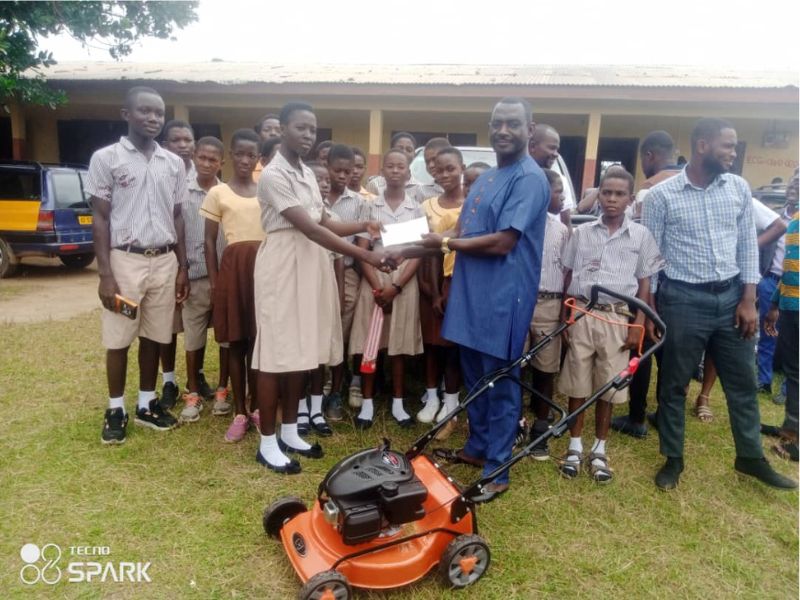
COP George Alex Mensah, presenting the gesture to the students of Nerebehi MA Basic school in the Bekwai municipality of the Ashanti region.

Commissioner of Police (COP) George Alex Mensah has donated items to the Nerebehi M/A Basic School in the Bekwai Municipality to aid academic activities.

COP George Alex Mensah, presenting an undisclosed amount of money to the Bekwai NHIA to be used to register about 2000 children onto the scheme.

The GH¢20,000 worth of items included mathematical sets for final years students who are due to sit for their Basic Education Certificate Examination (BECE), a lawn mower, and an undisclosed amount of money, which is to help the pupils sit their mock examinations.

He also donated an undisclosed amount of money to the National Health Insurance Authority (NHIA) of Bekwai to register about 2,000 kids in the Municipality, including his hometown, Wioso-Nerebehi.

According to COP Mensah, he celebrated his birthday, and as part of the celebration, he decided to share it with the kids and the students in his hometown. He has also promised to give the school a very ultramodern teachers’ bungalow in order to keep the teachers in the community instead of commuting from afar.

He noted that education was one of the major issues in the development of Ghana, and in the smaller communities the quality was not as high as those in the cities, adding that some parents struggled to pay small amount of money for the children in school, hence, he decided to come to their aid since education was the best legacy one could offer his or her children.

The Headmaster of the school, Stephen Ofori Debrah, who could not hide his joy, expressed appreciation to COP Alex Mensah, adding that he had not seen such a gesture ever since he came to the school.

Ofori Debrah appealed to parents to take the education of their wards seriously, since the government could not shoulder the responsibility alone.

The Ghanaian Chronicle