Home Blog Page 266

Mahama Reduces Cocoa Price … To Address Market Variations

0
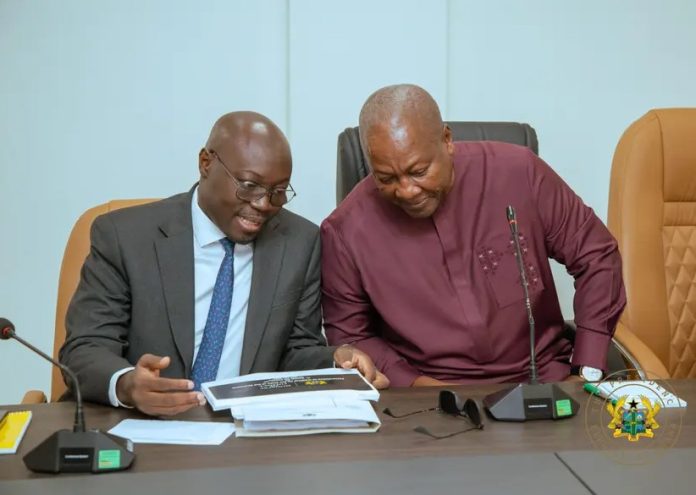
President Mahama and his finance Minister, Dr Ato Forson

The government, through the ministry of finance, has adjusted downward the producer price of cocoa for the rest of the 2025/2026 crop season.

The Minister for Finance, Dr Cassiel Ato Baah Forson, on Thursday, 12 February 2026, announced that for the remainder of the 2025-2026 crop season the cocoa producer price per bag “will now be GH¢2,587 per bag.

This is a reduction of about GH¢1,038 from the GH¢3,625 announced last year for the 2025/2026 crop season.

The minister also announced that the GH¢51,660 per tonne of cocoa will now be GH¢41,392 per tonne.

This cocoa producer price haircut is coming at a time the ruling government promised a higher amount in opposition.

Cocoa

It would be recalled that, in the heat of the 2024 electioneering campaign, the then opposition, the National Democratic Congress (NDC), promised cocoa farmers honey.

The Akufo-Addo government had increased the price of cocoa per bag from GH¢475 to GH¢3,100.

However, the NDC in their campaign told cocoa farmers that they deserved more and promised to pay GH¢6,000 per bag, but could only do GH¢3,600 when it assumed office, owing to the world market price.

There is no gainsaying that the NDC benefitted from the promise to increase the producer price of cocoa from the GH¢3,100 per bag to GH¢6,000.

REALITY

The Minister for Finance, Dr Ato Forson, explained the need for the reduction, indicating that Ghana’s price was not competitive, a situation driving buyers away and could possibly trigger smuggling of cocoa into Ghana.

“Let me say that the reality today is that our beans are very expensive and buyers are not buying them, and obviously there is no point when the world market price is an average of $4,200 per metric tonne to buy your cocoa at $7,200 per metric tonne.

“Certainly there’s no incentive and this is something that we have to live with, and so yes, the reality is that after careful revision of the situation, the producer price review committee came to that conclusion that something needs to be done, but being mindful of the impact on the farmer, as the chair of the producer price review committee and a strong advocate for cocoa farmers, I will push so that cocoa farmers get 90 percent of the producer price for $4,200 at a prevailing exchange rate,” he mentioned.

“The current situation is largely driven by the unwillingness of buyers to purchase Ghana’s cocoa because it has become uncompetitive. Cocoa from other producing countries is now selling at prices significantly lower than the producer price of Ghana,” Ato Forson stated.

ISSUE

The Minister for Finance, Ato Forson, acknowledged that the cocoa sector was facing some turbulence, and sweeping reforms were needed to salvage the situation.

Addressing the media yesterday, the minister for finance highlighted the chronology of events leading to the price reduction.

He said that the 2025/26 cocoa season began in August 2025, with a producer price of GH¢51,660 per tonne calculated as 70% of the gross FOB of US$7,200 per tonne using an exchange rate of 10.25 cedis to the US dollar.

He said that, on October 1, 2025, Côte d’Ivoire announced a new producer price, 20% above that of Ghana.

According to him, the decision by the Ivorians, coupled with movements in the exchange rate, resulted in a significant difference in the producer price of cocoa between Côte d’Ivoire and Ghana.

The price difference, he added, had the potential to trigger significant smuggling of Ghana’s cocoa to Côte d’Ivoire.

POLITICS

Following the announcement to reduce the cocoa price per bag, some commentators have blamed the politics for the backlash the government is receiving.

Discussions on multiple radio, television, and social media platforms point to the fact that the NDC, in opposition, played politics when it promised to increase the producer price to GH¢6,000 without the caveat that the increment would be based on the world market price.

The world market price has dropped significantly from the average of US$7,200 per tonne to US$4,100 per tonne.

WAY FORWARD

Meanwhile, the government has announced some measures to deal with the liquidity issue facing COCOBOD.

The minister noted that a cocoa bond will be issued to raise a “revolving fund for COCOBOD to turn around at least once during the season.”

He stated that the state-owned produce buying company (“PBC) will be revived to resume full operations and become the leading licenced buying company in the cocoa sector with immediate effect.”

With the new financing model, the cocoa board can sell beans of any volume to local processing companies to promote value addition and job creation, Minister Ato announced.

“Cabinet has also directed that beginning from the 2026-2027 crop season, a minimum of 50% of all cocoa beans should be processed locally, and this will be part of the cocoa board bill going to parliament,” he stated.


For more news, join The Chronicle Newspaper channel on WhatsApp: https://whatsapp.com/channel/0029VbBSs55E50UqNPvSOm2z
Minority Rejects New Cocoa Price

0
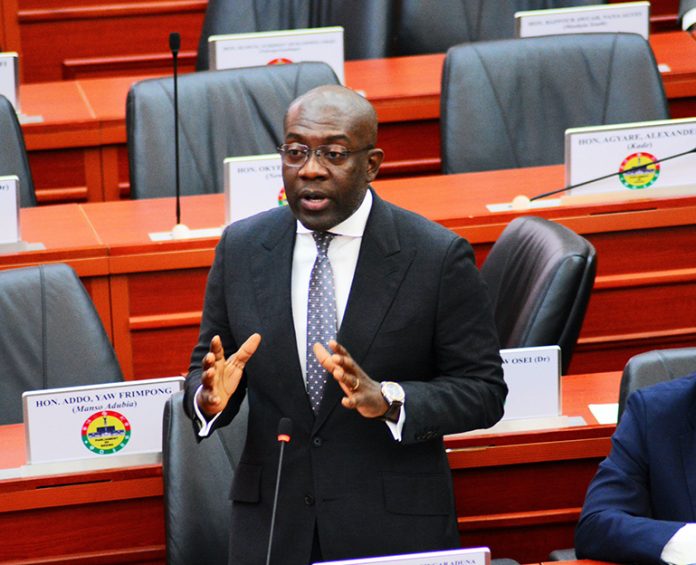
Minority spokesperson on the Economy and Development, Kojo Oppong Nkrumah

The Minority in Parliament has criticised the government’s decision to slash the producer price of cocoa for the remainder of the 2025/2026 crop season.

Addressing the media on Thursday, 12 February, 2026 the minority indicated that the new price of GH¢2,587, “is totally unacceptable”, adding that the GH¢3,625 should either be maintained or increased by the government.

The minority spokesperson on the Economy and Development, Kojo Oppong Nkrumah, on behalf of the caucus, was reacting to the directive by the government to reduce the producer price of cocoa from GH¢51,660 per tonne of cocoa to GH¢41,392 per tonne and from GH¢3,625 to GH¢2,587 per bag.

The Minister for Finance, Dr Cassiel Ato Baah Forson, had earlier that day announced Cabinet’s decision regarding the troubling cocoa sector, including cocoa producer price reduction and issuance of cocoa bonds.

Reacting to the directive, Kojo Oppong Nkrumah said: “This action to announce a 28% reduction in the price amounts to a haircut, a haircut of about 28% on close to 1 million Ghanaian cocoa farmers.”

RESET

According to the Offoase-Ayirebi Legislator, who spoke for the minority, the new managers of the cocoa sector have reset the trading programme of the cocoa board.

“We (NPP government) used to sell about 70% on forward sales and 30% on spot. They (NDC) argued that that was an incompetent approach and decided to change it, and now they are selling about 70% on spot.

“That is why today, as prices have dipped, they are struggling and are saying that the price they had announced ends up being higher than their current prices on the market,” he noted.

The minority has since called on the president to relieve the COCOBOD CEO, Dr Randy Abbey, of his responsibilities at this point in time.

The minority argued further that the previous government absorbed the shock and protected the cocoa farmers whenever cocoa prices fell.

“The NDC government should absorb the cost of what they have done and protect the cocoa farmer and restore at least the 3,625 that they promised,” the minority demanded.

BAILOUT

The former Minister for Finance, Dr Mohammed Amin Adam, a member of the minority, argued that the evidence does not support the claim that the economy is being managed well.

He said given the scale of the crisis, the government was expected to give COCOBOD a bailout, rather than reducing the producer price for cocoa.

“A bailout would have been necessary, particularly at the time we are told that the economy is strong and resilient. They said they are better managers of the economy.

“An economy that is better managed cannot pay cocoa farmers. An economy that is better managed reduces the producer price of cocoa,” he stressed.

OVERVALUATION

The former Minister for Finance recalled that the opposition NPP warned this government about the “reckless overvaluation of our currency.”

He remarked that the government was warned several times that the pumping of dollars into the economy was a “reckless intervention.”

He further recalled that in the first year of this government, US$10 billion was pumped into the economy, adding that the move will affect the economy.

“Because those of you who understand economics know that when you overvalue your currency, it adversely affects the export competitiveness of your country.

“Governments should know, because they have economists amongst them, that any time you are implementing a policy, there are trade-offs.

“Therefore, by overvaluing the currency as a policy, they should know that other sectors will suffer. So, what a responsible government has to do is to achieve what we call policy equilibrium,” he remarked.

Litigation Over Tse Ado Lands: Anas Wins Big At Supreme Court

0
Anas Aremeyaw Anas

A seven-member panel of the Supreme Court has dismissed an application brought by a businessman, Adolph Tetteh Adjei, seeking to overturn a judgment entered in favour of renowned investigative journalist, Anas Aremeyaw Anas, over a land dispute.

In dismissing the application by an overwhelming 7-0 unanimous decision, the court said, having considered the motion and affidavits, both in support and opposition, statements of case of counsel for both sides and heard oral submissions of lawyers of the parties.

It found that the application did not meet the minimum threshold for a review of the decision of the ordinary bench of five justices, delivered in November last year.

The parties, Adolph, Anas and Holy Quaye, have been locked in an intense legal battle over a parcel of prime land in Accra.

The case travelled from the High Court through the Court of Appeal to the Supreme Court, the last and final arbiter of disputes in Ghana, culminating in a judgment in November 2025 entered in favour of the journalist.

Dissatisfied with the decision of the five-member panel, Mr Tetteh Adjei brought a review application, which was heard on January 27, 2026, by a seven-member panel presided over by Justice Gabriel Scott Pwamang.

Generally, for the Supreme Court to review its own decision, an applicant must demonstrate exceptional circumstances such as a fundamental error of law or fact apparent on the face of the record, the discovery of new and compelling evidence previously unavailable, or the breach of the rules of natural justice.

Lawyers for Mr Tetteh laid down six grounds they argued constitute a miscarriage of justice, misapplication of the law, among others, and therefore form the basis for a review of the earlier decision of the court.

The seven eminent justices, however, unanimously held in their judgment delivered on Wednesday, February 11, 2026, that the applicant, Mr Tetteh, had failed to meet the minimum threshold required to invoke the apex court’s review jurisdiction.

This decision brings a significant finality to the protracted dispute and vests title to the said land firmly in Anas Aremeyaw Anas, who acquired same from the Ataa Tawiah Tsiniatse and Numo Ofoli Kwashie Family

The full bench reaffirmed certain aspects of the November decision of the ordinary Bench.It pointed out that the 2015 consent judgment of the Court of Appeal, which purported to compromise an earlier judgment of Justice Ofori-Atta at the High Court, remained valid unless and until set aside.

This is in recognition of the pending High Court case challenging the validity of that consent judgment. But the Supreme Court on Wednesday said that until the High Court determines otherwise, the consent judgment remains valid.

On the scope of the judgment, the court reaffirmed that beyond Mr Tetteh and in relation to the two acres – the subject of the dispute – it did not affect the rights of other third parties whose grants remained valid until otherwise determined by a court of competent jurisdiction.

The other justices who sat on the review application are Justice Richard Adjei Frimpong, Justice Hafisatu Amaleboba, Justice Yoni Kulendi, Justice Bright Mensah, Justice Janapare Bartes-Kodwo and Justice Ernest Gaewu.

Source- myjoyonline.com

CenPOA condemns vote buying in NDC Ayawaso East Primary

0

The Centre for Public Opinion and Awareness (CenPOA) has raised serious concerns over alleged vote buying during the recent National Democratic Congress (NDC) parliamentary primary, warning that such practices threaten the party’s historical identity and the integrity of Ghana’s internal democracy.

In an article authored by CenPOA Executive Director, Michael Donyina Mensah, the organisation noted that recent reports of aspirants distributing money, food and other inducements to delegates in the Ayawaso East primary follow similar allegations from the New Patriotic Party (NPP) presidential primary held in January 2026.

CenPOA described this trend as “particularly disturbing” for the NDC, given its founding principles of probity, accountability, social justice and anti-corruption.

Tracing the party’s ideological roots to the Provisional National Defence Council (PNDC) era, under Flight Lieutenant Jerry John Rawlings, the piece highlights how anti-corruption values were central to the party’s identity.

Under civilian leadership in the Fourth Republic, leaders such as President John Evans Atta Mills reinforced this image, earning widespread respect for integrity, modesty, and firm rejection of corruption.

“Reports of vote buying within the NDC primary represent a clear deviation from the party’s founding ideals,” the CenPOA article stated.

While vote buying has long been associated with Ghanaian politics, particularly within the NP and evidence now suggests that inducement-based practices may be gaining deeper roots within the NDC.

CenPOA also noted that the problem appears to have been exacerbated during the tenure of President John Dramani Mahama (2012–2017), citing concerns over political financing, patronage networks and weak enforcement of internal party discipline.

The organisation, however, welcomed recent corrective actions, including President Mahama’s public condemnation of the alleged acts, initiation of internal investigations and the recall of an ambassador who was actively contesting in the primary, a move that addressed clear conflicts of interest.

CenPOA stressed, though, that condemnation alone is insufficient, calling for structural reforms to tackle the root causes of vote buying.

Among the recommendations, CenPOA urged the NDC to revisit the expanded delegate system introduced in 2015, which broadened participation in internal elections and reduced the influence of small, easily targeted delegate pools, a measure shown to diminish inducement-based politics.

“Ultimately, vote buying is not merely an NDC problem, it is a national democratic problem.

Yet for a party whose origins are rooted in a radical rejection of corruption and moral decay, the stakes are undeniably higher.”

CenPOA concluded that reclaiming the party’s moral heritage is not an exercise in nostalgia, but a democratic necessity aligned with Ghana’s constitutional ideals and the NDC’s founding promise.


For more news, join The Chronicle Newspaper channel on WhatsApp: https://whatsapp.com/channel/0029VbBSs55E50UqNPvSOm2z

CDM goes bonkers over new cocoa price

0
Cocoa farm

The Centre for Democratic Movement (CDM) has strongly condemned the Government of Ghana’s decision to reduce the cocoa producer price to GH¢2,587 per 64kg bag, describing it as a “monumental betrayal” of campaign promises and an “assault on the dignity and livelihoods of cocoa farmers.”

In a statement issued after the pronouncement by the Minister for Finance following a marathon cabinet meeting held to tackle the near collapse of the cocoa sector, the CDM accused the ruling National Democratic Congress (NDC) of breaking repeated assurances made during the 2024 general election campaign, when party leaders, including President John Dramani Mahama, pledged to substantially increase cocoa prices.

During the campaign, President Mahama had assured cocoa farmers that under an NDC government, prices would rise to not less than GH¢6,000 per bag, emphasising that farmers are “the backbone of the rural economy.”

The current Finance Minister, Dr. Cassiel Ato Baah Forson, while in opposition, had also criticized the prevailing cocoa pricing regime and promised an immediate review to reflect the true value of farmers’ labour.

Yet, barely a year into office, the CDM notes, the government has not only failed to increase cocoa prices, but has instead slashed them to GH¢2,587 per bag, a move the group calls “one of the most shocking policy reversals in recent Ghanaian history.”

The CDM warned that the decision comes at a time of soaring living costs, high farm input prices, rising labor expenses, and worsening climate conditions, all factors already pressuring cocoa farmers.

According to the group, reducing the producer price threatens to push farmers toward illegal mining (galamsey) as a survival option, undermining national anti-galamsey efforts and exacerbating environmental degradation.

“This reduction will accelerate the destruction of cocoa farmlands, intensify water pollution and land degradation, and deepen food and environmental insecurity,” the CDM said.

Demands for Reversal and Farmer-Centered Policy

The Centre for Democratic Movement (CDM) is demanding that the government immediately reverse the decision to reduce the cocoa producer price to GH¢2,587 per bag.

The group is also urging the administration to honour its campaign promise by setting the price at no less than GH¢6,000 per 64kg bag.

In addition, the CDM call for urgent consultation with cocoa farmers and their unions to ensure their voices are heard, and insist on the establishment of a transparent pricing framework that places the welfare of farmers above political convenience.

The CDM concluded that the price reduction represents not only an economic misstep but also a moral and political failure, arguing that the government’s action contradicts its promises and undermines public trust.

“The cocoa farmer deserves respect, justice, and economic dignity—not broken promises and policy punishment,” the CDM said, reaffirming its commitment to advocating for fair pricing and people-centred governance.


For more news, join The Chronicle Newspaper channel on WhatsApp: https://whatsapp.com/channel/0029VbBSs55E50UqNPvSOm2z

A/R Minister urges Planners to uphold integrity and professionalism 

0
Dr. Frank Amoakohene addressing the Committees

Dr. Frank Amoakohene, the Ashanti Regional Minister, has tasked planners and technicians of Metropolitan, Municipal and District Assemblies (MMDAs) to discharge their duties with integrity, transparency and professionalism.

He reminded them that communities are counting on them to ensure proper development according to approved planning standards.

Speaking at the inaugural ceremony of Spatial Planning Committees and Technical Sub-committees, Dr. Amoakohene emphasised that the committees’ sole purpose is to perform spatial planning and human settlements management functions and that the inauguration gives them the legal backing to operate and perform their mandates.

The Ashanti Regional Minister urged the committees to ensure district and local plans are carried out as approved, and development permits are issued according to Act 215.

He stressed that the committees’ purpose is to ensure sustainable development, protect the environment, and reserve areas for important infrastructure like roads and drainage.

The Minister noted that Spatial Planning Committees play a crucial role in ensuring development aligns with approved plans and regulations, and Issuing permits and monitoring compliance with building codes and zoning laws.

He said the Committees also ensure safeguarding natural resources and promoting sustainable development, planning and coordinating infrastructure like roads, water and sanitation.

The Ashanti Regional Minister disclosed that MMDAs’ development plans typically includes setting development goals and priorities, identifying projects that align with national and regional priorities, securing funding and resources for projects,  executing projects and monitoring progress.


For more news, join The Chronicle Newspaper channel on WhatsApp: https://whatsapp.com/channel/0029VbBSs55E50UqNPvSOm2z
Editorial: GES Ban On Schools Is A Step In The Right Direction

0
Banned

The Ghana Education Service (GES) in the Eastern Region has imposed a two-year ban on Koforidua Senior High Technical School (SHTS), New Juaben Senior High School (SHS) and New Nsutam Senior High Technical School (SHTS) from participating in all sporting and co-curricular activities. The sanctions follow reported incidents of gang rape and a stabbing incident during a recent inter-school sports competition in Koforidua.

Under the directive announced by the Eastern Regional Director of Education, Ivy Asantewa Owusu, the three schools are prohibited from organising, participating in, or attending events such as sports competitions, quizzes, debates, cadet programmes and entertainment activities. Each school has also been fined GHC 500 and will bear any costs related to property damage or injuries.

The action is grounded in Section 2.17 of the GES Code of Conduct on physical and psychological violence, as well as the Eastern Region Schools and Colleges Sports Association Code of Discipline. Two underage students have been arrested and charged with conspiracy to commit rape and rape. A third suspect, believed to be a former student, is currently at large. In a separate case, another student has been arrested for allegedly stabbing a colleague near the sports stadium.

The decision by the Ghana Education Service to impose a two-year ban on the three schools is not merely a disciplinary action, it is a moral statement. It signals that our educational spaces must remain sanctuaries of safety, learning and character formation, not theatres of violence and criminality.

Inter-school sports and co-curricular events are designed to promote teamwork, discipline, camaraderie and healthy competition. When such platforms are instead marred by allegations as grave as gang rape and acts of stabbing, the very foundation of school culture is shaken. The GES cannot afford to treat these incidents as isolated misbehaviours; they represent a dangerous breakdown of supervision, values and accountability.

Critics may argue that banning entire schools punishes innocent students alongside the guilty. That concern is understandable. However, discipline at the institutional level often serves a broader corrective purpose. Schools are not merely academic centres; they are communities. When violence occurs during organised school activities, it points to systemic lapses, whether in supervision, security, student mentorship or internal disciplinary structures.

Institutional sanctions compel school authorities to re-examine these gaps and implement stronger preventive mechanisms. Moreover, the gravity of the alleged crimes demand a response that reflects zero tolerance. Sexual violence, particularly involving minors, is not youthful exuberance gone wrong but it is criminal conduct with lifelong consequences for victims.

The same applies to knife violence. By invoking specific provisions of the GES Code of Conduct and the Regional Sports Association’s disciplinary framework, the Education Service has acted within established legal and administrative parameters. This strengthens the credibility of the sanctions and reinforces the rule-based governance of schools.

That said, punishment alone is not enough. The two-year suspension period must be used constructively. The affected schools should implement comprehensive reforms: intensified guidance and counseling services, stricter security protocols at events, collaboration with parents and community leaders, and sustained education on consent, conflict resolution and personal responsibility. Without such interventions, the ban risks being symbolic rather than transformative.

Ultimately, the protection of students especially the most vulnerable must take precedence over trophies and public image. If this decisive action restores discipline, deters future misconduct and compels schools across the country to strengthen safeguards at public events, then it will have served a greater good.

The message is clear: educational excellence cannot thrive where safety and dignity are compromised. Schools must be spaces where young people compete fiercely on the field, but respect boundaries off it.


For more news, join The Chronicle Newspaper channel on WhatsApp: https://whatsapp.com/channel/0029VbBSs55E50UqNPvSOm2z

Africa’s Youth Could Power the Quantum Age -Peter Haynes

0
Prof. Peter Haynes, Deputy President and Provost of Imperial College London, addressing attendees at the closing ceremony of the International Year of Quantum (IYQ) at the Labadi Beach Hotel in Accra, Ghana

As governments and corporations pour billions into quantum technologies, Africa’s most competitive advantage may not be found in ultra-cold laboratories or specialised hardware, but in people: a young, fast-growing population with strong mathematical potential.

That was the argument advanced by Prof. Peter Haynes, Deputy President and Provost of Imperial College London, at the closing ceremony of the International Year of Quantum (IYQ), held at the Labadi Beach Hotel in Accra.

Led by UNESCO, the IYQ convened a broad international constituency—quantum scientists and engineers, universities, policymakers, industry leaders, educators, students, youth innovators, science communicators and the wider public. Events spanned both developed and developing countries, with a deliberate emphasis on Global South participation, skills development and the responsible deployment of quantum technologies.

A section of participants and stakeholders pose for a group photograph at the event.

Speaking under the theme “Preparing the World for a Quantum Future: Education, Skills and Youth-Led Innovation,” Prof. Haynes, a distinguished British computational physicist made a clear distinction between potential and preparedness. Africa’s capacity to contribute to quantum science, he said, is no longer the question. The real issue is whether global systems are structured to enable that contribution.

“Africa’s ability to contribute to quantum science and technology is not in doubt. The question is whether the global quantum ecosystem is ready to enable that contribution.”

A Skills Crunch Meets a Youth Boom

Quantum technologies ranging from computing and sensing to navigation and secure communications are expected to underpin the next wave of scientific and industrial transformation. Projections cited by Prof. Haynes suggest that global quantum-related employment could reach about 250,000 jobs by 2030, climbing to more than 800,000 by 2035.

For now, however, those opportunities are concentrated in a small group of established “quantum nations,” including the United States, United Kingdom, China, Germany, France and Japan. This concentration often described as the quantum divide raises the risk that much of the Global South will remain users of quantum technologies rather than shapers of them.

Timing, however, may work in Africa’s favour. By 2030, young Africans are expected to make up more than 40 percent of the world’s youth population, just as the global quantum sector confronts a widening skills shortage.

What is often experienced locally as anxiety about employment and career pathways, Prof. Haynes argued, should be recognised internationally as a strategic opportunity.

“What feels like pressure locally should be recognised globally as an opportunity of historic proportion,” he said.

 Beyond Physics: The Hidden Workforce of Quantum

Although quantum science is rooted in advanced physics and mathematics, Prof. Haynes emphasised that its real-world impact depends on a far wider skills base. Translating laboratory breakthroughs into deployable technologies requires engineers, materials scientists, software developers, data scientists, technicians and manufacturing specialists.

A section of participants at the International Year of Quantum (IYQ) closing ceremony at Labadi Beach Hotel, Accra, Ghana.

Drawing on lessons from the UK’s decade-long national quantum programme, he noted that early investments focused heavily on physicists, only later revealing bottlenecks in engineering and materials science. At Imperial College London, this gap led to the creation of the Materials for Quantum Network, linking materials researchers with quantum scientists to accelerate innovation.

He illustrated the challenge with an example from Imperial’s labs: a cold-atom interferometry-based quantum positioning system capable of operating underground, where GPS cannot. Scientifically impressive, the prototype is still roughly the size of an air-conditioning unit—an engineering problem, not a physics one.

For Africa, the implication is straightforward. Quantum strategies should be designed around existing strengths and industrial realities, rather than imported wholesale.

“Quantum strategies are strongest when they build on the full range of capabilities already present within a country or region,” Prof. Haynes said.

Learning to Leapfrog—Again

Africa’s experience with mobile money offers a useful parallel. By bypassing landline infrastructure, the continent leapfrogged directly into mobile finance. Prof. Haynes believes quantum presents a similar opening.

With an estimated 150 countries worldwide still lacking a national quantum strategy, African governments have room to design more integrated approaches ones that place skills, applications and entrepreneurship alongside fundamental research.

Importantly, quantum-related skills are highly portable. Problem-solving, coding, modelling, systems thinking and interdisciplinary collaboration are valuable not only in quantum labs, but across telecommunications, energy systems, space science and advanced manufacturing.

“Learning quantum-related skills is not a narrow bet,” he told students adding, “Even if you never work directly on a quantum device, those skills remain valuable across sectors and across careers.”

Startups, Not Superlabs

Job growth in the quantum economy, Prof. Haynes argued, is unlikely to be driven primarily by large national laboratories or multinational firms. Instead, much of it will come from startups and small-to-medium enterprises, particularly in quantum-adjacent software, modelling and sector-specific applications.

In Africa, the most immediate opportunities are likely to emerge downstream in healthcare, energy, logistics, finance and telecommunications rather than in the capital-intensive business of building quantum hardware from scratch.

Developments in Ghana point in this direction. A recently established optics and photonics laboratory, supported by the Society of Photo-Optical Instrumentation Engineers (SPIE), illustrates how interdisciplinary capacity can strengthen quantum-relevant fields while also serving telecommunications and advanced manufacturing.

Such pathways, Prof. Haynes stressed, give young people agency. “You don’t just wait for opportunities, you help create them,” he said.

Education Alone Is Not Enough

Skills training, however, is only part of the equation. Prof. Haynes warned that education without supportive policy environments will not translate into jobs. Quantum ecosystems require long-term investment, informed regulation, public procurement strategies and investor confidence.

That, in turn, demands quantum literacy beyond the laboratory. At Imperial, this gap is addressed through a Quantum Fundamentals Programme aimed not at scientists, but at policymakers, regulators and investors whose decisions shape markets and institutions.

The objective, he explained, is not to turn officials into physicists, but to equip them to make informed choices that allow quantum industries and employment to grow.


For more news, join The Chronicle Newspaper channel on WhatsApp: https://whatsapp.com/channel/0029VbBSs55E50UqNPvSOm2z

He is our leader, nothing will happen –El-Rufai supprters during attempts to arrest him

0
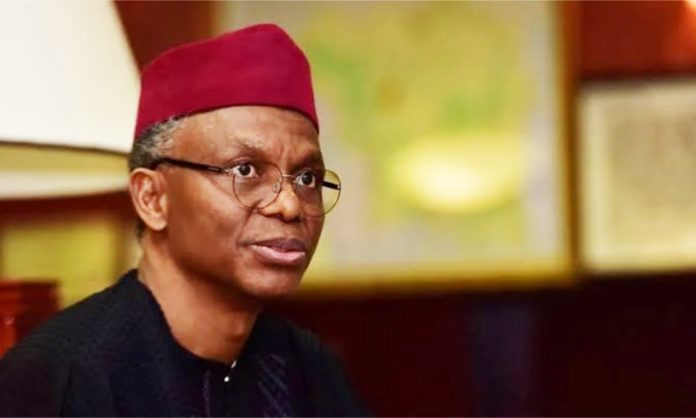
Ex Kaduna State Governor, Malam Nasir El-Rufai

Supporters of former Kaduna State Governor, Malam Nasir El-Rufai reportedly intervened on Thursday to prevent security personnel from arresting him at the Abuja airport.

According to multiple reports, operatives from the Economic and Financial Crimes Commission (EFCC) attempted to take El-Rufai into custody upon his arrival.

The former governor is said to have resisted the move, prompting his supporters to intervene and ensure that he left the airport safely.

In video footage shared online, El-Rufai’s backers can be seen escorting him out of the airport terminal as they chanted his support.

In a separate clip, supporters are heard praising the former governor while ensuring he is safely removed from the scene.

“He is our leader, nothing will happen,” some of the supporters chanted, underscoring the level of public engagement during the incident.

DAILY POST reports that El-Rufai had recently said he believed he could be arrested soon.

In an interview, he alleged that some of his former associates in Kaduna have already been picked up by security agencies, leading him to think he could be next in line.

Credit: dailypost.ng


Food & Beverage workers protest at NAFDAC Lagos Office over sachet alcohol ban

0
Members of the National Union of Food, Beverage and Tobacco Employees protesting

Members of the National Union of Food, Beverage and Tobacco Employees (NUFBTE) are currently occupying the NAFDAC office complex in Isolo, Lagos, to protest the agency’s refusal to comply with alleged Federal Government’s directive to suspend enforcement of the ban on the production and sale of alcoholic beverages in sachets.

The union is calling on NAFDAC to unseal production lines that were shut down, citing a directive allegedly issued by the Office of the Secretary to the Government of the Federation and the Office of the National Security Adviser.

Meanwhile, NAFDAC on Wednesday dismissed claims that the Federal Government ordered it to suspend enforcement of the ban on sachet and PET-bottled alcohol.

Earlier this month, NAFDAC began implementing the nationwide prohibition on the production and sale of alcohol packaged in sachets and polyethylene terephthalate (PET) bottles.

However, reports circulating on social media on Wednesday suggested that the agency had been instructed to halt the ban’s enforcement.

But in a statement signed by its Director-General, Mojisola Adeyeye, NAFDAC described the reports as “false” and “misleading,” stressing that it had received no directive from the federal government to suspend its regulatory activities.

“NAFDAC operates strictly within the ambit of its statutory mandate and in alignment with duly communicated Federal Government policies and directives,” the statement read.

“At no time has the Agency received any formal directive ordering the suspension of its regulatory or enforcement activities in respect of sachet alcohol products.”

The agency reaffirmed its commitment to public health protection and regulatory compliance, noting that any major decisions affecting national regulatory actions would be formally communicated through official channels.

“NAFDAC urges members of the public, industry stakeholders, and the media to disregard the false report and rely only on verified information issued through the Agency’s official platforms and authorised government communication channels,” the statement added.

The agency also warned against the spread of unverified information, saying it could cause “unnecessary public anxiety, economic uncertainty, or misinterpretation of government policy.”

“NAFDAC remains steadfast in its commitment to public health, economic stability, and national interest,” the statement concluded.

Credit: channelstv.com


The Ghanaian Chronicle