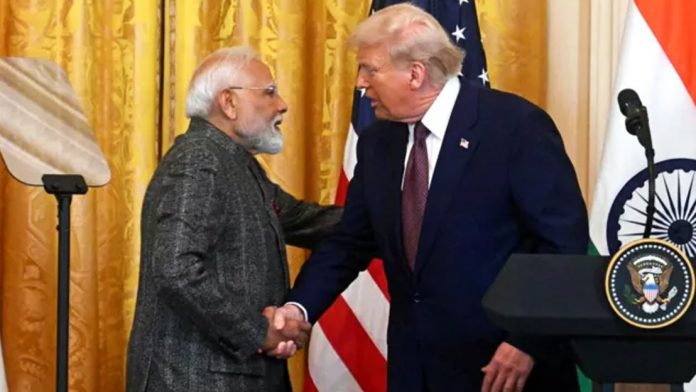
Indian Prime Minister Narendra Modi (left) last met US President Donald Trump
US President Donald Trump’s decision to lower reciprocal tariffs on India from 50% to 18% has been met with a sense of relief in Asia’s third-largest economy, even as precise details on the agreement remain sketchy.
India paid the highest tariffs in the world after Trump raised import duties on Indian goods from 25% to 50% in August last year, saying Delhi’s purchase of discounted Russian oil was helping fund Moscow’s war effort in Ukraine.
After his call with India’s prime minister on Monday, Trump claimed Narendra Modi had “agreed to stop buying Russian oil, and buy much more from the United States, and potentially Venezuela”.
India has not commented on these exact claims, but Modi thanked Trump “on behalf of the 1.4 billion people of India for this wonderful announcement”, saying he hoped to take the partnership with the US to “unprecedented heights”.
The patch-up comes after Trump’s trade war soured carefully cultivated relations between Washington and Delhi, with exports from India to the US falling sharply across key job-creating sectors such as textiles, seafood and jewellery.
Trump’s tariffs also forced a notoriously protectionist government in Delhi to expedite a flurry of other trade agreements and diversify its export markets.
Last week, India and the EU announced “the mother of all trade deals”, eliminating tariff on 80-90% of goods. It was Delhi’s ninth free trade agreement in four years, as the deal with Washington showed no signs of progress.
The long-delayed announcement by Trump was, as expected, widely welcomed by Indian industry.
Kyiv residents shelter at a train station during Russian air raids
Russia has used a record number of ballistic missiles to target Ukraine’s energy sector, President Volodymyr Zelensky has said.
The combined missile and drone strikes hit power plants and infrastructure in Kyiv and multiple locations causing “the most powerful blow” so far this year, according to private energy company DTEK.
The strikes were launched as temperatures dropped to -20C (-4F) and left more than 1,000 tower blocks in the capital without heating once again and damaged a power plant in the eastern city of Kharkiv beyond repair.
Zelensky said Russia was “choosing terror and escalation” rather than diplomacy to end this war and called for “maximum pressure” on Moscow from Ukraine’s allies.
The attack comes after a so-called “energy truce” agreed by Donald Trump with Vladimir Putin expired at the weekend.
Ukraine’s president suggested that Russia had simply used the time to stock up on missiles and prepare for the next attack.
It also came on the day Nato Secretary-General Mark Rutte was in Kyiv to meet President Zelensky and to address the national parliament.
Donald Trump’s initiative was meant to give diplomacy a chance. Negotiators from Russia and Ukraine are due to meet in Abu Dhabi for another round of talks co-ordinated by the US later this week.
It is clear that Russia has other ideas.
And in fact, there is always a gap between Russia’s massive strikes which makes Ukrainians doubt there was ever any real pause at all.
Iranian President Masoud Pezeshkian has said Iran will pursue negotiations with the US after requests from “friendly governments in the region” to respond to a US proposal for talks.
In a statement on X, Pezeshkian said he had told Iran’s Minister of Foreign Affairs Abbas Araghchi to pursue talks “provided that a suitable environment exists – one free from threats and unreasonable expectations”.
The Iranian president’s words come after the country’s supreme leader Ayatollah Ali Khamenei warned any attack on Iran would spark a regional conflict.
US President Donald Trump has threatened to intervene in Iran over its nuclear ambitions and deadly crackdown on protesters, building up forces nearby.
“These negotiations shall be conducted within the framework of our national interests”, Pezeshkian added.
The talks will be held in Istanbul on Friday, according to US media reports.
Pezeshkian’s announcement follows an interview with Araghchi in which he told CNN he was “confident that we can achieve a deal”.
Speaking to a press pool in the White House, Trump said on Monday “if we can work something out” that would be “great”, but warned that “bad things would happen” if not.
The US carried out targeted strikes on Iran’s nuclear facilities last year in what it called Operation Midnight Hammer. The strikes followed a large-scale operation by Israel to target Iran’s nuclear facilities and nuclear scientists.
Trump added that there was a “tremendous force” headed to Iran, including the “biggest and the best” ships. The build up of US military and navy includes air craft carrier USS Abraham Lincoln, which has an air wing of around 70 aircraft.
Iranian authorities previously said that 3,117 people were killed during the protests, but activist and monitoring groups say the toll is significantly higher.
You already know that a diet rich in fruits and vegetables is good for you. But when you’re going through cancer treatment or trying to keep cancer from coming back, some fruits may be better than others.
The research on fruits and cancer isn’t perfect. There aren’t many studies, and the results are often inconsistent. No food, and certainly no one fruit, can prevent or fight cancer.
Still, certain types of fruits may have cancer-fighting qualities. Others can make it easier for you to cope with the side effects of treatments.
Fruit During Cancer Treatment
Fruit provides nutrients that you need during cancer treatment. Some fruits may also help ease discomfort. Experts recommend these, depending on how you feel:
For nausea and vomiting: canned fruit, applesauce, peaches, and other soft fruit
For constipation: raw fruits, dried fruits, prune juice
For diarrhea: fruit juices, bananas, and apples as part of the BRAT (bananas, rice, applesauce, and toast) diet
For loss of appetite: high-calorie foods, including dried fruit and fruit smoothies
For mouth sores: nectars, apple juice, canned fruit, applesauce
Citrus Fruit
Citrus fruit, like grapefruits and oranges, may have a role in preventing certain cancers. One large study in Japan found that people who had citrus fruits or juices 3-4 days a week were less likely to get cancer than those who had them 2 or fewer days a week.
Though the research results aren’t clear-cut, they show that citrus might help fend off several types of cancer:
At least one meta-analysis — a study that looks at lots of previous research on a subject — linked apples with a reduced risk for cancer. The link seems strongest for lung cancer. But apples may also help protect against:
Another study found that eating white vegetables and fruits, like apples, pears, mushrooms, and onions, may help protect against colorectal cancer. (Apples and pears are considered white because of their flesh.)
The possible benefit from apples probably comes from two substances they contain: polysaccharides, a type of carbohydrate, and quercetin, a plant pigment. Both may help fight cancer cells.
Green Fruits
Green fruits may help protect against colorectal cancer, according to the same study that looked at white fruits and veggies. Green fruits include:
Kiwifruit
Honeydew melon
Green grapes
Other research also suggests kiwifruit may help prevent cancer. That’s partly because of the fruit’s antioxidants, and partly because kiwifruit promotes a healthy gut.
Dried Fruit
Dried fruit like prunes and raisins can be a healthy choice. Research shows that regularly eating dried fruit may help ward off some types of cancer. It might also help keep cancer from getting worse.
Eating three to five servings of dried fruits a week may help prevent:
Colorectal polyps, growths in your large intestine that aren’t cancerous but could eventually turn into cancer
Researchers are studying a range of plant chemicals that may play a role in cancer prevention, including:
Bromelain, an enzyme in pineapples
Carotenoids, plant pigments often found in orange fruits
Antioxidants in pomegranates
The research is in its early stages, so we really don’t know yet if these plant chemicals have cancer benefits. But at the least, these fruits are high in fiber. Fiber can help reduce your risk of certain cancers and help you maintain a healthy weight.
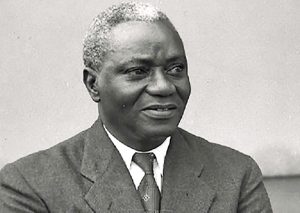
Ghana gained independence on March 6, 1957, with Kwame Nkrumah as the founding president. He promised a better, fairer, more inclusive country … sound familiar? But we all know that story. However, what we do not agree on is the chaos that followed. Nkrumahism began with promises of a perfect country — and ended in fear, detention, poverty, hunger, and death of patriots like Joseph Boakye Danquah in 1965.
J.B. Danquah
The one-party, dictatorial constitutional government that emerged was characterized by irrationalism, the suppression of freedom of expression, the absence of self-criticism, and the lack of property rights and free markets.
A few may be familiar with that dark history, but too many young Ghanaians are not. How do we know? Several years later, these dangerous ideas have been repackaged and rebranded. They are adopted by political parties and promoted by know-nothing politicians using words such as “equity,” “diversity,” and “social justice.”
The words sound harmless, but the ideas behind them are the same. Will they end up with the same terrifying results? Yes! Today, there is still the connotation of manipulation, greed, avarice, and grasping acquisitiveness associated with joining a political party for a profit.
The promise of wealth distribution, first championed by Kwame Nkrumah and echoed by successive administrations in various forms, was seductive: a free and easy life for the poor. But the reality has been far more painful. That promise rests on a false narrative — that governments can raise the poor’s living standards by redistributing wealth at no cost. It was a lie then, and it remains a lie today.
Sound economics and economic freedom have never been more crucial than today. Rampant inflation, tariffs, and higher taxes saturate every corner of our existence. The state continues to reach for control of all aspects of our lives. But we fail to fight back.
Meanwhile, Ghana is, by any standard, overindebted and poorly managed, which allows populist, chauvinistic, corrupt, partisan, and autocratic leaders to rise to power. In every other respect, our politicians are the same. They share the same hatreds, heroes, and a myopic worldview that describes government as a paternal authority and a guardian for everybody. This is the idea of socialism.
Poor economic fallacies have forced most citizens into financial hardship, declining incomes, anxiety, and resentment due to corruption, weak property rights, excessive government regulation, high trade barriers, and a preference for state-owned enterprises. The across-the-aisle promises of free education, free healthcare, and cheaper living for interest groups share fatal flaws: the mindset demanding “something for nothing” from society. The real casualty? Ghanaian development and prosperity.
Breaking the Chains
Ghana’s dilemma is not just economic—it is also moral. Income inequality and overall economic instability, which have shifted wealth from those who earn it honestly to those with political power, demand urgent attention to an alternative political path. It is unacceptable for bureaucrats to become the arbiters of income distribution, enriching themselves, politicians, and their allies at the expense of ordinary people.
True prosperity will not come from state handouts or protectionist fantasies. It will come from the economic opportunities embedded in a bottom-up free-market capitalist system. The new future will not arrive by accident. It must be built with intention.
Conceptual Framework: Principles for a New Ghana
The vision for the future must be anchored in three guiding principles:
Sustainability: Policies must serve future generations, not just immediate political gains.
Competitiveness: Ghana must become a magnet for talent, investment, and innovation.
Fairness: The state must serve all citizens—not partisan interests—and uphold the rule of law.
These foundational principles reflect our commitment to a conservative vision rooted in liberty, responsibility, and national renewal: Power must reside with the people. We uphold decentralization, the separation of powers, and constitutional checks and balances. A limited government ensures liberty, protects tradition, and secures the rights of future generations. Every citizen has the right to pursue life, liberty, and personal goals without undue interference. Freedom of speech, religion, and privacy shall be protected under the law. But rights must be matched by civic duty—respect for the rule of law and commitment to national service.
Private landowners deserve fair compensation and full transparency in any proposed acquisition—especially in mining zones. We affirm the right to oppose unlawful or forceful land seizures and call for lawful consent in all land appropriations. Ghana’s rural areas must not be left behind. We should expand access to small loans, improve wages, and invest in food security. Our best agricultural lands must be shielded from illegal mining and environmental degradation.
The Goalpost: A 20-Year Sprint Toward Prosperity
The success of Ghana’s cocoa industry was driven not by individual sacrifice for the common good, but by the productive genius of free men who braved uncertainty, went out on their own, and, through native wit, devotion, duty, and singleness of purpose, somehow created an agri-business where none existed before.
No one speaks on behalf of the rural farmer and the self-employed person. No one says he is more constructive than destructive. No one tells us it is more important to seek opportunity than to languish in government-created welfare. No one reminds us that each action of the individual … each new business in the informal economy… is a renewal of the democratic notion that all men are born equal and that the value of the individual to society does not depend upon family, social class, or political affiliation.
The deeper traditions of our society, its history, myths, and many of its heroic figures have fallen into oblivion, buried beneath a plethora of politics that seek to control, rule, regulate, and restrict.
Ghana must urgently reduce trade barriers that impede growth. This country cannot develop without a well-functioning financial sector operating according to market rules. To achieve real prosperity, Ghana should aim for sustained economic growth of over 10% each year for the next twenty years.
This is not a dream. It is a necessity. And it begins with a vote — for a vision, not a personality; for opportunity, not dependency; for a Ghana that finally trusts its people to build the future they deserve.
Seeking to overturn a two-goal first-leg deficit, EFL Cup holders Newcastle United travel to the Etihad Stadium to face Manchester City in an intriguing second-leg showdown on Wednesday night.
The victors of this all-Premier League contest will be in the final at Wembley Stadium on March 22.
Man City are in the driving seat to reach their 23rd domestic cup final at Wembley under the tutelage of manager Pep Guardiola, after securing a commanding 2-0 first-leg victory over Newcastle at St James’ Park three weeks ago.
Since that first-leg win, Guardiola and co have suffered a dip in form (W2 D1 L2) and most recently played out a frustrating 2-2 Premier League draw with Tottenham in North London on Sunday
Man City will nevertheless welcome Wednesday’s return to the Etihad where they have won 14 of their 18 home games in all competitions this season (D2 L2), while they have also won each of their last 11 home encounters with Newcastle by an aggregate score of 37-3, including a 4-0 top-flight victory in February 2025.
Newcastle do have the attackers at their disposal to trouble Man City’s leaky defence and exploit their high line, but the Citizens possess enough quality of their own in the final third to outscore their opponents and should secure an aggregate victory to reach the final.
Already on course to claim the league title, Inter Milan will continue their quest for a domestic double when they host Torino in Wednesday’s Coppa Italia quarter-final.
Inter Milan players
Two teams in very different form will convene for a cup tie at San Siro, with the winner set to meet either Napoli or Como in the last four.
Now, before resuming their Scudetto challenge with a weekend visit to bogey club Sassuolo, Inter Milan must return to their Coppa Italia campaign.
Nine-time winners – most recently in 2023 – Inter lost to city rivals AC Milan in last season’s semis, but they entered this term’s competition with a statement of intent, thumping Venezia 5-1 in the last 16.
That booked a quarter-final clash with perhaps their favourite opponents: the Nerazzurri have won 12 of their last 13 league meetings with Torino, and each of the last seven by a 17-2 aggregate score.
Following a 5-0 thrashing there in August, Torino are winless in their last 19 league visits to San Siro – including games against Milan.
Given that context, they should have next to no chance of eliminating Inter, but they did defy long odds to knock out Roma with a dramatic last-16 win at Stadio Olimpico.
The hosts are still missing regular starters Denzel Dumfries, Hakan Calhanoglu and Nicolo Barella, but Carlos Augusto could return after missing Sunday’s trip to Cremona.
Inter boast a flawless record against clubs inside the bottom half of Serie A -and the Nerazzurri are also a formidable force at San Siro, where Torino have repeatedly failed down the years.
Credit: sportsmole.co.uk
Valencia, Athletic Club Bilbao face-off in Copa del Rey
Valencia CF are gearing up to have a face-off against Athletic Club Bilbao for their quarterfinals fixture of the 2025-26 Copa del Rey. Mestalla Stadium will witness this interesting contest between these clubs.
Nico Williams, Athletic Club Bilbao
Valencia have come up with some decent performances in their last few games. They will be at home for their Spanish cup contest and this will be an advantage for them. Real Betis outplayed Valencia CF in their LaLiga outing, but their confidence levels will still be on the positive side.
Athletic Club Bilbao have been performing poorly this season. The upcoming Copa del Rey clash will not be an easy one for them. They were held to a 1-1 draw by Real Sociedad in their last league game. Athletic Club Bilbao came up with an underwhelming effort against Los Ches last time around, but will be keen to turn the tide now.
Valencia will miss out on the services of Julen Agirrezabala, Mouctar Diakhaby and Thierry Correia as they are injured. Guido Rodriguez and Daniel Raba might miss out due to lack of fitness.
Nico Williams, Oihan Sancet, Maroan Sannadi, Benat Prados, Unai Eguiuz and Daniel Vivian are not going to be in action for Athletic Club due to their injuries.
Neither of these clubs can afford to lose this fixture. Valencia are likely to come out on top and secure a win against Athletic Club Bilbao.
Alaves will welcome Basque rivals Real Sociedad to Mendizorrotza Stadium on Wednesday night, with the pair battling for a spot in the semi-finals of the Copa del Rey.
Real Sociedad have won this competition on two occasions, with their last success coming in 2019-20, while Alaves have been in the final once before (2017).
Goncalo Guedes of Real Sociedad
Alaves’ only appearance in the final of the Copa del Rey came in the 2016-17 season, when they took on Barcelona, suffering a 3-1 defeat to the Catalan outfit.
The Blue and Whites are therefore looking to create history this season, going in search of their first-ever Copa del Rey title, and they have been impressive in the 2025-26 tournament, winning four matches to reach this stage.
Indeed, Eduardo Coudet‘s side have overcome Deportivo Getxo, Portugalete, Sevilla and Rayo Vallecano to book a spot in the quarter-finals.
Alaves will enter this match off the back of an excellent result in La Liga, beating Espanyol 2-1, which made it back-to-back successes in Spain’s top flight.
The Basque outfit are currently 10th in the La Liga table, only three points behind eighth-placed Real Sociedad, and this is shaping up to be a fascinating battle in the quarter-finals of the Copa del Rey.
This is such a difficult match to call, and it would certainly not be a surprise to see Real Sociedad secure a spot in the semi-finals. Alaves have been excellent in their last two matches, though, and we believe that the home side could edge a close match here.
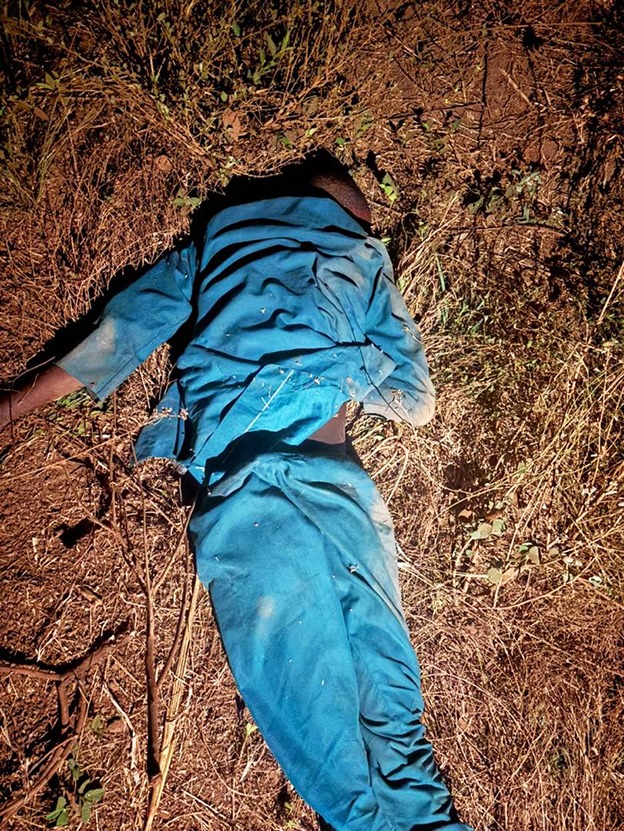
Police on Sunday gunned down the leader of a gang of highway robbers who have been terrorising commuters on the highway between Yeji and Atebubu in the Bono East Region.
The police pumped bullets into the said leader, Mahamadu Gariba Kirror, aka Jallo, after his team members had killed a driver and robbing passengers off valuable items on that particular stretch of the highway.
The items retrieved from him
Information available to The Chronicle, from a reliable source at the Police Headquarters, reveals that on Thursday January 29, 2026 at about 22:15hours, occupants of a mini van on the highway fell victim to the nefarious robbery activities of the bandits.
The driver of the van, with registration number AS 6444-14, was shot and killed while a woman sustained injuries.
On Saturday January 31, 2026 at about 10:30 hours, police intelligence led to the arrest of Gariba Kirror from his base.
A search conducted on him revealed the following exhibits: one (1) locally manufactured pistol, two (2) live BB cartridges, one (1) Samsung Galaxy AO7 mobile phone and a talisman.
Further enquiry established that the mobile phone belonged to Nafisa Owusu Haruna, the surviving victim of the shooting on the highway.
Upon interrogation, suspect Jallo reportedly admitted having taken part in the robbery, leading to the killing of the driver and injuring the woman.
He mentioned Umaru, Issifu, Furgur, Ibrahim, Shaibu and Yellow as his accomplices.
On Sunday, February 1, 2026 at about 19:45hours suspect Jallo led a team of detectives to a nearby bush, in the Atebubu Municipality, so as to apprehend his accomplices.
When the team was approaching the hideout of the bandits, the suspect advised police to use a footpath, which leads to the location.
However, Gariba Kirror, immediately took to his heels in an attempt to enter a forest to escape.
The escorting police personnel were, therefore, compelled to fire in order to incapacitate him.
Consequently, he sustained gunshot injuries and was pronounced dead at the Atebubu Government Hospital
Founder of the defunct Menzgold Ghana Limited, Nana Appiah Mensah, popularly known as
NAM1, has finally opened his defence in the ongoing criminal trial after several attempts to
stall proceedings.
Giving oral testimony before a High Court in Accra, presided over by Justice Ernest Owusu-
Dapaa, NAM1, led by his new counsel, Paa Joy Akuamoah Boateng, told the court that Menzgold operated under a license issued by the Precious Minerals Marketing Company (PMMC). At the start of proceedings, defence counsel informed the court that an application to stay proceedings had been rendered moot, following the withdrawal of a substantive application pending before the Supreme Court.
Counsel, therefore, prayed the court to strike out the motion dated January 13, 2026. The prosecution, represented by State Attorney Watkins Adama, said it was not opposed to the request. The court subsequently struck out the motion as withdrawn, noting that an appeal against the summary of proceedings remains pending.
The trial was ordered to continue. Answering questions in evidence- in-chief, NAM1 confirmed that Menzgold Ghana Limited was duly incorporated under the laws of Ghana.
He told the court that the company was established to undertake gold mining, gold buying,
value addition and export, among other activities.
He admitted that such operations required licensing from relevant state institutions.
According to him, at the time of Menzgold’s operations, the company held the necessary licenses. He said Menzgold applied to PMMC, completed all required documentation, paid the prescribed fees and went through internal screening processes before being issued a license to operate.
He added that two to three years later, PMMC’s mandate changed, with government designating it as a national assayer rather than a licensing authority, after which Menzgold was invited to sign a licence agreement with the Minister for Lands and Natural Resources.
NAM1 further told the court that he had proof of the licenses and incorporation documents but had been unable to access them. He explained that when the Securities and Exchange Commission shut down the company, the Economic and Organised Crime Office (EOCO) preserved all Menzgold offices, making it impossible for him to retrieve critical documents needed for his defence.
The court directed the accused persons to file their proposed documentary evidence at least three clear days before the next sitting. NAM1 was also ordered to file his witness statement by February 9, 2026.
The case has been adjourned to February 19, 2026 at 11:00 a.m. for Case Management Conference (CMC), failing which the oral testimony of the first accused will continue.
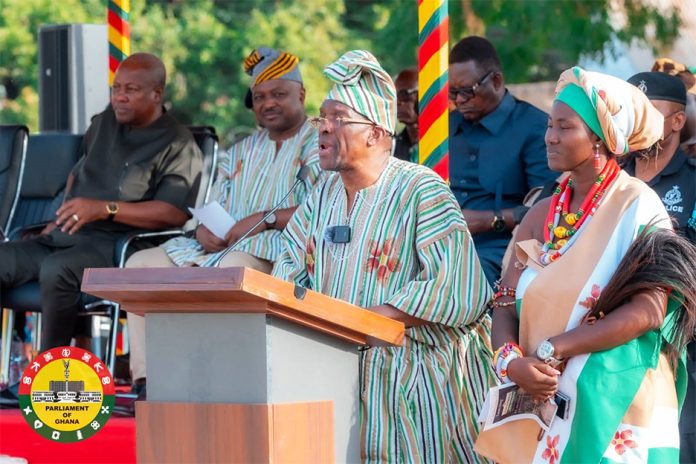
The Speaker of Parliament, Alban Kingsford Sumana Bagbin, has cautioned chiefs, landowners and residents of the Upper West Region against disputes over land allocation, warning that such disagreements could derail the success of the Sheapark Resource Hub.
Speaking at the official launch of the Sheapark Resource Hub in Wa, Speaker Bagbin said the project was a major development intervention meant to revive the socio-economic life of the region and must not be undermined by conflicts over where projects will be sited.
“Let us not mar the progress of this intervention with disagreements over land,” he said.
Speaker Bagbin described the launch as a historic moment for the Upper West Region, noting that the Sheapark Resource Hub is a development pathway not only for the region, but for Ghana as a whole.
He said the initiative, which took about 17 months of preparation, is guided by a detailed development blueprint aimed at unlocking the region’s economic potential.
The Speaker stressed that the project was not a ceremonial exercise or a political promise that will be abandoned after the launch.
He said government, traditional authorities, the private sector and development partners are all committed to ensuring the success of the initiative.
He called on residents of the Upper West Region to actively support the project, work with government and private investors, and avoid actions that could slow down development.
The Speaker described the Sheapark Resource Hub as a clear development pathway that will transform the Upper West Region and contribute significantly to Ghana’s overall economic growth.
According to him, the initiative had been designed to resuscitate the economy of the Upper West Region by unlocking its vast natural and human resources and turning them into sustainable economic opportunities.
He told the gathering that the project is guided by a well-thought-out development blueprint titled “Revealing Potential Pathways for Socio-Economic Development, 2025 and Beyond.”
The blueprint, developed through consultations with experts, traditional leaders, government officials and ordinary citizens, identifies shea as a major growth driver, supported by allied products such as dawadawa, neem, baobab, cotton, legumes, cereals and livestock.
It also highlights investment opportunities and proposes a new urban setting supported by modern infrastructure to promote commercial and industrial activities.
“We are not here to impress the world with an expensive launch only to abandon the project. We mean business and serious business.”
The Speaker noted that the Sheapark Resource Hub is not a solo effort but a collaborative initiative involving government, traditional authorities, the private sector, development partners and the media.
He commended President John Dramani Mahama for his commitment to the project, describing him as one of the key drivers of the vision behind the initiative.
He said the hub aligns with the President’s flagship programmes, particularly the 24-hour economy, the Big Push, and accelerated export development, which aim to build a self-reliant, industrially competitive and export-driven Ghanaian economy.
Speaker Bagbin emphasised that the Sheapark Resource Hub will operate within a 24-hour commercial framework, creating opportunities for women, men and young people to engage in productive activities such as farming, tree planting, harvesting, processing and marketing of shea and other products.
He said this will especially help women in micro, small and medium-scale shea butter processing to overcome challenges related to energy, financing, logistics and access to markets.
However, he cautioned that launching the project alone will not automatically lead to factories and jobs.
“If we cut the sod and go to sleep, nothing will change. There is serious work to be done and the work starts today.”
The Member of Parliament for Akropong Constituency in the Eastern Region, Sammi Awuku, has cautioned against calls for the New Patriotic Party (NPP) to widen its voters’ register, warning that such a move could allow unwanted elements into the party.
The flag of the New Patriotic Party (NPP).
He argued that opening up the party’s internal elections to every card-bearing member without proper safeguards could be dangerous.
“If you open your goalpost unprotected and allow every card-bearing member to vote in your internal primaries, they will end up electing your leaders for you,” he cautioned.
He further described the idea that every card-bearing member should vote in internal party elections as utopian, stressing that the practice does not exist anywhere in the world. He cited countries such as the United States and the United Kingdom as examples.
Speaking on the Citi Breakfast Show (CBS), Sammi Awuku, who also serves as a Senior Campaign Adviser to the Bawumia Campaign Team, revealed that some members of the National Democratic Congress (NDC) have infiltrated the NPP’s delegates’ album and could remain delegates till March, 2026.
“Even in my current album, I can tell you that there are a couple of NDC members who were able to find their way into it. They have a four-year mandate which ends in March. Through our scrutiny, we uncovered that these are NDC people,” he stated.
NDC
Earlier on the show, the Akropong legislator explained that Dr. Mahamudu Bawumia is focused on repositioning the NPP to make it more attractive to Ghanaians.
“What I know is key to him now, is how the NPP positions itself in the minds of the Ghanaian people. That is why it is about strengthening the grassroots of the NPP,” he said.
He added that discipline within the party is crucial for electoral success, noting that “a party that is not disciplined cannot win elections.”
Sammi Awuku further announced that Dr. Bawumia intends to make the NPP a party of choice, appealing to the middle class, captains of industry, and Ghanaians across all social levels.
He explained that the party’s policies, including free maternal healthcare and the School Feeding Programme, are aimed at addressing the needs of ordinary citizens while promoting economic growth.
According to him, the NPP is committed to building peace, unity, and cohesion within the party as it prepares for future elections.