Home Blog Page 2302

ISD sets up website to combat misinformation

0
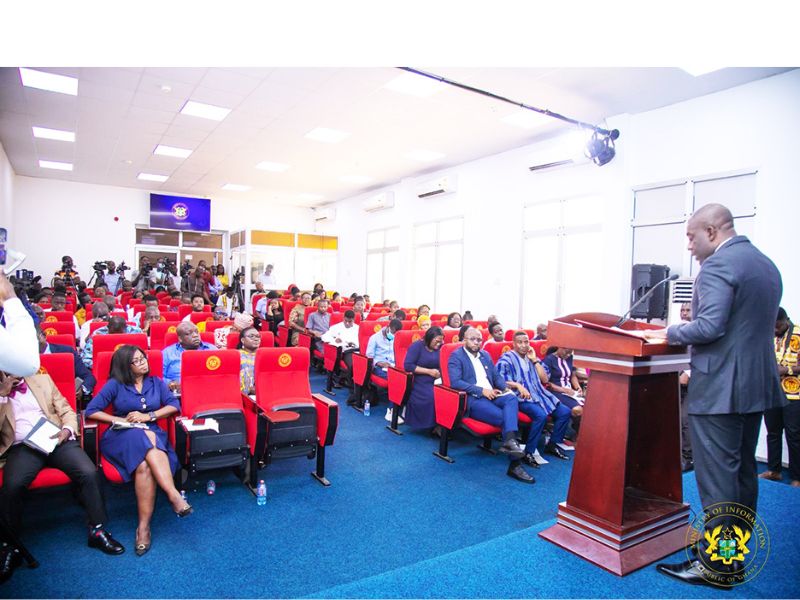
Information Minister, Kojo Oppong Nkrumah launching the programme yesterday
Acting Chief Information Officer, ISD, Mr David Owusu Amoah speaking at the launch of the website

The Information Services Department (ISD) of the Ministry of Information yesterday launched its own website to manage the flow of information and also combat misinformation.

The website (www.ghanatoday.gov.gh) is intended to aid the Department in the fight against misinformation by providing direct information from Ministries, Departments and Agencies about the works of government and becoming a repository of all happenings in government.

It is also expected to provide facts about government projects and programmes, full texts of all speeches by heads of Ministries, Departments and Agencies, official communications and publications, policies and program documents to reduce the level of misrepresentations and sometimes outright misinformation online.

Launching the website at the Ministry of Information’s press center in Accra yesterday, Minister for Information, Mr Kojo Oppong Nkrumah was confident that the ISD would be able to provide timely and credible information from across the country.

The Minister’s confidence steams from the fact that the ISD has department and officers in all 16 regions and 261 districts and would be able to feed the website with accurate and timely information.

The Minister also noted that the ISD now has a state-of-the-art research department, an ultra-modern Public Relations Coordinating Division and a Media Division which will ensure that the Department becomes a very vibrant institution for the dissemination of authentic information on government in order to keep the public well informed.

Speaking on why the ISD is embarking on this project, Minister Oppong Nkrumah indicated that a significant section of the Ghanaian population now rely on online platforms and other social media platforms for information.

He, however, observed that some unscrupulous persons now use many of these portals and social media platforms to propagate falsehood and misinformation.

The Minister noted that such misinformation if not managed will undermine Ghana’s democracy hence the launch of the website.

Minister Oppong Nkrumah said the levels of misinformation the country is experiencing today would not have happened had successive administrations and governments equipped the ISD.  He also bemoaned the inability of the department to keep up with the ever-changing media landscape and the technology that goes with it. He, therefore, called for the support of all for the ISD now that the government has resourced it.

The Minister urged that media to use the platform to authenticate information while he called on the general public to utilize the platform to validate information about government works that they may come across.

“To our colleagues in the media, we hope this becomes a useful tool that makes your all-important work easier. To the general public, reach out to www.ghanatoday.gov.gh if you want to validate the information about Government works that you may come across,” the Minister said.

The Acting Chief Information Officer, Mr David Owusu Amoah, on his part said that the ISD cannot control information due to media pluralism and information overload.

He said the ISD can, however, manage the kinds of information that are churned out and was very delighted that the website has been set up for that purpose. He said the ISD will ensure that its long standing values including objectivity are exhibited on the website.

Suspected Trooper Imoro Sheriff’s killers in court

0
The suspects being escorted to court

The Tema Regional Police, on Monday, hauled four persons to the Ashaiman Circuit Court over the murder of 22-year-old Imoro Sheriff, a soldier with the 3rd Infantry Battalion, Sunyani, on March 4.

Samuel Tetteh, 20 years old unemployed, and Abubakar Sadick, also 20 and a scrap dealer, both residents of Ashaiman, the police told the court, stabbed Imoro Sheriff to death at Taifa, a suburb of Ashaiman, to rob the latter of his mobile phone.

According to police investigations, Imoro Sheriff, on 3rd March at about 10:30 pm, visited a female friend at Ashaiman Newtown and left the place at about 01:30am the next day.

The police said at about 1:45am, Samuel and Abubakar stabbed Imoro Sheriff at Taifa and took away his mobile phone. The two later sold the mobile phone to Ibrahim Abdul Rakib for GH¢300, who also sold the same phone to Safianu Musah for GH¢350.

Safianu Musah, police said, was being evasive on the whereabouts of the phone and claimed to have sold it to Yussif Mohammed for GH¢500, and later to Abdul Gafaru Abdul Karim.

When they arrived at the crime scene upon the receipt of the information on the murder, the police said they retrieved several items including a knife with blood stains on it and a backpack. In the backpack the police found one Samsung tablet an Apple laptop, one military uniform with the name tag ‘Imoro’, eight other items of clothing, as well as a Ghana Card and a health insurance card bearing the name Imoro Sheriff.

Police said the accused persons were arrested at their hideout in Ashaiman on March 10.

Samuel Tetteh and Abubakar  Sadick are standing trial on conspiracy to commit crime, namely robbery, contrary to sections 23(1) and 149 of the Criminal Offences Act, 1960 [Act 29]; robbery, contrary to section 149 of the criminal offences Act, 1960 [Act 29].

Ibrahim Abdul Rakib, also a scrap dealer, is standing trial for dishonestly receiving contrary to section 146 of the Criminal Offences Act 1960 (ACT 29).

Lastly, Safianu Musah, a trader, is also standing trial for dishonestly receiving contrary to section 146 of the Criminal Offences Act 1960 (ACT 29).

Editorial: Exposing those who undermine the judicial system is the way to go

0
Editorial

It will be recalled that in September 2015, Anas Aremeyaw Anas premiered his undercover film, titled ‘Ghana In The Eyes Of God’, that exposed deep-rooted corruption in the country’s judiciary system.

The film exposed dozens of judges and other staff of the Judicial Services receiving bribes to pervert the course of justice. The exposé, which shocked the country, was the biggest corruption scandal to have hit the country’s judiciary. An investigation by the Service resulted in the suspension of some judges and dismissal of others.

Eight years on and it looks like some Ghanaians have still not learned any lessons from Anas’ exposé. A story in the Daily Graphic newspaper yesterday revealed that the Bolgatanga High Court Two, last Friday, convicted two persons, including a Chief, for attempting to influence the acting Supervising High Court Judge, Justice Alexander Graham.

According to the story, the two, who were convicted on their own pleas of guilty, are the Chief of Baare, Naab Nyakora Mantii, and the Secretary to the Paramountcy, Richard Sunday Yinbil.

“The events leading to their conviction were that, before the commencement of proceedings at the court last Friday, the two men sought permission from the court clerks to see the Judge in his chambers for a private conversation, which was duly granted.”

They then informed Justice Graham that they had been sent to invite him to be briefed properly, and to understand a number of mining-related cases from the area, which were pending before the court.

The Judge immediately realised that the action of the two persons was contemptuous, since there were many mining cases before the court for determination, and quickly walked out and ordered for their arrest. It is quite surprising that there are still people in the country who do not learn from mistakes that others did to land them in trouble.

The Judicial Service is obliged to administer justice freely and fairly and not to be influenced. It is disrespectful to try to influence the officers of the law. The Chronicle highly condemns this act. It is unacceptable and as such must not be encouraged.

The Chronicle applauds the Judge for the strong stance he took by not allowing himself to be influenced, and as such, we will urge other members of the Judicial Service to learn from this exemplary act. He must as well be rewarded to serve as motivation for other judges. If all judges learn from this, it will help to shore up public confidence in the judicial system.

The Chronicle would also use this medium to warn the public to desist from trying to corrupt judges in an attempt to get favorable outcomes in cases in court. The justice system must be seen to serve all manner of persons equally and fairly.

Kumasi continues to reel under growing filth

0
Wastes found on median of dual carriage few meters away from Dunkirk,Kumasi.
Filth found at the CBD of Kumasi.

The inability of the Kumasi Metropolitan Assembly (KMA) to rollout measures to address the growing sanitation challenges in the Central Business District of the Metropolis has seen Kumasi becoming filthy and accompanied by a foul stench.

This paper can state on authority that the sanitation situation in the Central Business District, which has been taken over by hawkers, is precarious and needs a holistic approach to curb what is becoming a health emergency.

In the last one month, The Chronicle has observed mountains of garbage at various locations of the Central Business District, including the median of roads. Among the areas of concern are Roman Hill, and a dual carriageway in front of the under-construction central market, which project has largely stalled.

Making this situation horrible is the sale of food stuffs and running of transport stations adjacent to these mounds of garbage. Per observation by The Chronicle, the Central Business District of Kumasi and filth are becoming inseparable.

Heap of garbage adjacent the St Peter’s Bacilica Cathedral at the Roman Hill,Kumasi.

This sanitation challenge has been in existence even before Sam Payne took over as the Mayor of Kumasi. The inability of the KMA to decongest the Central Business District without a human face has seen garbage, largely created by market women and transport stations, swallowing the once upon a time Garden City of West Africa.

The Central Business District of Kumasi has been turned into a cradle of filth and indiscipline, with people cooking on roads.

Speaking to a resident of Kumasi, who gave his name as Kwadwo Boadi, he expressed worry at the sanitation in the Central Business District.

Reached on phone, the Public Relations Officer of the KMA, Ms Henrietta Afia Kondu, told this paper that the Assembly collected the garbage during the day and at dawn.

Afia Konadu attributed the challenge to the attitude of the public.

Asked about the existence of the monthly clean up exercise, whereby the Central Business District was cleaned, she responded that the KMA had not abandon that programme, however,  owing to financial constraints it had put the exercise on hold.

Newmont pays GH¢2.76bn tax to govt

0
Tom Palmer, President and Chief Executive Officer

Newmont Africa has announced that its Ghana operations (Ahafo South and Akyem mines) paid a total of GH¢2.76 billion in taxes, royalties, levies, and carried interest to the Government of Ghana in 2022, through the Ghana Revenue Authority, Forestry Commission, and Ministry of Finance.

For the full year (2022), Newmont Africa paid GH¢1.53 billion as Corporate Income Tax, GH¢548.3 million as Mineral Royalties, GH¢261.3 million as Pay As You Earn, GH¢164.5 million as Withholding Tax, GH¢222.1 million as Carried Interest, and GH¢35.5 million as Forestry Levy.

In the last quarter of the year (September to December of 2022), Newmont Africa’s payment to government amounted to GH¢1.04 billion, across the two operations. Breaking it down by operation, Newmont Africa’s Regional Chief Financial Officer, Danquah Addo Yobo, said, “the Ahafo operation contributed GH¢1.22 billion for the year while the Akyem operation contributed GH¢1.54 billion.”

“Over the years, Newmont Africa has been recognised as a compliant and significant tax payer in Ghana, and has been duly acknowledged as such by the Ministry of Finance and its revenue agency, the Ghana Revenue Authority.”

Beyond meeting its tax obligations to the government, Newmont Africa also supports the nation’s growth through employment opportunities, local supply chain development, and social investment, among others. Newmont Africa played, and continues to play a major role in the government’s gold purchasing programme, designed to shore up the country’s gold reserves and help stabilize the national currency.

Kufuor’s Asem Boys School to be upgraded into model JHS 

0
Dr Adutwum addressing a section of journalists at the meeting

By January 2024, some selected Junior High Schools would be transformed into model schools.

Among these is the Asem Boys School in Kumasi, known to have moulded the basic education of former President of Ghana, John Agyekum Kufuor and former Secretary General of the United Nations (UN),the late Kofi Annan.

The School is to undergo a major transformation to become a Model Science Technology, Engineering and Mathematics (STEM) Junior High school.

The Ministry of Education (MOE) has redesigned the school to comprise a modern two- storey block to accommodate all the cluster of schools to be manned one headteacher and two assistants.

The premises, which will be fenced and gated will comprise classrooms, administration block, library and a mechanical borehole.

Other schools in Ashanti region to be upgraded to benefit from the new Model JHS are Bantams, Jurgen and Abenase JHS.

It is part of MOE’s Transformation Agenda to replace the present weak JHS system with a Model JHS system to ensure major reforms in the education sector.

The Minister of Education, Dr. Yaw Osei Adutwum, who announced the transformation agenda while meeting with journalists in Kumasi, on Sunday, said the intervention is part of irreversible transformational agenda, designed to make the MOE proactive and help bridge the gap in the education system.

Dr.Adutwum explained the intent of the Model JHS programme is to help reduce the existing 13,000 JHSs in the country to a minimum of 3,500 because there are schools that should not exist.

The sector Minister also announced that a number of schools will be retooled with science laboratories to upgrade faculties and help open the floodgates of science education in the schools, hoping that courses of study, particularly in aviation, would be encouraged.

He mentioned some of the schools to be equipped with science laboratories as Kumasi Anglican SHS, St. Louis SHS, Kenyasi High SHS and Wesley Girls, all in Kumasi.

Other STEM schools, he said, are in the Greater Accra and the Central regions.

The Education Minister also announced that Guidance and Counselling Centres would be established in schools to give full meaning to the Free SHS policy to ensure that all areas of learning are fully utilised.

Meanwhile, Yaw Osei Adutwum has,in another development, challenged Conference of Heads of Assisted Secondary Schools (CHASS) and Principals of Technical and Vocational Education and Training TVET Institutions to improve their educational outcomes or stand the risk of having their institutions closed down.

He explained that a school with a consistent zero to ten per cent pass rate should put together intervention programmes to ensure that majority of their students will find opportunity for further studies, rather than becoming a liability to their parents and society due to their inability to pass their exam.

He explained that closing the schools down would help save the nation the huge financial lose being incurred by the government, as a result of the existence of the school, so that the affected students would be redistributed to other nearby schools, so they could continue their education.

Dr Adutwum announced this over the weekend when he addressed the members of the Conference of Assisted Senior High Schools (CHASS) and Principals of Technical and Vocational Education and Training (TVET) institutions in Kumasi on Saturday and Sunday.

The meeting, which is an annual event was to share with them current state of education in the country, discuss new development in the sector and answer questions on issues affecting them.

The meeting, which were in two batches, saw all SHS heads attended on Saturday while Principals of TVET institutions across the country also attended on Sunday.

He lauded the heads for their role in the transformation of education in the country and pledged to continue providing the needed resources and urged them to work very hard to ensure that they attained the right results.

Don’t be a barrier 

Dr Adutwum also cautioned the heads to desist from preventing first year students from enrolling due to the fact that some items on their prospectus had not been procured.

He indicated that, “there is no way any student should be turn away from school because the parents have not been able to procure some items on the school’s prospectus, at least, let them come to the school and the rest could be procured with some time”.

The Education Minister lamented the addition of many other unapproved items on the school’s prospectus which in the long run lead to the bloating of the prospectus for first year students.

Dr Adutwum, who is also the Member of Parliament for Bosomtwe, advised the heads not to do anything that would discourage or prevent any student from having access to education.

He urged the heads to let it be their goal of doing everything possible to create enabling environment for students to study and not to disturb them from their studies.

The Deputy Minister for Education, in-charge of TVET sector, Ms GiftyTwum-Ampofo, reminded the Principals to ensure that students were well equipped for the job market and also let the schools pass through them and not the students passing through the school.

She also urged the Principals to spend time, enhancing their capacity through reading relevant courses and books to support their effort at getting the best training for their students.

Presentations were made by the leadership of the Ghana Education Service (GES), National Education Leadership Institute (NELI), Free Senior High School Secretariat, Funds and Procurement Management Unit (FPMU), Ghana TVET Service.

Over 9,000 Private Cars Caused Road Accidents in one year

0

The National Road safety Authority (NRSA) has revealed that out of the 24,974 accidents recorded from March 2022 to March 2023 – 9,017 were caused by private vehicles.

According to statistics from the Authority, which has been published on its website, saloon cars accounted for 5,538 of the accidents involving private cars, or 61% of all accidents, while 363 minibus accidents accounted for 4% of all accidents, 171 vehicles were involved in 2% of accidents involving government vehicles and 2,945 vehicles were involved in 33% of accidents involving SUVs in the year 2022.

A total of 7,545 Commercial Vehicles also recorded fatal accidents within that same year with buses recording 1,132 contributing to 15% in this category.

Mini buses contributed 31.5% to 2,377 accidents, trucks contributed 14.5% to 151,095, taxis contributed 36.0% to 2,693 accidents, and other commercial vehicles contributed 3.0% to 248 accidents.

The Authority also revealed that motorcyclists contributed to road accidents last year in addition to passenger vehicles and business vehicles.

“Motorcycles recorded 4,243, bicycles recorded 212, hand carts 37 and tricycles recorded 1,192.” the statistics revealed

Furthermore, 2,728 pedestrians were also knocked down within the same period.

Due to these accidents, there were 18,016 casualties, 2,589 fatalities, 2,263 adult fatalities, 326 under-18 fatalities and 15,517 injuries last year.

Meanwhile, the NRSA has put in place measures to reduce road accidents such as cautioning drivers to drive within posted speed limits, take a break after driving for journeys of more than 8 hours or 500 kilometers.

Additionally, they advised drivers not to drive a motor vehicle shortly after consuming alcoholic beverages.

It would be recalled that last year the NRSA launched the 2022 road safety campaign under the theme “Stay Alive;Gaye Obonsam Agyuma Nu” to reduce road accidents.

The Authority also added a short code 194 as an additional toll-free number to aid law enforcement and related agencies in minimising accidents and other safety-related issues.

Ghana is one of the African nations that experiences traffic accidents on a global scale. The top 10 causes of mortality in Ghana, according to the US Centers for Disease Control and Prevention, include fatal traffic accidents.

In a related development, the Ghana Journalists Association (GJA) recently asked stakeholders to press for the swift modification of the Road Safety Act (2012) to address the dangers posed by abandoned, broken-down automobiles along roadways.

A mandatory towing policy for defective automobiles is to be put into place according to the Act.

The GJA President made the request at the Journalists Platform on Road Safety’s inaugural meeting in Accra, which was organised by CUTS International in partnership with the National Road Safety Authority (NRSA) and BIGRS with assistance from the Global Road Safety Partnership.

Mr. Dwumfour stressed that GJA was prepared to support the revision to the Act and exhorted journalists to take the lead in the advocacy.

He believed that road safety was a crucial issue for socioeconomic and health reasons, and as such, any attempt to promote it needed to be supported. He also noted that the problem persisted and that more work was needed to address it.

Minister Amoako-Atta explains why Jomoro road projects have delayed

0
Minister for Roads and Highways, Kwesi Amoako-Attah

The Member of Parliament (MP) for the Jomoro, Dorcas AffoToffey, last Friday asked the Minister for Roads and Highways, Kwesi Amoako-Attah, to explain why some road projects in her constituency have been abandoned.


“Mr. Speaker, I rise to ask the Minister for Roads and Highways when the road from Samenya Barrier to Half Assini and New Town in the Jomoro Constituency would be completed”, the MP asked.

The Minister, in response, promised the Jomoro Legislator that execution of abandoned and delayed road projects in the Jomoro Municipality would be considered and captured under the 2024 budget.

“Mr. Speaker the Samenya Barrier to Half Assini road forms part of the regional roads 019, which stretches from Mpataba to the Ivory Coast Border. The road spans through Jomoro Municipality of the Western Region”.

“Already, the Samenya Barrier to Half Assini Road forms part of an ongoing project from Mpataba to Half Assini dual road measuring about 25 kilometres,” the minister said.

The Roads and Highways Minister, giving background information about the project, said work commenced on 25th June, 2020 to be completion by 24th December, 2022.

However, progress of work, he told the House, had come to a halt due to delay in payments.

“The block 2, Mr Speaker, work commenced on 26th June, 2020 to be completed on December 26, 2022.

“Physical completion is 26% and the Contractor is on site. Again, however, progress of work is slow due to delay in payments. The completion of works would depend largely on availability of funds.

“To the Newtown roads… Mr. Speaker, these roads, measuring 80 kilometres are feeder roads and form part of the Half Assini New town feeder roads. There was lack of suitable gravel materials. The contract has been curtailed due to lack of funds. The execution would be considered under the 2024 budget,” Mr.Amoako-Attah told the House.

But Legislator Affo-Toffey kicked against the minister’s position that the finance of the roads would be captured under the 2024 budget of the government.

Her reason was that the Government of Ghana was short of funds to construct the roads in question, as fast as her constituents would want it.

As a result, the allocation should rather be under the Ghana Gas social responsibility programme to construct such roads.

Ashaiman Chief calls for peaceful co-existence between military and civilians

0
Nii Annan Adjor II, Chief of Ashaiman

Nii Annan Adjor II, Chief of Ashaiman has appealed to the Military High Command to ensure peaceful co-existence in Ashaiman and its enclave and collaborate with the police in the prosecution of suspects in the death of Trooper Imoro Sheriff.

In an interview with the Ghana News Agency, the Chief said “two wrongs do not make a right” the military should not use the same approach the civilians used to kill their colleague.

According to Nii Adjor, the action of the military created fear and panic among residents, deterring school children from going to school, including traders who could not go about their routine activities.

He regretted the loss of a devoted and energetic young military officer who died in such a bizarre circumstance and pleaded with the military to collaborate with the police to conduct thorough investigations and prosecute the suspect but not to brutalise innocent civilians.

“I plead with the Military High Command to handle the case in a peaceful manner to avoid innocent people being beaten,” he said.

The Chief said the military should educate the public on the implications of attacking security personnel because that had the potential to create chaos.

He cited the Denkyira-Obuasi incident, where the late Major Maxwell Adam Mahama was lynched which led to the arrest of some suspects and affected residents but all too soon no lessons have been learned.

“Any attack on any military officer must be reported to the appropriate authorities,” and appealed to the military to also use the appropriate platform for redress instead of retaliation.

He added that the public did not have the right to attack the military and neither did the military also have the right to attack any civilian unlawfully.

By Priscilla Nimako

Source: GNA

Nigeria’s election was a positive for the region

0
Opinion

However imperfect, Nigeria’s democratic, peaceful election was a breath of fresh air in a region crippled by coups and persistent democratic backsliding.

On March 1, Nigeria’s Independent National Electoral Commission (INEC) declared Bola Tinubu of the governing All Progressives Congress (APC) the winner of the 2023 presidential election.

It said the 70-year-old former Lagos governor won the race with 37 percent of the vote, while his main rival, People’s Democratic Party (PDP) candidate Atiku Abubakar, came second with 29 percent. The Labour Party’s Peter Obi, who had become a surprise favourite in the run-up to the election, came third with 25 percent.

Soon after the results were announced, congratulatory messages started to pour in from across Africa and the world. The chairperson of the African Union Commission, Moussa Faki Mahamat, and the chairman of the Economic Community of West African States (ECOWAS), Guinea-Bissau President Umaro Sissoco Embalo, congratulated President-elect Tinubu on his win. So did the leaders of Ghana, Sierra Leone, Liberia and the Gambia.

The US Department of State, meanwhile, congratulated not only Tinubu but all Nigerians for what it viewed as a “competitive election” that “represents a new period for Nigerian politics and democracy”. UK Foreign Secretary James Cleverly also issued a statement, commending Nigerian voters “for their participation in the Presidential and National Assembly elections and for their patience and resilience in exercising their democratic rights”.

Despite these waves of praise and celebration, however, the election was hardly without problems.

It recorded the lowest turnout since Nigeria’s return to democracy in 1999, with only 27 percent of eligible voters casting ballots. There were widespread allegations of voter suppression and vote buying as well as a few isolated incidents of violence. Most crucially, both Abubakar and Obi disputed the outcome and vowed to challenge it in Nigeria’s highest appeals court.

Nevertheless, despite being far from perfect, Nigeria’s largely peaceful and somewhat efficiently conducted election – which received a stamp of approval from the African Union Election Observation Mission – was a much-welcomed sight in a region long suffering from military coups and strongmen clinging to power.

The head of the ECOWAS Observer Mission to Nigeria, former Sierra Leone President Ernest Koroma, had acknowledged the regional importance of this election days before the polls opened. “Nigeria’s election remains a guide to West Africa,” Koroma said on February 23. “Its failure would spell doom for the sub-region”.

Koromo felt the need to underline the importance of this election because in the days leading up to it, there were growing concerns about the possibility of electoral violence and other likely obstacles to a peaceful transfer of power – and for good reason.

In the last few years, Nigeria has been grappling with severe socio-political and economic challenges, including underfunded public services, police brutality, a stagnant economy, and countrywide insecurity caused by Boko Haram, armed bandits and separatists. Coupled with a long history of military rule, all this raised fears that Nigeria may experience some democratic backsliding in this election cycle.

But despite growing tensions, Nigeria successfully conducted its election and determined its next president without much disturbance. The military stepped in to ensure the security of the polls, but made no move to intervene in the democratic process. Sure, Obi and Abubakar dispute the result, but they appear determined to do so not through violence and populist provocation, but by legal means.

All this stands in striking contrast to the rest of Nigeria’s immediate neighbourhood, where many countries are suffering under military juntas or struggling to hold free and fair elections.

By Tafi Mhaka

Source: aljazeera.com

The views expressed in this article are the author’s own and do not necessarily reflect The Chronicle’s stance.

The Ghanaian Chronicle