Home Blog Page 2240

FoE to petition ECOWAS, others over environmental violations

0
Mr Franklin Leonard Masika, FoE member from Tanzania making his submission

Friends of the Earth-Africa (FoE Africa), a non-governmental environmental organisation has hinted on petitioning the Economic Community of West African States (ECOWAS), as well as other international bodies, about the violations and abuse of the environment.

According to the group, issues of pollution, degradation, land grabbing, illegal mining, and logging are practices which affect the environment negatively and deprive people off their use of these resources positively, hence the petition.

Some members of FoE

The group made this known at a worship programme, organised in Accra. Present at the workshop were a number of the organisations from different Africa countries, including Tanzania, Cameron, Liberia and the host country, Ghana.

Sharing experiences of the violations in their various countries, and the steps being taken to mitigate the situation, Franklin Leonard Masika from Tanzania said he believed his country had the biggest resources in the East Africa sub-region, but that had not translated into wealth.

He said there were a lot of degradation, land grabbing, and pollution activities being carried out by some multinational organisations.

He said activities of land grabbing, for instance, had robbed many families off pieces of land they depended on for survival.

He noted that these companies, after taking hold of the land for their parochial interests, either pay less or sometimes no compensations at all to the respective families.

He said his outfit, which worked directly with these impoverished families, had tried, and in some cases, succeeded in getting compensations for these families, but that was not enough, hence, his support for ECOWAS to be petitioned.

Flora Lamero Zok from Cameroon, who also narrated a similar experience, said FoE Cameroon was working to ensure that the land laws were reformed.

She said, to ensure that the laws reflected the interests of the minority group, FoE Cameroon was working with the groups to ensure that their views were captured in the land law reformation.

She noted that more attention would be given to the issues when escalated to the international level, hence, her conviction in joining her colleagues to petition the international bodies.

In Ghana, Mr. Nehemia Tettey Odjer-Bio, Programs Coordinator, Forests and Biodiversity, FoE Ghana, noted that his outfit had also put in place some initiatives that would help salvage the situation of illegal logging and mining.

He said, FoE Ghana was embarking on the Green Livelihood Project, which sought to re-plant trees that had already been felled.

He also spoke about the monitoring of environmental illegalities and engagements with the local communities, and that the wildlife sector had not been left out. He noted that his outfit was working hard to ensure that Parliament passes a Wild Life Resources Management Bill, which would offer protection for the wildlife sector.

He,  just like his colleagues, believed that petitioning international bodies would help salvage the environment from further violations, and enable people whose livelihoods depended solely on it to get the most out of it.

About FoE

Friends of the Earth – Africa (FoE – Africa) is a non-governmental environmental organisation, which operates in 72 countries around the world and 11 countries in Africa, (of which the West Africa sub-region is one) to check abuse and other human rights violations by these multinational companies operating on the Continent.


AfDB, Bretton Woods and Africa’s financial problems

0
OPINION

Some millennia ago, Africa was a world super power. There were a number of empires which exhibited great civilization and were giants in production and industry; commerce and trading; academics and schooling, and in military warfare.

The Kingdom of Kush, a Nubian empire (2000 BC) located south of Egypt, was known for economic power, minerals and military power; Land of Punt (2500 BC) also called the Land of the Gods and located in East Africa was rich in minerals, ebony; Carthage (900 BC), located in Tunisia, was a powerful military empire which rivalled Rome; Aksum (300 AD), located in Eritrea and Northern Ethiopia was a trading juggernaut; Ghana (750-1240 AD), located in Senegal, Mauritania and Mali, was known as the Land of God; Mali (1200 AD), located in West Africa, was very rich in gold. The richest man who ever walked this earth, is the Malian king, Mansa Musa who is worth $400 billion in today’s terms.

There was Songhai, (1500 AD) located in West Africa. It established the first university in the world with students coming from Spain, Europe to study. The modern governance and judiciary system evolved from Songhai’s sophisticated bureaucratic system and then the Great Zimbabwe (1300 to 1500 AD) was once a powerful kingdom located in Botswana, Mozambique and Zimbabwe.

Later empires included the Asante Empire, 1701 – 1902/1957, which was a well administered kingdom with such a great military force and sophisticated war tactics, some of which were adopted by the British. Asante. It was rich in gold and had running battles with the British, winning some and losing some.

Once upon an era, we Black Africans were from powerful nations with great civilization, economic power and military strength, unmatched anywhere in the world.

But today, Africa has been classified as the poorest in the world. And even though we export rich natural and mineral resources to the developed countries, we get paid peanuts, for in the cocoa industry, worth over $100 billion annually, the two top producers, La Cote d’Ivoire and Ghana which account for 65% of world producers, get only $2 billion. This means world producers of cocoa get $3.07 billion, less than 3%.

Today, we cry over the economic challenges we face and yet what we do not realize is that these are partly due to the super powers and our lack of political will. Unless we come out with practical solutions, we shall forever remain poorer.

African countries belong to the Bretton Woods Institutions, which can be called a union or association, where member nations pay annual capital subscription or dues. The benefit here is that member countries can then borrow from the institutions, when they fall into financial difficulties. It is just like belonging to a union and getting assistance through its welfare scheme.

Whenever an African nation member of the Bretton Woods Institution needs financial assistance to balance its economy, it approaches the Intuitions. After some time, we noticed the raw deal being played by the IMF and World Bank. If an African nation, needs say $10 billion for proper economic recovery, it would be given $1 billion and tough conditionalities that would further wreck its economy within a short time, making that nation poorer than before. This is never the case with first and second world nations.

Africa then decided to establish a bank, the African Development Bank (AfDB) in September 1964. Among others, the Bank was to be like the IMF and World Bank and it was to give adequate funding to member countries who need to enhance their economy.

Twelve years on and after two presidents, the AfDB could not realise the dreams of member countries facing economic challenges, until Kantinka Dr. Kwame Donkor Fordwor of Ghana became President. The Ghanaian saw that the problem was finances and so recommended some transformations which could always raise enough money to assist countries in dire economic situations. Among these was to offer shares to very rich non-African countries.

This was his downfall. During his third year in office, he was kicked out. And yet, later the AfDB offered shares to some non-African nations. Sadly the AfDB is still not in the position to assist African nations with adequate funds to shore up their economies, without any conditionality that would rather worsen their situation.

It is most likely that the developed world made sure Dr. Donkor Fordwor could not achieve his dreams. If he did, the West can no longer control the economies of African nations and this will harm their own economies. For example, Francophone African nations, repatriate $500 billion annually to France as Colonial Tax, which is illegal. And when these countries need financial assistance, their own money is given to them as loan at high commercial interest.

West Africa decided to have a united currency called the Eco and went ahead with the date to introduce the currency. I stated in the Ghanaian Chronicles, that with the Francophone countries dominating West Africa, this can never be realized. And lo and behold, it came to pass. France decided to replace the CFA with Eco and it was game over.

So, long as African countries, do not look from within to find solutions, financial et all, to our mirage of problems, but choose to listen to the developed countries, we shall forever be going to the IMF throughout eternity.

Hon. Daniel Dugan

The views expressed in this article are the author’s own and do not necessarily reflect The Chronicle’s stance.

Group asks Tinubu to compensate North-west with senate pesidency

0

A support group within the North-west chapter of the ruling All Progressives Congress (APC) has asked the President-elect, Bola Tinubu, to allow the zone to produce the next senate president.

It said this will ensure the consolidation of the strength of the party in the region.

The Support Group for Asiwaju Bola Ahmed Tinubu in the North-west made the call during a press conference in Kano on Sunday.

The youth leader for the APC North-west, Abdulalmid Umar, who spoke on behalf of the group, said the zone produced the highest number of votes for the APC during the 25 February presidential polls.

Mr Umar said zoning the position to the North-west will encourage the party to vote for the ruling party in future elections.

“The President-elect should be consolidating on the high votes he recorded in our zone so as to override attempts that both PDP and NNPP will make to muzzle APC.

“The pressure will be too much on our party and membership if we do not have a formidable force to withstand pressures from opposing parties who already have Kano governorship and four out of the six governors from the zone.

“To retain our relevance in the zone, push ahead to gain more grounds, as well as consolidate on our electoral performance, the zone, more than any other should have the senate president,” the group said.

The group’s position is against the proposal of the Progressives Governors Forum (PGF) that the president of the 10th Senate should be a Christian.

The APC governors, in a recent memo sent to Mr Tinubu, said the party should consider the South-south and South-east as preferred zones for the senate presidency, while the speaker should be left for North-west and North-central.

The APC governors equally asked the party to consider the contribution of each of the six zones during the presidential election in zoning the National Assembly offices.

Out of the 6.6 million total votes in the North-west, Mr Tinubu got 2.65 million. In the South-east, he polled 127,605 votes and 799,957 votes in the South-south.

Police officers on patrol must wear approved uniform – Official

0
Police

The Nigerian police have said their officers on patrol must be fully kitted in the approved uniform.

The Force spokesperson, Muyiwa Adejobi, in a series of tweets on Sunday said officers on patrol are not allowed to wear any clothes other than the approved uniform.

Mr Adejobu was reacting to a tweet by one Ayo-Bankole Akintujoye.

Mr Akintujoye had tweeted about seeing some officers dressed like the now disbanded Special Anti-Robbery Squad (SARS) on the Lekki-Epe expressway in Lagos.

“Is SARS back on Lagos roads? Or why are skinny jeans, armed robber looking, gun blazing unmarked men standing on the highway along Lekki-Epe express?,” he had tweeted.

Responding, Mr Adejobi asked the state command spokesperson, Benjamin Hundeyin, to look into the matter.

“Ben, should take this up.. We don’t allow or encourage our men on patrol to dress like this. This is not allowed,” he wrote.

“Any policeman on patrol and stop and search should be in complete uniform. That is the authority to flag down and/or park any vehicle.”

He bemoaned the attitude of some officers who detest wearing the uniform, adding that they “will need to intensify our efforts in standardising the police.”

“I don’t know why many of them don’t like putting on uniforms? I can wear my uniform to any gathering or a party if permitted to know how much I value the uniform,” he said.

“No tactical team is actually permitted to mount a point and be doing stop and search but to work on intelligence and burst any criminal’s den.”

Source: premiumtimesng.com

Anxiety as Nigerians begin long wait for Tribunals

0
Professor Mahmood Yakubu

The 2023 general elections are now over with the completion of the April 15 supplementary elections in 2,660 polling units (PUs) across Nigeria.

A rerun of governorship, State Assembly, senatorial and House of Representatives elections took place in 185 Local Government Areas in over 20 states following violence, cancelled votes, late arrival of materials, etc.

The States include Adamawa, Akwa Ibom, Bayelsa, Ebonyi, Edo, Ekiti, Enugu, Imo, Jigawa, Kaduna, Kano, Katsina, Kebbi, Kogi, Niger, Ogun, Oyo, Rivers, Taraba, Sokoto, Yobe and Zamfara.

Earlier, the Independent National Electoral Commission (INEC) conducted presidential and National Assembly elections on February 25, while state elections were held on March 18, one week after the original date.

INEC remains in the eye of the storm as a cross-section of Nigerians maintain it contributed to the controversial outcome of the presidential election and that of governorship in some states.

They contend that the malfunction of the Bimodal Voter Accreditation System (BVAS) and the failure to timely update the INEC Result Viewing Portal (IReV) was a breach.

Professor Mahmood Yakubu had promised the results would be uploaded in real-time as it was during the July 16 gubernatorial election in Osun.

At a media briefing in November 2022, the INEC chairman dismissed reports that the commission was planning to jettison transmission from PUs.

“The commission will upload polling unit level results and citizens will have access to those results in real-time. This innovation was introduced by the commission, the commission cannot undermine itself,” he noted.

But that did not happen in its entirety, especially during the presidential contest, where results were uploaded even after Bola Tinubu of the All Progressives Congress (APC) was declared winner on March 1.

On February 27, a report by the International Republican Institute (IRI) and the National Democratic Institute (NDI) joint observation mission declared that INEC lacked transparency.

Days later, FixPolitics, a movement led by a former Minister, Oby Ezekwesili, said the disputed results have made the populace to resent INEC, question the integrity of the ballot and the process.

In a chat with DAILY POST, a citizen close to the commission revealed the efforts by the IT department to keep the IReV portal up while the presidential election was going on.

“The results were uploaded without problems until late afternoon when continuous glitches were observed. INEC technicians, who were also at the national collation centre in Abuja, commenced work on the site.

“That took about two hours but by then, Nigerians, officers on the field and agents were understandably in a panic mode. If you remember, the site came up again and more results were uploaded.

“I agree that INEC should have handled communication better. I also believe they wanted to deliver the best election but you cannot rule out human errors, questionable staff, politicians and security personnel,” he said.

The source also spoke on BVAS and the transfer of ex-INEC Information and Communication Technology (ICT) Director, Chidi Nwafor to Enugu as the Administrative Secretary before the election.

“Those linking Chidi and BVAS are not informed; it was not a one-man invention. He and the ICT team developed the system, so other engineers know everything about it.

“The good thing is that the contents of BVAS are safe and secure, meaning a number of aggrieved candidates will be able to successfully prove their cases in court.”

In his contribution, a legal practitioner, Festus Ogun told DAILY POST that the general elections “leave quite a lot to be desired”.

“As an election lawyer and a citizen, the level of inefficiencies in the conduct is unprecedented. INEC under-delivered and didn’t meet the expectations of Nigerians.

“Clearly, as a result of the failure on the part of INEC to conduct a free, fair, transparent and credible election, the duty has shifted to our tribunals,” the rights activist added.

But Nigerians keeping track are concerned about the seeming delay at the Presidential Election Petition Tribunal (PEPT) and the State Election Petition Tribunals who can remove elected candidates even after inauguration.

According to the Electoral Act, 2022, Section 132 (7) & (8), petitions must be filed within 21 days after declaration of results; the tribunals are to deliver judgments within six months from the petition date.

At the Court of Appeal in Abuja, the PEPT secretariat, five standard bearers and their parties have filed separate petitions against Tinubu and the APC.

They are Nnadi Osita, Action Peoples Party (APP); Solomon Okangbuan, Action Alliance (AA); Chichi Ojei, Allied Peoples Movement (APM); Peter Obi, Labour Party (LP), and Atiku Abubakar, Peoples Democratic Party (PDP).

The issues raised border on alleged exclusion of Okanigbuan’s name on the ballot, Tinubu’s education background, alleged age falsification and drug trafficking indictment in the United States of America.

Others are Section 134 of the 1999 Constitution (25 percent of votes in the FCT); a candidate standing for presidential election but also earlier a senatorial candidate (VP-elect Kashim Shettima). Shettima replaced the placeholder, Kabiru Masari.

The President-elect, the ruling party, and INEC have responded to all arguments, while the nation and the international community await the tribunal to start day-to-day hearing.

Meanwhile, the Nigerian Bar Association (NBA) President, Yakubu Maikyau (SAN), legal luminary, Femi Falana (SAN), parties and stakeholders have called for a live broadcast of the proceedings.

In his opinion, Olisa Agbakoba (SAN) stated that the presidential tribunal could conclude hearings within seven days if the court systems are proactive.

  Source: dailypost.ng

I charge to perform at shows, artistry is expensive – Obaapa Christy

0
Obaapa Christy

Celebrated gospel performer, Obaapa Christy has explained why she charges a huge amount to perform at shows. The veteran artist clarified that putting up a good show comes with splendid artistry which is expensive, speaking on UTV’s showbiz night she listed makeup and costumes as a part of the craft hence factoring that into her charges.

“When I began singing and granting interviews, I was asked if I charge before performing at shows…Yes, I charge, they ask, as a Christian why do you charge? makeup is expensive, costume to appear good is equally expensive and I also have to eat. Even the bible says he who works for the lord eats from their gains”

She appealed to people, to be honest with themselves and do what pleases their soul and what is right by the lord.

The Glory hitmaker further shared her view on Christians who listen to secular music, she referred to them as “Songs of wisdom and Inspiration”

Source: pulse.com.gh

Preachers’ Obed Psych encourages musicians to spread love and positivity

0
Obed Psych

The lead singer of Ghanaian award-winning urban gospel group Preachers, Obed Psych, has called on his music colleagues to use their talent to spread positivity and love to the world.

According to the songwriter, rapper, and producer, artists are obliged to use the microphone as a tool to spread love and positivity to the world, not otherwise.

Posting on his Facebook wall, Obed expressed his fulfilment as an artist. He wrote, “As an artist, there is nothing more fulfilling than using the mic as a tool to spread love and positivity to the world. Every time I step onto that stage or into that studio, my heart is overflowing with the desire to touch your souls and bring joy to your hearts through my music.”

The ‘Tun Bu Toara’ hitmaker also added on his wall how grateful he is for the support he has received for his craft. He added, “I am truly grateful for every one of you who has taken the time to listen to my music and allowed me the chance to connect with you on a deeper level. I hope that my music has left you feeling enriched, appreciated, loved, and uplifted, among many other beautiful emotions.

He also assures music enthusiasts that he will be consistent by dropping loads of his spirit-filled melodious songs: “I am humbled by the power of music to unite us, and I promise to continue creating songs that will move your spirit and inspire your heart. Let’s spread love together and make the world a better place, one beautiful melody at a time. Thank you for your unwavering support, and I can’t wait to share more of my heart with you soon.”

Obed Psych is one of the three members of the renowned urban gospel group. The group has won awards and performed on bigger stages. Obed has singularly released over 6 singles namely ‘Ti Ku Len Kpi’, ‘Odin’ Number One, ’You Are Not Alone (Live Performance)’

He is currently working on some music projects that are soon to be released on the top charts.

Source: pulse.com.gh

Preachers who rebuke secular music in public listen and jam to it in private – Kumchacha

0
Prophet Kumchacha

Founder and leader of Heavens Gate Ministries, Prophet Nicholas Osei, known as Kumchacha has decried persons who rebuke secular music.

He is of the view that every moment has a song to relate to, a time to praise, a time to love, and a time to enjoy hence there is no wrong listening and jamming to such songs.

In his submission on UTV’s showbiz show, he lashed out at some preachers who rebuke secular music describing it as hypocrisy.

“There is no music as secular music, every song has an inspiration behind it. the preachers who say that, yet receive offerings from secular artists, why don’t they equally reject the offering? he quizzed

“We have believers and unbelievers, I Kumchacha say these preachers are hypocrites. they come out to rebuke it in public and hide in private to jam to it”

Source: pulse.com.gh

Vivian Jill refutes prostitution claims against actresses

0
Vivian Jill

Kumawood actress, Vivian Jill Lawrence has denied allegations that most actresses have turned to prostitution due to the seeming collapse of the Ghana movie industry.

According to her, she works hard to cater for herself and her family.

Ms. Lawrence was reacting to claims by actor and producer, Kwame Borga that over 70 per cent of Kumawood actresses have resorted to “hookups.”

In a video that has gone viral on social media, he claimed the majority of the actresses are now into prostitution to make ends meet.

Actress Vivian Jill responds to allegations saying, I don’t do hookups; I sell charcoal.#BadwamAhosepe#AdomShowbiz pic.twitter.com/q8hR1z0q71

But Vivian described the allegation as baseless, noting that she runs a number of businesses including selling charcoal aside from acting.

“Some of us have been tagged in a certain light so if you raise some accusations against us, it serves as a confirmation. You know that I work like a beast. Not too long ago, I started loading charcoal to Tema.”

“Aside from acting, some of us have things to do. Even this morning, I have gone to do some work rounds before coming here. I don’t do hookups. I haven’t even heard of it until recently. In our time, you can’t even date someone you don’t know, how much more being invited by a stranger?” she quizzed.

Source: myjoyonline.com

Japan approves first abortion pill, decades after other countries

0
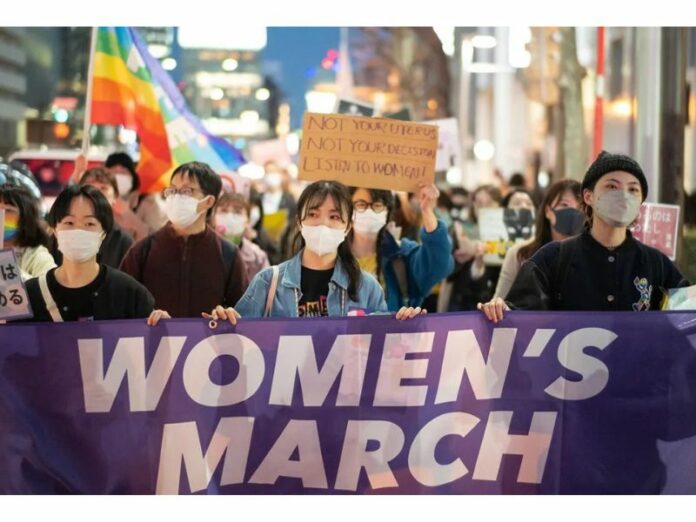
Demonstrators during a Women's Day march in Tokyo

A panel in Japan’s health ministry has approved the country’s first abortion pill, in a major step for reproductive rights decades after other countries made abortion medication widely available.

The ministry’s pharmaceutical board granted approval on Friday to the MeFeego Pack, an abortion pill manufactured by British pharmaceutical Linepharma, according to a spokesperson from the Ministry of Health, Labor and Welfare.

The ministry had first convened in January to review the drug, before asking for the public to submit their opinions through an online portal. It will now go to the health minister for final approval.

The medication consists of two types of pill, and can be used within nine weeks of pregnancy, according to Japanese public broadcaster NHK. In a clinical trial in Japan, 93% of participants had a complete abortion within 24 hours, NHK reported.

The medication combines mifepristone and misoprostol, which the World Health Organization has included in its Essential Medicines List, described as safe and effective for pregnant people.

To date, only surgical abortion is available in Japan through two methods: the curettage method, which removes tissue inside the uterus with a metal instrument, and the evacuation method, which sucks out tissue through a tube, according to NHK.

The WHO has described curettage as an “obsolete” method that is less safe and much more painful, and has called for it to be replaced by the evacuation method or by medication like abortion pills.

The move also comes as abortion and reproductive rights have gained revived attention worldwide, with the US Supreme Court reversing overturned Roe v. Wade last year – ruling that there is no longer a federal constitutional right to an abortion.

Since then, a number of states have restricted access to abortions, while others moved to increase access.

The Japanese panel’s decision on Friday was celebrated by the country’s medical experts online.

Kanako Inaba, an obstetrician and gynaecologist, wrote on Twitter that the approval of abortion pills was an opportunity to spread greater sex education and awareness about contraceptive methods.

Japanese activists have been pushing for years for approval of the pills, with similar medications made available decades ago in other countries as Japan lagged ever further behind.

For instance, mifepristone was first approved in France in 1988, and in the US in 2000.

But others also pointed to the long road ahead, calling for greater protection for women.

Mihyon Song, another well-known Japanese obstetrician and gynaecologist, pointed to Japan’s controversial abortion laws, which require spousal consent – which activists have long argued denies women the right to make decisions on their own body.

Under Japan’s existing laws, women can only receive an abortion if a pregnancy “may significantly damage the person’s physical health due to bodily or economic reasons” or if they became pregnant due to rape.

Source: cnn

The Ghanaian Chronicle