Home Blog Page 2027

Coup is never the answer

0
Opinion

Stating that a coup is not the answer to our problems does not mean I am in league with the Economic Community of West African States (ECOWAS) and countries which insist that irresponsible civilian administrations must be left untouched. My call is against the three types of coups – the Institutional Coup, the Military Coup and Popular Uprising.

A statement alleged to have been made by President George Weah of Liberia puts this across, strongly: “As long as ECOWAS tolerates institutional coups that allow lifetime presidencies, and fraudulent declaration of election results, manipulation of judicial announcements, there will always be military coups. We cannot condemn military coups when we do not condemn those who carry out institutional coups. ECOWAS should work for the interest of our people.”

A constitution should essentially be the true will of the people, and a guide for the constitutional administration, to fairly and justly administer the affairs of the state. But whenever a government in power changes the constitution or writes one to suit the head of state, then an institutional coup has taken place. And this can invite the military coup or popular uprising.

Among all the three military coups that toppled constitutional governments in Ghana, the 1966 coup is justified.

When he became president, Nkrumah kept changing the 1956 Constitution, which was the true will of the people, to the 1964 constitution, which was against the will of the people, making him president for life and Ghana, a one-party state, with his CPP as the only official party. In 1965, Ghanaians no longer elected their MPs, Nkrumah appointed them. The people no longer controlled their destinies so the February 1966 coup came in and overthrew the bogus constitution. After three years, a constitutional government was restored.

All said, even though the military will come in and “do the will of the people,” as they always put it, in the end things could most likely be worse than before.

Perhaps, the only military dictator in Africa who actually turned the lives of his entire people for the better was Col Gaddafi of Libya.

It is clear that, generally, Africa has a big problem when it comes to respecting the will of the people. Civilian presidents will change the constitution to extend their stay in office and military officers will overthrow the constitution and make themselves supreme rulers, either in uniform or later as constitutional leaders.

The civilians will indirectly overthrow the constitution to suit their desires and the military will directly overthrow the constitution through coups.

With military leaders, it is very interesting the way they go. They will entrench themselves in power and after many years, they will set up an assembly to draft a constitution that will mainly suit their desires. And they will stand for elections, win and continue ruling the people. Ghana has a very good example.Some keep going on as heads of state until, another coup topples them or until they finally pass on to the life hereafter.

In some cases, sons of those who passed on,inherited their fathers.This type of dynasty had the Kabila family ruled DR Congo, for twenty-two years and in Chad, the Itno family has been in charge for thirty-three years.  In Gabon, the Bongo family has been ruling for fifty-five years and in Togo the Gnassingbe Eyadema family has been ruling for fifty-six years.

We also live in a society where people will justify the wrongs, they do, but they will strongly criticize their neighbours for any wrong they commit. Currently the opposition NDC is attacking the vice president for failed promises, whereas, while in government, the NDC failed to implement the one-term-premium for NHIS it promised to do and instead of reducing fuel prices as also promised, it increased it by 70%. This is what splits the country and the poor suffer most.

We are living in an environment where no one has regards for the welfare of the state but only for their self-interest.

Unless, we become a people, both civilians and military, who resolve to turn new leaves, to abide by the laws, to do what is right and frown upon what is wrong, to build a just society and protect what belongs to all of us, to think nation first, before personal interests and to resolve to do all we can to enable the nation to progress, whatever type of coup that comes, institutional, military or popular uprising, seeking to change the status quo, as the French will say, “plus ça change, plus c’est la même chose,” the more the change, the more it will remain the same.

No change can be established if that change does not come from within and it must come with sacrifices and good examples for the coming generations to follow. Then all governments will rule to the delight of the people.

Those calling for coup in Ghana may be people under the ages of fifty years who have never experienced the outcome of a military regime.

Coups, whether institutional or military or popular uprising, are not the answer, when we have food sellers selling rotten chicken to the unsuspecting public and nurses demanding eight times more than the official consultation fee before attending to patients.

The perfect coup should be one from within which will topple all evil and wrongs in our person and only after being transformed, will society benefit.

Hon Daniel Dugan

The views expressed in this article are the author’s own and do not necessarily reflect The Chronicle’s stance.
Bekwai aspiring MP supports BECE candidates with Maths sets, Pens

0
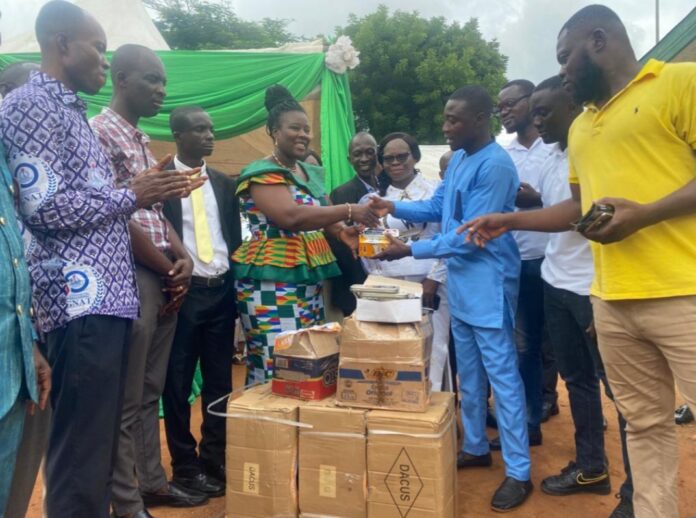
Lawyer Ralph Poku-Adusei presenting the items to the beneficiaries school

Lawyer Ralph Poku-Adusei, a private legal practitioner and parliamentary candidate hopeful for the ruling New Patriotic Party (NPP) for Bekwai Constituency, has donated over 500 mathematical sets and pens to each Basic Education Certificate Examination (BECE) candidate from some selected Junior High Schools in some deprived communities in the Bekwai Constituency of the Ashanti Region.

The beneficiary schools included Afransie M/A Junior High School (JHS), Ntinanko R/C JHS, Ntinanko M/A JHS, Awiam-Amerese M/A JHS, Assamang M/A JHS, Asanso Kyekyewere M/A JHS, Asanso M/A JHS, Denyase M/A JHS, Asokore M/A JHS, Bodoma M/A JHS Ntroaku M/A JHS,Kokotro MA JHS, Kokotro RC JHS, Wioso-Nerebehi JHS. Essankwanta MA JHS, Sarfokrom MA JHS, Kwabenakrom MA JHS, Sehwi MA JHS , Ahwia MA JHS,  Kyekyewere Betinko JHS and Amoamo MA JHS.

According to Ralph Poku-Adusei, the gesture was to inspire and encourage the candidates to have confidence in writing their BECE examination and come out successful towards their future aspirations to become responsible adults in society.

Krofrom East Assembly Member donates educational materials to schools

0
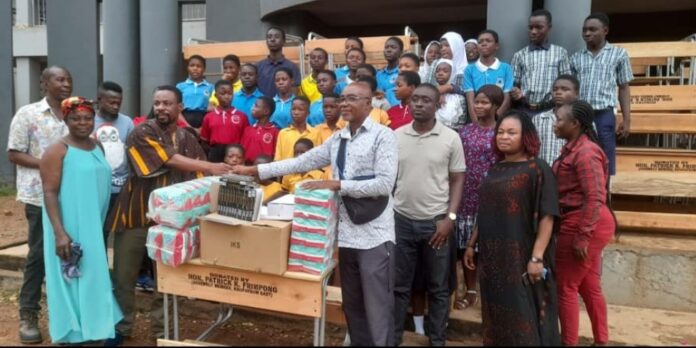
A headteacher receives the items from Mr. Frimpong

The Assembly Member for Krofrom East, Mr. Patrick Kwame Frimpong, has donated educational materials worth GH¢25,800 to three schools in his electoral area.

He donated Mathematical sets to all final year BECE students in his electoral area, sanitary pads to female students, and 150 dual desks to the New Tafo M/A Basic and Junior High schools (JHS) and Adabyia Islamic Basic School, which received 50 dual desks.

New Tafo M/A Division Basic School got 70, while Division JHS received 30.

Mr. Frimpong, who is the Presiding Member (PM) of the Kumasi Metropolitan Assembly (KMA) and also the Chief Executive Officer of Safe Journey Foundation, a Non-Governmental Organisation (NGO), which focuses on road safety campaigns, said the donation formed part of his annual contributions to enhance teaching and learning in the electoral area.

He advised the pupils, especially the Basic Education Certificate Examination (BECE) candidates to take their studies very serious.

The KMA PM also encouraged parents and guardians not to relent in their efforts to provide basic materials for their wards, and stressed the need for them to invest highly in the education of their children, because it was the bedrock of every developed society or community.

Mr. Frimpong also admonished the headteachers and teachers of the various schools to give off their best in bringing up the children.

He commanded the teachers in the area for their commitment in ensuring the provision of quality education.

The donation was received by the Headteacher of the New Tafo M/A JHS, Mrs. Roska Boahen, on byelaw of the beneficiary schools.

They commended the Assembly Member for his continued support towards the provision of quality education in the area.

She called on churches, organisations, well meaning individuals, and stakeholders to emulate the gesture of Frimpong, who she described as an exceptional leader.

According to her, from 2018 to date, Mr. Frimpong had made it an annual ritual to support New Tafo M/A Basic School with educational materials, as well as the BECE candidates with the requisite materials for their examinations.

KNUST to launch Day of Giving in aid of GH¢200m on-campus accommodation infrastructure

0
Prof. Rita Dickson - KNUST Vice Chancellor

The Kwame Nkrumah University of Science and Technology (KNUST) has set aside October 6, 2023, and every other October 6 as a KNUST Day of Given to raise funds for expansion and upgrading of on-campus accommodation infrastructure.

The objective of the initiative is to provide secure and safe accommodation for its students.

The campaign is targeting GH¢200 million for the construction of a 2,000-bed capacity accommodation infrastructure.

The proposed accommodation infrastructure

The Vice Chancellor (VC), Prof. Mrs. Rita Dickson, who announced the campaign in Kumasi, said it would help improve the residential needs of students, and reduce the deficit on campus.

She urged stakeholders to generously contribute towards this cause, stressing that no amount was too small.

The VC stressed that one of the primary concerns of KNUST was to ensure that students had access to suitable accommodation options.

According to her, the Directorate of Students Affairs, in conjunction with 500 private hostels, had, in the interim, teamed up to address the current accommodation challenges.

The VC further disclosed that KNUST was exploring Build, Operate and Transfer (BOT) models for both students and staff to enhance on-campus facilities, and announced that the University was prepared to offer suitable land in this partnership to impact on the lives of its teeming students.

Senator Jimoh Ibrahim advises Tinubu to create Ministry of Revenue

0
Senator Jimoh Ibrahim

Senator representing Ondo South Senatorial District, Jimoh Ibrahim, has advised President Bola Ahmed Tinubu to create a Federal Ministry of Revenue.

This call was against the backdrop of the confirmation of 48 ministerial nominees by the Nigerian Senate on Saturday.

In a statement he issued on Sunday and made available to journalists, the lawmaker said the ministry, when created, would serve as a coordinating platform for all revenue-generating agencies.

It stated that Ibrahim advised President Tinubu on the need to create the ministry when he paid him a courtesy visit.

According to him, the envisioned ministry is indispensable for the nation to waggle its way out of the current socio-economic quagmire.

“There are many revenue-generating agencies in Nigeria today without a coordinating body or platform.

“The Ministry of Finance is not giving the required mobilisation and coordination in this regard, hence, the need for the Ministry of Revenue.

“In Nigeria over the years, we have the Ministry of Finance more or less playing the role of Bursar disbursing all the monies remitted into national coffers by generating agencies, but there is no Treasurer to keep proper records of revenues generated by the various affected agencies and give them the required impetus to generate more.

“Nigeria definitely needs a national treasurer to be symbolised by the Federal Ministry of Revenue when created,” he posited.

He added that the idea had been sold to President Tinubu, who, according to him, saw the need for it in line with his pedigree on improved revenue generation.

He said the ministry would serve as one of the strategies through which the nation’s debt could be defrayed by serving as a window for improved revenue generation to fast-track the nation’s development.

“The nation’s debts of N77 trillion shouldn’t be a cause for worry considering the current debt to Gross Domestic Product ratio of less than 31 percent and required innovative ideas of defraying it,” he added.

Credit: dailypost.ng

Resident doctors declare daily protests over unmet demands

0
Nigerian Association of Resident Doctors

The Nigerian Association of Resident Doctors (NARD) has announced its decision to embark on a daily peaceful protest and picketing of the Federal Ministry of Health, Office of the Head of Civil Service of the Federation, as well as all federal and state tertiary health institutions nationwide.

Giving the notice on Saturday in a letter addressed to the Permanent Secretary, Federal Ministry of Health (FMOH), the association said this is to press home its demands which have been largely neglected by the Federal Government.

The letter was signed by NARD President, Dr Emeka Orji and Secretary-General, Dr Chikezie Kelechi.

“We wish to bring to your notice, of the decision of the National Executive Council of NARD to embark on daily peaceful protests and picketing of FMOH, Office of the Head of Civil Service of the Federation.

“Also, all federal and state tertiary health institutions nationwide, with effect from August 9th at 10.00 a.m.

“This has become necessary to press home our demands which have been largely neglected by our parent ministry and the Federal Government.

“We therefore resolved that it is time the whole world hears our side of the story, the decay and corruption in the health sector as well as the neglect, the public health institutions have suffered all these years that led to repeated industrial actions,” the letter read.

NARD, however, said that it believed that the government still had time to genuinely address the issues at stake before Aug. 9, or leave it with no other option.

Channels Television reports that NARD had on July 25declared a “total and indefinite strike action”.

Credit: channelstv.com

Fear grips northern Nigeria as Tinubu seeks military action against Niger coupists

0
Fear grips northerners

Palpable fear has gripped Nigerians, especially northern residents, following the decision of President Bola Tinubu to seek military action against the junta in Niger Republic.


DAILY POST reports that following the toppling of Niger’s democratically elected president, Mohamed Bazoum by his military guard last week, leaders of the West African regional bloc are devising means to restore democracy to that country.


Recall that about 10 senior military officers led by Colonel Major Amadou Abdramane had via a National broadcast on July 27, announced a coup in Niger over alleged poor governance and inability of the government to tackle security and other challenges bedevilling their country.


In a swift move to quell another military rule in the region, the Economic Community of West African States, ECOWAS, led by its newly elected Chairman, President Bola Tinubu gave the junta seven days ultimatum to restore normalcy or face some stringent sanctions.


The ultimatum was issued last week during an emergency meeting in Abuja, Nigeria.

In a bid to execute the resolutions, Tinubu, on August 3rd, dispatched a delegation to Niger with a mandate to expeditiously resolve the political impasse in the country.


The delegation, headed by former Nigerian Head of State, General Abdulsalami Abubakar (Rtd), left for Niamey on Thursday after a briefing by President Tinubu at the State House in Abuja.


Credit: dailypost.ng

 Niger Coup: Senate rejects Tinubu’s troop deployment plan, urges political solution

0
Senate house

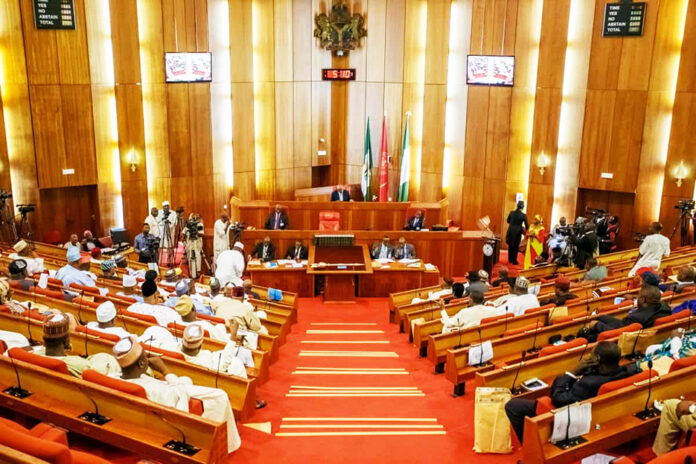
The Nigerian Senate has reached a resolution rejecting President Bola Tinubu‘s request to deploy Nigerian troops in Niger Republic to restore democratic rule in that troubled country.

Rather the upper legislative chamber advised Mr Tinubu and the Economic Community of West Africa States (ECOWAS), which he leads, to explore political solution to the crisis.

The resolution confirms an earlier PREMIUM TIMES report that Senators had taken a decision opposing military action in Niger.

President Tinubu had on Friday sought the approval of the upper chamber to mobilise the Nigerian Army to Niger Republic to combat the Nigerien coupists who overthrew their democratically elected president, Mohammed Bazoum.

In a resolution after deliberating on Mr Tinubu’s request at a closed session Saturday, the Senate supported other steps being taking by Nigeria and the Economic Community of West African States (ECOWAS) to reverse the coup but rejected the option of a military action in the poor West African nation.

The President of the Senate, Godswill Akpabio, read the resolution after the lawmakers returned to plenary.

Me Akpabio suggested that the President did not seek the approval of the Senate to go to war in Niger Republic but that is incorrect because Mr Tinubu clearly indicated a plan to execute an ECOWAS mandate to deploy troops in Niger should the coupists remain recalcitrant.

Mr Tinubu is coordinating ECOWAS’ response to the coup in Niger, including the implementation of the regional body’s sanctions imposed on the neighbouring country to mount pressure on the coupists to restore democracy in the country.

Credit: premiumtimesng.com

Ghana to license only electric vehicles for trotro, taxis -Minister 

0
Hassan Tampuli, Deputy Minister for Transport

Commercial mini buses, also known as Trotro in Ghana, taxis, and private cars are to transition from fossil fuels to electric, the Ministry of Transport has said.

A Bus Rapid Transit (BRT) system to be piloted in Kumasi would make use of only electric vehicles.

This is to help prevent toxic emissions from fossil fuel vehicles entering the environment that warm the planet.

The transition is not expected to happen overnight, but as a gradual process, which is projected to take between 10 and 50 years.

Hassan Sulemana Tampuli, Deputy Minister for Transport, told journalists at a stakeholder consultation on electric vehicles (EVs) and the implementation framework in Accra, on Wednesday, August 2, 2023.

He said the transition was happening around the globe, and Ghana could not be left out.

The Deputy Minister indicated that instead of kicking against the change, the country must rather put mechanisms in place in order not to be taken over by events.

Mr. Tampuli reiterated that the change had been necessitated by the phenomenon of global warming and the environmental and health challenges being posed by carbon dioxide (CO2) release into the atmosphere by fossil fuel vehicles and the like.

He admitted that although Africa’s contribution to global CO2 emissions was insignificant, the task of saving the planet was every country’s responsibility.

He added that the consultation was to brainstorm with the various stakeholders in the transportation industry on the shortcomings of the policy, and a way forward.

On what happens to the over 4,000 petrol stations across the country, he said: “These stations will not immediately fold up, because the policy is just not going to be started tomorrow; it will take us a bit of time, and, from all indications, from 2030 to 2040, and that is quite some time.

“We are not going to immediately have EVs across the country, so definitely people will still consume petroleum products, and more importantly, heavy-duty vehicles and trucks will still consume petroleum products.”

And also, in order not to repeat the mistakes of countries like the United Kingdom, which, from the initial stages of the transition, lost about £35 billion from revenue they could have generated from petroleum duties, the Transport Ministry was working closely with the Ministry of Finance in that regard.

Furthermore, an inclusive consultation was being held on the nature and design of the country’s road networks.

He also advocated for the pace at which rural electrification was being rolled out to be accelerated for a smooth takeoff and soft landing of the policy.

The Deputy Minister commented on how the lithium-ion deposit in the country would contribute significantly to drive toward this agenda.

The Ministry is also in talks with the Ghana Revenue Authority (GRA) to fine-tune excise duties on the importation of EVs.

With energy, he said Ghana produces enough to meet its needs in that regard.

Most immediately, the point not to make Africa a dumping ground for fossil vehicles by the Northern countries as they transition has been well made by the African Heads of State and governments.

Cylinder Recirculation module starts September

0
Cylinder-Recirculation-Model

Starting this September, consumers of liquified petroleum gas (LGP) would no longer need to fill their empty cylinders, but exchange them with already filled ones, Curtis Perry Kwabla Okudzeto, Deputy Chief Executive Officer (CEO) of the National Petroleum Authority (NPA) announces.

The new policy is being rollout under the NPA’s Cylinder Recirculation Module (CRM).

At a media briefing in Accra on Friday, Mr. Okudzeto said customers only needed their Ghana Card, money and empty cylinder(s) in exchange for those filled.

According to him, there was no cap on how many filled gas cylinders one could purchase at a go, but the only difference in the current policy against the former was the cylinders would now be owned by the gas bottling plants.

The Deputy CEO explained that the only reason for which the exchange would require the Ghana Card before purchasing was to register and track unreturned cylinders in consumers’ possession.

“Go and identify yourself at the exchange point, and when you finish using it you bring it back to the exchange point and take another one,” he added.

Similarly, he added that the new policy would not immediately fade out the existing gas stations, but run concurrently till the country was totally covered by the latter.

He said the four bottling plants – three in Accra and one in Kumasi – had the capacity for the current demand of 30,000 metric tonnes a month.

Thus, the bottling plants have a capacity to fill 80,000 cylinders on a daily basis, meanwhile it was 50,000 being consumed a day.

Perry Okudzeto allayed the fears of consumers that the new policy would attract additional fees, adding: “Nothing in the price build up is going to change.”

The NPA is looking to have more bottling plants to come up in order to increase the production capacity, as well as LPG consumption by 50%.

While consumers will not be charged for faulty cylinders, he urged them to take good care of the cylinder; “…the fact that you don’t own the cylinder and the bottling plants owns the cylinder does not mean you can throw it about, kick it, and destroy it.”

He stated that the business module under the CRM was so flexible that petty traders in rural areas could register, train, and operate a well-managed LPG exchange point.

Mr. Okudzeto also encouraged businesses operating under the old framework to seize opportunities that were being presented by the new policy.

However, he mentioned that the new policy was not targeted at bulk consumers.

The Ghanaian Chronicle