Home Blog Page 1978

Deputy CEO of NPA adjudged Outstanding Female in Oil and Gas

0
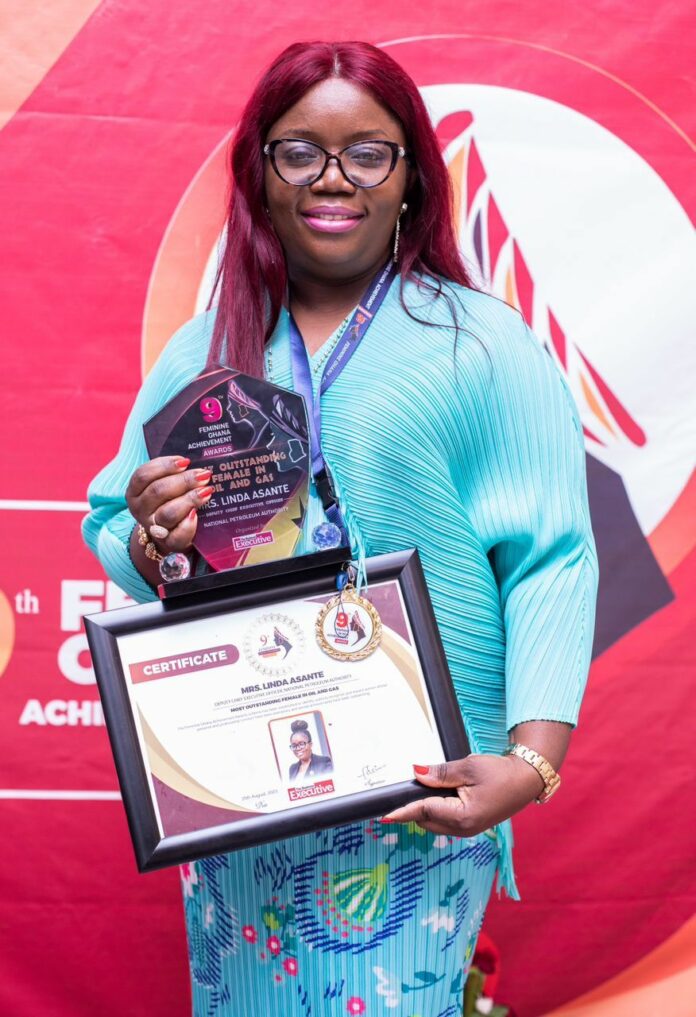
Mrs. Linda Asante displaying her award

A Deputy Chief Executive of the National Petroleum Authority (NPA), Mrs. Linda Asante, has been adjudged as the most outstanding female in oil and gas.

The award was given to her by the Business Executive on Friday, August 25, 2023 at the 9th Feminine Ghana Achievement Awards, held at the La Palm Beach Hotel in Accra.

This honour, according to the Organisers, was conferred on Mrs. Asante in recognition of her stellar contribution to the growth of the nation’s oil and gas industry, having worked in that space for over two decades and achieving significant milestones.

She is the first Female in Ghana to occupy this top Executive position in the nation’s petroleum downstream sector.

The Feminine Ghana Achievement Awards scheme was established to identify, publicly recognise and reward women in Ghana and across the globe who have achieved outstanding accomplishments in various forms of endeavor, across both the public and private sectors such as entrepreneurs, professionals, corporate executives and diplomats among others.

The Business Executive, Organisers of the longest-running annual awards scheme for outstanding conduct and performance among women in Ghana, is a Pan-African media organisation and events firm with a track record of successfully organizing awards schemes, international summits and other corporate events across the globe.

The 2023 edition of the awards was held on the theme: ‘Empowering Women to Drive Ghana’s Economic Recovery.’

Other notable awardees included ace broadcaster, Gifty Anti of the Standpoint; Marina Lamptey of the GIPC, Gifty Tetteh, CEO, Africa Women in Energy; Gladys Nana Akua Cobbina, Founder – Glendycob Enterprise and Mrs Adelaide Siaw Agyepong, CEO, American International School.
All the award winners have been admitted to the prestigious Feminine Hall of Fame, which is the top most connective female network platform in Ghana.

Violence has become new norm for NPP -Mahama

0
Former President John Dramani Mahama

Former President John Dramani Mahama has condemned the violence that occurred at the just ended New Patriotic Party (NPP) Super Delegate Conference, describing it as detrimental to democracy.

Making the comment on his Facebook page on Saturday, August 26, 2023 Mr Mahama bemoaned that violence has become the new normal for the NPP.

He said: “It would appear that violence has become the new normal for the NPP in any electoral contest they are involved in. An act of violence during what should be a peaceful civic exercise must be condemned by all well-meaning Ghanaians.

“Such brutal acts have no place in modern society, especially during an internal contest among persons who belong to the same party and have known each other for many years.”

The flag-bearer of the National Democratic Congress (NDC) further stated that, “the barbarity of Ayawaso West Wuogon by-elections in 2019 and the murder of eight innocent Ghanaians during the 2020 elections will forever be a blot on the legacy of President Akufo-Addo and Vice President Mahamudu Bawumia.”

An attack on one Ali Zakaria, the agent for flagbearer hopeful of the NPP, Alan Kyerematen, at the North East Region polling center during the Special Delegates Congress of the governing NPP was reported to the police.

Speaking on GHOne TV with Joshua Kodjo Mensah, the deputy spokesperson for Alan Campaign Team, Richard Nyamah, stated that the agent was beaten to pulp for protesting the public display of ballot papers by some delegates. A situation that left him hospitalised due to the severity of his injuries.

Meanwhile, in a signed statement by the North East NPP Regional Communication Director, Walibe Amos, he indicated that the incident was a purely between two people and not a mob action.

“The incident was a purely two man affair and not a mob action. The regional Youth Organiser acted involuntarily to prevent Alan’s agent from snatching his thump printed ballot paper by incidentally hitting the agent with his elbow, leading to his fall and subsequent bleeding,” Mr. Walibe disclosed.

The NPP, on Saturday, had their Super Delegates Congress, which saw 958 delegates nationwide voting for a shortlist of five presidential candidates, ahead of their Presidential Primaries in November, 2023.

In all, 956 delegates voted at 17 polling centers across the country to cut down the number of candidates to five, pursuant to Article 12(b) of the party’s constitution, which demands that the number of presidential aspirants was to be reduced from ten to five.

At the end of the poll, the five elected aspirants to continue with the journey towards becoming the flag bearer of the party was Dr. Mahamudu Bawumia, Kennedy Agyapong, Alan Kyeremanten, Afriyie Akonoba, with both Boakye Agarko and Francis Addai – Nimo securing the same number of votes for the fifth and sixth position.

The party is, however, expected to hold a run-off election for the two aspirants on Saturday, September 2, 2023 to determine which of the two will be part of the top five.

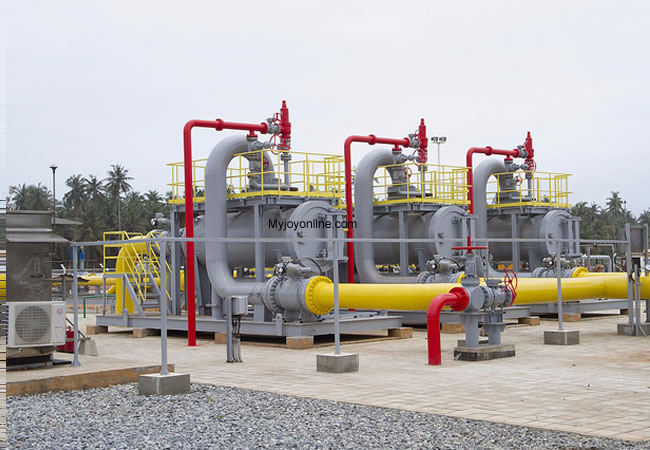
Feature: Look no further, domestic gas is Ghana’s answer

0

Even before the lavish opening of the 2022 FIFA World Cup in Qatar, the world had seen what well-managed oil and gas resources could do for a country. Having spent a staggering $200 billion to host the world’s biggest sporting showcase, Qatar has captured the global spotlight

The Gulf state’s discovery of natural gas in the middle of the 20th century was a game changer.

Today, about 99% of its economy is powered by gas, earning the tag, “world’s largest exporter of Liquefied Natural Gas” (LNG). With its world-class airline and major air transport hub, and stunning corporate and tourist infrastructure, one will not be faulted for believing that we can also drive our own development agenda through domestic gas.

This begs the question: Why is Ghana not doing more to tap into the immense benefits of its domestic gas resources?

The transformative potential of gas

Ghana’s gas reserves are not as significant as others in the region. However, current domestic gas capacity is more than 10 times the nation’s current consumption. Ghana’s estimated 1.5 trillion cubic feet (tcf) of gas reserves – while not near as extensive as Nigeria’s (approximately 200 trillion tcf) or Mozambique’s (over 100 trillion tcf of natural gas reserves) is more than enough to drive the nation’s energy agenda.

Across the African continent, natural gas has boosted economies on a large scale. Algeria, with its abundant gas reserves, is a net exporter of natural gas to Europe, as is Egypt. The extensive Algiers Metro (part of which is underground) and the newly built Cairo capital are projects that were financed respectively by these hydrocarbon riches.

Nigeria’s Lagos-Calabar railway could very well be a similar modern train service from Accra to Paga, seeing as both straight-line distances are just over 500km. If gas revenues are funding such projects in neighbouring African countries, Ghana cannot afford to miss out on these developments either.

Ghana’s Gas resources

In August 2023, Tullow Ghana Limited and the Jubilee Partners – Kosmos Energy, Petro SA, Ghana National Petroleum Corporation (GNPC), and Jubilee Oil Holdings – confirmed that they had signed an amendment to the Interim Gas Sales Agreement in Ghana, ensuring that gas was sold at the low-cost price of $2.90 per Metric Million British Thermal Unit (MMBtu), the very price of Jubilee gas referenced back in the 2017 Jubilee Plan of Development.

Because of what this means for funding national development programmes, the government, especially deserves praise for its foresight. Achieving massive industrialisation is not possible without a regular supply of cheap energy sources.

While this short-term agreement terminates before the fourth quarter of 2023, it is a signal of intent that Ghana is ready to utilise domestic gas as a reliable and sustainable energy source to power the nation’s industrialisation ambitions.

Oil and gas stakeholders in Ghana are optimistic that acceptable commercial terms for the export of future long-term volumes of locally drilled gas will be agreed upon before the expiration of this interim agreement (set to expire by the end of September 2023). This step in the right direction signals a willingness to prioritise the domestic gas value chain in the long run.

However, plans are also far advanced for Ghana’s industries to be powered by imported LNG. Presently, a terminal worth over $400m is already under construction, with plans to import LNG from oil giant Shell.

While this will boost gas availability, the associated costs of importing gas hold long-term implications.

The UK Guardian recently published a story titled, “Will Ghana’s gas gamble perpetuate a cycle of fossil-fuel-related debt?” In it, the writer, Chloé Farand, outlined a bleak outlook into what on the surface would have looked like a boost to the industrialisation plans the government has outlined. First, the importation agreement ties Ghana to a 17-year contract with Shell.

This is likely to result in future fossil fuel-related debt, from the high cost of import. This is an expense Ghana cannot afford amid economic struggles intensified by events on a global scale – from the COVID-19 pandemic to the Ukraine war.

Under the terms of agreement, the taxpayer would still be liable even if Ghana is unable to utilise the gas. Such contracts are notorious for hamstringing African governments, further deepening the poverty cycle many have become mired in.

Of note is the fact that the gas would arrive in a liquified form, making it necessary for the process of regasification with its environmental implications.

According to Mike Fulwood in an article titled, “Does Ghana Need LNG?”, written for The Oxford Institute for Energy Studies (OIES), “The risk is that a variable supply of LNG to Ghana and potential problems relating to the chain of contractual arrangements could mean that the importation of LNG is seen as less than a success, sending a message to other countries that LNG is not reliable when the real lesson is that Ghana probably doesn’t need the LNG in the first place.”

Taking Advantage of Domestic Gas

Key to this industrialisation dream is Ghana’s gas fields, which will power the existing Aboadze and Sanzule thermal plants at costs much cheaper than we are presently paying. The gas-rich Sankofa field, a joint venture between Eni, Vitol, and GNPC, is mainly non-associated gas and provides a dedicated supply of domestic natural gas.

The Tweneboa, Enyenra, and Ntomme (TEN) fields and the Jubilee fields, operated by Tullow on behalf of its Partners, also hold copious reserves of both associated and non-associated gas resources.

With the anticipated long-term gas sales agreement as an important catalyst for future investment, we can ensure that Ghana is able to utilise and export natural gas rather than flaring it – a practice that has severe environmental ramifications.

Contributions to the West Africa Gas Pipeline (WAGP) will not only make more energy available in the sub-region but will also serve as an extra source of foreign exchange. Moreover, utilising gas as an energy source is cost-effective, maximises resources, and boosts revenue, further enhancing the country’s economic prospects.

Additionally, the projected savings from gas – over $1 billion – and over $400m revenue from domestic gas export per year, can accelerate economic growth, providing the government with a unique opportunity to allocate resources for strategic development initiatives.

This is even before one considers the hundreds of direct and indirect jobs that will come from the new domestic gas industry. Whether this results in funding flagship projects like One District, One Factory (1D1F) or a nationwide road infrastructure, domestic natural gas has the potential to change the trajectory of the economy.

Government is Key

However, achieving optimal gas production necessitates concerted efforts and substantial investments in developing gas resources from Ghana’s oil and gas fields. The TEN Enhancement Plan to be delivered under a revised plan of development for the TEN field, is vital in arresting the decline of the field.

Officials of Tullow stated to Ghana’s parliament recently that there is potential to supply cost-competitive gas in the long term. The plan aims to unlock untapped hydrocarbon reserves and intensify domestic exports.

It will also provide additional gas resources from both the TEN and Jubilee fields for power generation and energy security. In 2020, the World Bank in its 2020 “Ghana – Sankofa Gas Project” Report, made a point that the Eni and the Sankofa Partners’ gas project “is enabling natural gas usage to its full capacity of 171 mmscf/d, and contributing to Ghana’s energy security, reduction of pollution by limiting Heavy Fuel Oil consumption and saving more than $100 million of the budgetary spending every year due to the substitution of more expensive fuels with natural gas.”

Central to these aspirations is the development of production, storage, and transportation infrastructure for natural gas processing, export, and delivery. The country needs more midstream infrastructure projects such as the Western Corridor Gas Infrastructure Development Project (WCGIDP), upgrading the current gas processing plants’ capacity beyond 300 mmscf/d, gas pipelines to transport gas from the western corridor to the middle belt of the country, and other midstream gas infrastructure.

Recently, the Parliamentary Select Committee on Mines and Energy released its report on an enquiry into the multi-year gas sales agreement between GNPC and Genser Energy Ghana Limited (GEGL). It was alleged by the African Centre for Energy Policy (ACEP) and IMANI that Ghana stood to lose over $1.5 billion with GNPC’s sale of domestic gas to GEGL.

While both sides of the aisle disagree on the veracity of these claims, this enquiry is a clear indication that Ghanaian lawmakers have a finger on the pulse of the nation’s energy issues and are ready to act in the best interest of the state.

We are at the threshold of a historic decision that could impact future generations. Do we want debt or development? Look no further, domestic gas – not imported LNG – is the answer and it is critical that we don’t let this opportunity evaporate.

By Annie Adu

Source: myjoyonline.com

“I have been dreaming to play in this league” -Mohammed Kudus

0
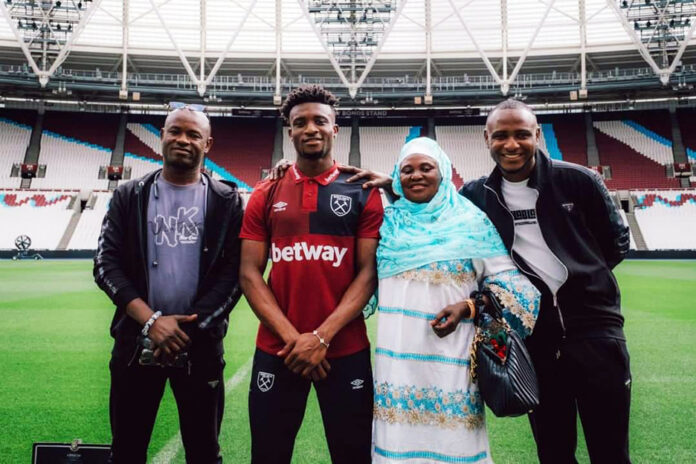
Mohammed Kudus at the unveiling with his mum and brothers

After completing his transfer to West Ham United, Mohammed Kudus sat down to talk about his early life, his experiences, his playing style, his ambitions and why he has chosen to continue his football journey in Claret and Blue…

West Ham United (Q): Welcome to West Ham United. How does it feel to be here?

Mohammed Kudus (A): “I’ve been dreaming to play in a league like this since I was a kid, so I’m just taking each day by itself and following my a dream and I’m here today. It doesn’t stop here, as we keep writing history and keep going.”

Q: You started out with a club called Strong Tower in Accra, Ghana, so how did your journey start?

A: “Normally in Ghana we have communities in our cities that played like a league, but of course it’s a different level and stuff like that. Strong Tower is a club where I grew up in my town and was one of the biggest clubs there. So I started from school, then I got picked up to the Strong Tower team and that’s when everything became serious in my football career. I was ten-years-old.”

Q: Players from Ghana play all over the world, so there must be scouts from clubs everywhere looking for talented young players to sign?

A: “When I was 18, I had a lot of interest because as an African player, you can only play in Europe when you’re 18. When I was 17 we traveled a lot to all over Europe to play tournaments around the world, so there was a lot of interest.”

Q: You went to the Danish club Nordsjælland, which has strong links with Ghanaian football, at the age of 18 – a big move at such a young age, but to a good league to continue your development?

A: “Yeah, I think for me, a player from Africa, I think it was a good step for me because I didn’t want to take big steps because I think I needed time to learn a lot of stuff because it’s a whole different culture in Europe, compared to Africa, so it was a good step and learning experience for me. I was there for two seasons, and then boom, to Ajax!”

Q: We hear so much about Ajax’s Academy, so what is it like to be part of it?

A: “The most significant thing is developing young talents and then, obviously, selling them for the next level. Of course, they want to win trophies and stuff like that, but mostly the aim is to build talent and then get them ready for the next step. So, for me, I felt that was a perfect middle step for me to take before taking another step.

Q: Who did you work under at Ajax, because they love to have former players who we will know on their staff? And what do they teach you?

A: “When I was there, it was Erik ten Hag and also Michael Reiziger. It’s more about performance than results, and I believe that’s the best way to develop. It’s not just about the result, it’s about developing as a player, and really, the style of play really fits how I want to play, with more focus on the technical and tactical part of the game, so it was a perfect learning experience over there.”

Q: To anybody who isn’t familiar with your style of play, how would you describe yourself?

A: “I like to entertain the fans as I think that is what football is about, and my dribbling ability, strength and finishing also. I’m just here to do my best to help the team. The fans should expect some entertainment!”

Q: You seem to always be in the right place on the pitch. Is that something you were coached at Ajax?

A: “I learned that. Before, I was playing in a more central role and I was more involved around the box so I had to learn the timing in the box.”

Q:I’m not sure anyone has had a better last game for their club than your last game for Ajax – a hat trick against Ludogorets in a UEFA Europa League play-off round tie! What a way to say goodbye!

A:“It felt good. For me, the situation I was in as a player, the only job I could do was just do my job on the pitch and I just did it on the pitch. When I’m on the pitch, all the noise outside stays there.

So everything on the pitch stays on the pitch, so my full focus was on that game, even though the other stuff was going on off the pitch. That’s the job of my family and my agent to take care of that and fully focused on the pitch.

I live in the present moment so, at that exact moment, I was an Ajax player, so I was just doing my best for the badge and you’ll see the same thing over here.”

Q:Your dribbling seems to be a big part of your game. Is that something that’s always been with you naturally?

A:“Yeah, I think it has always been one of my qualities and I think it started from my childhood club in Ghana, Strong Tower. The coach there gave me the freedom as I was young then and it wasn’t really about the results. It was just playing for the passion and for fun, so he just gave me the role to just any time I got the ball, to just try and take on as many men as I can so. Naturally, I’ve been built with this low centre of gravity to the ground, so it’s easy for me to turn around.”

Q:You are more than a dribbler, though, and like many Ajax players you can play in many different positions?

A:“Of course, we all know my versatility for the past years, but I think the position I’ve played most spots from my actions are from the central areas, but it’s the team that’s above everyone else so the position the coach feels is best for me to help the team, of course, I will give my 100 per cent best. Everything that I’ve played in did my best is from like, an attacking position, from the midfield.”

Q:Our technical director Tim Steidten travelled to meet you in Amsterdam, so what did he tell you about the West Ham project that made you want to join this Club ahead of other big teams?

A:“The project he presented to me was developing the Club to the best possible level they can so he wants to sign new young talents, play good football, and that’s fits with my ambition and goal as a player. I want to play in the Premier League, but I also want to play at Club that I know I can develop. I just loved the project that was presented to me, and I think it fits well with my ambition and where I’m heading to.”

Q:And this was a decision you made with your family?

A:“Yes, my family always support me 100 per cent and advise me. Of course, it’s football, and I’m going to be on the pitch and have most of the experiences, so I just follow my gut feeling because most of my decisions I make, it’s from my stomach and what my gut feeling is telling me and it was telling me it was West Ham, so my family supported me 100 per cent.”

Q:Did you speak to Edson Álvarez, your former Ajax teammate who joined West Ham earlier this summer, before deciding to make the move?

A:“Yeah, he gave me a great impression. He told me his experiences and he is loving it so far as he also pushed for me coming here, so I’m glad I’m here!”

Q:You become the third Ghana international to join the Club after John Paintsil – who also wore the No14 – and the current Black Stars captain André Ayew, so have you spoken to either of them, too?

A:“Ayew has been speaking highly of West Ham, but John Paintsil is way older so I didn’t get a chance to speak with him! Andre is still in the national team and speaks a lot about experiences in most clubs and West Ham is one of the clubs that he speaks highly of.”

Q:From Tony Yeboah through to the Ayew brothers, Ghanaians have made their mark on the Premier League, so are you looking forward to continuing that story?

A:“You, I heard about these guys – Michael Essien, Asamoah Gyan, Sulley Muntari, John Mensah, the Ayews – and there have been a lot of them and a big tradition in this league.”

Q:The Ghanaian Hammers supporters’ club are so happy you’ve signed for West Ham and want to know if you’re going to go and visit them?!

A:“Definitely! I didn’t know about them before but when I had the impression that I was going come here, I saw them messaging me on my platforms a lot of times so I clicked on it and I saw what they do. They are raising funds for some charity works and stuff like that, so I think it’s brilliant. It’s more than just supporting the Hammers. I think it’s more than football which is all about people and stuff like that, so I will definitely visit there and we will see how we can impact in other people’s lives using football.”

Q:You played in the recent 2022 FIFA World Cup for Ghana, getting two goals as you beat South Korea 3-2 in the group stage. Has that been the highlight of your Ghana career so far?

A:“Yes, I think with the national team the World Cup is the biggest stage in world football, so to perform on that stage was a career highlight for me!

Q: We’ve got some big Premier League games coming up at home to Manchester City and away at Liverpool. Are you looking forward to those?

A: “All the fixtures are big. For me,they are bigger teams and stuff like that, but me as a player I approach every game with the same mentality whether you’re playing league or bottom, I take the same approach in every game, so I’m looking forward to all the games, actually.”

Credit: whufc.com

Wolves Nunes misses training to force Manchester City move

0
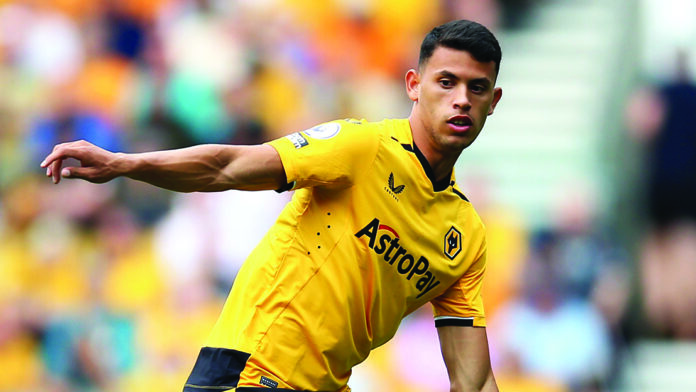
Wolves midfielder Matheus Nunes

Wolves midfielder Matheus Nunes will be fined after missing training in an effort to secure a move to Manchester City.

Premier League leaders City had a £47m bid for the 25-year-old Portugal international turned down last week.

However, Wolves are expecting an improved offer before Friday night’s transfer deadline.

Nunes did not attend training on Sunday or Monday and did not have permission to be absent from manager Gary O’Neil.

It is understood Wolves want in excess of £60m for Nunes, who has made it clear he wants to join Pep Guardiola’s side.

The Midlands club signed the player on a five-year contract last summer, paying a club-record £38m to Sporting Lisbon.

Nunes was a key figure during the second half of last season as Wolves successfully avoided relegation, finishing 13th in the table.

Credit: bbc.com

Prosecutors open preliminary probe into kiss by Spanish FA president

0
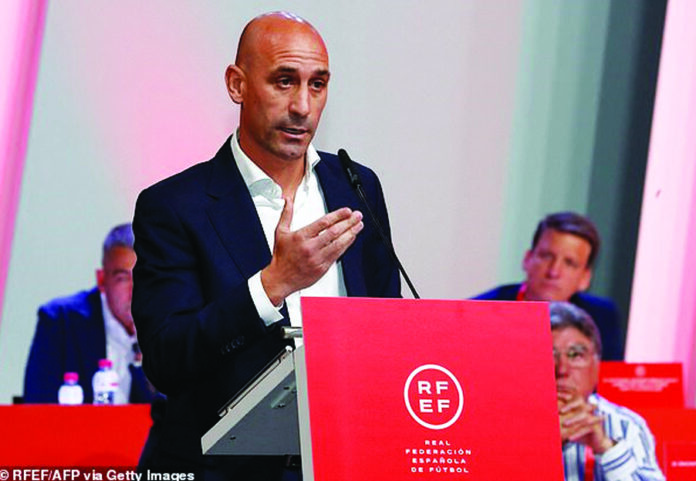
Spanish football federation president Luis Rubiales

Spain’s top criminal court has opened a preliminary investigation into the country’s football federation president Luis Rubiales after he kissed player Jenni Hermoso on the lips.

The prosecutors are looking into whether the incident amounts to a crime of sexual assault.

Rubiales, 46, has been widely criticised after the incident following Spain’s Women’s World Cup final win.

Hermoso, 33, said the kiss was not consensual.

Rubiales was suspended on Saturday by world football’s governing body Fifa.

The previous day, Rubiales had insisted he would not resign.

The court said it was opening the investigation in light of the “unequivocal nature” of Hermoso’s statements, saying it was necessary “to determine their legal significance”.

“Given the public statements made by Jennifer Hermoso, the sexual act she was subjected to by Luis Rubiales was not consensual,” a statement said.

Legal experts will also contact the player “to offer her the option of legal action, giving her the chance to contact National Court prosecutors within 15 days for information about her rights as a victim of an alleged sexual assault should she wish to file a complaint”.

It added: “In order to proceed with a case for sexual assault, harassment or sexual abuse, it will be necessary for the injured party or their legal representative to file suit, or the public prosecutors’ office.”

The Spanish government has asked for Spain’s Sports Tribunal (TAD) to suspend him – a request which will be discussed at a TAD meeting on Monday.

Credit: bbc.com

Ex-Chelsea star Eden Hazard ‘set to retire aged 32’ 

0
Eden Hazard

Former Chelsea star Eden Hazard is reportedly set to announce his retirement at the age of 32.

Hazard has been without a club since his Real Madrid contract expired at the end of last season.

According to Get Football News France, although Hazard has been the subject of interest from clubs, his intention is now to retire.

Hazard has been linked with a move to MLS side Vancouver Whitecaps as well as clubs in the Saudi Pro League and there have also been suggestions of a return to France, where he previously excelled for Lille.

His barber recently claimed that Hazard has turned down approaches from six clubs. 

Hazard endured a challenging spell at Real Madrid, where he often struggled for form and fitness.

In December last year, following Belgium’s exit from the World Cup, Hazard announced his retirement from international football.

Last season he was restricted to just six league appearances for Real and in total he only scored seven goals in 76 appearances for the club.

He played 352 games for the Blues and scored 110 goals, while he provided 92 assists.

During his spell at Stamford Bridge he won two Premier League titles, the FA Cup, the League Cup and two Europa Leagues.

Hazard won an array of trophies with Real Madrid, including the Champions League, and he also won the double of the Ligue 1 title and Coupe de France with Lille in 2011.

On the international stage he played 126 times for Belgium and scored 33 goals.

Credit: dailymail.co.uk

Manuel Neuer returns to training for the first time since breaking his leg in December 2022

0
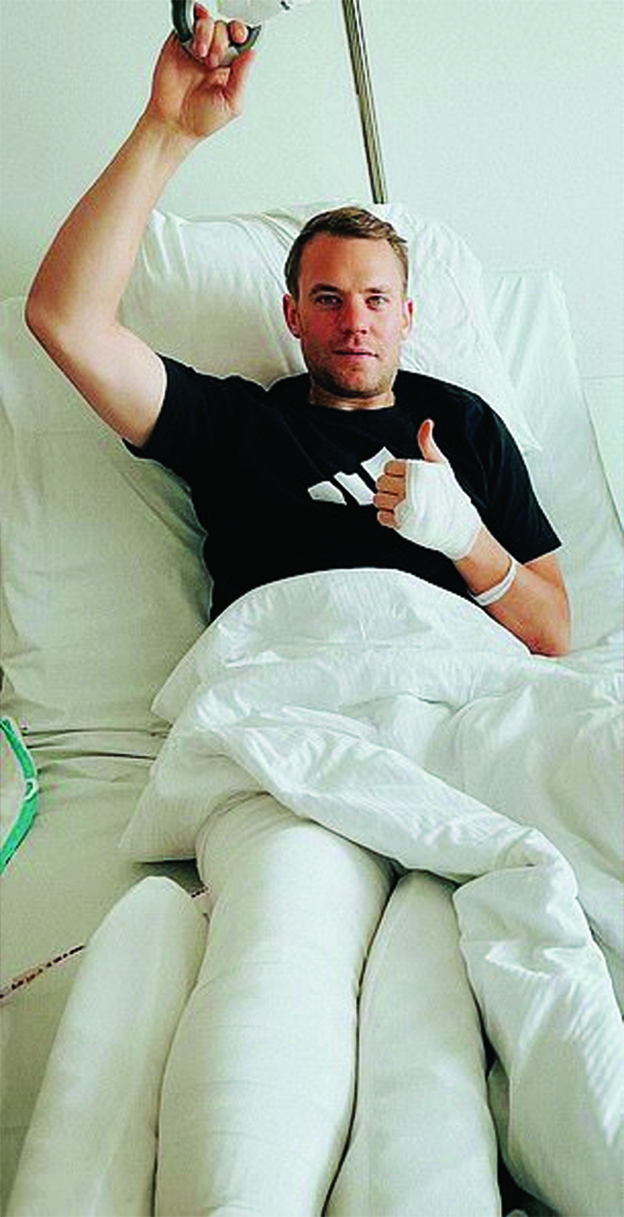
Manuel Neuer

Manuel Neuer has returned to training with Bayern Munich‘s goalkeepers for the first time since breaking his leg in a skiing accident in December.

Bayern said in a statement that ‘the 37-year-old captain completed a session with his goalkeeping colleagues’ and that he ‘has now taken the next step on the comeback trail.’

Bayern didn’t give details of what kind of training Neuer is able to do, or when he might be ready to play a game, though the club published a picture of him diving to stop a ball. His last game was for Germany at the World Cup on December 1.

Neuer’s longtime backup Sven Ulreich has been in goal for the first three games of Bayern’s season, including Sunday’s 3-1 win over Augsburg.

Bayern said Neuer was training on Monday alongside new arrival Daniel Peretz, who signed from Maccabi Tel Aviv on Friday to add depth to the German champion’s squad.

The uncertainty over Neuer’s fitness has overshadowed Bayern’s transfer window. Even as the club made waves by signing England striker Harry Kane, Bayern chief executive Jan-Christian Dreesen acknowledged he had wanted to sign goalkeeper Kepa Arrizabalaga from Chelsea too. Kepa opted to join Real Madrid on loan instead.

Following recent surgery to remove metal implants from Neuer’s leg, Bayern coach Thomas Tuchel indicated this month that the goalkeeper’s recovery was going faster than expected.

Bayern had Switzerland goalkeeper Yann Sommer as a stopgap last season when Neuer was injured, but he left for Inter Milan this month. Another goalkeeper, Alexander Nubel, was loaned out to Stuttgart.

Credit: dailymail.co.uk

Complete Massacre! … As 629 out of 797 grassroots of NPP  endorse Veep Bawumia to break the 8

0
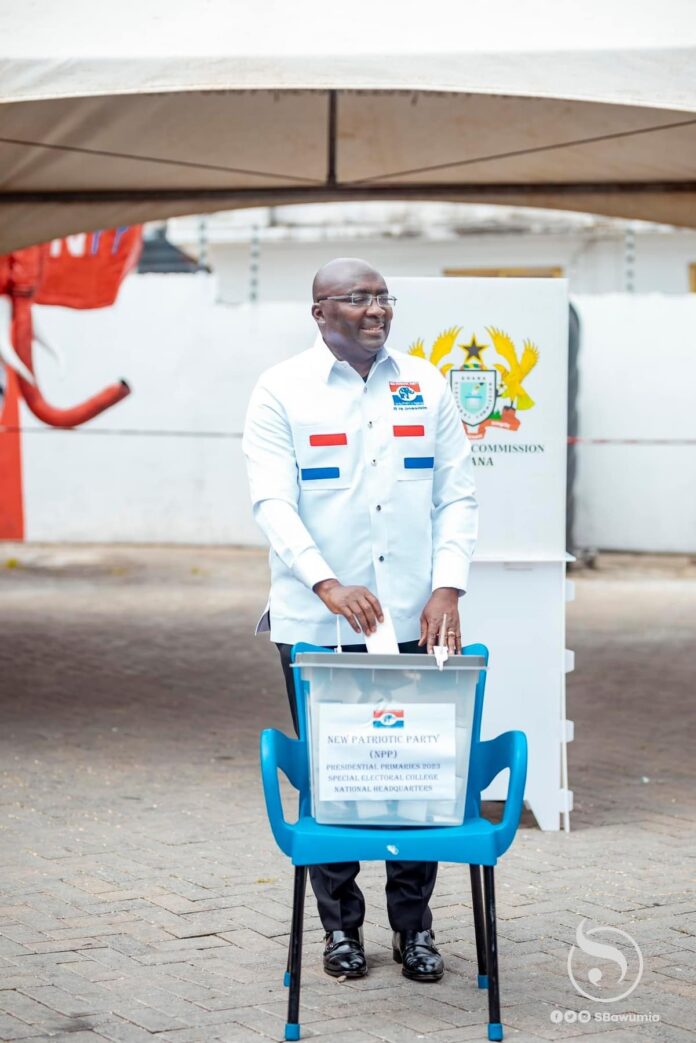
Dr Bawumia casting his ballot

The Vice President, Dr. Alhaji Mahamudu Bawumia, has convincingly been endorsed by the grassroots of the New Patriotic Party (NPP), ahead of the crucial November 4 battle for the flagbearership slot.

Majority of the constituency, regional, national executives as well as the 137 Members of Parliament who cast their ballot, did so in favour of the Vice president.

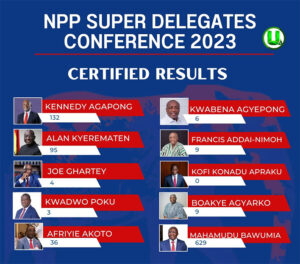
None of his opponents could get 23 percent of Bawumia’s 629 total votes garnered at Saturday’s Super Delegate Congress held across the country. There were 927 total votes cast and 923 total valid votes.

The closest contender, Kennedy Agyepong, managed 132 votes, which translates into 21 percent of Bawumia’s votes, with the next candidate, Alan Kyerematen, polling 95 votes, representing 15 percent of what Bawumia secured.

It is instructive to note that Bawumia beat all the aspirants across the 16 regions, as well as the party headquarters.

At the backyards of Kennedy Agyepong and Alan, Central and Ashanti regions, Bawumia polled 25 and 97 votes respectively.

In his home region, Central region, Kennedy Agyepong had 19 votes and Alan had 4 votes. In the Ashanti region, Ken had 6 votes and Alan had 10 votes.
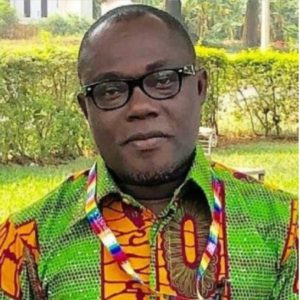

The Vice President, through the special delegates’ congress, has registered himself rightfully going into the November 4 delegates’ congress, where over 200,000 voters would choose one out of the five.

According to official results from the Electoral Commission, which supervised the voting process, Dr. Bawumia, Kennedy Agyepong, Alan Kyerematen, and Dr. Owusu Afriyie Akoto picked a slot each out of the five.

There was a tie between Francis Addai-Nimoh and Boakye Agyarko, with 9 votes each. The constitution of the party has made provisions that, in such an event, there should be a run-off to separate the tie.

The party’s election committee, chaired by Prof. Aaron Mike Oquaye, has said that the run-off will be held on Saturday, September 2, 2023. There is also the probability of one stepping down for the other to join the four.

AMENDMENT

Meanwhile, the Ashanti Regional Chairman of the NPP, Bernard Antwi-Boasiako, is advocating for an amendment in the constitution of the party to back the selection of the five with numbers.

According to him, Article 12 (5) as it stands is vague, as it allows the nearest highest vote to qualify to be part of the five, no matter how insignificant it may be to the first highest.

Article 12 (5) (b) of the NPP constitution, as amended in 2009 reads: “Where there are more than five contestants for nomination as the party’s presidential candidate, a special electoral college shall cast their votes by secret ballot for the first five contestants to be short-listed.”

He cited in a media interview that a candidate securing 70 percent of the total votes and the next having 1 percent and still being selected to face off again should be looked at.

His contention was that the outcome of the special delegates’ votes was an indication of the direction of the wind ahead of the main congress.

He opined that such an amendment would save the party money and provide adequate time to bring all participants back on track, ahead of the general election.

PRECEDENT

In 2014, there was a special delegate congress to select five out of the seven who contested, four of whom vied again this time: Joe Ghartey, Francis Addai-Nimo, Alan Kyerematen and Kofi Konadu Apraku.

The other three were; Nana Akufo-Addo, Kofi Osei Ameyaw and Asamoah Boateng. At the end of the polls Akufo-Addo secured 81.28%, Alan had 8.01%, Joe Ghartey polled 2.85% and the rest scored less.

Internal discussions and pleas to have the candidate who secured a larger percentage lead in order not to spend limited resources on the main delegates elections were not accepted by the other candidates.

The party went ahead to hold the main presidential primary and Nana Akufo-Addo increased from 81.28% to 94.35%. Alan, who had 8.01% of the special delegates votes declined to 4.75%.

Alan stands better chance on November 4 than Bawumia -Gyampo

0
Alan John Kwadwo Kyerematen

Prof. Ransford Edward Van Gyampo, an Associate Professor of Political Science and Director of the Centre for European Studies of the University of Ghana, Legon, says the standings of the first three winners in Saturday’s New Patriotic Party (NPP) Super Delegates Elections was not surprising.

Dr. Bawumia swept 629 of the votes (68.15%), followed by Kennedy Agyapong and Alan Kyerematen with 132 votes (14.3%) and 95 votes (10.29%) respectively.

According to the renowned political scientist, majority of the delegates were “politically made” by the establishment and their continuous stay in office as appointees, and even as elected people, is based on the support of the establishment and, therefore, “couldn’t have varied their votes”, the Professor posted on his Facebook page shortly after the results were declared by the Electoral Commission.

Prof. Ransford Edward Van Gyampo – Political Scientist

He contended that Ken also garnered his kind of “great show” among those who felt they could get his support in terms of money in their future electoral and political endeavors.

“He (Ken) could be a kingmaker and would easily nominate some of these guys for positions,” Prof  Gyampo noted and further  explained that  “what makes him a serious force in the future is that, he is also very much a grassroots person”.

The political scientist, therefore, cautioned the Vice President not to be complacent because the real kingmakers will be at the grassroots where both Alan and Ken are likely to make huge incursions quoting very scientific data on the NPP delegate preferences.

Prof. Gyampo has, therefore, urged Alan and Ken to work harder contending that “the future of the NPP Presidential Aspirant race is heavily pregnant with hugely uncertain possibilities”.

He noted that the Veep will have to do more work to get to the grassroots and that more work must be done by Alan to win more people at the top believing that  he (Alan) is likely to put up a better show among the grassroots in November.

Prof. Gyampo, who sees Ken as a maverick, advised him to work harder to appeal to both segments of the delegates. He explained his position on the three presidential aspirants in the fact that those who voted in the Super Delegates elections could still change their minds towards any direction for which reason no one must be complacent, neither should any of them give up.

He suggested that delegates at the grassroots must remain fired up to decide who must lead the party accordingly vote ONLY TO THEIR CONSCIENCE and not to be influenced by the outcome of the just-ended electoral exercise.

He congratulated all the Aspirants, especially the Vice President Dr. Mahamudu Bawumia, the Assin Central MP, Kennedy Agyapong and the former Trade and Industry Minister, Alan Kwadwo Kyerematen.

The Ghanaian Chronicle