President Bola Tinubu receives the United States Secretary of State, Antony Blinken
The US Secretary of State Anthony Blinken has assured of the country’s companies’ readiness to partner with and invest in the Nigerian economy. Blinken, who is on an African tour, made the remark in Abuja during his visit to President Bola Tinubu at the Presidential Villa.
“American entrepreneurs and companies are ready to partner and invest in Nigeria, particularly in the tech sector,” he said while briefing the press after he met with Tinubu at the State House in Abuja
“We have tech giants that have teamed up with Nigerian partners to help meet President Bola Tinubu’s one million digital jobs initiative.”
“Our tech entrepreneurs are fostering Nigeria’s next start-ups and our venture capital companies are working to finance them,” Blinken added, saying American firms are also working to broaden internet access in the West African country.
“So, we want to work in partnership to drive Nigeria’s tech revolution,” he said.
Despite the promises investing in Nigeria holds, the US diplomat is aware of the challenging business environment in the country.
Nigeria remains one of the lowest ranked on Transparency International’s widely watched corruption perceptions index. Tackling this and also creating a better business environment, Blinken believes, are key to unlocking the Nigerian economy.
“Nigeria offers real clear competitive opportunities for real investors. But at the same time, I think it is no secret that there remain long-term challenges to unlock its full potential,” he said.
He maintained that “tackling corruption and making it easier for companies to repatriate capital” is essential for Nigeria to attract foreign investments.
Tinubu, who took office last May, has repeatedly called for patience to allow his reforms to take effect after ending a fuel subsidy and freeing up the naira currency — policies the government says will bring more foreign investment despite the short-term austerity they cause.
The moves have been praised by investors. But they have also led to a sharp fall in the naira’s value against the dollar, and access to foreign currency in Nigeria remains a major problem for foreign companies.
Blinken said while the impacts of these reforms might be harsh on the people, the US will continue to support Nigeria to cushion the effects.
Two residents of Teshie in Accra, Isaac Obour Mensah and Richard Mensah, have reportedly defrauded a public servant to the tune of GH¢260.000.00 in a land deal.
The duo promised the public servant, Felicia Dadeboe Azuma, two plots of land located at Nmai Dzorn in the Adentan Municipality.
Issac and Richard have, therefore, been accused of conspiracy to commit a crime and defrauding by false pretence.
Richard pleaded not guilty when he was brought before the Accra Circuit Court, presided over by His Honour, Isaac Oheneba Kuffour on Thursday, 18th January, 2024.
The plea of the first accused (A1), Issac Obour Mensah, was not taken because he was absent.
Mr Kuffour has admitted A2 to bail in the sum of GH¢300,000 with two sureties, one of whom should be justified with movable or immovable property title deeds.
The prosecuting officer, Deputy Inspector of Police (DSP) Evans Kesse, told the court that sometime in 2016, the accused persons approached the complainant that their father, Nii Mensah, now late, has vast tract of land at Nmai Dzorn for sale, to address some financial challenges.
The accused persons invited the complainant, who showed interest in acquiring the land to Nmai Djorn, to show her the property.
After the site visit, the complainant was taken to see the accused persons’ father at Teshie, who claimed ownership of the said land. The complainant was also shown some documents to convince her that the land sale was authentic.
The complainant agreed to purchase the land and paid the cedi equivalent of US$60,000.00 (GH¢260,000.00) to the accused persons.
After completion of payment, the complainant realised that the land doesn’t belong to neither the late Nii Mensah nor his sons, but a developer.
All efforts to retrieve her money or get a replacement of the land from the accused failed.
On January 5, 2022, she filed a report with police, but the accused persons allegedly refused to honour several invitations extended to them by the law enforcement agency.
An amount of GHC48 million was disbursed to eleven Municipal and District Assemblies (MDAs) in the Upper West Region for the first phase of the Gulf of Guinea Northern Ghana Social Cohesion (SOCO) project implementation.
The Minister of Local government, Decentralisation and Rural Development, Mr Daniel Botwe, said the amount was to implement 127 sub-projects across all the Municipal and District Assemblies in the Region.
He indicated that GHC 107 million had been allocated to the region for the second phase of the project, which is expected to commence soon.
Mr. Botwe made this statement last Thursday, during a Consultative workshop on SOCO Scoping Report and Digital Knowledge Management Platform,organised by the National Development Planning Commission (NDPC), in collaboration with MLDGRD and the Project Implementation Unit (PIU).
The programme provided a platform for experts, indigenes, and academics and professional groups to be informed about the SOCO project and review the Scoping Reports and the Digital Knowledge Management Platform, to offer suggestions and ideas for the improvement of the program.
Forty Eight (48) Municipalities and Districts in six regions in Northern Ghana, including Oti- Region are benefiting from the $150 million SOCO Project.
“This money is available, it has been sent to the region, GHC 48 million. No contractor or consultant will say we done this work, and we are waiting for payment, no, the money is available.
“If the project is not going as it should and you go to the Municipal and District Chief Executive, the Coordinating Director and they are giving excuses, no,” he pointed out.
Mr Botwe, therefore, urged the media and other stakeholders to monitor the implementation of the Sub-Project from the start to completion to ensure they were implemented to yield expected result.
The Minister for Local Government, Decentralisation and Rural Development reminded the MDCEs and the Coordinating Directors of the provisions of the Local Government Act, 2016 (Act 936), which enjoined the Assemblies to play effective role of the activities of the development at the district level to bring the government closer to the people.
The Vice Chairman of the National Development planning Commission (NDPC), Mr David Quaye Annang, indicated that the SOCO Project was expected to stop the spillage of violent extremism into Ghana from the neighbouring countries and vulnerabilities caused by climate change and to strengthen local institutions to provide economic opportunities for the youth.
He indicated that, interventions of government and Non-governmental Organisations in the past to address the development challenges in the country were inhabited by the lack of coordination and fragmented approach to those interventions among stakeholders.
The Chief Analyst at the NDPC, Mr Bright Atiase, who did the presentation on the Scoping Study Report, stated that the report would be launched in March 2024.
The Upper West Regional Minister, Dr Hafiz Bin Salih, called for collaboration and partnership between the MLGDRD and the NDPC, the Regional Coordinating Council and MMDAs into the implementation of the SOCO Projects, to help achieve the expected results.
The World Bank has approved a $300 million Development Policy Operation for Ghana. The First Resilient Recovery Development Policy Financing is a critical contribution by the Bank’s International Development Association (IDA) to help Ghana’s economic recovery and support the country’s resilient and inclusive growth.
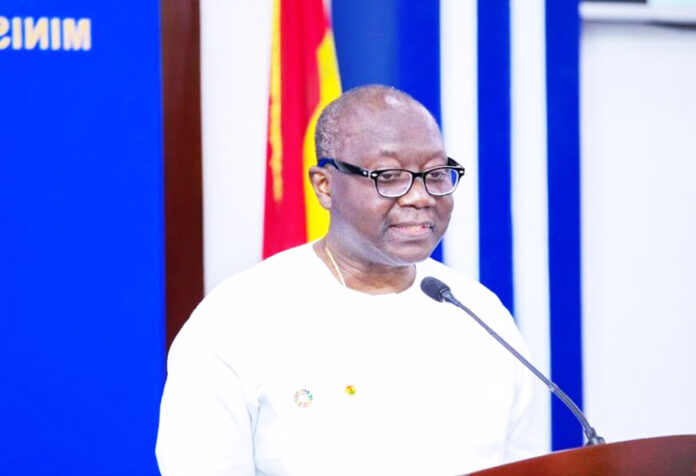
“The Government of Ghana remains committed to restoring macroeconomic stability and to the implementation of lasting reforms to set the economy on a path of strong long-term sustainable growth and transformation. The disbursement of this $300 million Development Policy Financing, the first in a series of three, will play a vital role in easing Ghana’s fiscal constraints, sustaining the momentum of economic recovery while protecting the poor and vulnerable,” said Ken Ofori-Atta, Minister of Finance for Ghana.
The approval of this financing package follows last week’s agreement in principle by the Official Creditors’ Committee under the G20 Common Framework on the key parameters of the proposed debt restructuring for Ghana. The agreement, which is consistent with the Joint World Bank-International Monetary Fund Debt Sustainability Framework, represents a critical milestone toward restoring debt sustainability.
“Restoring fiscal and debt sustainability, bolstering growth prospects, curbing inflation, and protecting the most vulnerable – measures supported by this financing – are urgent prioritiesfor Ghana. They are also essential steps to allow the country to attract more foreign investment, revitalize its domestic private sector, build resilience against climate change, and improve the quality of life of its people,” said Ousmane Diagana, World Bank Vice President for Western and Central Africa.
The Resilient Recovery Development Policy Operation is the first in a series of three operations of $300 million each and part of a broad World Bank engagement for crisis response and resilience in Ghana.
Its objectives are to:
1) restore fiscal sustainability;
2) support financial sector stability and private sector development;
3) improve energy sector financial discipline; and
4) strengthen social and climate resilience.
Specific reforms supported by this financing series include strengthening domestic revenue mobilization, controlling expenditures, safeguarding financial sector stability, removing barriers to private investment, setting the energy sector on a sounder financial and operational footing, strengthening the country’s social protection system, and mainstreaming climate adaptation and mitigation across policies.
Dr Kojo Pumpuni Asante, Director of Programmes and Policy Engagement, CDD
It has been suggested on the Ghana Center for Democratic Development (CDD-Ghana) platform that the Ghana Revenue Authority (GRA) and Social Security National Insurance Trust (SSNIT) should give the Fourth Estate of the realm a reality check.
This check, Dr. Eliasu Mumuni, Head of Department of Communication, Innovation and Technology, Faculty of Communication and Cultural Studies of the University of Development Studies (USD),said will organically reduce the country’s oversize media space.
He said although Ghana has a little over 30 million people, it has more media outlets than any country on the African continent.
Hitherto, media work is one of the less-paying jobs in the country, with some practitioners receiving not more than GH₵400.00 as monthly salary, begging the question of the payment of social security.
The UDS head of Department was responding to a question posed by Samuel Nartey George on the acquisition of broadcasting spectrum and keeping the numbers in check, at the launch of research findings by CDD-Ghana on “ensuring accountability in the governance of media and the internet,” in Accra, last week.
Dr. Mumuni was of the view that media houses cannot be forced to close down or merge, however, if workers are not being paid and the attrition rate keeps rising, as well as GRA and SSNIT chasing after media owners over employees’ welfare, the numbers of media system will automatically push the weaker mediums out of business.
He argued that, “if we have a welfare package designed in the way that SSNIT will come after you, GRA will come after you, without doing due diligence, you won’t be able to operate,” adding this would be determined by the market.
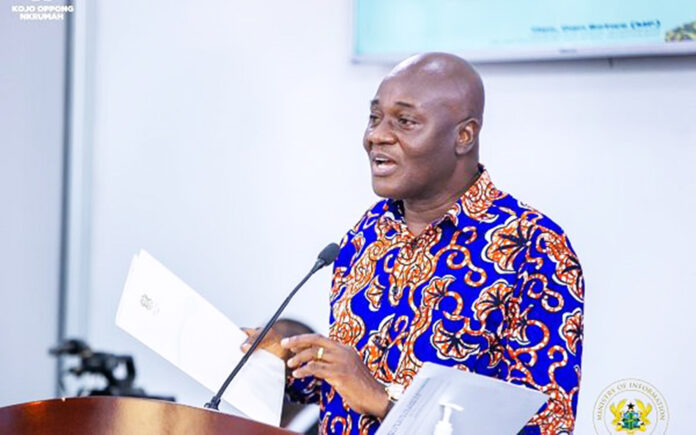
While he said there was no law on social media and the political will and commitment to approve the Broadcasting Bill was equally lacking, Vincent Kojo Oppong-Nkrumah, Minister for Information, responded otherwise.
The minister said the delay in the passage of the bill was not for want of a political will, but the last draft was overtaken by several events, including the definition of broadcast that only reflects television.
Mr Kojo Oppong-Nkrumah, Minister for Information
Mr. Oppong Nkrumah asked about who takes responsibility for a purported “reckless” comment on social media under a traditional media live-streaming programme or international media content, which is contrary to Ghana’s law, adding that these are some of the challenges delaying the passage of the bill.
Presenting the research findings, Dr Mumuni indicated that the media revenue sources are limited to subscriptions, advertisement, paywalls, and sponsorship, making media financial sustainability weak.
Furthermore, it was discovered that most media houses are diversifying into mining, real estate, and pharmaceutical industries, but these business diversifications were not born out of media profitability, but rather the opposite.
He added that they also discovered that most of the print media have also evolved, by taking advantage of the online to push forth their news.
It was also realised that fake accounts, cyber trolling, cyberbullying, cyberstalking and the use of surveillance on people, were the most dominant threats posed by the evolved media.
Dr. Kojo Pumpuni Asante, Director of Programmes and Policy Engagement at CDD-Ghana, added that the essence of the research was to understand the rapidly changing technologies in the media space and the implications for media business modules.
He stated that while freedom and independent media are essential for democracy, the quality and credibility of news sources are also important assets.
According to him, this new system of journalism lacks traditional safeguards of journalism like the National Media Commission, Ghana Journalist Association, and editorial teams whereas more Ghanaians rely on online news without the challenge of fact-checking the contents.
He acknowledged that the changing technologies have also been overwhelming for the government, due to threats to state security, balancing free speech, safeguarding the public, and being accountable.
According to him, it was essential to examine technology and its impact on changing media space and business modules if the public wants to sustain free and independent media that promotes healthy democracy.
“Media owners and media supporters must pay serious attention to the media business and ensure that it is sustainable,” he suggested.
The research used over 1000 sample sizes of media practitioners, public relations officers, and Civil Society Organisations (CSOs) in partnership with the media. The researchers deployed a mixed methodology- qualitative and quantitative – to arrive at their findings.
Dr. Patrick Kuma-Aboagye, Director General, Ghana Health Services
The Government of Ghana, in partnership with the United States (US) has launched a $25 million support programme to improve healthcare delivery in Ghana.
The Government-to-Government (G2G) agreement would support the Ghana Health Service (GHS) to improve the quality of primary health care delivery at Community-Based Health Planning and Services (CHPS) and health centres across the country.
A statement signed and copied to the Ghana News Agency, said the United States Agency for International Development (USAID) would provide $18.8 million in funding, while the GHS is expected to contribute $6.2 million over the five- year period.
Kimberly Rosen, USAID/Ghana Mission Director said investments in health paid back dividends for generations, saying: “The partnership we announced today will help provide quality services to all Ghanaians no matter where they live or how much they can afford to pay.”
Dr. Patrick Kuma-Aboagye, Director General, GHS, believed that the support would help to provide continuous quality health care and also enhance patient experience through the network of practice as the Service marched towards achieving universal health coverage.
The statement said the United States Government remained Ghana’s largest bilateral partner with over $150 million in support in the last year for health, economic growth, agriculture, education, governance, security, and more.
It said the five-year agreement was in line with Ghana’s health objectives, including the Universal Health Coverage Roadmap (2020-2030).
USAID and the GHS would also support 60 Networks of Practice (NoP) in five regions, including the Northern and Western Regions with essential equipment, training of health staff, and on-the-job supportive supervision to strengthen their skills.
The Network of Practice (NoP) model would link community health facilities to district health centres for improved healthcare delivery while the agreement would also support the GHS to operationalise their Planning and Budgeting Management Information System and the Ministry of Finance for its Integrated Financial Management Information System, among others.
The USAID/Ghana Mission Director also handed over three Yamaha motorcycles to the GHS to support community health officers to access hard-to-reach areas.
USAID has donated more than 300 motorcycles, 20 vehicles and 3,000 electronic tablets to the GHS to facilitate health service delivery over the past years.
Fidelity Bank has undertaken impactful educational initiatives to enhance access to quality education, particularly for the underprivileged.
This is towards meeting the Sustainable Development Goal 4:”Ensure inclusive and equitable quality education for all.”
This is in a statement to the Ghana News Agency in Accra to mark International Day of Education which falls on January 24.
This year’s theme is: “Learning for Lasting Peace,” designated by the United Nations, which serves as a reminder of the transformative impact education holds in fostering global peace and development.
“At Fidelity Bank Ghana, ‘Learning for Lasting Peace is not just a theme but a call to action.”
“It is a promise whispered in classrooms, echoed in playgrounds, and etched in the hearts of every child, who dreams of a world where knowledge is their weapon and education their shield,” the statement said.
The Bank’s flagship Orange Impact Initiative, which marked its 15th anniversary, supported 15 underprivileged schools, from constructing classroom blocks to distributing teaching materials.
Schools like Duose D/A Primary, Mamprobi Ebenezer 4, and Okogyeasuo M/A Basic, the statement said, were already experiencing the transformative power of the initiative.
In line with the commitment, the Eco-Schools Project, in partnership with the Center for Sustainable Transformation Ghana, reflects the Bank’s dedication to sustainability.
The statement said through employee training and volunteering, the project fostered sustainable practices and awareness in selected Orange Impact Schools, aiming to leave a positive impact on both the school and the local community.
Initiatives such as supplying refurbished computers to the ICT lab at the Andylynn School in Kumasi, elevated the learning experience and digital skills of students, it said.
The statement said the Bank had contributed to the growth and development of children at the Fidelity House of the Herman SOS Village, sponsored empowering programmes like the Empower Her Bootcamp and Creativity for a Change Project, and actively engaged in community initiatives, with a particular focus on the education and development of young minds.
An example of this commitment is the “Making Learning Happen” project, where the Bank ensures the provision of desks and chairs to underprivileged schools across all regions in Ghana.
According to UNICEF data, approximately 283,000 primary school-age children and 135,000 lower secondary school-age children were reported to be out of school in 2020.
“On this International Day of Education, Fidelity Bank exhorts all of us to join hands, break down barriers, and ensure that every child and every adult has the opportunity to learn, grow, and contribute to a world where peace reigns supreme,” it said.
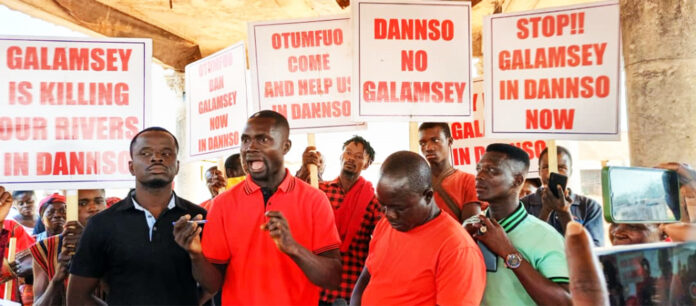
The spokesperson for the Concerned Group of Dannso, Mr. Kwaku Tawiah, aka Ahoufe, speaking at the news conference at Dannso
Tension is brewing at Dannso, a community in the Bosome-Freho district of the Ashanti region over the introduction of a community mining scheme in the area.
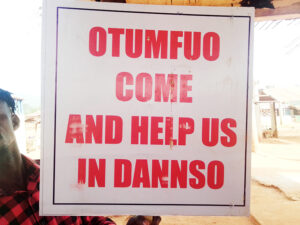
The irate residents are of the view that mining in the town will threaten the existence of their only source of drinking water-River Dane.They have, subsequently, called on His Royal Majesty, Otumfuo Osei Tutu II to intervene.
Addressing a news conference at Dannso, which is a farming community, Mr. Kwaku Tawiah (Ahoufe),Spokesperson for the Concerned Group expressed worry over the intention to introduce mining in the area.
Ahoufe indicated that mining at Dannso will threaten their very survival and that it could result in the drying up of River Dane.
Ahoufe, who spoke in the Twi dialect, accused the chief of Dannso, Nana Opoku Kyei, the District Chief Executive (DCE) for Bosome-Freho, Kofi Adu Amoateng and the Member of Parliament for the area, Akwasi Darko Boateng (ADB) for orchestrating what he described as “Environmental Suicide”.
“This menace involves the chief of Dannso, Nana Opoku Kyei, and other leaders like Akwasi Darko, Member of Parliament for the area and the DCE of Bosome-Freho, Kofi Adu Amoateng,” Ahoufe alleged at the news conference.
According to him, the former DCE for the area was dismissed because of galamsey related issues, and when President Akufo Addo appointed Adu Amoateng as the new DCE, they were hoping their new DCE would take a cue from what happened to his predecessor, but that is not the case.
“The former DCE was axed due to galamsey and we thought we had gotten a new DCE to end this galamsey. Alas, it has exacerbated. We are against this community mining at Dannso because it will destroy our land, water and our livelihood.
A placard appealing to His Royal Majesty Otumfuo Osei Tutu II to intervene in the Dannso community mining programme.
“We have only one water body in our community, which we use for several purposes. We drink from River Dane, use it to water our crops and for domestic uses”, he said.
Reacting to the complaints of the Concerned Group of Danso, the Chief of Danso, Nana Poku Kyei denied his involvement in deliberations which led to the introduction of community mining in the area.
He argued that as a traditional leader, he has no locus to bring community mining to Danso.
Asked if indeed River Dane would be affected by community mining, he could not give a definite answer, except to say that the programme was introduced by the government through the assembly.
According to him,during the inauguration of the community mining, he was not even allowed to speak, so he could not talk about it.
When Mr. Kofi Adu Amoateng,the District Chief Executive (DCE) for BosomeFreho was contacted last year, hedisclosed to The Chronicle that nobody had reported any issue of potential environmental challenge associated with the community mining at Danso to him.
“Personally, I do not know the rationale behind the demonstrations the community has been staging. As I sit here, I would ensure that their water project is completed before they start the community mining project.
The community mining, according to Adu Amoateng, started long before he was sworn into office as the DCE for Bosome-Freho.
“The processes of launching the community mining started sometime in March (last year) and I assumed office in August”, he said.
He denied accusation that River Dane risks being polluted, emphasising that work had not commenced.
“I do not have any idea that there is a galamsey activity going on along River Dane. It is just that some people are only trying to be saboteurs. Some people are trying to gamble with these lands for illegal mining activity and the MP of my community stopped it.
“Those people who wanted to conduct illegal mining are the same people who are rallying against the community mining.”
Asked about when the community mining will start, Kofi Boateng told The Chronicle that he did not know the exact time. When this reporter further asked him about financiers of the mining project, he answered that “I don’t know. I know that some people started this programme before my coming, so I know that some people are going to do the work.”
Mr. Akwasi Darko Boateng (ADB), the Member of Parliament (MP) for BosomeFreho, when contacted, told this reporter that he works in Accra and that, it is the DCE who works at the district level, so he cannot comment on the issue.
Nigeria’s Vice President, Kashim Shettima has said Kizz Daniel and Tekno’s 2023 hit song, ‘Buga,’ is almost becoming the country’s second national anthem.
Speaking in an interview with Arise TV, Shettima whose ‘Buga’ dance video went viral last year, explained that he joined the challenge because Nigeria needs to showcase its arts and culture to the world.
He said the government has a vision called “Nigeria Destination 2030″ and remains committed to promoting arts and culture for the actualization of the grand vision.
He said “We have a grand vision called ‘Nigeria Destination 2030.’ We can not run away from the fact that Nigerian arts and culture are creating waves in the global scene. And Nigeria has been out of the global scene for quite some time. This is an avenue for us to reintroduce Nigeria. And the ‘Buga’ dance is almost becoming our second national anthem. So we have to showcase Nigeria.”
Nigerian singer Stanley Omah Didia, popularly known as Omah Lay, has reacted to fans tagging his style of music as “Afro-depression.”
Speaking in a recent interview with The Beat FM, London, United Kingdom, the singer said he doesn’t care about whatever tag his music is given as long as fans are enjoying it.
He added that he would never argue with the opinions of fans. Omah Lay said, “I just make my music how I want to make my music. I try as much as possible to stay away from titles and everything the world is trying to put on you. Because as my guy would always say, ‘When the smokes clear, then you see clearly.
“So when you identify with those things [titles and tags] it just… I just make my music, I don’t care what anybody wants to tag it to enjoy it as long as you enjoy the music. If you feel like it’s Afro-depression, I am okay with that as long as you enjoy the music. Some other people would dance to it.
“It’s art. That’s what I make and I just leave the world to enjoy how they want to enjoy it. The fans have their own opinions, I would never argue with that. If that’s how they enjoy it, that’s how they enjoy it.”