Home Blog Page 169

GMC to establish $450m manganese refinery plant in Tarkwa

0
Economy Manganese Refinery

The Ghana Manganese Company (GMC) says plans are underway for the establishment of a $450 million manganese refinery plant within the Tarkwa enclave of its Mine, near Nsuta in the Western Region.

Mr Sun Yuanwei, Deputy Managing Director of GMC, announced this when the GMC, in collaboration with the Ghana Ports and Harbours Authority (GPHA), and Cosco Shipping Lines welcomed and inaugurated the largest bulk carrier vessel to ever berth in any West African Waters to the Takoradi Port.

He stated that the establishment of the plant formed part of the GMC’s operational strategies to leave a lasting positive impact through sustainable resource management, environmental stewardship, and local content development. He said the facility would help create jobs for the youth and improve upon the socioeconomic development of Ghana.

Mr Kwabena Okyere Darko-Mensah, the Member of Parliament (MP) for Takoradi, speaking to journalists on the side-lines said the erstwhile New Patriotic Party (NPP) government signed a deal with the GMC to establish the manganese refinery plant to add value to the raw material.

He said: “What we want the ships to be carrying out of the shores of the country are refined manganese, and so what we are demanding from the company is to start building the refinery.”

He said the country would continue losing substantial revenue if the company continued to export raw manganese, “so we have to be smart now and insist that the refinery be built.”

Nana Kobina Nketiah V, President of the Western Regional House of Chiefs, said the adding value to raw materials was one of the surest ways to rope in more revenues for the government, create jobs for the youth, and foster community development.

He, therefore, welcomed GMC’s plans to establish the refinery, and asked them to ensure the project was delivered on time to help boost local development.

From Emmanuel Gamson, Takoradi  

GNA 

Only 44% of Ghanaians have access to clean water

0
A child enjoys piped borne water in Ghana

The Minister for Works, Housing and Water Resources, Kenneth Gilbert Adjei, has raised alarm over Ghana’s water access crisis, despite the country’s abundant natural water resources.

Speaking at the Government Accountability Series, which was monitored by The Chronicle, the Minister said data from the Ghana Statistical Service and the WHO/UNICEF Joint Monitoring Programme show that while 88 per cent of the population can access basic water services, fewer than half enjoy safely managed water, defined as water that is available on premises, reliable and free from contamination.

Water access remains deeply unequal, he noted. Urban areas record coverage of 96 per cent while rural communities average 34 per cent, with some regions reporting rates as low as 42 per cent. Even where systems exist, supply is often intermittent and unreliable.

The Minister for Works, Housing and Water Resources identified non-revenue water, currently estimated at 80 per cent, as a major threat to urban water supply, far above the international benchmark of 25 per cent.

He added that ageing infrastructure, low maintenance investment, pollution, climate variability and high operational costs continue to undermine service delivery.

Nearly four million Ghanaians, he said, still depend on surface or limited water sources.

To improve access, the Minister announced progress on key urban water projects, including Keta (72%), Wenchi (91%) and Sekondi-Takoradi (89%), with new projects in Damango and Sunyani set to begin soon.

Government is also finalising funding for water projects in Tamale, Yendi, Techiman and Tarkwa, while Danish grant support will expand services in low-income communities in Wa and Bolgatanga.

The Minister warned that Ghana’s per capita renewable water availability has dropped from 3,000 cubic metres in the 1960s to about 1,650 cubic metres today, below the UN water-stress threshold.

He attributed the decline to climate change, illegal mining, deforestation, poor land use and rapid urbanisation, noting that over 50 per cent of river catchments have been degraded.

He said government, through the Water Resources Commission, is restoring buffer zones, strengthening local water governance and deploying digital systems to regulate mining and protect water bodies.

Two new legislative instruments on riparian buffer management and waste discharge control are also being prepared for Parliament.

Despite financial constraints, Kenneth Gilbert Adjei reaffirmed government’s commitment to water sector reforms and called for stronger collaboration among state institutions, communities and development partners to secure safe and reliable water for all Ghanaians.


For more news, join The Chronicle Newspaper channel on WhatsApp: https://whatsapp.com/channel/0029VbBSs55E50UqNPvSOm2z

Police fire tear gas as protesters storm Lagos Assembly over demolitions

0
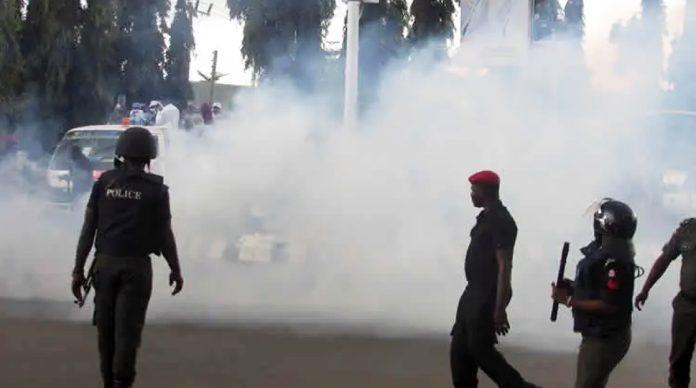
Police fire tear gas

Police officers at the venue of the ongoing protest against demolitions in parts of Lagos State have fired tear gas to disperse demonstrators gathered at the Lagos State House of Assembly complex, Alausa, Ikeja, on Wednesday.

The protesters had converged at the assembly complex to demand an end to forced evictions and the demolition of homes in communities across the state.

DAILY POST observed that the release of tear gas triggered panic in the area, forcing protesters, residents, traders and commuters to flee in different directions to avoid being affected.

DAILY POST gathered that the situation disrupted movement around the complex, as people scampered for safety amid the chaos.

As of the time of filing this report, security operatives were still present at the scene, while the protest had been temporarily dispersed.

Credit: dailypost.ng

Gov Yusuf defects to APC with 22 State, nine Federal Lawmakers

0
Deputy Senate President Barau Jubrin raise Gov Yusuf’s hands

Kano State Governor, Abba Yusuf, has officially defected to the All Progressives Congress (APC) alongside 22 members of the Kano State House of Assembly and nine members of the House of Representatives.

The governor announced the decision at a political event held at the Coronation Hall, Government House, Kano on Monday.

Addressing party leaders, lawmakers and supporters at the event, Governor Yusuf said the decision followed extensive consultations with elected representatives and key stakeholders across the state.

“After wide consultation, 22 out of 24 members of the Kano State House of Assembly and nine out of 14 members of the House of Representatives have concluded that we should join the APC,” Yusuf said.

He explained that the move was aimed at strengthening governance and accelerating development in the state.

“We are choosing partnership rather than polarisation. Political parties are vehicles; the destination is to bring positive change to the people of Kano,” the governor stated. “Judge this decision by the work we do for the people of Kano.”

The event was attended by prominent APC leaders, including former National Chairman of the party, Abdullahi Ganduje; Deputy President of the Senate, Senator Barau Jibrin; and Chairman of the House Committee on Appropriation, Hon. Abubakar Kabiru Bichi, among others.

Reacting to the development, the Kano State APC Chairman, Abdullahi Abbas, described the mass defection as bold and historic.

“This is a bold decision. APC members in Kano will remain loyal to Governor Abba Yusuf as he joins the party,” Abbas said.

The Deputy President of the Senate, Senator Barau Jibrin, also urged his supporters to rally behind the governor.

“I urge all my supporters to support Governor Abba Yusuf so that we can work together for the progress of Kano State,” he said.

Former APC National Chairman Ganduje welcomed the governor and the lawmakers into the party, describing Yusuf as a progressive politician.

Credit: channelstv.com

Turkey stands by Nigeria in fight against terrorism, says President Erdogan

0
Turkey President Recep Tayyip Erdoğan welcomes President Tinubu

Turkish President, Recep Erdogan, says his country will support Nigeria’s fight against terrorism, expressing readiness to deepen cooperation in military training and intelligence.

Speaking at a joint press conference with President Bola Tinubu during his official visit to the capital Ankara, Erdogan said that under Tinubu’s leadership, Nigeria is taking firm steps against terrorism, and Türkiye stands by the Nigerian people in this struggle.

“We are ready to share Türkiye’s significant experience in counterterrorism,” presidential spokesman, Bayo Onanuga, quoted the Turkish leader as saying.

The Turkish president said terrorist groups, particularly in Africa’s Sahel region, pose a threat to the continent’s stability.

Nigerian officials also held meetings with Türkiye’s leading defense industry firms during the visit and expressed confidence that the outcomes of those talks would be positive.

Erdogan said they reviewed “opportunities for closer cooperation” in the defence sector.

On trade, the Turkish leader said the two countries reaffirmed their $5 billion trade volume target, exploring new steps to enhance bilateral economic ties.
He stated that during the talks, both leaders discussed concrete steps needed to reach that goal and welcomed the establishment of the Joint Economic and Trade Committee (JETCO) to support bilateral efforts.

Erdogan believes that Tinubu’s visit reflected Nigeria’s strong political will to deepen economic ties.

“Türkiye supports investments in Nigeria and welcomes cooperation between Turkish Petroleum Corporation, BOTAS (Turkish firm), and Nigerian energy firms,” he added, pointing to the African country’s potential as the continent’s largest oil and gas producer.

According to him, Nigeria holds a key role in restructuring Africa’s energy economy and Türkiye is eager to strengthen investment and trade relations in this field.

Nigeria has been fighting the insurgency war for over 12 years with thousands killed and more displaced.

Credit: channelstv.com

President Tinubu ‘in great shape’ after falling at Turkey reception

0
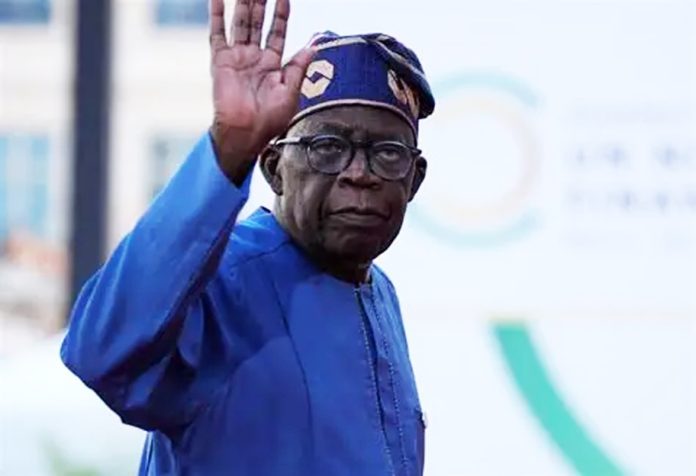
Tinubu falls in Turkey

Nigeria’s President Bola Tinubu is “in great shape” despite falling over at a reception ceremony in Turkey, one of his aides said.

Tinubu, 73, was being welcomed by his Turkish counterpart at an official ceremony in the capital, Ankara, when he stumbled.

After walking past a line of soldiers and dignitaries Tinubu can be seen on the official video on the Turkish president’s X account moving to his right when he stumbles and falls. The film briefly shows people helping the president before cutting to an aerial shot and 45 seconds later Tinubu and Recep Tayyip Erdogan are seen next to each other.

Tinubu appeared unhurt and aide Sunday Dare said he was able to continue with a bilateral meeting.

Video clips of the incident are being shared on social media.

A spokesman for the president, Bayo Onanuga, later said that Tinubu had stepped on a metal object “on the floor, which made him lose his balance”.

“This is not a big deal, except for those who want to make mischief out of a fleeting incident. It was a mere stumble, thank God, not a fall,” he added.

The last time the president fell over in public, in June 2024, he made a joke about it, saying people thought he was doing a popular dance move.

At that time the incident was described as a “mild misstep” by an aide, and there was also a lot of sympathy for Tinubu, including from leading opposition politician Atiku Abubakar, who called it an “unfortunate incident”.

Tinubu’s visit to Turkey was “aimed at strengthening the existing cordial relations”, the president’s office said in a statement before he left for Ankara on Monday.

Credit: bbc.com

BoG cuts Policy Rate to 15.5% as inflation falls faster than expected

0
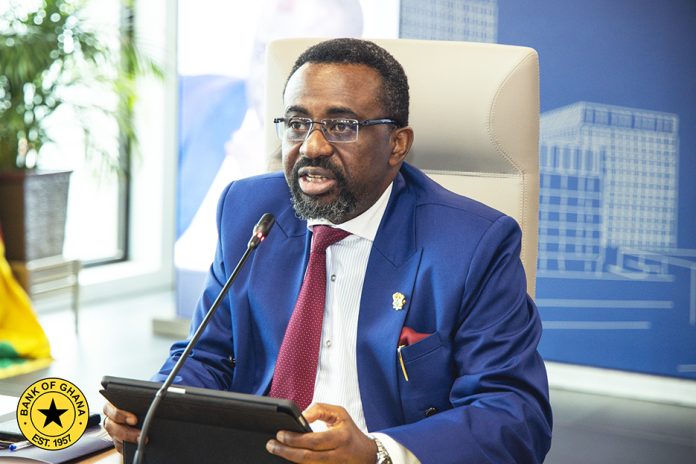
Dr. Johnson Pandit Asiama, Governor of the Bank of Ghana

The Bank of Ghana (BoG) has reduced the Monetary Policy Rate by 250 basis points to 15.5 per cent, citing a faster-than-anticipated disinflation process, strengthened economic growth, improved fiscal discipline, and a significant build-up of external buffers that have restored macroeconomic stability.

The decision was taken by a majority vote of the Monetary Policy Committee (MPC) at the end of its 128th meeting on Wednesday, January 28, 2026 marking one of the most decisive policy adjustments since Ghana emerged from the depths of its recent economic crisis.

The Committee stressed, however, that the move does not signal a shift to loose monetary policy, insisting that monetary conditions remain tight and will continue to be actively managed to preserve price stability.

“Macroeconomic conditions have improved significantly. Inflation has declined faster than anticipated, expectations remain well anchored, and growth has strengthened,” Governor of the Bank of Ghana, Dr. Johnson Pandit Asiama, told journalists at a press briefing, following the MPC meeting.

He explained that with stability largely achieved, the focus of policy is gradually shifting from crisis containment to consolidating the gains and supporting stronger real sector recovery, job creation, and improved financial intermediation, while remaining alert to downside risks.

Global backdrop supportive

The MPC’s decision was taken against a backdrop of relatively favourable global developments. According to the Governor, global growth is expected to remain steady, with the International Monetary Fund (IMF) projecting growth of 3.3 per cent in 2026, driven largely by artificial intelligence-related investments, particularly in the United States and Asia.

Global headline inflation has continued to ease towards central bank targets, supported by lower oil prices, softer food inflation, declining underlying inflationary pressures and easing financial conditions.

These developments have led to improved risk appetite, expectations of policy easing by major central banks and depreciation of the US dollar, conditions which the MPC believes are broadly supportive of Ghana’s external position.

Dr. Asiama said these global dynamics have helped reinforce domestic recovery efforts and reduced external vulnerabilities that previously constrained policy flexibility.

Growth recovery gains momentum

On the domestic front, economic growth has strengthened markedly. Provisional data from the Ghana Statistical Service show that overall real GDP expanded by 6.1 per cent during the first three quarters of 2025, compared with 5.8 per cent over the same period in 2024.

Growth was even stronger in the non-oil economy, with non-oil GDP expanding by 7.5 per cent, up from 5.8 per cent previously.

The expansion was driven mainly by the services and agriculture sectors, reflecting improved confidence, stronger consumption and better harvests.

The Bank’s Composite Index of Economic Activity (CIA) also pointed to sustained momentum. The index recorded 8.8 per cent growth in November 2025, compared with just 1.5 per cent in November 2024, reflecting improvements in industrial production, international trade, private sector credit and consumption.

Consumer and business confidence surveys further confirmed the recovery, with respondents citing declining inflation, a more stable currency, lower perceived corruption costs and improved short-term business prospects as reasons for growing optimism.

Inflation collapses faster than forecast

Inflation developments were central to the MPC’s deliberations. Headline inflation declined sharply from 23.8 per cent in December 2024 to 5.4 per cent in December 2025, falling below the central bank’s medium-term target band of 8±2 per cent.

The Governor described the disinflation process as broad-based, supported by tight monetary policy, fiscal consolidation and significant appreciation of the cedi.

Inflation expectations across households, businesses and the financial sector have remained well anchored, while the Bank’s core inflation measure which excludes energy and utility prices also eased, signalling reduced underlying inflationary pressures.

During the question-and-answer session, Dr. Johnson Asiama dismissed suggestions that the rate cut could reignite inflation, stressing that easing over the past year had been carefully calibrated.

“Throughout last year we were easing, but we were sterilising at the same time,” he said, adding that the Bank had not compromised its disinflation gains despite lower policy rates.

Liquidity remains tightly managed

Data presented to the MPC showed that growth in monetary aggregates remained moderate. Reserve money grew by 12.5 per cent in 2025, significantly lower than the 47.8 per cent recorded in 2024, largely due to intensified sterilisation operations.

Broad money supply growth also slowed sharply to 16.5 per cent, from 31.9 per cent a year earlier.

Money market rates declined in response to policy easing. The 91-day Treasury bill rate fell to 11.08 per cent in December 2025, from 27.73 per cent a year earlier.

Average lending rates declined to 20.5 per cent, down from 30.25 per cent, supporting a rebound in private sector credit.

Private sector credit growth rose to 13.1 per cent in 2025, from just 2.0 per cent in 2024. Dr. Asiama described the shift as encouraging, noting during the Q&A session that banks were increasingly reallocating credit away from government and towards businesses.

“That is real financial integration,” he said, adding that some banks had begun calling customers to apply for loans at rates as low as 15 per cent, compared with over 30 per cent a year earlier.

Fiscal discipline anchors policy

The MPC also pointed to continued fiscal consolidation as a key factor underpinning the rate cut. Provisional fiscal data up to November 2025 showed that the overall fiscal deficit on a commitment basis stood at 0.5 per cent of GDP, well below the target of 3.5 per cent.

The primary balance recorded a surplus of 2.8 per cent of GDP, compared with a target of 0.6 per cent, while public debt declined sharply to 45.5 per cent of GDP, from 63.1 per cent a year earlier.

According to the Governor, disciplined fiscal policy has reduced pressure on monetary policy and strengthened coordination between the central bank and the Ministry of Finance.

External sector surges, cedi stabilises

The external sector recorded a robust performance in 2025. Ghana ended the year with a provisional current account surplus of US$9.1 billion, up from US$1.5 billion in 2024, driven by strong gold export earnings, increased private transfers and moderation in services and income payments.

These developments, together with high capital inflows, resulted in a provisional balance of payments surplus of US$3.98 billion. Gross international reserves rose to US$13.8 billion, equivalent to 5.7 months of import cover, compared with US$9.1 billion or 4.1 months of cover at the end of 2024.

Improved reserve accumulation strengthened confidence in the cedi. The currency appreciated by 40.7 per cent against the US dollar in 2025, reversing a 19.2 per cent depreciation in 2024 and has remained relatively stable in the early weeks of 2026.

Responding to concerns about a marginal depreciation in January, Dr. Asiama explained that Ghana operates a managed floating exchange rate regime.

“Don’t get worried if the cedi moves a little bit. It is normal,” he said, attributing recent movements to short-term factors such as uncertainty and speculative behaviour rather than structural weaknesses.

FX policy and gold strategy defended

During the Q&A, the Governor also addressed calls for the Bank to administratively prioritise foreign exchange for intermediate and capital goods imports.

While agreeing that Ghana should reduce consumption-driven imports, he insisted that FX allocation would remain market-based, noting that balance of payments data already showed stronger imports of intermediate goods relative to consumer goods.

Questions were also raised about the decline in Ghana’s gold holdings to 18.6 tonnes. Dr. Johnson Asiama clarified that the move was part of a portfolio rebalancing strategy, not a drawdown of reserves.

“It was sold for FX and invested. It is earning returns and contributing to reserve accumulation,” he said, adding that the Bank would reassess optimal gold holdings and re-accumulate over time.

Banking sector resilient

The banking sector recorded a strong performance in 2025, with total assets expanding on the back of growth in deposits, domestic borrowings and shareholders’ funds.

Financial soundness indicators showed the sector remained solvent, profitable and efficient, although the non-performing loan (NPL) ratio, at 18.9 per cent, remained elevated despite improving from 21.8 per cent in 2024.

The Governor said ongoing measures to resolve legacy loans, enforce stricter credit underwriting standards and address willful defaults are expected to further improve asset quality.


For more news, join The Chronicle Newspaper channel on WhatsApp: https://whatsapp.com/channel/0029VbBSs55E50UqNPvSOm2z

Kpandai re-run yaamutu

0
Matthew Nyindam

The desire of the ruling National Democratic Congress (NDC) to snatch the Kpandai parliamentary seat from the opposition New Patriotic Party (NPP) has failed.

The Supreme Court on Wednesday, 28 January 2026, in a 4-1 majority decision, quashed the ruling of the Tamale High Court that ordered a re-run of the 2024 Kpandai parliamentary election.

The decision by the apex court comes as a huge relief to the Member of Parliament and the party, which struggles with numbers in the 9th Parliament.

The Minority had already lost a seat to the Majority at the Akwatia by-election, following the demise of the MP and could not afford another defeat at Kpandai, which would have further shrunk their number to 86 as against 189 of the majority.

DEMAND

In their quest to secure an absolute majority in parliament, the NDC challenged several parliamentary seats declared in favour of the NPP during the 2024 elections.

Aside from Kpandai, Nsawam-Adoagyiri, Suhum, and even the Akwatia seat that was won by the late Ernest Yaw Kumi were all challenged. In all three petitions, the court upheld the victory of the NPP.

However, immediately after the Tamale High Court ruled in favour of the NDC in the Kpandai case and ordered a re-run, the majority in Parliament pressed a demand for the immediate removal of Matthew Nyindam from the Chamber.

The MP had prepared to contribute to proceedings on the floor, but the majority resisted, arguing that by the order of the Tamale High Court, he ceased to hold himself out as the MP for the Kpandai constituency.

The Majority Chief Whip, Rockson-Nelson Dafeamekpor, who raised the matter, indicated that though the MP had filed an appeal and a stay of execution, it was not enough.

“The mere filing of an appeal or a stay of execution does not operate to stop the judgement of the court,” he added. “We will not allow Nyindam to continuously carry himself as an MP, and we will not allow him to speak.”

“Mr Speaker, these are very serious matters,” Dafeamekpor said. “He cannot enter the chamber and even attempt to debate.”

WITHDRAW

Days later, the Clerk of Parliament, by a letter dated December 4, 2025, notified the Electoral Commission of the vacancy of the Kpandai seat and the need for an election to be held to fill the gap.

However, the minority, unhappy with the move, registered their displeasure and called on Parliament to withdraw the letter it wrote to the EC.

The Nsawam-Adoagyiri MP, Frank Annoh-Dompreh, who is the Minority Chief Whip, described the action as unlawful and procedurally flawed.

His argument was that the letter was issued in disregard of due process, especially since a motion for stay of execution was still pending in court.

He said “We strongly submit that the letter that was filed with the Electoral Commission was out of place, was unfortunate, and flies in the face of law and procedural justice.

“That letter must be withdrawn forthwith… Ghana is a fledgling democracy and the least we can do is to support the procedure.”

The letter to the EC triggered its constitutional mandate under Article 112(5) to hold by-elections when necessary.

Meanwhile, the affected MP, Matthew Nyindam, following the declaration of the seat vacant, ceased attending parliamentary activities as a member.

He told the media that he was respecting the law and thus would stay aside till the final determination by the SC, which he was confident would legitimise his election.

At the SC, the NPP lawyers raised legal issues about time.

They told the court that the petition was filed outside the 21-day window for parliamentary election petitions to be filed after gazetting.

The NPP candidate won the seat with 27, 947 votes, and the NDC had 24, 213, with the last contender obtaining a paltry 104.


For more news, join The Chronicle Newspaper channel on WhatsApp: https://whatsapp.com/channel/0029VbBSs55E50UqNPvSOm2z

Election 2028: Who leads NPP?

0
Kennedy Agyapong

In a few days, about 280,000 delegates of the opposition New Patriotic Party (NPP) will go to the polls to elect a flagbearer to contest the Presidential race in the 2028 general elections.

Five candidates have stated their claim and counting on the delegates from across the 276 constituencies to get the mandate.

They are former Vice President, Dr. Mahamudu Bawumia; Kenneth Akompreko Agyapong, former Assin Central lawmaker; Dr. Bryan Acheampong, for Minister of Food and Agriculture; Dr. Osei Yaw Adutwum, former Minister of Education and Kwabena Agyei Agyapong, former General Secretary of the party.

All five presidential aspirants of the New Patriotic Party (NPP) have made significant contributions to the party’s growth and governance but the frontrunners in the presidential primary are Dr. Mahamudu Bawumia and Kennedy Agyapong.

According to recent polls, Dr. Mahamudu Bawumia leads with 48% of stated voting intentions less 2% of the required votes, followed by Kennedy Agyapong with 34% while Dr. Bryan Acheampong follows at 6 per cent.

Dr. Yaw Osei Adutwum polled 1 per cent, with Mr. Kwabena Agyapong recording a negligible figure.

The delegates will partake in the election and provide an answer to the question posed above. Their choice will depend on a number of factors against the background of the aspirants as follows;


Dr. Mahamudu Bawumia: (Born 7th October, 1963)

He was the immediate past Vice President.

Dr. Mahamudu Bawumia, going by the slogan – “It is possible” – failed in his bid at the Presidency when he managed 4,897,611 votes (41.75%) against candidate John Mahama’s 6,591,790 votes (56.42%) in the 2024 elections.

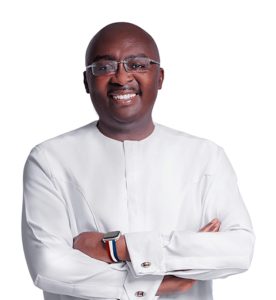
Dr. Mahamudu Bawumia

But Surveys predict he will win the primary with 57-70% of votes, citing his experience, national appeal and readiness to lead. Dr. Bawumia’s strengths include national recognition, intellectual leadership, digital transformation agenda and economic stewardship.

He is also seen as a continuity candidate who can modernise the economy (He is Samira’s Economic whizkid) and sustain the NPP’s governance credentials.

His vision is to create a tent big enough to accommodate all Ghanaians, focusing on digital transformation, economic growth and job creation.

He aims to achieve 100% internet penetration, prioritise STEM education and implement policies to support women and vulnerable groups.

Dr Bawumia also plans to expand infrastructure, including housing and healthcare, and promote private sector growth.

Dr. Bawumia has been instrumental in shaping the party’s economic policies as a Vice President, promoting digital transformation and financial inclusion.

His notable achievements include implementing the Ghana Card, Mobile Money Interoperability and the digital addressing system.

The Agenda 111 and One Ambulance for Each Constituency programmes which he initiated have had mixed results.

As of March 2025, only one hospital has been completed, but it remains non-functional, lacking essential equipment and staff.

The project has faced delays, funding gaps, and criticisms over transparency and project management.

The One Ambulance for Each Constituency programme has distributed 307 ambulances across Ghana’s 275 constituencies, with over 2,300 individuals recruited into the National Ambulance Service.

The program has improved emergency healthcare delivery, reducing the ratio of people to ambulances from 595,600 to 85,435.


Kennedy Agyapong – ( Born 16th June, 1960)


The “Show down” man is a firebrand politician known for his boldness, honesty and outspoken nature. Some see him as unpredictable, but he is popular among grassroots supporters.

Kennedy Agyapong’s vision is centered around industrialisation, job creation and economic growth. He aims to surpass Dr. Kwame Nkrumah’s infrastructure legacy, focusing on education, healthcare and employment opportunities.

Kennedy Agyapong, 66, also plans to promote Ghanaian culture through music and arts, and tackle corruption.

Kennedy Agyapong’s campaign focuses on honesty, national discipline, and rejecting corruption and complacency.

A founding member of the NPP, he has contributed significantly to the party’s grassroots mobilisation and has been a vocal advocate for anti-corruption measures.

The former Assin Central Member of Parliament is also known for his philanthropic work, sponsoring students, building clinics and supporting local entrepreneurs.


Dr. Bryan Acheampong – (Born 27 November 1972)

The youngest of the aspirants, young and intelligent Dr. Bryan Acheampong is said to be well-connected and often criticised for his perceived closeness to the establishment.

Dr. Bryan Acheampong

Dr. Acheampong’s vision is to rebuild the NPP, promote unity, and drive national transformation. He focuses on food security, industrialisation, and job creation, with an emphasis on agriculture, infrastructure development, and private sector growth.

Fifty four year old Bryan Acheampong also plans to tackle corruption, promote transparency, and support youth empowerment.

As Minister for Food and Agriculture, he promoted agricultural modernization and supported farmers. He also constructed dams in Northern Ghana and initiated projects to boost irrigation and food security.

His Bryan Acheampong Foundation supports education, healthcare, and community development.


Dr. Osei Yaw Adutwum – (Born 9th April 1964)

A former Education Minister, he has emphasised educational transformation and national development.

Dr Yaw Osei Adutwum

Some key achievements by the former Education Minister included implementing Free SHS, championing and pioneering Science, Technology, Engineering, and Mathematics (STEM) education, building new STEM schools with advanced labs and integrating subjects, reforming TVET, establishing the pre- engineering programme at universities like UMaT and transforming public schools as well as commissioned numerous educational projects and pushed for digitalization and new teaching methods.

He also has the credit of focusing on improving teacher skills and student performance through innovative methods and digital tools. He has promised free university education.


Ing. Kwabena Agyepong – (Born 6th March 1962)

A former General Secretary, he is touted for his technical expertise and political experience.

Kwabena Agyei Agyepong

His following believe he is the perfect choice to lead the New Patriotic Party (NPP) to victory. They say his unwavering dedication and unrelenting efforts make him the ideal candidate for the flagbearership.

He has variously been described as innovative and forward  thinking and has the unique ability to bring NPP members together, fostering a sense of  unity and purpose and inspire a new generation of NPP leaders and members.

“With Kwabena Agyapong at the helm, the NPP stands to achieve Party Cohesion and Electoral Success to ensure Effective Governance for a brighter future for the NPP and Ghana”, a supporter of Agyapong’s bid stated.


Expanded Electoral College

The delegates, (Electoral College) was expanded from 220,000 to 280,000 (40%) to broaden internal democracy and give more voice to party members.

They will include National Leadership comprising Members of the National Council, National Executive Committee and National Council of Elders;

Regional and Constituency Representatives, Members of Regional and Constituency Executive Committees, Electoral Area Coordinators and Polling Station Executive.

Others are Elected Officials, Sitting and past MPs, Ministers and Deputy Ministers; Party Veterans: Past National Directors, National Patrons and Founding Members.

The rest are Youth and External Representatives comprising TESCON representatives from recognized tertiary institutions as well as 15 delegates from every external branch.

The choice rests with the 280,000 delegates constituting the Electoral College mandated to elect a new flagbearer for the NPP on Saturday, January 31, 2026.

Only they (delegates) can prove surveys right or otherwise.


Kanye West doubles down in ‘huge apology’ to Jewish community

0
Kanye West

After Ye pulled out a full-page newspaper ad to apologise for his previous antisemitic comments, the rapper is doubling down and attempting to assure the public that it’s not a PR stunt.

Ye, formerly known as Kanye West, said in a series of emailed statements to Vanity Fair, published Tuesday, Jan. 27, that his apology letter to the Black and Jewish communities was not a part of a strategy ahead of his new studio album, “Bully.”

Instead, the rapper insisted that “these remorseful feelings were so heavy on my heart and weighing on my spirit” and that he owed “a huge apology once again for everything that I said that hurt the Jewish and Black communities in particular.”

“I look at the wreckage of my episode and realise that this isn’t who I am,” Ye told Vanity Fair.

In the apology letter featured in a Wall Street Journal advertisement Monday, Jan. 26, Ye said his mental health history – including a diagnosis of bipolar disorder and a four-month manic episode that took place in the first half of 2025 – was what allegedly fueled his “reckless” behaviour.

Ye gave context about his state of mind in the Vanity Fair interview, saying he’s “been put on and taken off of many medications” over time. “Toward the end of my four-month-long manic episode, my medication was changed. In that shift, the antipsychotic drug took me into a really deep depressive episode.”

He said his wife, Bianca Censori, “recognised” the issues and helped him find an “effective and stabilising course correction in my regime from a rehab facility in Switzerland.”

“When you’re manic, you really don’t think that you’re sick,” Ye told Vanity Fair. “You think that everyone else is deeply overreacting. You feel like you’re seeing the world so much more clearly on things, when in reality you’re losing your grip entirely.”

Now, experts are weighing in on Ye’s apology and whether his mental state is enough to win him back in the public’s good graces.

The Ghanaian Chronicle