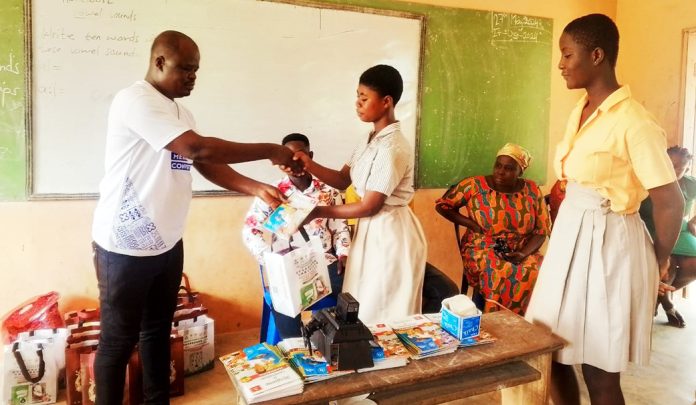
Hon. Osei-Wusu presenting pads and hygiene handbooks to the pupils
The Assembly Member for the Nintin Electoral Area, Nicholas Osei-Wusu, in partnership with Sunda International, dealers in sanitary products, has organised separate fora for basic school pupils at Nintin and Hwidiem Electoral Area.
The beneficiary girls were from the Roman Catholic Primary, Presby Primary and Junior High and M/A Junior High Schools at Nintin, as well as their counterparts from the Hwidiem M/A Primary and JHS.
At the fora at Nintin and Hwidiem, nurses and midwives took the girls through a practical demonstration of the most appropriate way of wearing and disposing of sanitary towels, how to keep personal and environmental hygiene and sanitation during the monthly period.
The beneficiary students take their packages home
The girls and the female teachers from all the schools received a package containing sanitary pads that could last them a minimum of two monthly cycles, as well as washing powder to keep them hygienic and healthy.
They also received a copy of a handbook on ‘Hygiene and Sanitation’, with extra copies donated to the schools as teaching and learning material.
Mr Osei-Wusu thanked Sunda International for the partnership and called on government to, as a social intervention, waive off entirely the tax component of the prices of menstrual pads, to make it affordable for pupils and students.
A Senior Staff Midwife of the Ghana Health Service, Madam Charity Azaare, a resource person, called for increased public education on menstruation and its hygiene and health-related issues for everybody, especially parents, to support their daughters during that stage.
Meanwhile, a retired educationist, Nana Adu Asare, has appealed to the government to consider free distribution of sanitary pads and related materials to adolescent school girls as a major social intervention to encourage basic and second cycle schools’ enrolment, particularly in the rural communities across the country.
He explained that, the prevailing socio-economic difficulties being faced by parents of such children makes it challenging to cater for sanitary pads, which are essential for them to ensure personal and environmental hygiene, as well as boost their self-confidence while remaining in schools throughout their menstrual periods.
Nana Adu Asare, who is also the head of the Nintin Royal Family, made the appeal at Nintin in the Mampong Municipality during a forum to commemorate this year’s ‘World Menstrual Hygiene Day.’
Nana Adu Asare described the initiative as historic and exemplary since it was the first time such an initiative has been seen in the area.
According to the retired educationist, inadequate information about menstruation has had various socio-economic and educational consequences on the girls, school attendance, hygiene and environmental sanitation over the years.
He urged teachers to develop the deepest understanding of their adolescent girl pupils during the monthly periods.
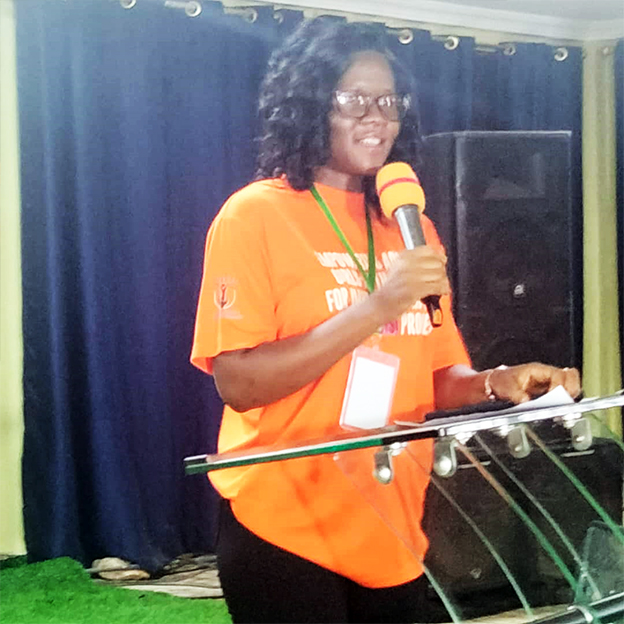
Mrs. Opoku-Gyasi, the Executive Director, EWEF, addressing the gathering
Erudite Women’s Empowerment Foundation (EWEF), an NGO with funding support from the African Women’s Development Fund (AWDF) and Defence for Children Ghana (DCI-GHANA) has commemorated the 2024 World Menstrual Hygiene Day with an awareness creation on sexual and reproductive health outreach programme for some 150 young girls.
Stakeholders in a group photograph with some of the young girls
The outreach programme for girls with and without disabilities at the PIWC Auditorium at Konongo Ahyiaem in the Asante Akim Central Municipality of Ashanti region was well attended by stakeholders, including representatives from traditional and religious leaders, male champions, health care providers, Adesua Foundation and the Ghana Education Service, who took their turns to educate the girls on the sexual and reproductive health needs.
Mrs. Ohenewaa Constance Opoku-Gyasi, the Executive Director of EWEF, in an address, observed that Menstrual Hygiene is fundamental to the well-being of women and girls, because it influenced their ability to attend school and work, but often does not receive the much attention it deserves.
She said lack of access to proper menstrual products and inadequate sanitation facilities, as well as the pervasive stigma around menstruation, created barriers that millions of women and girls must overcome every month, emphasising that these challenges “are particularly severe in low-income communities, where access to basic necessities is already limited.”
Mrs. Opoku-Gyasi said the mission to commemorate the day is to work together to break down the barriers and advocate for policies that ensure that “every woman and girl has access to affordable and sustainable menstrual products”.
The Executive Director stressed that “menstrual hygiene is not a luxury, but a necessity and also not a privilege but a right,” and called on stakeholders to support initiatives that provide education on menstrual health and also to invest in infrastructure that guarantees safe and private sanitation facilities for all.
The girls joyfully displaying their sanitary pads
Nana Frimpong Manso Adakabre, the Adesuahene of Agogo Traditional area who is also the CEO of Adesua Foundation Ghana, suggested that government should consider free supply of sanitary pads to second cycle schools, because it is too expensive for the girls to afford every month.
Alternatively, government must wave all the taxes on the imports of sanitary pads to make it affordable to girls of menstrual age.
Facilitators from the Ghana Health Service took the girls through a training workshop on menstrual hygiene management and cervical cancer prevention and treatment, general health screening and distributed free sanitary pads.
Dr. Francis Aboagye Kwarteng, a retired social worker and a Consultant who is also the CEO of FRANBENNY Group of companies remarked that it is not proper to organise the menstrual hygiene day only as an annual special event and suggested to the stakeholders to consider distributing sanitary pads to schools frequently, without organising it as a special day.
Minister of State for Environment, Dr Iziaq Salako, has underscored the importance of collective commitment to promoting a sustainable environment in Nigeria.
He emphasized that the Federal Government needs robust support from stakeholders to effectively address the challenges posed by climate change.
While speaking at the 60th-anniversary celebration of the Nigerian Institute of Public Relations held on Saturday at the Moshood Abiola Polytechnic, Abeokuta, where the Ogun State Chapter of NIPR unveiled its Diamond Anniversary Green Park, he stressed the need for concerted efforts to reduce carbon footprint in the country and improve the health of its ecosystem.
The minister was represented by the Director-General and Chief Executive Officer of the Forestry Research Institute of Nigeria, Professor Zacharia Yaduma, at the event, which featured the planting of 60 economic trees.
It was preceded by a colourful street walk themed, ‘Walking for Economic Transformation’, within the Abeokuta metropolis.
The minister donated 1,000 tree seedlings to support the tree-planting campaign of Ogun NIPR.
Salako said it is possible to create a new Nigeria that not only thrives today but also flourishes for the coming generations.
“As we reflect on our journey as a nation, we are reminded of the vital importance of sustainable development. Greener Nigeria is not just a slogan; it is a call to action. It urges us to embrace practices that promote environmental stewardship, to innovate in ways that reduce our carbon footprint, and to invest in the health of our ecosystems.
“Today, as we celebrate this Diamond Anniversary, let us renew our pledge to protect and enhance our natural heritage. Let us work together to ensure that our forests remain lush, our rivers flow clean, our gutters waste-free and our air stays pure.
“Let us support initiatives that drive green energy, sustainable agriculture and conservation efforts across our beloved nation,” he said.
Attorney General of the Federation, Lateef Fagbemi.
The Attorney General of the Federation and Minister of Justice, Prince Lateef Fagbemi SAN, has condemned the call to industrial action by organised labour describing it as “premature, ineffectual, and illegal.”
Fagbemi’s stern rebuke comes in response to the announcement made on May 31, 2024, by the leadership of the Nigerian Labour Congress and Trade Union Congress declaring an indefinite nationwide strike action from June 3, 2024.
Highlighting the premature nature of the strike declaration, Fagbemi in a letter dated June 1 addressed to the leadership of the TUC, NLC emphasised that negotiations between the Federal Government and other stakeholders on determining a new national minimum wage had not reached a conclusive end.
He underscored the importance of considering the interests and capacities of all employers, including the organised private sector, in setting a minimum wage that benefits the entire working population.
Drawing attention to legal provisions, Fagbemi cited Sections 41(1) and 42(1) of the Trade Disputes Act 2004 (as amended), which mandate both NLC and TUC to issue mandatory strike notices of at least 15 days.
He argued that the failure of the labour unions to comply with these provisions renders their strike action illegitimate and unlawful.
Furthermore, Fagbemi questioned the legality of the proposed strike action, pointing out that the labour unions had not initiated trade disputes with their employers or issued any strike notices as required by law.
He emphasized the gravity of non-compliance with the mandatory 15-day notice, highlighting the criminalization of such actions under Sections 41 and 42(1) of the Trade Disputes Act.
A violent rainfall and high winds have claimed the lives of at least four traders participating at the North East Trade Fair being held at IBB Square in Bauchi.
On Saturday night, the storm severely damaged tents at the trade fair complex in the state capital, causing the death of two persons at the Gombe and Yobe States’ pavilions.
A statement issued to the media on Sunday by Ahmed Wakil, the police spokesperson in the state, confirmed the tragedy.
Mr Wakili added that a 31-year older woman, Fatima Isa, was still receiving treatment at the hospital.He named the victims of the incident as “Abdullahi Abubakar, 38, of Yakubu Wanka, Sadik Ahmed Alfa, 32, of Fadaman Mada, Malam Musa from Maliya Furnitures Tudun Salmanu, and Abdulaziz Abdulrahman from Gombe State.”
Mr Wakili said emergency response teams, under the direction of law enforcement and other security authorities, launched search and rescue efforts after the tragedy.
“Sadly, five people were discovered beneath the collapsed buildings and were sent to the hospital. Fatima Isa “F,” a 31-year-old Inkil patient, is one of the few who is presently undergoing medical attention and making progress towards recovery.
“To deal with the storm’s aftermath, the authorities have done what has to be done, including putting the deceased people in the mortuary.
“Assessments are being made to determine how much property damage the storm caused. Following this regrettable incident, a police presence is being maintained at the square to safeguard public safety and deter criminal activity,” the police said.
Last month, many people were made homeless in Waptan village as a result of a downpour that caused havoc in the Tafawa Balewa Local Government Area of the state.
The Jigawa State chapter of the opposition Peoples Democratic Party (PDP) has warned against the alleged plan to amend the state’s electoral law.
The party fears the exercise is being done to allow the imposition of caretaker committee chairpersons in the 27 local government areas of the state.
The state House of Assembly has constituted an eight-member ad hoc committee to review the State Independent Electoral Commission (SIEC) and Local Government Laws.
The lawmakers said the committee was mandated to review the law to conform with the Electoral Act 2022.
The development was a sequel to the adoption of a report by its Committee on Local Government, which studied a petition presented by the Inter-Party Advisory Council (IPAC).
The IPAC, in a communique issued at the end of its meeting on 25 March and read on the floor of the House on 27 April, advocated the review of the SIEC and Local Government Laws.
PDP disagrees
But the PDP claimed the move by the All Progressives Congress (APC)-controlled Assembly violates the 1999 Constitution and undermines democracy.
The party’s state chairman, Ali Idris, in a statement, said the appointment of unelected executives as local council chairpersons is unconstitutional and undemocratic.
Isaac Agyenim Boateng, Senior Business Advisor at GEA
The Ghana Enterprise Authority (GEA) has sensitised members of the Ashanti Regional Association of Physically Challenged on Enterprise Support Programme towards economic empowerment and self-reliance.
The objective of the grant is to support members to take those who beg on the streets off for decent jobs.
Mr. Isaac Agyenim Boateng, Senior Business Advisor at the Ghana Enterprise Authority explained that the PWDs Enterprise Support Programme is a nationwide programme for persons with Disability by which the Government of Ghana and World Bank have secured support for all physically disabled persons irrespective of one’s condition.
The members were taken through the design and processes one goes through to apply for the about twelve business sectors including Agriculture, Agribusiness, Manufacturing, Construction and Education.
He disclosed that members can also visit business advisory offices in the various districts for guidelines for the applications.
Mr. Eric Oti Nyarko, Ashanti Regional Manager of GEA said the support grant is meant for every disabled person irrespective of their category provided one is able to apply successfully.
Members of Ghana Association of Physically Challenged who participated in the programme
He noted that the support grant could also be used as a Start-up capital for the unemployed disabled people and those on the streets begging.
He entreated those who would go through the application successfully to use the support for the intended purpose to benefit them and their families.
Mr. Stephen Djan, Ashanti Regional Chairman of Ghana Association of Physically Disabled expressed worry over the plight of members of the Association adding that it is not their fault to be on the streets begging.
He attributed development to the suffering that the disabled go through.He urged the government to always empower members to alleviate their sufferings.
The World Bank today approved a $250 million International Development Association (IDA) credit for a five-year Ghana Financial Stability Project.
The project will support Ghana’s Financial Sector Strengthening Strategy (FSSS) by contributing to financial stability through the recapitalization of viable Banks and Specialised Deposit-taking Institutions (SDIs) impacted by Ghana’s Domestic Debt Exchange Program (DDEP).
The financial system is critical to the functioning of the Ghanaian economy, providing critical services to households, firms, government and supporting economic growth.
To address the severe impact of the DDEP on financial institutions, the Government established the Ghana Financial Sector Stability Fund (GFSF) to provide solvency support to banks, pension funds, insurance companies fund managers and collective investment schemes.
“This project will contribute to Ghana’s financial stability, by providing solvency support to banks and SDIs impacted by the DDEP through the GFSF,” saidRobert R. Taliercio, World Bank Country Director for Ghana, Liberia and Sierra Leone.
“Through direct support to banks and SDIs, the project will benefit Ghana’s financial sector and the economy by supporting the access of depositors and other financial consumers to savings, payments and other core financial services provided by adequately capitalised banks and SDIs.“
The Ghana Financial Stability project is expected to immediately benefit eligible undercapitalised but viable banks and SDIs and become accessible to other banks and SDIs that may need support in the future due to potential new losses and providing a backstop against unexpected losses.
“The World Bank Group’s support aims to help address short-term shocks to improve prospects for long-term sustainable development and long-term resilience against future shocks. The project promotes financial stability, a key requirement to protect people and preserve jobs,” saidCarlos Leonardo Vicente, Senior Financial Specialist and Team Lead.
The project complements the World Bank’s Development Program Financing series and the IMF-Extended Credit Facility, which support reforms to improve the macroeconomic environment and enable financial institutions to operate profitably and generate internal capital. It also complements other World Bank funded projects aimed at economic recovery and job creation in Ghana, such as the Ghana Development Financing Project which supported the establishment of the Development Bank of Ghana and provides long-term financing to small and medium enterprises and small corporates.
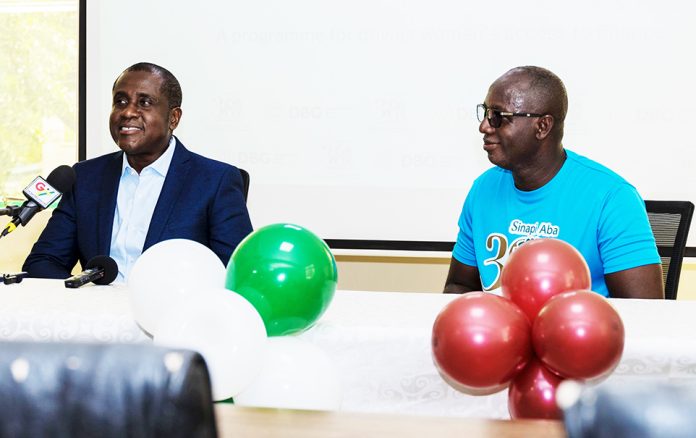
The Deputy CEO of DBG,Michael Mensah-Baah and Tony Gyasi-Fosu ,CEO, Sinapi Aba Savings and Loans ,seated at the news conference
The Development Bank Ghana (DBG) has collaborated with Sinapi Aba Savings Loans to give businesses, which are led by women a boost.
Christened “LeapHer” 2,500 women will benefit from the lending initiative, which aims to empower women who are into business and thereby enhancing their financial inclusion.
The collaboration between the two entities follow a research conducted by DBG on Gender Mainstreaming Investment that established gender disparities and barriers within Ghana’s financial landscape.
In view of the above, DBG has given a total of GH¢23M to Sinapi, to be disbursed to women in specific sectors of the economy.
Announcing the collaboration at the 30th Anniversary celebration of Sinapi Aba Savings & Loans Ltd, which was held in Kumasi recently, Mr. Michael Mensah-Baah, the Deputy Chief Executive Officer (CEO) at the DBG, stated that the bank had launched its tailored lending program, specifically for women owned businesses, in partnership with Sinapi Aba.
“The program, dubbed ‘Leap Her, is specifically customised to address the challenges and barriers that female entrepreneurs encounter in accessing finance for their businesses.”
Mr Mensah-Baah told the media the partnership forms part of DBG’s vision of accelerating an inclusive and sustainable economic transformation, by fostering the growth of a competitive private sector.
On the partnership between DBG and Sinapi Aba, he indicated that the collaboration was at its formative stage, disclosing that many of such programs are in the offing to support women-led businesses.
Following a research conducted by DBG on Gender Mainstreaming Investment in Ghana, the bank, according to Micheal Baah-Mensah, had already announced its commitment to investing 15 percent of its available funding, approximately GHS1billion into women-led businesses in the next 3 to 5 years.
On his part, the Chief Executive Officer of Sinapi Aba, Mr. Anthony Gyasi Fosu, hailed the creation of DBG by the government, underscoring that DBG was not only focused on bigger corporations, but they have found it necessary to fund institution like Sinapi Aba.
This pact, according to Gyasi Fosu, was a great move since they (Sinapi Aba) had been in the market for over thirty years and had noticed that women-led businesses do not perform well.
Rev. Fr. Dr. Emmanuel Okpoti Oddoye, retired Scientist of Cocoa Research Institute (CRIG) and witness in the ongoing cocoa trial, says it is a blanket statement for anyone to suggest that all fertilisers must undergo a field test before approval.
According to him, that impression is erroneous and misleading, adding that field test or no field test dependoncertain circumstances.
He said fertilisers such as Ammonium sulphate,submitted by Plantco Limited, as well as Omni Cocoa Aduane Granular fertiliser,were subjected to only laboratory test and granted a pass.
Dr.Oddoye told the Accra High Court, presided over by Justice Aboagye Tandoh, that the laboratory test took three months and were recommended for matured cocoa tree.
The witness added that Ammonium Sulphate fertiliser, for instance, does not contain urea and as a nitrogenous fertilizer, it does not require field testing.
The witness also shot down claims by Dr. Franklin Manu Amoah, Dr. Alfred Arthur and Dr Yaw Adu-Ampomah, who have all appeared before the court that it was an error for lithovit fertiliser to be tested for only six months.
Samuel Codjoe, counsel for Dr Opuni, held that these three witnesses of the prosecution all testified that his client instructed Scientists to cut corners with the testing of fertilisers, hence the six months testing of lithovit fertilizer.
Contrary to their testimonies before the court that protocol demands two to three years testing of fertilisers, they certified new fertiliser without field trial, as well as not satisfying the two years or more testing requirement.
Mr Codjoe stated that, “a person would be breaching the commandment of bearing false witness against his neighbour if he is a scientist at CRIG who has taken part in a test such as in Exhibit 41, which recommends use of fertiliser for matured cocoa after comparing the nutrients of a new fertilizer to now state before a committee that all fertilizers before approval for yield should undergo field trial.”
The counsel went on to say that Dr. Alfred Arthur himself confirmed that the laboratory test of Ammonium sulphate fertiliser, contained urea and confirmed that it was a fertiliser without testing it in the field.
Exhibit E
According to the testimony of Dr Franklin Manu Amoah, second prosecution witness (PW2) ,lithovit foliar fertiliser when submitted to CRIG for testing was not liquid but powder.
He further told the Yaw Adu-Ampomah committee that it weighed 10 kilograms (kg).
However, when the current witness in the box was handed a container with the lithovit powder, which is Exhibit E, to determine the weight, he said it could surely not be even 5kg.
Rev. Fr. Dr.Oddoye could not determine the exact weight of the container he tossed and turned in his hand, because there was no information provided on the label to that effect.
Although the container is sealed but not full, he said it is difficult to say it weighs 1kg, but definitely not 5kg.
He is the fifth subpoenaed witness (DW4) ofSeiduAgongo and Agricult Ghana Limited (A2 & A3) and testified before the High Court last week Tuesday.
Jerome Abgesi Dogbatse (DW3), a senior research scientist at the Soil Science Division of CRIG, denied ever seeing Exhibit E at CRIG.
Mr. Dogbatse made the claim when he appeared before the court and the Exhibit was shown to him.
Similarly, Dr. Yaw Adu-Ampomah, former Deputy Chief Executive of Agronomy and Qualify Control of COCOBOD and PW3, also made the same claim the he does not know where the sample is coming from.
He told the court then presided over by Justice Clemence Jackson Honyenuga on November 27, 2019 that “My Lord, I don’t know where this is coming from because this will not be the sample that was brought the first time.
“The first sample came in 2013 and I don’t know whether it is this same sample you are referring to. The sample which came in 2013 of which Dr Amoah is referring to, I wouldn’t know if it is the same thing you are showing to me,” Dr Ampomah responded at the time.
Ethical fertilizer testing
The court also heard that the practice and/or process of the approval of fertilisers for use on matured cocoa existed before Dr.Opuni occupied the office of chief Executive of COCOBOD in the year 2014.
Despite the prosecution’s claim that lithovit is a bad fertiliser because it was tested on cocoa seedlings and not matured trees, Dr Oddoye, the current witness in the box, said the practice was not new.
Dr.Oddoye said there are other fertilisers that never underwent field testing but could be recommended for use on matured cocoa trees.
Transfer, demotion, contract termination and reinstatement
Dr. Oddoye further told the court that members of the adhoc Committee, which handled the case of Dr Alfred Arthur, PW2, who, on his own, took delivery of 30 sacks of Cocoa Nti fertiliser from Enapa Ventures, were all transferred from CRIG Tafo.
DW5 was not only transferred from CRIG to a sub-station, but demoted as the Deputy Executive Director of CRIG and Chairman of the Committee on Testing Chemicals and Machines (CTCM).
He added that Dr Gilbert AnimKwapong was transferred as the Executive Director of CRIG to COCOBOD without portfolio and was replaced by a retiree, Dr Franklin Manu Amoah (PW1).
Furthermore, the contract of Dr. Francis Oppong, who was the Deputy Chief Executive, Agronomy and Quality Control of COCOBOD, at the time, and requested for the setting up of the adhoc committee at CRIG to investigate Dr Alfred Arthur, was terminated and was also replaced by Dr Yaw Adu-Ampomah (PW3) who had also retired from active service.
Dr. Francis Oppong instructed punitive measures to be taken against Dr Alfred Arthur for having received Cocoa Nti fertiliser without recourse to COCOBOD and CRIG.
Law Court Complex, Accra
After Dr F.M. Amoah and Dr Adu-Ampomah had occupied these positions, instructed Dr Oddoye to reverse the sanction on Dr Alfred Arthur and reinstate him.
No directive to shorten fertiliser test
Dr Oddoye, who had gone on sabbatical leave fromSeptember, 2013 to August, 2014 and,therefore, did not attend Dr.Opuni’s maiden visit to CRIG in January, 2014 said he never heard Scientists being instructed to shorten testing period for fertilisers.
At the time Dr Opuni visited CRIG, Dr F.M. Amoah (PW1) was the Executive Director, but DW5 said PW1 never passed down any information to him, as the then head of the Bunso sub-station that the scientific branch of COCOBOD ought not to test fertiliser fully.
DW5 indicated that if such directive really existed, he would surely have known of it.
Cross examination
Q: The practice and or process of the approval of fertilizers for use on matured cocoa, which was applied with respect to Cocoa Aduane as contained in Exhibit 41 is an accepted CRIG practice.
A: Yes.
Q: And this practice and or methodology predates the appointment of the 1st accused, Dr. Stephen KwabenaOpuni as Chief Executive of Cocobod.
A: Yes.
Q: When did you become a member of the CTCM of CRIG?
A: I became the chairman in January 2017.
Q: When did you first become a member of the CTCM?
A: I was never a member until I became chairman.
Q: But Dr. Alfred Arthur to your knowledge was a member prior to your assuming the position of chairman in 2017.
A: That is correct. He was a member representing the Soil Science Division.
Q: Can you please confirm the date of when you assumed the position of chairman of CTCM, was it in 2016 or 2017?
A: It was in January 2017.
Q: When were you appointed as Deputy Executive Director of CRIG?
A: I was so appointed in September 2016.
Q: Can you please confirm when or the period or duration of your tenure as the chairman of the CTCM and by this I mean when you were first pointed and when you were transferred from this position?
A: I became chairman in January 2017 and ceased to be the chairman in July 2018.
Q: You can confirm to this Court that during your tenure as the chairman of the CTCM, Cocobod approved identical recommendation of use of fertilizers on matured cocoa, which had not undergone field trials just like Cocoa Aduane fertilizer as contained in Exhibit 41 and specifically after having had laboratory test?
A: That is correct.
Q: You can also confirm that when you were transferred as the Deputy Executive Director of CRIG the substantive existing Executive Director, Dr. Gilbert AnimKwapong was also transferred from CRIG around the same time?
A: No. Dr. Gilbert AnimKwapong was transferred to Cocobod Head Office in January 2017 and was replaced by Dr. Franklin Amoah.
Q: You can also confirm that Dr. Francis Oppong who was the Deputy Chief Executive, Agronomy and Quality Control of Cocobod at the time and who requested for the setting up of the Ad hoc committee which was set up by Dr. Gilbert AnimKwapong of which you were a chairman was also no more in Cocobod as he had his appointment terminated?
A: That is correct.
Q: You would confirm that all the principal parties who were in charge and or authorized and or set up this ad hoc committee on the testing of Cocoa Nti Fertilizer were transferred or had their appointment terminated or from the function of testing of fertilizers namely from CRIG?
A: That is correct.
Q: If you turn to page 1 of Exhibit 18 that is the next page after the executive summary and you can confirm that at the time Dr. Alfred Arthur took possession on his own without the consent of CRIG of the 30 bags of Cocoa Nti Fertilizer for testing, Dr. Franklin Amoah (PW1) was the Executive Director of CRIG in 2013/2014?
A: That is correct.
Q: You can also confirm that the then Deputy Chief Executive, Agronomy and Quality Control of Cocobod at the time this unlawful test took place was Dr. Yaw AduAmpomah (PW3)?
A: Yes.
Q: When Dr. Alfred Arthur appeared before the committee, his evidence was that he received email instructions (on page 21) from the then Deputy Chief Executive, Agronomy and Quality Control to receive this sample from Enapa Ventures?
A: The report states as such. I however doubt if the said email message was ever produced otherwise it would have been part of this Exhibits.
Q: You can also confirm that on page 17 that is on the testimony of Dr. Alfred Arthur before the committee, his first answer, second paragraph He stated that Enapa Ventures people in 2017 had had prior discussions with Dr. Franklin Amoah (PW1) the then Executive Director of CRIG with respect to this Cocoa Nti Fertilizer?
A: That was what Dr. Alfred Arthur stated in his submission to the committee.
Q: But you can confirm that the committee’s report is with CRIG and Cocobod and that Dr. Franklin Amoah, PW1 and Dr. Yaw AduAmpomah when they returned to their previous positions of Executive Director, CRIG and Deputy Chief Executive, Agronomy and Quality Control Cocobod respectively in 2017 knew about this report?
A: Indeed CRIG and Cocobod had copies of the report and by virtue of their office, Dr.Amoah and Dr. Yaw AduAmpomah would have had access to the report.
Q: I am putting it to you that it is not wholly that they would have had notice of Exhibit 18 by virtue of their office as you state but they actually were aware of the content of Exhibit 18 and instructed you to write Exhibit 14 which is the letter nullifying the sanctions meted out to Dr. Alfred Arthur (PW2)?
A: That is so.
Q: You will agree with me that Dr. Alfred Arthur after the committee had sanctioned him did not appeal against the sanction and accepted the punishment for the wrong he committed with respect to the testing of this Cocoa Nti Fertilizer?
A: That is correct but if I may point out that the original sanctions as prescribed by the committed were rather mild considering the gravity of the offence. The then DCE, Agronomy and Quality Control advised that we apply stronger sanctions in consultation with the Executive Director, CRIG as per his minutes on the letter that forwarded the report to him.
Q: You would agree with me that before Dr. Yaw AduAmpomah (PW3) and Dr. Franklin Amoah (PW1) both instructed you to reverse the sanctions, they definitely would have read the entire proceedings contained in Exhibit 18 which includes the evidence of Dr. Alfred Arthur (PW2)?
A: That is correct.
Q: You would agree with me that both PW1, Dr. Franklin Amoah and PW3, Dr. Yaw AduAmpomah would have become aware that Dr. Alfred Arthur stated that he on his own received these 30 bags of Cocoa Nti Fertilizer directly from the company Enapa Ventures and he tested them?
A: That is correct
Q: And you would also confirm as contained on page 17 of Exhibit 18 that both PW1 and PW3 would have become aware that Dr. Alfred Arthur’s testimony is to the effect that the sample of fertilizer from Enapa Ventures did not come with any name.
A: That is correct.
Q: On page 18 of Exhibit 18, you can confirm that both Dr. Franklin Amoah and Dr. Yaw AduAmpomah would have become aware that Dr. Alfred Arthur stated that he on his own received these 30 bags from Enapa Ventures on behalf of CRIG
A: Yes.
Q: And he stated in answer to a question that “when I joined CRIG, I saw samples coming directly to CRIG without recourse to Cocobod. It was later in 2014 that at a seminar held at the Club House the decision was taken that all request for testing of chemicals must emanate from Cocobod”. By this PW2, Dr. Alfred Arthur was emphatic and explicit that prior to the later part of 2014, scientists could receive and or were receiving samples of fertilizers to be tested on their own not through Cocobod or CRIG?
A: That is correct.
Q: Both Dr. Franklin Amoah (PW1) and Dr. Yaw AduAmpomah (PW3) were aware of this and never disputed this statement of fact to your knowledge?
A: Not to my knowledge.
Q: You can confirm from Exhibit A that lithovit came to Cocobod in 2013 and the test was also conducted in 2013 according to Dr. Alfred Arthur and Mr.Afrifa and even the prosecution?
A: Based on the documentation that is so.
Q: During your time in CRIG and also during your tenure as the head of CTCM, you are aware that before any fertilizer is tested by CRIG the suppliers of the fertilizer would be invoiced with respect to the cost of the test and quantity of the fertilizer required for the test. That is what happens?
A: That is correct.
Q: The sample of fertilizer in this case lithovit which accompanied this letter Exhibit A is definitely not the sample which would have been used to conduct the test because it is only CRIG and by this the scientists of CRIG who would determine the quantity of fertilizer required for the test?
A: That is not quite the case. A sample would normally accompany the introductory letter to allow Scientists to run some preliminary test. Thereafter, if scientists decide to go further that is when specific quantities of the material would be requested and an invoice given to the company to facilitate payment of the cost of the test.
Q: You can confirm on page 40 of Exhibit H which is the Dr. Yaw AduAmpomah committee’s report that Dr. Franklin Amoah (PW1) in one breath states that the sample of lithovit fertilizer which came for testing was 10kg?
A: According to the report that is correct.
Q: You can confirm that this sample Exhibit E you have in your hands cannot contain 10kg as the maximum weight on it is 1kg?
A: Weight is difficult to confirm. I cannot see the weight on the container. But while I cannot confirm that this is 1kg, it is definitely not 5kg.
Q: As you speak you have half the quantity of the alleged product in the container in your hand Exhibit E?
A: The product is sealed so by feel it is not full but I cannot confirm what is still left.
Q: When you turn to page 29 of Exhibit H, on question 4 on page 29 when Mr.Afrifa was questioned he stated that what he received from the company was liquid that is the sample. The question was did he deliver through the correct process powder or liquid and his answer was liquid. That was before the committee. Is that correct?
A: That is what the report states.
Q: From the answer given by Dr. Alfred Arthur (PW2) to your committee and specifically on page 18 of Exhibit 18, he stated that it was only in the later part of 2014 that the decision was taken that all requests for testing of chemicals must be through Cocobod and not through individual scientists. That is correct?
A: That is so.
Q: When Mr.Afrifa informed the Dr. Yaw AduAmpomah committee on page 29 of Exhibit H after series of questions that he received this lithovit liquid fertilizer for testing through the same means namely directly from the company he was only doing what pertained at the time?
A: That would be so.
Q: Dr, Franklin Amoah (PW1) and Dr. Yaw AduAmpomah (PW3) have not disputed to your knowledge this statement of facts with respect to the existing practice on receiving samples from applicant companies prior to the later part of 2014 when the decision was taken to change that practice?
A: Yes, they have not disputed that fact.
Q: You were at a point in time the Deputy Executive Director, CRIG and chairman of the CTCM and you can confirm that the nursery testing of fertilizers would require that the fertilizer would be applied on seedlings for specific period of time within the test periods.
A: That is correct.
Q: In your position you can confirm that it is not possible to test seedlings in respect of a nursery study on the efficacy of a particular fertilizer for a period of six months without applying more than one tin of this fertilizer Exhibit E in practice.
A: The difficulty is that this is a specialist area. The amounts that are to be applied are very small and the nursery test is done in gauze house may be a little smaller than this Court room. So within this room there would several treatments which are repeated several times within this room. Seedling are very small and very small amount or quantity are required.
Q: Can you tell or you cannot tell?
A: I cannot tell and I was trying to explain why.
Q: I am putting it to you that if this tin i.e. Exhibit E was enough for the test of lithovit PW1, Dr. Franklin Amoah would not have stated he requested for 10kg for the test as he stated before Dr. Yaw AduAmpomah committee in Exhibit H (page 40, the last but one paragraph ).
A: According to this report Dr.Amoah states that the sample that came was 10kg of powder. So perhaps more of the sample was supplied. I am not in the position to say so definitely.
Q: When Dr. Alfred Arthur appeared before your committee during your investigation into his malpractice in the testing of Cocoa Nti fertilizers, when you questioned him on page 18 of Exhibit 18 on how reports are written and your question was based on the fact that some of the names he claimed to have participated in the test claimed not to have taken part in the test. He claimed that a name is put there even though the person would not have participated in all aspects of the test. That is so?
A: According to the answer given by Dr. Alfred Arthur all scientists whose name appeared on a scientific report would usually have contributed to its writing in one way or the other.
Q: You can confirm on page 19 of Exhibit 18 and in answer to the second question, Dr. Alfred Arthur (PW2) was explicit that until the protocols for receiving fertilizers were developed in 2014, samples of fertilizers for testing came directly from the applicants companies without passing through COCOBOD?
A: That is what is stated but that is not so. Exhibit A the letter on which is dated May 2013 is indicating that the proper way was being followed but as is often the case we come across what I will term “rogue scientists” who do their own thing.
Q: The practice in Cocobod if you cast your mind back is that the letter from Cocobod to CRIG would have a sample but CRIG would request for the actual quantities that it requires for the test together with the budget for the test hence the original sample received from Cocobod is not what would be used for the entire test and in the case of lithovit it stated that it required 10kg for the test. You would agree with that?
A: That would be the usual case.
Q: On page 19 of Exhibit 18, PW2 Dr. Alfred Arthur informed your committee that the Cocoa Nti fertilizer episode which you were investigating was not the only time he had received chemical directly from a client.
A: That is correct.
Q: He also informed your committee that the then Deputy Chief Executive, Agronomy and Quality Control, Dr. Yaw AduAmpomah approved of the testing he did by virtue of some emails he received privately from Dr. Yaw AduAmpomah (PW3).
A: That is what Dr. Alfred Arthur told the committee.
Q: Neither Dr. Yaw AduAmpomah PW3 nor Dr. Franklin Amoah, PW1 when they instructed you to nullify the punishment imposed on PW2 as contained in Exhibit 18 challenged this position of Dr. Alfred Arthur PW2 even though they were aware.
A: They did not do so.
Q: Dr. Franklin Amoah in his evidence in chief to this Court on 16th July, 2018 states that he was appointed the acting Executive Director of CRIG in 2010 and was subsequently confirmed as the Executive Director at the time of his tenure, you were also at CRIG. Is that not it?
A: That is correct.
Q: In CRIG your position was one of a senior scientist in 2013/2014.
A: At that time I was a principal scientist.
Q: Your positions was amongst that of the top scientists in CRIG by way of hierarchy.
A: That is so.
Q: So when 1st accused, Dr. Stephen KwabenaOpuni had visited CRIG in January, 2014, you were a member of the top scientists.
A: All though I was a principal scientist, my work was more or less limited to running the Bunso substation of which I was the head.
Q: In your position, you would definitely have attended meetings of top scientists of CRIG.
A: Scientists met as a group. There was no grouping for senior scientists. Perhaps heads of scientific divisions which may include the head of the sub stations.
Q: At that time you were the head of the substation in Bunso which entitled you to attend meetings of top scientists in CRIG if there was any such meetings.
A: That is correct.
Q: During Dr.Opuni’s maiden visit to CRIG in January, 2014 as the head of the Bunso station you would definitely would have been present except your absence is for a very good reason.
A: I now recall that between September, 2013 and August, 2014, I was on sabbatical leave.
Q: When did you return from sabbatical leave?
A: August 2014.
Q: Where did you return to in CRIG?
A: I resumed duty as the head of Bunso substation at Bunso.
Q: You would, definitely in your position, have had interactions with Dr. Franklin Manu who was the head of CRIG or his successor Dr.AnimKwapong because of your position.
A: Yes. That is correct.
Q: It never came to your attention and or knowledge that during your absence a directive had been issued for the shortening of the test period on fertilizers.
A: Such a directive was never issued.
Q: If any such directive was in existence you would definitely would have known about it.
A: That is correct.
Q: You can confirm that CRIG itself had one of its testing protocols namely that it would not conduct field trials for the efficacy of a particular fertilizer on matured cocoa if the result of its laboratory test shows that the nutrient in the new fertilizer being tested is the same or similar to a previously tested effective fertilizer.
A: No. that is not correct. All though a senior member of staff, I was not directly involved in these matters, would hear little bit of information but this one I do not recall being aware of.
Q: Cast your mind back and confirm that from Exhibit 41 you forwarded the scientific report on Cocoa Aduane for approval by Cocobod.
A: Yes. That is correct.
Q: And you can further confirm on the last page of Exhibit 41 that this scientific report recommending Cocoa Aduane as good for matured cocoa was based on the reasoning that field test of similar fertilizers with the same chemical composition as this Cocoa Aduane fertilizer had proven to be effective on matured cocoa. Is that not it?
A: That is so.
Q: And according to your own letter, CRIG was approving of this fertilizer because it had the same nutrient as previously tested fertilizers. Is that not the case?
A: That is correct.
Q: Contrary to your answer which you gave earlier on, CRIG itself had its own protocol as is contain in Exhibit 41 that in so far as the nutrient are the same and confirmed from laboratory results, field trials are not necessary for a new fertilizer for use on matured cocoa if there are previously existing ones which are being used by Cocobod.
A: Counsel’s previous question refers to events in 2014. As at that time I was not privy to this information.
Q: When did you subsequently become privy to this information namely that field trials for a new fertilizer was not necessary if laboratory test results of the nutrient content is the same as already existing fertilizers.
A: This came to my notice when I became chairman, CTCM in January, 2017 and particularly when Exhibit 41 was brought to my attention.
Q: You would agree with me that it would be disingenuous and the height of hypocrisy for a scientist in CRIG who is involved in the testing of fertilizer to claim or allege or state as a fact that in CRIG all fertilizers have to go through field trial to test for yields based on this existing practice which you subsequently came to know?
A: That would be so.
Q: I am putting it to you that a person would be breaching the commandment of bearing false witness against his neighbour if he is a scientist at CRIG who has taken part in a test such as in Exhibit 41 which recommends use of fertilizer for matured cocoa after comparing the nutrients of a new fertilizer to now state before a committee that all fertilizers before approval for yield should undergo field trial?
A: Indeed the blanket statements to the effect that all fertilizers must have a field test before approval would be misleading. Under certain circumstances, field testing may not be required.
Q:Namely?
A: That ammonium sulphate is so well known as a nitrogenous fertilizer that upon confirmation of content field testing is not required.
Q: So Dr. Alfred Arthur (PW2) as late as the 8th day of May, 2017 was aware of this and in fact confirmed it to you?
A: That is so.
Q: Dr. Yaw AduAmpomah (PW3) as at the 10th May, 2017 was in the knowledge and informed about this findings of this scientist which requested for approval?
A: The letter as part of Exhibit 42 indicates that initially the thinking of CRIG management was that a field trial would be necessary. Since there was no correspondence forwarding the two bags of ammonium sulphate fertilizer and no report on the field trial.
It is likely that the recommendation that there was no need for the field test was upheld. So the earlier question by counsel has made me rack my brains and I have come to the conclusion that given the fact that there is still some amount of the initial sample of lithovit presented to CRIG in the plastic container, it is likely that more of the sample was sent to CRIG for the gauze house test.
Q: From Exhibit 42 on minutes 2, who is the EDCR?
A: EDCR is the short form of Executive Director Cocoa Research who as at that time was Dr. Franklin Amoah.
Q: What did you minute to Dr. Franklin Amoah in minutes number 2?
A: I advised that ammonium sulphate being a well-known fertilizer may not require field testing.
Q: Did Dr. Franklin Amoah (PW1) the then Executive Director agreed with you as suggested by Dr. Alfred Arthur (PW2) that there was no need for field trial?
A: Minutes 3 on the same letter indicates that he was not fully in agreement and it is a result of his position that the letter to DCE, Agronomy and Quality Control, Cocobod requested for two bags of fertilizer for a seedling trial.
Q: You can confirm that in Exhibit 41 he agreed that there was no need for a field trial on Cocoa Aduane when you signed this letter confirming the scientific report which said you could dispense with field trial based on similarity in the existing nutrient?
A: Yes.