Home Blog Page 1233

Ghana needs a leader with track record -Domelevo

0
Daniel Yao Domelevo, former Auditor -General

Mr. Daniel Yao Domelevo, former Auditor-General of Ghana, has stated that Ghana needs a leader who has track record.

According to him, the only indicator to help the positive transformation of the country was electing a trustworthy leader with the ability to make a bold decision, accountable, and equitable to all Ghanaians.

“We need a leader with a track record. Some leaders play with our brains and because they can speak English, they speak plenty of English and people start clapping for them; they think it is English we use to develop a country, then Ghana would have been a developed country on earth,’’ said Mr. Domelevo.

The former Auditor-General, who is an astute Accountant and currently serves as a board member of the Global Fund, advised Ghanaians to elect a leader who is a ‘father for all’, ahead of the forthcoming general elections.

Speaking during the Scarface of Corruption, organised by crusaders against corruption, in Koforidua, Mr. Domelevo urged the youth to vote for a leader who can uphold the rule of the country.

Mr. Domelevo stated that Ghanaians should look for fairness, accountability, trustworthiness, honesty, equitability and a leader who respects the views of the citizenry – attributes he claimed bring good results.

Speaking on the topic: “a nation in a sinking ship,” the Leader for Crusaders against Corruption, Chief Crusader Emmanuel Wilson Junior, indicated that corruption cases in Ghana are alarming, adding that the country loses about three (3) billion dollars annually due to corruption.

Touching on the importance of the programme, the Lead for Crusaders Against Corruption, Chief Crusader Emmanuel Wilson Junior, said the programme was to discuss the effects of corruption and its consequences on the economy.

He explained that the ‘Crusaders Against Corruption is a Civil Society Organisation (CSO), which was formed to build and strengthen state agencies for good governance practices and promised to extend the crusade to all the regions.

Dialysis services to be permanently included in NHIS 

0

Dr. Da-Costa Aboagye, Chief Executive of the National Health Insurance Authority (NHIA), has announced that dialysis services will be permanently included in the National Health Insurance Scheme (NHIS).

He said that actuarial analyses had confirmed the feasibility and sustainability of the initiative.

Dr. Aboagye made the announcement during the opening of the NHIA’s district office in Kpandai, Northern Region, emphasizing the government’s commitment to providing quality and accessible healthcare for all.

“After doing due diligence, the Authority has been offering free dialysis for all patients at varying proportions, which was expected to end after six months.

“We aim to make dialysis coverage a permanent part of the National Health Insurance Scheme,” he said.

The Scheme has already covered the costs for eight dialysis sessions per month for patients under 18 and over 60 years, while providing two sessions per month for those aged 18 to 59 during a six-month pilot programme.

Dr. Aboagye noted that the initiative was part of the NHIA’s corporate social responsibility (CSR) efforts to bridge the gap in healthcare access while the government develops a long-term solution.

“The inclusion of dialysis in the NHIS benefit package, along with other recent additions, marks a transformative moment in Ghana’s healthcare system.

“As the NHIA continues its journey towards healthcare modernisation, Ghanaians can look forward to more initiatives aimed at improving health outcomes, reflecting the government’s overarching goal of leaving no one behind in its quest to provide affordable and accessible healthcare,” he said.

Dr. Aboagye acknowledged the NHIS’s achievements in making timely claims payments but pointed out that in 2017, the scheme was burdened with a significant debt of 1.2 billion Ghana cedis, which represented the entire budget for that year.

“As a result, health facilities went unpaid for a full year, leaving many Ghanaians struggling to access necessary care.

“However, thanks to the dedicated efforts of President Nana Akufo-Addo and Vice President Dr Alhaji Mahamudu Bawumia, we have successfully reversed this situation.

“Today, we are proud to announce that the NHIA has achieved unprecedented claim payments, with over Ghc800 million cedis disbursed in just the past month, along with an additional over GHc300 million cedis disbursed in October.

“Currently, we have paid claims up to August 2024 and have no vetted outstanding claims to pay. We are now calling on facilities to submit their claims for payment to enhance services under the Scheme,” he said.

Dr. Aboagye stated that the E-Pharmacy policy was part of the strategy to eliminate the co-payment initiative within the NHIS.

He also announced that mental health conditions, including depression and anxiety, would be added to the NHIS benefit package starting November 1, 2024, to enhance accessibility to mental health services.

Dr Aboagye had earlier inaugurated similar district offices in Suaman and Juaboso in the Western North Region, as well as in Damango in the West Gonja Municipality of the Savannah Region.

He emphasised that the district offices were to ensure that resident’s access 95 per cent of primary healthcare needs covered by the NHIS.

Alhaji Shani Alhassan Shaibu, the Northern Regional Minister, praised the NHIA for its initiatives to enhance the scheme’s infrastructure in a speech delivered on his behalf.

He emphasised the benefits of NHIS enrollment, noting that it had led to increased healthcare utilization and lower out-of-pocket expenses for both outpatient and inpatient services.

Consequently, Alhaji Shaibu encouraged community members to enroll in the scheme to take advantage of the expanded benefits, which now include dialysis treatment, mental health coverage, and free medical care for individuals aged 60 and older.

Mr. Kofi Tatabika, the District Chief Executive said that the upgraded office would facilitate health insurance enrollment and assist patients in navigating the healthcare system effectively.

“This is a vital step towards ensuring our people receive the care they need,” he added.

Mr. Tatabika expressed his appreciation to the board and management of the NHIA for approving the upgrade, saying that the development would enhance the health and well-being of the community.

By Samira Larbie

GNA

Hassan Ayariga Outlines Policies and Vision for GUTA if elected President 

0
Dr. Hassan Ayariga and officials of GUTA in a picture

Dr. Hassan Ayariga, Leader and Flagbearer of the All People’s Congress (APC), has presented his policies and vision ahead of the 2024 general elections to the Ghana Union of Traders Association (GUTA).

During a meeting held on Tuesday, October 22, 2024 at GUTA head office, in Accra, Dr. Ayariga emphasised that his party, the APC, focuses on actionable policies rather than empty promises, asserting that Ghanaians are tired of broken promises from political parties over the years.

In his opening remarks, Dr Ayariga stressed the importance of changing the mindset of Ghanaians to improve the country’s development.

“We need to change our mindset towards work and our country. Leadership must be transparent, sincere and honest in dealing with Ghana and the citizens,” he stated.

Dr. Ayariga believes that the country’s current attitude toward development, where citizens wait for others to build the nation, is counterproductive. He encouraged collective responsibility and urged citizens to take an active role in the country’s progress.

A key part of Dr Ayariga’s presentation focused on prioritising Ghanaians in trade and industry.

He expressed concern that foreigners have taken control of key sectors of the economy, including the oil and mining industries, while Ghanaians are sidelined.

Another major policy discussed was the implementation of a national data system to streamline governance and development.

According to Dr. Ayariga, a data-driven economy will ensure every Ghanaian is accounted for, from their properties and businesses to their family details.

This system, he explained, would simplify processes like voter registration and aid in more effective decision-making across various sectors.

Ayariga also shared plans for an economic lockdown to promote self-sufficiency by encouraging local production.

He stated that the country spends billions annually on imports, including rice, cooking oil, and frozen chicken, which could be produced locally.

To reduce the cost of production for businesses, Dr. Ayariga introduced a policy on flat rates for electricity and water.

This would ensure that households and businesses pay a standardised rate, making utilities more affordable and easing the financial burden on Ghanaians.

He explained that this approach would enable manufacturing companies to operate at lower costs, allowing them to produce goods at competitive prices.

Dr. Ayariga reiterated his commitment to creating a fair and transparent government that prioritises the welfare of Ghanaians, with policies tailored to improve the standard of living, reduce dependence on foreign goods, and build a strong, data-driven economy.

Dr. Joseph Obeng, President of the Ghana Union of Traders Associations (GUTA), who also addressed the media, emphasised the importance of harnessing the positive contributions of all political contenders during the electoral process, not just focusing on the winner of the election.

He called for an electoral process where ideas from various candidates are integrated for the country’s benefit, suggesting that this would make the process more meaningful and inclusive.

“The electoral process should not just be about who wins the election. It should be a platform for harnessing the contributions of all contenders, so we can use the best ideas for the good of the country,” Dr. Obeng stated.

Dr. Obeng praised Dr. Ayariga’s stance on reducing foreign influence in Ghana’s economy, particularly in sectors like retail and mining, which have seen significant foreign control.

He agreed that the impact of foreign dominance extends beyond the trading sector, affecting the entire economy.

“Foreign influence in our retail sector has long been a challenge for GUTA, but it goes beyond that—it affects all sectors of our economy, including mining and our water bodies,” he noted.

Addressing the issue of galamsey (illegal mining), Dr. Obeng pointed out that illegal mining has existed for many years without damaging the environment until modern techniques were introduced.

He suggested that the focus should be on adopting the right methodology to legitimise small-scale mining rather than engaging in protests without meaningful solutions.

“We need to define the right method for mining and legalise it. Protests without solutions will not help,” Dr. Obeng said.

On taxation, Dr. Obeng supported Dr. Ayariga’s proposal for a flat-rate tax system, which would simplify tax collection and reduce corruption.

He described it as a “game changer” for the trading community, as it would allow businesses to project their costs and enhance competitiveness.

“The flat rate system will make it easier for businesses to plan and pay their taxes. This will lead to greater accountability, increased productivity and more competitive pricing,” he added.

Editorial: Let’s Add Herbal Drugs To The List Of Approved Medicines On NHIS

0
Editorial

The Ghana Federation of Traditional Medicine Practitioners Associations (GHAFTRAM) has urged the government to include approved herbal drugs on the list of approved medicines on the National Health Insurance Scheme (NHIS), according to a graphiconline report.Per the story, the federation expressed concern that the traditional medicine sector had received very little attention from successive governments.

The President of GHAFTRAM, Prof. Samuel Ato Duncan, said this at the commemoration of the 22nd African Traditional Medicine (ATM) Day and 25th Traditional Medicine Week celebration held in Accra.The President of GHAFTRAM pointed out that in spite of the fact that approved herbal medicines had not been included in the list of approved medicines on the NHIS, they emphasised that “the two are twin brothers and must be raised together.”

Prof. Duncan, who is also the President-General of COA Research and Manufacturing Ltd, said it was as a result of this that the executive of GHAFTRAM was pushing for the Green Gold Agenda, a programme that sought to harness the potential of traditional medicine through research and to develop them to international standards for the global market.

For too long, the traditional medicine sector in the country has been relegated to the sidelines, despite its immense potential to contribute to healthcare delivery and the country’s economy.The Chronicle can confirm that herbal medicines are often the first recourse for many Ghanaians, especially those in rural areas, where access to conventional medicine can be limited. These natural remedies have been used for centuries, passed down through generations and remain relevant in treating various ailments.

Despite their widespread use, successive governments have failed to integrate them fully into mainstream healthcare, leaving a gaping hole in health equity. This lack of attention is not only a missed opportunity for improving public health but also a potential economic loss.

The herbal medicine industry is one of the fastest-growing sectors globally, driven by the increasing preference for natural products and the perception that they are more effective and safer than synthetic drugs. The global herbal medicinal products market is projected to reach $177.65 billion by 2029.

Countries like Asia, China, India and Malaysia have successfully integrated traditional medicine into their healthcare systems, generating significant revenue in the process. It is time Ghana follows this model.

The World Health Organisation (WHO) has long recognised the importance of traditional medicine, as evidenced by the WHO Traditional Medicine Strategy 2014–2023, which advocates for the integration of traditional and complementary medicine into universal healthcare systems.

Ghana should heed this global call and act quickly to include herbal medicines in the NHIS.

Herbal medicines have been subjected to rigorous testing and approval processes by the appropriate regulatory bodies, making them safe for public consumption. Therefore, including them in the NHIS would expand access to affordable healthcare, reduce the burden on conventional health facilities and create jobs within the herbal medicine sector. This would ultimately contribute to achieving the country’s universal health coverage goals.

For these reasons, The Chronicle is of the view that it is imperative that the government acts on the request by GHAFTRAM. Listing approved herbal medicines on the NHIS is not just about tradition or culture; it is about embracing an untapped resource that can strengthen our healthcare system and support the nation’s economic development.

We must recognise the potential of herbal medicines and treat them with the seriousness they deserve. The government must move beyond lip service and take concrete steps toward the integration of traditional medicine into the NHIS, ensuring that all citizens, regardless of their healthcare preferences, have access to the treatment they need.

Now is the time to raise both “twin brothers” together for the benefit of all.

Bench Warrant issued for 70-year-old businessman in fraud case

0
Bench Warrant

A bench warrant has been issued for the arrest of a 70-year-old businessman, Adams Afful, who stands accused of defrauding a trader, Lantana Sani, of GH¢20,000 under false pretences.

The Dansoman Circuit Court, presided over by Her Honour Halima El-Alawa Abdul Baasit, issued the warrant after the accused failed to appear in court on two occasions, first in September and again on October 16, 2024.

The case was presented by Chief Inspector Nyarko and the warrant remains in force.

Adams Afful has been charged with defrauding by false pretence, contrary to Section 131(1) of the Criminal Offences Act, 1960 (Act 29).

The specific charge relates to an incident that occurred on January 10, 2024, when Afful allegedly convinced the complainant, Lantana Sani, to part with GH¢20,000 by falsely claiming that he could influence the rescheduling of an interview at the U.S. embassy.

Case Details

According to the facts presented in court, the complainant, Lantana Sani, a trader residing in New Fadama, Accra, was introduced to the accused by Eric Nyame, a close friend of Afful.

The accused had claimed to have a daughter in the United States and discussed the possibility of finding someone to take care of her children.

In January 2024, Afful, with the help of Nyame, met with Sani at her home and proposed assisting her daughter, Suwab Bawa, with obtaining a visa.

Afful led Bawa to the U.S. Embassy and purchased a visa processing form, securing an interview date for October 9, 2024.

However, Afful told the complainant that the date was too far and claimed to know someone at the embassy, who could reschedule it to an earlier date, for which he demanded GH¢20,000.

Sani handed over the money, but Afful failed to honour his promise.

After several unsuccessful attempts to recover the money, Sani reported the matter to the authorities, leading to Afful’s arrest.

During the investigation, Afful admitted to the offence and promised to refund the money within a month but failed to do so.

Following the investigation, Afful was charged and brought before the court. However, his repeated failure to appear led to the issuance of the bench warrant.

The warrant remains in effect as the court awaits the next steps in the case.

KNUST ready to contest Prof Assasie Oppong’s claims in court

0
Court Gavel

The Kwame Nkrumah University of Science and Technology (KNUST), per the Registrar, Isaac Berko, has filed its case against the claims of Prof. Rexford Assasie Oppong, the head of the Department of Architecture at KNUST, who is seeking a court order to invalidate the actions taken by the fact-finding committee and to prohibit the implementation of the Vice Chancellor’s directive.

The action by Professor Rexford Assasie Oppong centers on allegations of improper disciplinary procedures and breaches of university regulations.

It seeks a range of legal remedies, including an injunction against the implementation of a directive issued by the vice chancellor based on the recommendations of the committee in question.

In a statement of case in opposition to the claims filed by Nene Ahuma K. Korda, Esq., solicitor for the respondent university on October 21, 2024 KNUST argued that the Ampadu Fact-Finding Committee was established as a fact-finding committee (and not a disciplinary committee) to determine whether a prima facie case existed against the applicant.

It said the Vice Chancellor has the power under Statute 12 of the KNUST Statutes to set up a fact-finding committee.

The respondent said the committee acted within its powers and followed the proper procedures in conducting its investigations and stressed that the recommendations were appropriate and in accordance with the regulations of the university.

It further contends that the applicant was not denied a fair hearing and that there was no breach of natural justice.

The respondent has therefore submitted that the applicant’s application is misconceived and should be dismissed because it lacks merit.

A Kumasi High Court, presided over by His Lordship Justice Frederick Tetteh, sits on the matter today (October 25, 2024) to determine the legalities.

Court Rules on Ernest Thompson & Others’ Application Nov 29

0
Court Complex

The Accra High Court has set November 29, 2024 to deliver its ruling on a submission of no case to answer, filed by former Director-General of the Social Security and National Insurance Trust (SSNIT), Ernest Thompson and four others.

The accused are facing charges related to the acquisition of the SSNIT Operational Business Suite (OBS), a project valued at $14.8 million.

The other accused persons are Mr. John Hagan Mensah, a former IT manager at SSNIT; Ms. Juliet Hassana Kramer, CEO of Perfect Business Systems (PBS); Mr. Caleb Kwaku Afaglo, former Head of Management Information Systems (MIS) at SSNIT and Mr. Peter Hayibor, a lawyer for SSNIT.

The group has been charged with causing financial loss to the state in relation to the OBS project.

The charges, first brought against the accused in July 2018, stem from alleged irregularities in the handling of the OBS project, which was initially launched in June 2010, with a budget of $34 million.

The aim of the project was to overhaul SSNIT’s operations using Information and Communications Technology (ICT) to improve the country’s pension administration system.

According to the prosecution, the project, intended to modernise SSNIT’s operations, ballooned in cost from $34 million to over $66 million between September 2013 and September 2016, yet failed to deliver the anticipated results.

The accused are alleged to have engaged in illegal activities that contributed to the financial losses during this period.

Despite the charges brought against them, the accused have all pleaded not guilty, and the prosecution has successfully presented all their witnesses under the presiding judge, Justice Henry A. Kwofie, a Supreme Court judge.

The court’s decision on the submission of no case to answer will determine whether the trial will proceed or the charges will be dismissed.

Winning 2024 And Beyond: NPP Blows Cover Of NDC Secret Plans

0
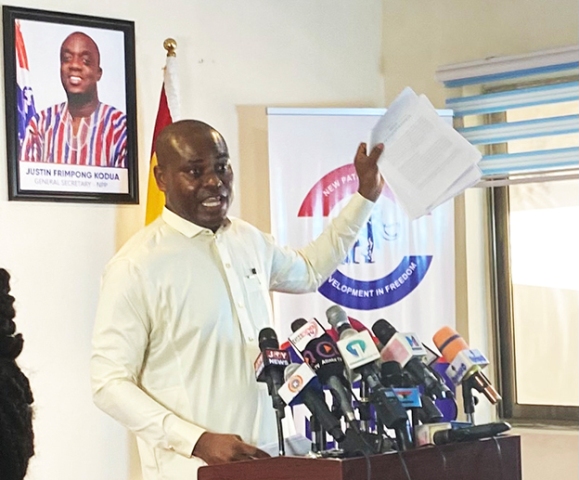
National Communications Director, Richard Ahiagbah addressing the media with the alleged document in hand

The New Patriotic Party (NPP) says it has uncovered an alleged secret plan by the National Democratic Congress (NDC) to sabotage the government, make it unpopular and win the December 2024 elections.

According to the NPP, the plan, contained in a document they had uncovered, reveals that their opponent is unleashing the strategy bit by bit, and recent events give credence to the plan by the NDC to win the upcoming 2024 general elections through underhanded tactics.

Addressing journalists at the party’s Asylum Down Headquarters in Accra, on Wednesday, October 23, 2024 the NPP Director of Communications, Richard Ahiagbah, said the document they had uncovered provides strategic instructions for the NDC to undermine the government.

Quoting from portions of the said document titled: “Winning 2024 and Beyond: A Comprehensive NDC Strategy,” Richard Ahiagbah indicated that the NDC had a plan to frustrate the government by exploiting parliamentary dynamics, with Speaker Bagbin as an ally, to block key government policies and revenue measures.

This plan, according to the NPP, has been in operation since 2021 and is meant to create widespread disaffection among Ghanaians, ultimately making the government appear incapable and discrediting its governance, ahead of the December elections.

“It is not a fake document; it is a true document the NDC has been working with since January 7th or 8th, 2021.

The document consists of 11 chapters, each directing the NDC on various disruptive, unfair and outright crude tactics to aid its capturing of power in 2024,” the NPP Communications Director stated.

REVENUE SABOTAGE

Referring to pages 7 and 8 of the document, under the subheading “Maximising Control of the Legislature,” Mr Ahiagbah described how the NDC had mapped out a detailed approach to manipulate its position in Parliament, given the evenly split seats between both political parties.

He noted that the NDC had used its influence to delay or block crucial government bills, such as the 2022 E-Levy which was designed to generate revenue for national development.

Mr Ahiagbah claimed that the NDC aimed to cripple the government’s ability to effectively manage the economy and implement policies.

He said that Chapter 10 of the document, titled “Strategic Economic and Political Manoeuvring,” allegedly directs the NDC to block the revenue generation measures that were to fill the fiscal gaps left by the COVID-19 pandemic, compelling the government to go to the International Monetary Fund.

He also claimed that the NDC’s action directly undermined investor confidence in Ghana’s economy, adding that the strategy was to cause harm to the economy and the people of Ghana.

“The NDC’s strategy was not only about winning power but also about causing harm to the economy and the people of Ghana.

“Their plan was to make the NPP government look bad by causing economic difficulties and then turning around to blame the government for the hardships,” Mr Ahiagbah said.

HOODWINK VOTERS

Beyond economic sabotage, the NPP accused the NDC of plotting to “hoodwink” voters by creating a perception that the government was failing, while promoting themselves as the solution.

The NPP stated that this tactic by the NDC was part of a broader effort to use foul means to win the trust of voters, particularly the youth and the middle class.

He called on Ghanaians to take a critical look at the actions of the NDC since 2021, and to recognise that their opposition to key policies was not in the national interest, but rather part of a cynical political plot.

He said there were no better alternative policies the opposition NDC had brought forth, ahead of the elections.

APPEAL TO VOTERS

In concluding the press conference, Richard Ahiagbah called on Ghanaians to vote against the NDC in the December elections, accusing the party of putting political ambitions above the national interest.

He urged voters to reject a party that was willing to manipulate the economy and parliament for their electoral gains and instead support the NPP, which he described as committed to satiability and development.

He urged Ghanaians to vote for the NPP presidential candidate, Dr. Mahamudu Bawumia and all NPP parliamentary candidates.

COMMENDATION

He also commended the NPP MPs in Parliament for their restraint in the face of what he called the NDC’s “delinquent conduct,” referring to recent parliamentary impasses that highlighted the NDC’s disruptive tactics.

“On December 7, Ghanaians must punish this gross abuse of trust by the NDC. We are counting on the people to choose a responsible government that puts the nation first, led by Dr. Mahamudu Bawumia, whose vision for Ghana will continue to restore hope and economic prosperity,” Mr Ahiagbah said.

The document, sighted by The Chronicle, does not have a specific date apart from “confidential 2021,” with 56 pages.

Meanwhile, the Deputy General Secretary of the NDC, Mustapha Gbande, speaking to Joy FM, said the document was fake.

According to him, the strategy of the NDC for the 2024 election was not documented but rather in their “heads.”

It would be recalled that not long ago, there was a document in circulation called “Agyapade3,” which the NDC alleged was a plot by some factions in the NPP to capture state resources, but the latter debunked it.

Government To Break Ground For US$450m Manganese Plant In W/R

0
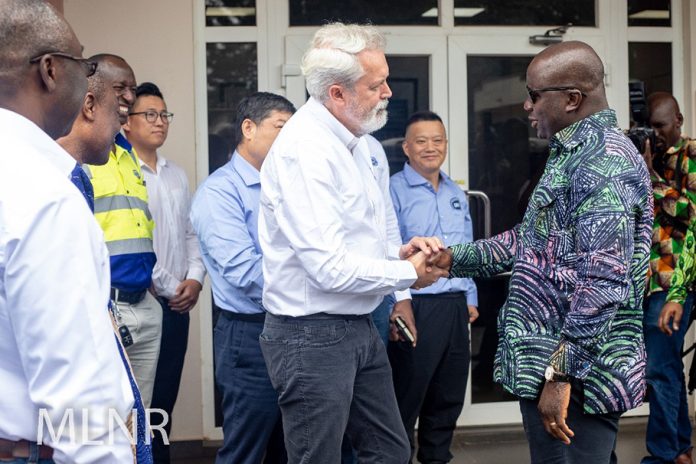
Minister for Lands and Natural Resources, Samuel Abu Jinapor shaking hands with the Jurgen Eijgendaal, the Managing Director of GMC

President Nana Addo Dankwa Akufo-Addo is set to break ground for the construction of a $450 million manganese processing plant at Nsuta, in the Western Region, on Thursday, November 21, 2024.

This announcement was made by the Minister for Lands and Natural Resources, Samuel A. Jinapor, during a tour of the Ghana Manganese Company (GMC) on Wednesday, October 23, 2024.

Mangannese Carbonate

He revealed that all necessary processes for the project are nearing completion, with the expectation that construction will begin before the close of the year. Addressing the media during his tour of the Ghana Manganese Company (GMC) in the Western Region, Jinapor commended the management and staff of the company for their dedicated service to the country.

He further explained that the construction of the refinery is the result of extensive collaboration between teams from Ghana and China, who have been working diligently on the project.

He explained that the country is on the verge of crossing the Rubicon relative to the processes for the commencement of construction of the refinery and that it is a significant milestone for the government, which has consistently delivered on its promise to the country.

Once operational, the manganese refinery will bring an end to centuries of raw manganese exports from Ghana.

Instead, processed manganese products will be produced domestically, which is expected to generate more employment opportunities and increase revenue for the country.

“The company is working to get its next strategic phase done and far advanced. I am happy to report that we are currently at the concluding phase of beginning the construction of a refinery here in Nsuta.

“This will mean that products of this company, which have been shipped in their raw form for many years, will now have value addition in Ghana.

“A lot of work has been done on this matter. Teams from Ghana and China have visited both countries, and there has been a lot of work. At this stage, we are left with a few issues and getting parliamentary approval for the fiscal regime.

“Thereafter, we will be very much on the highway in terms of getting the refinery constructed and commissioned. This will mean that the centuries of exporting raw manganese will be a thing of the past.

“We are now going to have value addition and retain the reasonably highest end of the value chain of the manganese industry here in Ghana.

“It will have positive implications on employment and have several linkages, in terms of downstream industry and its economic effects.

“It forms part of President Akufo-Addo’s vision for the mining sector of this country. The president’s vision has been value addition for all our natural resources,” he said.

Jurgen Eijgendaal, the Managing Director of GMC, commended Samuel A. Jinapor for the visit and the rich support the company has enjoyed under his stewardship as sector minister.

He disclosed further that the company is readying itself for the refinery journey and that a number of areas will undergo significant investments and revamp to ensure that they provide the needed natural resources for the refinery plant.

Adopt Tech-Driven Cost Management Approaches -KON Urges Surveyors

0
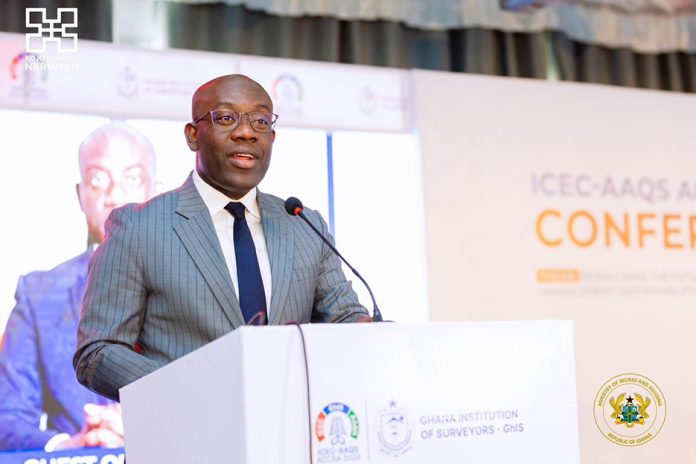
Minister for Works and Housing, Kojo Oppong Nkrumah speaking

The Minister for Works and Housing, Kojo Oppong Nkrumah, has urged quantity surveyors, cost engineers, and other industry professionals to adopt sustainable and technology-driven approaches to construction cost management.

Speaking at the opening ceremony of the 2024 International Cost Engineering Council and the Africa Association of Quantity Surveyors (ICECAAQS) Conference in Accra on Monday, October 21, 2024, the Minister called for greater collaboration between the public and private sectors to redefine traditional practices in the construction industry.

Under the theme “Reimagining the Future of Construction Cost Management: Sustainability & The Digital Frontier,” the three-day conference, which runs from October 21 to 23, has drawn over 300 participants from various industries to deliberate on the future of cost management within the context of sustainability and digital innovation.

Addressing the gathering, Mr. Oppong Nkrumah emphasised the importance of integrating environmental stewardship and technological advancements into construction cost management, arguing that these factors are critical in ensuring both financial efficiency and sustainable development. He noted that the intersection of sustainability, technology, and cost management is where the future of the construction industry lies.

“At the heart of this conference is a bold reimagining of how we manage construction costs by integrating sustainability principles and embracing the opportunities of the digital frontier. This is a crucial intersection where cost efficiency, environmental stewardship, and technological innovation must come together to redefine traditional practices in construction and quantity surveying,” Oppong Nkrumah stated.

The Minister highlighted the need for innovative financial products tailored to address the specific needs of modern construction projects, particularly in managing cash flow.

He called on the Ghana Institution of Surveyors and the broader quantity surveying community to collaborate with financial institutions to design adaptive solutions that can mitigate financial risks and enhance project delivery.

“Effective and sustainable project delivery hinges on sound financial strategies. I charge the Ghana Institution of Surveyors and the Quantity Surveying community to work closely with our financial and insurance institutions to design innovative financial products tailored to the construction industry,” he urged.

Mr. Oppong Nkrumah also underscored the growing necessity of sustainability in construction, pointing out that buildings and infrastructure are significant contributors to global carbon emissions.

He said the industry needs decisive actions to decarbonise the built environment, stressing that the construction industry has a responsibility to lead the way in this effort.

“Sustainability is no longer a choice; it has become a necessity. We must take bold steps to decarbonise our built environment. Our focus must extend beyond the initial construction phase to the entire life cycle of a building—managing not only upfront costs but also long-term operational and maintenance expenses,” he explained.

This revealed that the Ministry of Works and Housing, with support from international partners such as the United Nations Office for Project Services (UNOPS), has developed a comprehensive roadmap to decarbonise Ghana’s building and construction industry. This roadmap is expected to be officially launched in the coming days.

The ICEC-AAQS 2024 Conference, which is being hosted by the Ghana Institution of Surveyors, brings together global leaders and industry experts to discuss emerging trends and best practices in cost engineering and quantity surveying. The event is expected to result in actionable recommendations that will shape the future of construction cost management in Ghana and beyond.

As the conference continues over the next two days, participants will engage in a series of workshops, panel discussions, and technical presentations aimed at addressing the challenges and opportunities presented by digital transformation and sustainability within the business environment. With both local and international experts in attendance, the ICEC-AAQS 2024 Conference promises to influence policy and practice in the construction industry for years to come.

The Ghanaian Chronicle