In a related development, Mustapha Rabiu Kwankwaso, the Secretary of the Kwankwasiyya movement and son of former Kano governor Rabiu Kwankwaso has officially resigned his membership from the New Nigeria People’s Party (NNPP).
In a statement made public on Monday via his Facebook page, Mustapha said his decision to leave the party was carefully considered and not taken lightly.
The letter reads – “I want to inform general public that as of today, I have officially resigned my membership from the New Nigeria People’s Party, NNPP,” it said.
He announced that he is currently in the process of joining the African Democratic Congress (ADC), describing the move as the beginning of a new chapter in his political journey.
“This decision has not been taken lightly, and I want to assure you that it is a deliberate and well-considered move. I am currently in the process of joining the African Democratic Congress, ADC, and I am excited about this new chapter in my political journey.
“My decision to join the ADC is driven by my conviction that it is best positioned to bring the desired change and progress to our country, Nigeria, and particularly to our state, Kano. I believe that the ADC, with its vision and values, offers a viable platform for us to work together towards achieving our shared goals of good governance, economic prosperity, and improved well-being for all.”
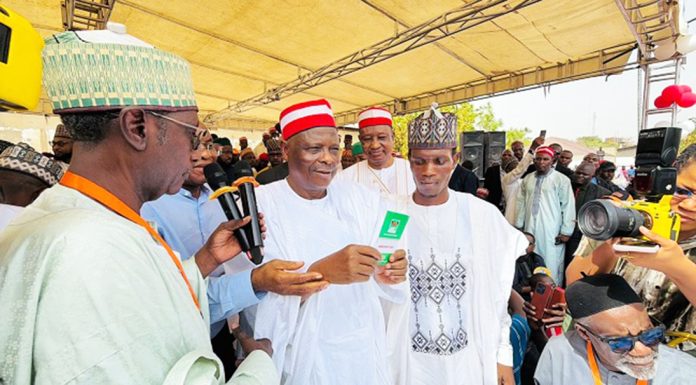
Kwankwaso with his membership card after registering as member of the ADC
Top members of the African Democratic Congress (ADC) were present in Kano for Senator Rabiu Kwankwaso’s official defection to the party on Monday.
The former Minister of Defence registered with the party and received his membership card at Gidan Kwankwasiyya, Miller Road, Bompai, Kano.
Among the prominent personalities were former Senate President and ADC National Chairman, David Mark; ADC National Secretary and former Minister of Interior, Rauf Aregbesola; former Anambra State governor, Peter Obi; former Sokoto State governor, Senator Aminu Waziri Tambuwal; former Minister of Transportation, Rotimi Amaechi; Senator Dino Melaye; former APC National Chairman, Chief John Odigie-Oyegun; and former Imo State Governor, Emeka Ihedioha.
Dr Rabiu Musa Kwankwaso, the presidential candidate of the New Nigeria Peoples Party (NNPP) in 2023, said Nigerians have a duty to free the country from the shackles of misgovernance and to go out on election day with serious-looking faces.
“For you to understand what I’m talking about, from today I will not allow anybody to pass the gates of my house without ADC and INEC registered cards; therefore, go out and ensure that you register accurately with our party and INEC,” he said.
Speaking, the national chairman of the ADC, Senator David Mark, said the day marks a defining moment in the history of the nation’s democracy. He added that it marks a special day in the journey to make Nigeria a better country and a more united nation.
Jos lies in one of the most volatile parts of Nigeria
A 48-hour curfew has been imposed in parts of the central Nigerian city of Jos, after gunmen opened fire at an open-air bar, leading to deadly revenge attacks, local reports say.
Twelve people were reportedly killed when attackers ambushed the drinking spot. A mob is then said to have retaliated, killing 10 more people.
Announcing the curfew, Plateau state governor Caleb Manasseh Mutfwang said an investigation had been opened and those responsible for the killings would be brought to justice.
The state has long been considered one of the most volatile parts of Nigeria.
Paul Mancha, chairperson of the youth council in Plateau state, suggested that the true number of casualties could be even higher.
“People were here in the evening and unfortunately, wicked terrorists came and attacked our people,” he told Reuters news agency. “We have counted scores of people who are now dead and then so many others are also in the hospital receiving treatment.”
In a statement announcing the curfew, the Plateau state governor condemned the killings as “barbaric and unprovoked,” and said security agencies had been directed to pursue those responsible and bring them to justice.
Local residents said threats had been posted on social media before the attack.
The curfew, which began at midnight local time, is due to remain in force until 1 April. Residents have been ordered to stay indoors as security personnel intensify patrols and maintain a visible presence across the affected areas.
Security forces were deployed swiftly after the shooting, with troops and other personnel moving to secure the area and restore calm.
Sunday’s attack highlights the persistent fragility of local security arrangements and the ease with which violence can disrupt daily life.
While authorities insist the situation is under control, the imposition of a curfew underscores the seriousness of the threat and the urgency of preventing further escalation.
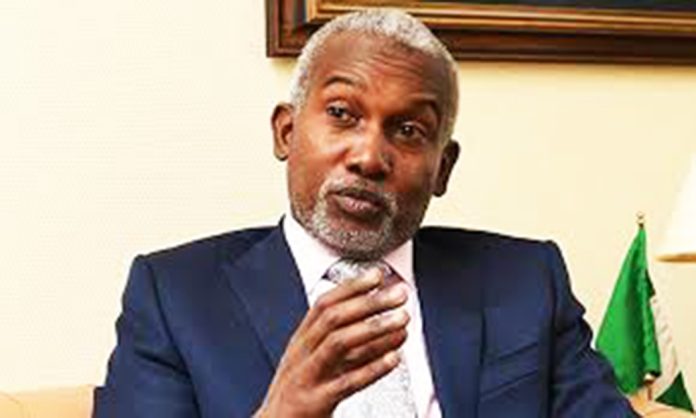
The Minister of Foreign Affairs, Yusuf Tuggar, has resigned.
Tuggar’s resignation was confirmed by the ministry’s spokesperson, Kimiebi Ebienfa, on Monday.
The minister’s action followed the directive of President Bola Tinubu to all political appointees in his administration who intend to contest elective positions in the 2027 elections to resign from their posts on or before March 31.
The president had hinged his decision on Section 88(1) of the Electoral Act 2026 and the timetable released by the Independent National Electoral Commission (INEC) for party primaries ahead of the 2027 polls.
Tuggar’s resignation comes amid the speculation of his interest in contesting the 2027 Bauchi State governorship election on the platform of the All Progressives Congress (APC).
He is a seasoned diplomat, policymaker, and political figure who was appointed as minister by Bola Ahmed Tinubu in August 2023.
Born on March 12, 1967, he has built a distinguished career spanning diplomacy, politics, energy, and strategic consulting.
He is widely regarded for his role in shaping Nigeria’s global engagement and advancing its foreign policy priorities.
His political career includes serving as a member of the House of Representatives from 2007 to 2011, representing the Gamawa Constituency in Bauchi State.
The diplomat later contested the governorship of the state in two election cycles.
From 2017 to 2023, Tuggar served as Nigeria’s ambassador to Germany, where he played a key role in strengthening bilateral relations, enhancing trade cooperation, and promoting Nigeria’s interests in Europe.
As Minister of Foreign Affairs, Tuggar led Nigeria’s diplomatic efforts under the Tinubu administration.
Volunteers helping to rescue worshippers who got trapped
Parliament has demanded a full-scale investigation and prosecution of engineers responsible for the tragic collapse of a building at Accra Newtown, underscoring urgent concerns over accountability in Ghana’s construction sector.
The Majority Leader, Mahama Ayariga, who visited the disaster site, said the collapse highlights systemic failures in project supervision and the need to hold engineers responsible for safeguarding lives.
“It calls into question the way we supervise projects and construction in this country. Time and time again, it is only when structures collapse and lives are lost that the issue is discussed, yet little is done afterwards. Engineers supervising these structures must be held accountable,” he stated.
The tragedy occurred on Sunday, 29 March 2026, when an old school building near the Experimental Junior High School, reportedly being used as a makeshift place of worship caved in, killing three people and trapping 23 others, including three minors.
Emergency teams from the Ghana National Fire Service (GNFS), alongside local residents, conducted rapid rescue operations.
Twenty victims were safely recovered and rushed to nearby health facilities for treatment.
Construction experts argue that such incidents are often the result of inadequate oversight, use of sub-standard materials and regulatory lapses.
“Accountability is not optional. Engineers, contractors, and regulators all have a duty to safeguard lives. Failure to act puts everyone at risk,” said an anonymous civil engineer familiar with the case.
Local residents described chaotic scenes as families scrambled to free victims from the rubble.
The GNFS confirmed that its first and second rescue teams arrived within 20 minutes of the distress call, highlighting the speed of emergency response even as structural oversight failures remain evident.
Mr. Mahama Ayariga extended condolences to the families affected and warned that without stringent enforcement of building codes, tragedies like this will continue to claim lives.
“Ghana cannot continue to wait for disasters to expose weaknesses in our construction sector. Those responsible must face the full weight of the law,” he emphasised.
As investigations unfold, attention now turns to the engineers, contractors, and regulatory authorities responsible for the collapsed structure, with Parliament and the public demanding swift action to prevent future loss of life.
The Deputy Minority Whip, Jerry Ahmed Shaib, has broken ground for the construction of a modern Emergency Block at the Weija-Gbawe Municipal (Akawe) Hospital.
The event marks a major step toward improving emergency healthcare delivery in one of the fastest‑growing municipal areas in the Greater Accra Region.
Speaking at the ceremony on Monday, March 30, 2026 Jerry Shaib, who is also the MP for Weija-Gbawe said the project represents a “deliberate decision to respond to a real and long-standing need” in the constituency.
He noted that the current hospital infrastructure has been overstretched for years, with emergency cases often competing for space and resources with general ward patients.
Hon. Jerry Ahmed in a group photo with some officials of the Weija-Gbawe Municipal Hospital
The new Emergency Block, largely being funded by the MP is, therefore, expected to significantly reduce congestion and enhance the hospital’s capacity to provide timely and specialised care.
When completed, the facility will boast of a 25-bed male ward, a 25-bed female ward, a recovery ward, consulting rooms and a records room.
It will also include a records room, a pharmacy and fully equipped laboratory, administrative spaces, including a cash recovery point, doctors’ and nurses’ restrooms and an ambulance bay for rapid emergency response.
Jerry Shaib emphasised that the project is not only for residents of Weija-Gbawe but also for adjoining communities such as Weija, Gbawe, Tetegu, Oblogo and parts of Kasoa. All these areas depend heavily on the Akawe Hospital during emergency situations.
The MP highlighted his commitment to healthcare through his flagship constituency health initiative, the health train, which has so far reached all 16 electoral areas multiple times, over the last two years.
The ambitious initiative has provided free medical screenings, NHIS registrations, blood pressure machines and support for critical surgical procedures including eye surgeries, hernia repairs and fibroid treatments.
The Deputy Minority Whip described the new Emergency Block as a natural extension of this commitment and a necessary investment in the wellbeing of residents.
Jerry Shaib expressed appreciation to health professionals, hospital leadership, traditional authorities, political leaders and community members who have supported the initiative.
He also commended the staff of the Akawe Hospital for their dedication, despite working under difficult conditions, noting that the new block will greatly improve their working environment.
In his remarks, the MP also referenced the newly completed Weija-Gbawe Children’s Hospital, a state-of-the-art facility initiated in 2024, under former President Nana Addo Dankwa Akufo-Addo.
The Deputy Minority Whip urged that the necessary processes be fast-tracked to ensure its commissioning so that it can begin serving both Weija-Gbawe and the country as a whole.
Describing the ceremony as the start of “a new chapter” in the healthcare story of the Weija-Gbawe constituency, Jerry Shaib reaffirmed his commitment to championing initiatives that improve access to quality medical care.
He called for collective support to ensure the project is completed on schedule and fully equipped to serve the growing population.
Cold and flu season is upon us again, and this year is a doozy. In addition to the flu vaccine, supporting your gut health with good nutrition and a healthy lifestyle can help protect you against viruses that can knock you down for days or even weeks.
How the Gut Fights Colds and Flu
Nearly 80% of the cells in the immune system reside in the gut, where trillions of tiny organisms called microbes also live. Microbes work with immune cells to help fight infection within the gut and throughout the rest of the body.
The gut contains beneficial bacteria as well as some pathogenic bacteria, the kind that can make you sick. Beneficial bacteria produce several compounds that have a positive effect on the immune system in many ways, including small-chain fatty acids (SCFA). Small-chain fatty acids encourage the creation of immune cells and strengthen your gut lining so that pathogens stay out of the bloodstream.
Most SCFA stay in the gut, but a small amount of SCFA get into the bloodstream. A growing body of evidence suggests that SCFA support immunity and reduce inflammation in other organs affected by colds and the flu, including the lungs.
Gut Health and Vaccines
Your gut health may also help determine how you respond to the flu vaccine and other vaccines, including the one for COVID-19. Some animal and human studies suggest that certain SCFA and other by-products produced by gut microbes bolster the effectiveness of vaccines.
Not everyone reacts to vaccines or an infection in the same way, of course. Preexisting conditions, such as having an autoimmune disease, your age, genetics, and ongoing antibiotic use, affect the gut and the immune system.
How to Support Your Immune System
While researchers continue to discover more about the relationship between gut health, immunity, and vaccine response, do what you can every day to avoid colds and flu, including avoiding antibiotics when they’re not needed.
Antibiotics don’t cure infections from cold and flu viruses, but they may be necessary if other conditions arise from having an infection. Taking antibiotics when you don’t need them contributes to antibiotic-resistant microbes and disturbs the community of microbes living in your gut.
Try these lifestyle strategies to help avoid colds and flu this season.
Figure in fiber and phytonutrients.
The bacteria that protect the gut and the rest of the body thrive on fiber and phytonutrients, which are typically found in the same foods. Aim for at least 30 grams of fiber daily from plant foods, including fruits, vegetables, nuts, seeds, and whole grains. Coffee and tea also provide phytonutrients.
Consider supplements.
Adequate intakes of several nutrients, including vitamins A, C, D, E, B6, and B12, as well as selenium and zinc, support immunity, but you don’t need large doses of single supplements. A multivitamin with no more than 100% of the daily value of the nutrients it supplies is usually enough to bridge small gaps in your diet.
Include adequate protein.
The protein in food provides the raw material to produce immune cells and other compounds that fight infection. Include foods such as dairy, meat, seafood, beans, eggs, and soy at every meal.
Maintain a healthy weight.
Extra fat tissue makes and releases hormones that contribute to low-grade chronic inflammation that weakens the immune system. Having obesity also decreases the production and function of certain immune cells, possibly increasing the risk of colds, flu, and other respiratory infections.
At 75, Rebecca Ocansey starts and ends her day the same way — on her feet. The retired athlete walks twice daily, barefoot, and credits the habit with keeping her energetic years after surviving a mild stroke.
Across town in Kumasi, 60-year-old Francis Opoku, a former body builder, deliberately gets off public transport two kilometres from home each evening, choosing to walk rather than sit after long hours minding his shop in the Central Business District.
Mr. Prince De-Gaulle Deku (BSc, MPhil, CExR), a Clinical Exercise Rehabilitation Therapist at the Department of Physiotherapy and Sports Science under the Facu
For Rebecca Ocansey, the lesson was learned long ago. Two gentle walks a day, bare feet on the ground, and a 75-year-old body that still wants to move. The science, it turns out, is firmly on her side.
These are not unusual stories. Scientists say people like Ocansey and Opoku are, quite literally, building better brains — and bodies — one step at a time.
Four Brain Regions, One Simple Act
Walking may look effortless, but it is one of the most neurologically demanding activities a person can perform, according to Dr. Thomas Amatey Tagoe, a neuroscientist and Senior Lecturer at the University of Ghana.
“Something as simple as walking — I have like four main areas of the brain that are required for you to walk,” Dr. Tagoe told The Chronicle.
The first area decides which muscles to move; the second initiates the movement; the third provides feedback confirming that the body is doing what was planned; and the fourth manages spatial awareness — mapping the route, scanning the environment, deciding where to step.
“The more parts of the brain you have involved in doing something, the better for your brain altogether,” he explained.
As these regions communicate during walking, increased blood flow and oxygen rush to serve them.
The result is a brain that is better nourished and more alert — much like how muscles visibly fill with blood during heavy labour.Memory, Creativity and the Einstein Connection
Dr. Tagoe says regular walking measurably improves memory, concentration and creative thinking. His explanation draws on a well-known peculiarity of Einstein’s brain: post-mortem scans revealed it was more richly interconnected than the average person’s. Walking, he argues, produces a similar effect.
“Because these four areas, when we are walking, they are constantly needing to talk to each other, it then helps cognition, it helps memory — and I’m sure most of your readers will agree that sometimes it’s just good to go and walk if you need to think. As you are walking, the thinking seems to flow a little bit easier.”
The brain region most associated with memory and spatial navigation — the hippocampus — is one of the very few areas in the adult brain capable of generating new cells. Walking, Dr. Tagoe notes, directly stimulates this region.
Start Them Young
The same principles apply — perhaps even more critically — to children and young people, Dr. Tagoe says. Because a young person’s brain is still developing, the window for building strong neural foundations is especially important.
When children walk regularly, those four brain regions get into the habit of communicating with each other early. They build connections, generate new cells and release positive chemicals during the very period when the brain is most receptive to growth.
“If you have young people whose brain is now developing, and it gets into the habit of these four areas talking to each other, it gets into the habit of strengthening connections, it develops new cells, it is able to release all these positive chemicals — then this young person is developing with a brain that is constantly doing something, getting communicated and being able to grow much better,” Dr. Tagoe explained.
Dr. Thomas Amatey Tagoe, a neuroscientist and Senior Lecturer at the University of Ghana.
He contrasted this with children who are physically inactive. A child who does not walk much, does not explore places, and does not engage those four brain regions will simply not develop as well neurologically. For parents and schools, the implication is clear: encouraging children to walk is not just good for their fitness — it is an investment in the quality of their developing minds.
The Feel-Good Chemistry
Exercise triggers the release of several mood-regulating chemicals, and walking is no exception. Dr. Tagoe identifies three key ones: dopamine, widely known as the “feel-good hormone”; endorphins, which are released during physical exertion and create a sense of reward; and serotonin, which supports positive mood and memory.
“All three have positive effects, and it is shown that whilst you are walking and engaging in physical activity, their levels in the brain go up,” he said. This chemical cascade explains why walking has been shown in numerous studies to reduce stress, anxiety, and depression — and why hikers climbing the Aburi Mountains return exhausted but elated, and come back the following week to do it again.
A Weapon Against Neurological Decline
For older adults, the stakes are higher. Alzheimer’s and Parkinson’s diseases are neurodegenerative — the brain loses cells and connections over time. Walking does the opposite: it builds connections and can stimulate new cell growth. Studies have shown it can slow cognitive decline in elderly populations.
“Walking can be a way to slow down this decline,” Dr. Tagoe said. “We don’t have a medicinal cure for diseases like Alzheimer’s and Parkinson’s. Walking is a free way to manage them.”
For stroke survivors like Ocansey, the science is equally encouraging. Stroke disconnects brain regions, impairing speech, memory and movement.
Because walking helps forge new neural connections, Dr. Tagoe says it can meaningfully accelerate recovery — though he cautions it is not a cure.
Good for the Knees, Not Just the Mind
The benefits extend well below the skull. Mr. Prince De-Gaulle Deku (BSc, MPhil, CExR), a Clinical Exercise Rehabilitation Therapist at the Department of Physiotherapy and Sports Science under the Faculty of Allied Health Sciences at KNUST, says walking strengthens the muscles that stabilise the spine and support the knee, while also reducing mechanical stress on joints.
“Regular walking lowers the risk of chronic knee pain recurrence and improves knee pain associated with osteoarthritis — when performed progressively and correctly,” he told The Chronicle.
For conditions such as obesity, arthritis and hypertension, Deku cites WHO and CDC evidence placing walking among the most effective lifestyle interventions available. Brisk walking, he adds, can significantly reduce cardiovascular mortality risk by improving the heart’s efficiency as a pump.
How to Walk Well — and How Much Is Enough
Both experts converge on dosage: 30 to 60 minutes of moderately brisk walking, five days a week, is the target. A useful gauge for intensity is the talk test — you should be slightly breathless but still able to hold a conversation.
For those who prefer counting steps, Dr. Tagoe suggests three to five thousand steps a day as a reasonable maintenance target, with more required to unlock deeper benefits.
Technique matters too, Deku warns. Walkers should maintain an upright posture, relax their shoulders, keep the head up and eyes forward, engage their core, and follow a heel-to-toe foot strike — landing on the heel, rolling through the foot, and pushing off with the toes. Arm swing should be natural, and strides should not be overextended.
“Avoid shoes that don’t properly mimic how your feet are naturally designed,” he added, noting that many modern sneakers restrict the natural splaying of the toes and compromise gait mechanics. Occasionally walking barefoot, as Ocansey does, can help restore this natural contact with the ground.
Warning signs of overdoing it include persistent or worsening joint pain, swelling, excessive fatigue, shortness of breath disproportionate to effort, dizziness, and chest discomfort.
Start Slow, Progress Steadily
The most common mistake walkers make, according to Deku, is doing too much too soon.
“The body has to have time to acclimatise. If you are doing something you have not done before, you have to progress gradually,” he said. “Gradual improvement is far more beneficial than sporadic, intense effort.”
Kotoko players applauding the travelling fans after the game
Matchday 27 of the Ghana Premier League delivered one of the most unpredictable rounds of the season, with stunning upsets, high-scoring encounters and crucial dropped points that have significantly reshaped both the title race and the relegation battle.
Played across three days, the round saw several favorites stumble, while underdogs seized the moment to boost their campaigns dramatically.
Aduana 0:0 Asante Kotoko
At Dormaa, Aduana FC and Asante Kotoko played out a tense 0-0 stalemate in a match that promised much but ultimately delivered little in terms of goals.
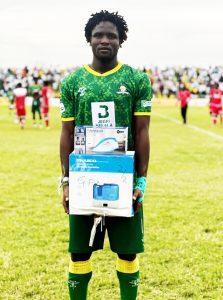
Seidu Saana, Aduana FC
Both sides approached the game cautiously, aware of the stakes involved. Kotoko enjoyed spells of possession and attempted to dictate the tempo, but Aduana’s defensive structure remained compact.
Chances were few and far between, with neither side able to carve out clear-cut opportunities. The result represents a missed opportunity for Kotoko to gain ground in the title race, while Aduana will be satisfied with a point against a strong opponent.
Hearts 2:2 Swedru All Blacks
At the Accra Sports Stadium, Accra Hearts of Oak were held to an entertaining draw by Swedru All Blacks in one of the most exciting matches of the round.
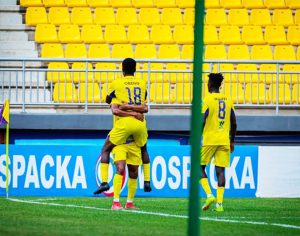
Hearts players celebrating the equalizing goal
Swedru All Blacks started brightly and took the lead, All Blacks took advantage of the loss of focus on the side of Hearts of Oak and doubled their lead. The Phobians, backed by their home supporters, fought back to pull one back. Hearts, with the momentum after pulling one back, went on to equalize. A goal that changed the tempo of the game.
Despite late pressure from Hearts, All Blacks held firm to secure a valuable away point. The result leaves Hearts frustrated, while All Blacks will view it as a significant boost in their fight for survival.
Hohoe United 0:3 Dreams
Dreams FC produced one of the most commanding performances of the round with a comprehensive 3-0 victory over Hohoe United.
Playing away from home, Dreams FC showed attacking flair and clinical finishing, taking control of the match early and never relinquishing it. Their fluid movement and sharp passing proved too much for Hohoe United, who struggled to cope defensively.
The emphatic win strengthens Dreams FC’s position in the upper half of the table and signals their intent to finish the season strongly.
Karela 2:0 Gold Stars
Karela United boosted their survival hopes with an important 2-0 victory over Bibiani Gold Stars.
Karela were disciplined and efficient, making the most of their chances while maintaining defensive solidity. Gold Stars, who have been inconsistent in recent weeks, struggled to impose themselves and were punished for their lack of cutting edge in attack.
The victory could prove pivotal for Karela as they continue their fight to avoid relegation.
Nations 1:1 Chelsea
Nations FC and Berekum Chelsea settled for a 1-1 draw in a closely contested encounter.
Nations took the lead with a well-worked goal, but Berekum Chelsea responded with resilience, finding an equaliser to ensure the points were shared.
Both sides pushed for a winner in the latter stages, but defensive organization and missed opportunities ensured neither could claim all three points.
Samartex 1:2 Bechem United
In arguably the biggest upset of the round, Bechem United defeated FC Samartex 1996 2-1 away from home.
Samartex, who have been inconsistent throughout the season, took the lead and appeared on course to turn the narrative. However, Bechem United produced a spirited comeback, scoring twice to turn the game on its head.
Young Apostles 3:0 Heart of Lions
Young Apostles FC delivered a dominant performance to thrash Heart of Lions 3-0.
From the opening whistle, Young Apostles played with intensity and purpose, overwhelming their opponents with aggressive attacking play. Their clinical finishing ensured they capitalized on their dominance, while Lions struggled to find any rhythm.
The emphatic victory boosts Young Apostles’ standing and highlights their attacking potential.
Vision 0:0 Holy Stars
Vision FC and Holy Stars FC played out a 0-0 draw in a match lacking in clear goal-scoring opportunities.
Both sides were organized defensively, but neither could find the creativity required to unlock the opposition. The result does little to significantly impact either side’s position on the table.
Medeama2:0 Eleven Wonders
Medeama SC secured a comfortable 2-0 win over Eleven Wonders to continue their strong run of form.
Medeama players celebrating a goal
Medeama controlled the match from start to finish, demonstrating superior quality in both attack and defense. Their goals came at crucial moments, effectively sealing the victory and ensuring a relatively straightforward afternoon.
Table
The result pushes Medeama to the top of the league log, as the season approaches its climax.
Managing Director of CMC, Dr. Wisdom Kofi Dogbey (left in cap) in a picture with officials of WAMCO touring the facility
In a proactive move to align with the government’s recent announcement mandating that at least 50% of cocoa be processed locally, Dr. Wisdom Kofi Dogbey, Managing Director of the Cocoa Marketing Company (CMC), visited West Africa Mills Company (WAMCO) to evaluate the readiness of cocoa processing companies for this significant reform.
This reform encompasses CMC’s own Project Elevate, aimed at transforming raw cocoa into semi-finished products for export.
This is a bold and visionary government’s reform by His Excellency President John Mahama and it is designed to enhance the value chain within the cocoa sector, ensuring that Ghana capitalises on its rich cocoa resources while boosting local employment and economic growth.
By increasing local processing through key players like CPC, WAMCO and Private Processors, the initiative aims to create a more sustainable and resilient cocoa industry.
During the visit, Dr. Charles Amoah conducted a thorough assessment of WAMCO’s processing capabilities, infrastructure and operational readiness to meet the impending changes, among others.
“It’s crucial that we prepare our processing facilities to handle the increased capacity and quality standards that will come with this reform,” the Managing Director of the CMC stated. The visit included discussions with WAMCO executives about production targets, pricing, demand and investments in technology and quality certifications to support the transition.
WAMCO, a key player in the cocoa processing industry, has expressed its commitment to enhancing production capabilities in line with the government’s vision.
The company’s management highlighted ongoing efforts to upgrade certifications and improve operational efficiencies to meet demand for semi-finished cocoa products.
The Managing Director of the CMC emphasised the collaborative effort required from all stakeholders in the cocoa sector to ensure the successful implementation of the reform.
“This is not just a government initiative; it is a collective responsibility that requires the active participation of all stakeholders in the value chain,” Dr. Dogbey added.
The visit to WAMCO marks a critical step in CMC’s ongoing efforts to lead the charge in cocoa value addition and exportation.
By fostering partnerships with processing companies and aligning with government policies, CMC aims to enhance the cocoa sector’s contribution to Ghana’s economy.
As the cocoa industry gears up for this transformative reform, the commitment from both the government and industry leaders like CMC signals a promising future for Ghana’s cocoa processing landscape, ensuring that the nation maximizes its potential in the global cocoa market.