Home Blog Page 1151

Alan’s Yellow army invade Kumasi for votes

0
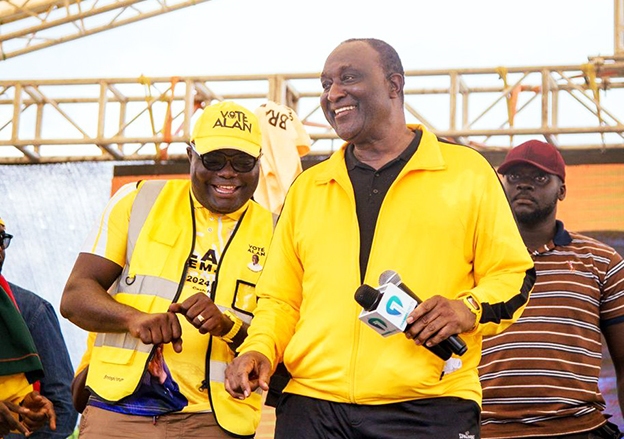
Alan Joh Kwadwo Kyerematen addressing the gathering

A wind of change swept through Kumasi, the Regional capital of the Ashanti region, considered to be the stronghold of the New Patriotic Party (NPP), when the large following of the Movement for Change undertook a mega walk last Saturday.

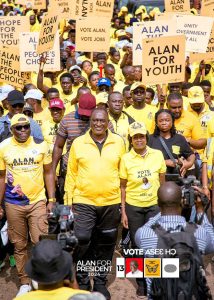
The three-hour Afranfranto Mega Victory walk in the Ashanti region, which marked the end of the campaign tour of the Ashanti region, ended at the Kumasi City Mall premises, where leaders of the Movement for Change (MFC) addressed the teeming supporters that converged there.

The occasion sent a clear message to the youth to rise up and work against the NPP and NDC duopoly and seek a brighter future for Ghana to rise again, under the Movement’s Great Transformational Plan (GTP).

Mr. Alan Kwadwo Kyerematen, the Presidential candidate of the Movement for Change, invoking the Ashanti spirit in “kum apem a, apem beba” refrain, assured that he was prepared to transform Ghana and give hope to the youth.
He said he had the wherewithal to accomplish his vision in his Great Transformational Plan, stressing “I have the vision, competence, capability and integrity to bring about the required transformation, which Ghana needs badly”.

The MFC flagbearer said the proposed GTP would focus on eight thematic areas to ensure the needed change through his leadership.

He mentioned these areas as the 32-year-old NPP and NDC duopoly which made Ghana mark time, the “winner takes all” syndrome, disunity from the politicisation of national issues and the lack of continuity of national projects.

He also proposed a Master Blueprint for the development of Ghana and move Ghana forward from insatiability to stability.

Mr. Kyerematen also announced that his government of national unity will transform Ghana within a year, suggesting that the 1992 Constitution would be reviewed due to its resultant corrupt elements passed as a hindrance to development in Ghana.

He also assured that his administration would address arrogance of power and ensure that those appointed to serve under his government have the capability and expertise, irrespective of one’s political background.

“There will be no need for a party card to be an appointee in an MFC government,” he assured.

The flagbearer hopeful, however, cautioned Ghanaians against indiscipline and called for attitudinal change and respect for law and order, the lack of which would impair transformation.

Mr. Kyerematen’s running mate, Kwame Owusu Danso, said the time for the Ghanaian youth to salvage Ghana is now, by showing the NPP and NDC the exit on December 7, 2024.

Alan addressing a mammoth rally after the walk

He described MFC’s flagbearer as the new Kwame Nkrumah of Ghana and the only hope for Ghanaians, particularly the youth.

Other speakers at the forum, including Nana Ohene Ntow, former General Secretary of NPP, Mrs. Patricia Kyerematen: Hopeson Adorye, Leading member of MFC, Akwasi Addai Odike, founder of defunct United Progressive Party (UPP) and Abraham Beady, alias Opooman, former KMA Presiding Member, touted the capabilities of Mr. Kyerematen to lead the country, describing him variously as a unifier, peace maker, savior and agent of change.


NEIP unveils ambitious Bawumia Agenda for the youth

0
Some Youths present at the launch

The national entrepreneurship and innovations Programme- NEIP has unveiled an ambitious project targeted at creating 120,000 jobs after training 100,000 in skill areas.

The programme, dubbed: Skills ForJobs Project, was launched in Accra recently. Unemployment remains a major challenge to the youth of Ghana and to help reduce it, NEIP is proposing the skills for job project to provide practical skills in some trade areas to help provide jobs for about Six Hundred Thousand youth.

The aim is to help reduce rural urban migration, as well address the jobs and skills challenges faced by the youth of Ghana, especially in the rural and peri urban areas.

NEIP Boss, Kofi Ofosu Nkansah (l) in a picture with the deputy Finanace Minister, Dr. Stepehen Amoah

The Skills for Jobs (S4J) Project is a deliberate Jobs and Skills intervention expected to train about 100,000 youth to provide them with lifelong skills to enhance their employability and further ensure sustainable livelihood across the country.

The training is expected to take place across all the Metropolitan, Municipal and District Assemblies.

Addressing the youth at the launch of the programme, the Chief Executive Officer of the National Entrepreneurship and Innovations Programme-NEIP, Mr. Kofi Ofosu Nkansah, said the NEIP since 2017 has provided business development support to about 250,000 beneficiaries, provided starter packs to 35,000businesses and provided funding support to about 15,000businesses.

These have created about 100,000 jobs,Mr. Nkansah said “We are here again to unveil another impactful intervention from H.E Alhaji Dr. Mahamoud Bawumia – The Skills for Jobs project. It is an expanded version of the vocational skills Programme H.E the Vice President tasked us to give our Kayayei Sisters under the Kayayei Empowerment Programme.

“5,000 women are being trained in various skills and he has instructed us to train an additional 100,000 youth across the Country in these skills areas”.

Areas of training under the skills for jobs include; Soaps and detergents making, Cereals processing, Yoghurt and local drinks, Cosmetics, Baking, Beading and Jewelry, Pedicure & Manicure, Décor, Makeup artist, Mobile phone repairs, Key cutting, CCTV installation, general soft skills and entrepreneurship training among others.

Trainees will be selected from Districts across the Country with the help of MPs and MMDCEs.

The Deputy Minister of Finance in-charge of Wealth Creation, Dr. Steven Amoah, said the government was committed to reducing unemployment through projects like the skills for Jobs. He said the NPP government was the only government who wanted to provide alternative livelihood for the youth, away from Okada ridding, which has been the main campaign promise and the vision of NDC’s John Dramani Mahama for the youth of Ghana.

He said all social interventions and projects are introduced by the NPP government and the NDC has no single sustained policy to their credit.

He admonished the youth to take advantage of the numerous opportunities introduced by the government to alter the course of their lives.

Bagbin got it all Wrong-Freddie Blay

0
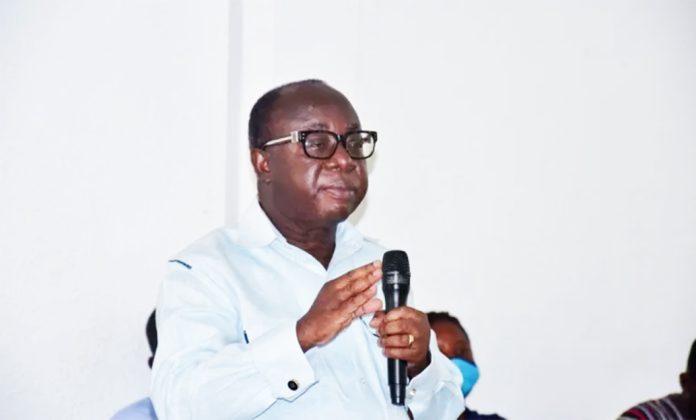
Mr Freddie Blay, Former First Deputy Speaker of Parliament

Former three-time First Deputy Speaker, Freddie Blay, has rejected the decision by Speaker of Parliament, Rt Hon. Alban Bagbin, to declare the seats of four Members of Parliament (MPs) vacant.

The Speaker’s action, which was taken last week, Thursday, prompted by the affected Members’ decision to run as independent on December 7, pending the national elections, according to him contravenes Articles 97(1)(g) and (h) of the Constitution. The development has provoked intense debate in and outside Parliament.

But the experienced parliamentarian and lawyer has described the move as unfortunate and has the tendency of stifling the development of democracy in the country.

Expressing his disappointment over the Speaker’s move in an interview, he said “What is happening in Parliament is not good. It doesn’t in any way help the development of Parliamentary democracy. It’s unfortunate, taking into account even the fact that we have just two months to Elections.”

He contended that “When one files for nomination to participate in the December 7 Election, it is the expression of desire of what one wants to do, come January 2025 Parliamentary Session.

“When you file your nomination with the EC, you are not crossing carpet now. You are giving notice to the public that you want to participate in an election, which will result in what you want to do, come 2025.

“Merely filing papers does not mean you have changed your allegiance or crossed carpet within this period of your four year tenure because those who are members of parliament started from say 2021 to 2025, it does not mean l have done it from 2021 to 2024.

“Even if the party decides to sack you for expressing your intentions to another party, they can’t ask you to leave Parliament, according to me, unless you decide yourself, but that should be within now. But if you say come 2025, I will change party and go elsewhere, it doesn’t mean I am going now before the end of the session. If l do that it doesn’t mean l should be penalised.”

He mentioned that “Article 97 (g) says if you decide to leave within your tenure, they will tell you that you are crossing carpet so leave.

“But if you say I am not doing so within my tenure, but next session, nothing prevents you. The party may not be happy with you.

“It was unnecessary for the Speaker to take that decision, he should have waited for Supreme Court’s interpretation if he finds that controversial, his move could amount to disorder and constitutional lawlessness.

“For a Speaker to get rid of four MPs because according to him they intend to change their loyalty, to whichever party they belong to now, or even go independent, constitute breach of their obligations – I don’t think so and totally disagree.

“It is not healthy, at this crucial time that Parliament is hanged, it amounts to constitutional lawlessness, it doesn’t help democracy.”

However, he takes delight in the fact that the matter is before court, saying “Fortunately, it is going to the Supreme Court, the only body that interprets the construction – l am convinced the Law Lords will right the wrong.”

Dangers of ‘alcoholism’ or ‘alcohol abuse’

0

The classic picture of someone with alcohol use disorder is someone who always drinks too much and whose life is falling apart because of it. But it doesn’t always look like it from the outside.

Some people seem to be just fine even though they misuse alcohol. You may hear them called “functional” or “high-functioning” alcoholics. But those aren’t official medical terms.

Although you may still hear people talking about “alcoholism” or “alcohol abuse,” the official term is alcohol use disorder (AUD). It’s a condition that ranges from mild to moderate to severe. And it’s all still problem drinking, even if you think it’s “mild.” If AUD goes unrecognized and untreated, it’s linked to risks in many aspects of your health and life.

People can have this condition even if they seem to have a great “outside life,” with a job that pays well, home, family, friendships, and social bonds, says Sarah Allen Benton, a licensed mental health counselor and author of Understanding the High-Functioning Alcoholic. They can appear responsible and productive. They might even be high achievers or in positions of power. And their success may lead people to overlook their drinking.

In Denial?

Those who appear “functional” or “highly functional” might not recognize their own drinking problem. They could be in denial, like many other people with AUD. They might think, “I have a great job, pay my bills, and have lots of friends; therefore, I am not an alcoholic,” Benton says. Or they might make excuses like, “I only drink expensive wine” or “I haven’t lost everything or suffered setbacks because of drinking.”

But in reality, they aren’t doing fine, says Robert Huebner, PhD, of the National Institute on Alcohol Abuse and Alcoholism. No one, he warns, “can drink heavily and maintain major responsibilities over long periods of time. If someone drinks heavily, it is going to catch up with them.”

What Are the Signs?

What is heavy drinking? For women, it’s having more than three drinks a day or seven a week. For men, it’s four or more per day or 14 a week. If you drink more than the daily or weekly limit, you’re at risk.

That’s not the only way to tell if you or someone you care about needs help. There are some other red flags. You might:

  • Say you have a drinking problem or joke about your alcohol use.
  • Not keep up with major responsibilities at home, work, or school.
  • Lose friendships or have relationship problems due to drinking, but you don’t quit alcohol.
  • Have legal problems related to drinking, such as a DUI arrest.
  • Need alcohol to relax or feel confident.
  • Drink in the morning or when you’re alone.
  • Get drunk when you don’t intend to.
  • Forget what you did while drinking.
  • Deny drinking, hide alcohol, or get angry when confronted about drinking.
  • Cause loved ones to worry about or make excuses for your drinking.

Risks

A “functional alcoholic” may seem to be in control. But they may put themselves or others in danger by drinking and driving, having risky sexual encounters, or blacking out, Benton says.

Heavy drinking has many other risks. It can lead to liver disease, pancreatitis, some forms of cancerbrain damage, serious memory loss, and high blood pressure. It also makes someone more likely to die in a car wreck or from murder or suicide. And any alcohol abuse raises the odds of domestic violence, child abuse and neglect, and fetal alcohol syndrome.

How to Get Help

If you think that you or someone you know may be drinking too much, ask your doctor about getting help – whether it’s from a therapist, psychiatrist, or other addiction specialist.

In “case management,” a professional may work with you one-on-one. Outpatient programs make it possible for you to get treatment during the day and still live at home.

The most in-depth care allows you to live full time at a treatment facility. These setups can also work along with 12-step programs such as Alcoholics Anonymous. Relating to other people with substance abuse issues may help someone break through denial and begin to recover.

Source: webmd.com

Naira appreciates significantly to end week on good note

0
Naira appreciates

The naira appreciated significantly against the dollar at the foreign exchange market to end the week on a good after several days of depreciation.

FMDQ data showed that the naira gained to N1600.78 per dollar on Friday from N1660.49 exchanged on Thursday. This represents an N59.71 appreciation.

The development comes as FX transactions increased to $350.72 million on Friday from $330.18 million on Thursday.

This comes after three days of depreciation against the dollar.

In the week under review, the naira had appreciated twice and depreciated thrice at the official FX market.

Meanwhile, at the parallel market, the naira fell to N1725 per dollar on Friday from N1705 recorded the previous day.

In the past months, the naira has continued to fluctuate against the dollar at the FX market despite interventions by the Central Bank of Nigeria.

Olayemi Cardoso, the Central Bank governor, recently said a weak naira is advantageous with adequate investment into the country.

Credit: dailypost.ng

Govt imposes fresh 5% tax on Telecoms, betting services

0
Tax on telecommunication

The Nigerian government plans to impose a 5 percent tax on telecommunication, gaming and betting services in the country amid economic hardship.

This was contained in the Economic Stabilisation Bills recently sent to the National Assembly by the Federal Government.

Analysis of the bill indicated that it seeks to introduce excise duties on services such as telecoms, gaming, gambling, lotteries, and betting provided in Nigeria.

By implication Nigerians using telecoms and betting services would have to pay more as part of the government’s drive to overhaul the country’s tax framework.

An analysis of the proposed legislation on Friday showed that it seeks to introduce excise duties on services such as telecoms, gaming, gambling, lotteries and betting provided in Nigeria.

“Services, including telecommunications, gaming, gambling, betting and lotteries however described, provided in Nigeria shall be charged with duties of excise at the rates specified under the Tenth Schedule to this Act in a manner as may be prescribed by the Service.”

This comes after the Federal Executive Council in September 2024 approved the bill as recommended by the Presidential Committee on Fiscal Policy and Tax Reforms.

Similarly, the bill contained plans to impose a 25 percent tax on Nigerians earning above N1.5 million as salaries.

The bill is expected to come into force in 2025 if it scalesled through the National Assembly.

DAILY POST reports that the plan to introduce the 5 percent excise comes after the Former Minister of Communications and Digital Economy, Isa Pantami in May 2023 announced the exemption of the tax on the sector.

Credit: dailypost.ng

Court fixes date for commencement of Ex-Kwara Gov’s trial

0
Former Kwara Governor Abdulfatah Ahmed

Justice Mahmood Abdulgafar of the Kwara State High Court has fixed December 3, 2024, for the commencement of the trial of the immediate past governor of Kwara Abdulfatah Ahmed over a 15-count charge bordering on the alleged diversion of N3 billion public fund.

The presiding judge, Justice Abdulgafar, later fixed December 3, 2024, for the commencement of the trial.

In an interview with journalists, the counsel to the Economic and Financial Crimes Commission (EFCC) Rotimi Jacobs said that the re-arraignment of the former governor from the Federal High Court to the state High Court was due to the conclusion of the investigation of other aspects of the allegations and to prevent moving from one court to another.

Charges Against the ex-Kwara Gov

That you, ABDULFATAH AHMED (while being the Governor of Kwara State) and ADEMOLA BANU (while being the Commissioner of Finance of Kwara State), on or about 14 January 2015 in Ilorin, within the jurisdiction of this Honourable Court, did illegally spend the sum of N1,000,000,000.00 (One Billion Naira) to pay Salaries of civil servants in Kwara State which sum was originally domiciled in the Kwara State Universal Basic Education Board (SUBEB) Matching Grant account and which sum formed part of the funds allocated for the execution of the projects stated in the action plan for the year 2013 and approved by the Universal Basic Education Board (UBEC) and you thereby committed an offence contrary to section 22(5) of the Corrupt Practices and Other Related Offences Act, 2000 and punishable under the same section.

That you, ABDULFATAH AHMED (while being the Governor of Kwara State) and ADEMOLA BANU (while being the Commissioner of Finance of Kwara State), on or about 14th January, 2015 in Ilorin, within the jurisdiction of this Honourable Court, in such capacity having dominion over certain property, to wit: the sum of N1,000,000,000.00 (One Billion Naira), committed criminal breach of trust in respect of the said sum, when you dishonestly transferred the said sum from the Kwara State Universal Basic Education Board (SUBEB) Matching Grant account into the Kwara State Pension Salary account domiciled with Polaris Bank for the payment of salaries of civil servants in Kwara State contrary to the direction of the Compulsory Free Universal Basic Education Act, 2004, and you thereby committed an offence contrary to section 315 of the Criminal Code and punishable under the same section.

Credit: channelstv.com

Govt has started implementation of 300% salary hike for judicial officers

0
Attorney General and Minister of Justice Lateef Fagbemi

The Attorney General and Minister of Justice Lateef Fagbemi says the Federal Government has started the implementation of the 300% pay rise for judicial officers. 

Fagbemi said this on Monday at the 12 Convocation ceremony of the Afe Babalola University, Ado-Ekiti (ABUAD) in Ekiti State.

“One ongoing concern before I took office was the poor remuneration of judicial officers,” the AGF said at the event’s grand finale where he was conferred with an honourary doctorate in Law.

“I am again pleased to report that a major intervention of the Tinubu administration in the judiciary is the recent 300% upward review of the remuneration of judicial officers in Nigeria across board. To be true, I can confirm that the implementation of this has begun in earnest.”

He described the move as “an important first step” in the President Bola Tinubu administration’s resolve to “strengthen the judiciary”.

Tinubu had in August signed into law a bill seeking a 300% increase in salaries and allowances for judicial officials. His comment came months after the Supreme Court recently ruled in favour of local government autonomy in what many have described as a watershed in the nation’s democratic journey.

Earlier in the year, Justice Fagbemi had sued the 36 state governors over alleged mismanagement of local government funds.

Credit: channelstv.com

Understanding Rules Of Origin Under AfCFTA: Ghana Customs Pushes For More Collaboration

0
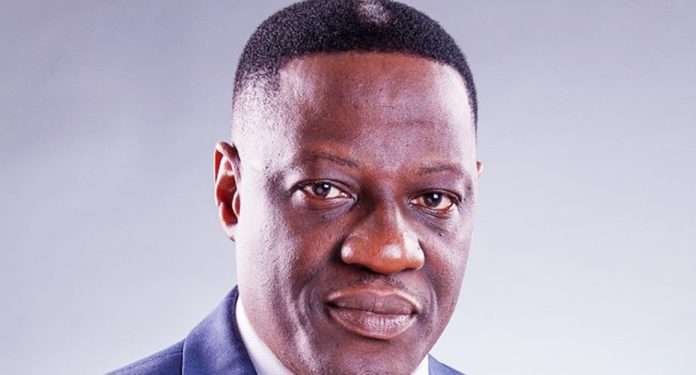
Chief Revenue Officer Jonathan Dabrah

A Chief Revenue Officer and Acting Head of Tariff and Trade Unit at the Customs Division of the Ghana Revenue Authority (GRA), Jonathan Dabrah, has acknowledged that while Customs has a pivotal responsibility in enforcing trade regulations, its effectiveness depends largely on working hand-in-hand with private sector stakeholders.

As he emphasized the critical role that Customs plays in facilitating trade under the African Continental Free Trade Area (AfCFTA) during a discussion on the Eye on Port television program, CRO Dabrah called for stronger collaboration between the Customs Division, Customs House Brokers, and the private sector to ensure smooth implementation of the rules of origin under the agreement.

“The success of AfCFTA lies in collective efforts. We can’t achieve much if Customs works in isolation. It’s crucial that brokers, traders, and manufacturers all align with the standards and expectations under the agreement,” Mr. Dabrah stressed.

He urged all stakeholders to engage more closely with Customs, pointing to the ongoing capacity-building efforts designed to equip brokers and other key players with the necessary skills to comply with the new trade protocols.

The discussion centered on the Rules of Origin, a key aspect of AfCFTA aimed at determining the economic nationality of goods and ensuring that only qualifying products benefit from preferential tariff treatment. According to CRO Dabrah, the rules of origin help identify products genuinely produced within AfCFTA member states, preventing goods from non-member countries from accessing the benefits of the agreement through fraudulent claims of origin.

He broke down the technicalities, emphasizing the concept of “substantial transformation,” which ensures that raw materials undergo significant changes before qualifying as originating from a specific country. Factors such as a change in tariff classification, value addition, and specific processes used in manufacturing are critical in determining origin. Dabrah highlighted examples like Ghanaian cocoa being transformed into chocolate, as illustration of how value is added to meet origin criteria.

Chief Revenue Officer Jonathan Dabrah underscored the need for customs brokers to be fully educated on these rules, as they play a key role in facilitating trade between the Customs Division and the business community. To this end, the Customs Division has intensified its training programs, ensuring that brokers are well-informed and equipped to handle the complexities of the rules of origin.

He hinted at the establishment of an AfCFTA Academy by the AfCFTA Secretariat as a significant step towards empowering customs brokers and other trade-related professionals across the continent. In Ghana, Customs officers have undergone advanced rules of origin training, with the aim of aligning them with the requirements of AfCFTA. This initiative, Dabrah said, is key to preventing potential errors in documentation and facilitating faster processing at the country’s ports and exit points.

He also highlighted the creation of a specialized Tariff and Trade Unit within the GRA, which was set up to oversee the implementation of free trade agreements, including AfCFTA.

“Management has shown strong commitment by establishing this unit to ensure that we are adequately prepared to handle AfCFTA, alongside other trade agreements like the ECOWAS Trade Liberalisation Scheme (ETLS), the Ghana-EU Partnership Agreement, and the Ghana-UK Partnership Agreement,” Mr. Dabrah added.

In reinforcing the role of Customs in facilitating trade, Mr. Dabrah said his outfit will continue to strictly enforce the division’s risk management approach, which includes selective inspections of goods and post-clearance audits. He assured that while Customs would maintain its focus on trade facilitation, it would not compromise on the necessary controls to ensure compliance with the rules of origin.

“Our systems are designed to detect irregularities, but at the same time, we are working to make the process smoother for compliant traders,” he said.

Mr. Dabrah praised the over 60 Ghanaian companies that have been approved to trade under AfCFTA, noting Ghana’s participation in the first guided trade under the agreement as a milestone.

The Customs Division, as the designated competent authority, is responsible for inspecting and certifying goods manufactured in Ghana before issuing certificates of origin, ensuring that they meet AfCFTA strict standards.

The Acting Head of Tariff and Trade Unit at the Customs Division of the Ghana Revenue Authority (GRA), CRO Jonathan Dabrah stressed the importance of collaboration between customs administrations, customs brokers, and the private sector across AfCFTA member states.

He said his outfit will continue to champion the cause for increased collaboration and continuous training of key players in order to foster a robust and thriving trade environment for Ghana and its trading partners under the agreement.

Customs Brokers In Ghana Trained On Rules Of Origin

0
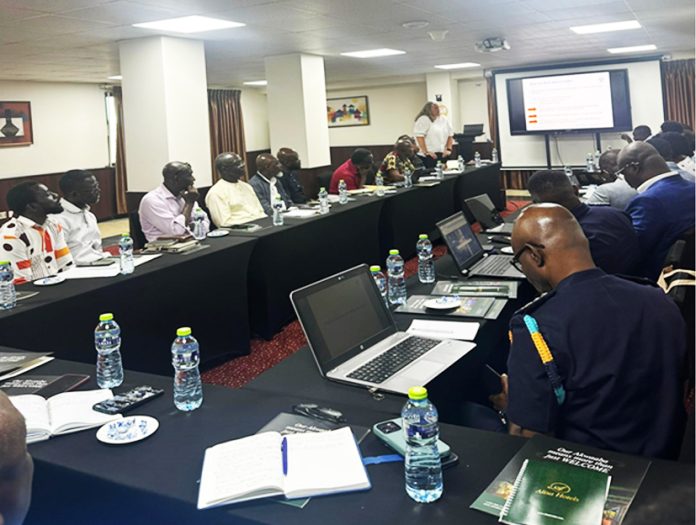
Rules of Origin Training Program in Accra

Members of the Council of the Freight Forwarder Association (CoFFA) are the latest to benefit from the European Union-World Customs Organization Rules of Origin Africa Program.

This initiative aims to support the African continent to improve its capacity to deal with rules of origin and ultimately to support the harmonized and well-coordinated implementation and application of the rules of origin under Annex 2 of the African Continental Free Trade Area (AfCFTA) and other regional and international commitments.

The program, which had been restricted locally to customs officials since its inception, is the first one done specifically for customs brokers and freight forwarders who serve as intermediaries between government actors and traders.

The Assistant Commissioner in charge of Trade and Tariffs at the Customs Division of the Ghana Revenue Authority, Fechin Akoto, encouraged the private sector to immerse themselves in such training programs to equip them for effective intra-continental trade.

“Let me mention that this is the basics and we have an advanced one it shouldn’t be the end. Every year we have an origin meeting at the Customs Head Office you can register and participate where you get to hear the problems from other parts of the world,” he added.

The President of the Customs Brokers Association, Ghana (CUBAG), Nana Fredua Agyeman Ofori-Atta, described the 3-day training in Accra as ground-breaking for his industry and hinted at more of such in the future.

Lead Origin Expert for the Program at the World Customs Organization, Mette Werdellin Azzam, who was the training facilitator, elaborated on the concept of rules of origin to Eye on Port.

“Rules of origin is what will determine the nationality of the goods. So in a free trade agreement, it will be mentioned what does it take for you, what do you have to do in your country for the goods to be originating? Do they come entirely from your country or do you use inputs from other countries and in that case what is the work you need to carry out here in your country for the goods to be originating?”

She emphasized the importance of properly roping in the private sector for the success of AfCFTA and other intra-continental trade agreements.

“I think that training on all levels is very important whether it is for Customs, for the intermediate business or for the business people themselves. We all need to understand the rules in order to take advantage of them and traders need to understand the rules so that they can make sure their goods are fulfilling the requirements when they want to export to other countries. You cannot count on brokers or whoever to know that for you,” he said.

The Ghanaian Chronicle