Home Blog Page 114

How to Lose Weight Safely

0

Make a Weight Loss Plan

You’ve probably heard the saying, “calories in, calories out” — as in, you just need to burn more calories than you eat and drink.

But it’s not that simple, as many people can tell you from their own experience.

Nutrition and exercise are both important when trying to lose weight. Eating fewer calories has a bigger immediate impact, but staying active will help you keep the pounds off. And, of course, exercise has major benefits for your body and mind whether you’re trying to lose weight or not.

Your metabolism — how well your body turns calories into fuel — matters, too.  If you cut too many calories, you not only skimp on nutrients, you slow down your metabolism, making weight loss even harder in the long run.

There are many ways you can safely start losing weight without cutting calories too much. You could:

  • Cut back on portions.
  • Figure out how many calories you get in a usual day, and trim back a bit.
  • Read food labels to know how many calories are in each serving.
  • Drink more water, so you’re not so hungry.

Whatever method you use, you’ll need to favor good-for-you foods like vegetables, fruits, whole grains, and lean protein. But there’s no one-size-fits all plan for healthy eating. Working with a dietitian is a good idea so you make a plan that covers your specific needs. And when you make a healthy weight loss plan, it’s important to stick with it. To get healthy and stay that way, the trend has to continue — not just for a week or a month, but for the long term.

Weight Loss Support

Many apps can help you track your eating. Since you probably have your smartphone with you all the time, you can use it to keep up with your plan. Or keep a pen-and-paper food journal of what you ate and when.

You’ll also want to have people on your side to help you stay motivated and to cheer you on. So ask your family and friends to support your efforts to lose weight.

You might also want to join a weight loss group where you can talk about how it’s going with people who can relate. Or talk with someone you know who’s lost weight in a healthy way. Their encouragement is contagious, in a good way.

Eating Habits for Weight Loss

At the most basic level, food is fuel. It gives you energy to do things. But very few people eat just for that reason. Food is at every social gathering. And it’s where a lot of us turn when we have a rough day.

You’ll need to know what makes you want to eat when you’re not hungry and have a plan for those moments. You’ll also want to develop some of the other habits proven to help weight loss.

Find out what drives you to eat

What are your triggers? Do stress, anger, anxiety, or depression make you want to eat? Or is food your main reward when something good happens?

Try to notice when those feelings come up, and have a plan ready to do something other than eating. Could you take a walk? Text a friend?

Reward yourself for making better choices

Get yourself a bouquet of flowers or indulge in a weeknight movie. Just don’t use food as the reward.

Eat more often

This might seem backwards, but if you eat 5-6 times a day, it could keep hunger at bay. You could split your calories equally across all of those mini-meals, or make some bigger than others. You will need to plan portions so that you don’t end up eating more than you bargained for.

Eat more mindfully

Savor your food. Notice how it smells and tastes and feels in your mouth. Notice when you start to feel full. Just being aware of your food in this way may help you lose weight — and make eating more pleasurable to boot.

Limit portion sizes

If you eat a lot of restaurant meals or are used to heaping plates of food at home, you might be surprised to learn what’s considered a portion size by dietitians. For example, a portion of protein, like a hamburger patty or chicken breast, should be the size of a deck of cards. A serving of cooked pasta is half a cup. Sticking to modest portions like these can help you lose weight.

Use smaller plates

One way to make small portions look bigger is to serve them on smaller plates. Some, but not all, studies suggest this is a helpful weight loss strategy.

Eat more slowly

Research shows slow eaters consume fewer calories and are less likely than fast eaters to have obesity.

Avoid eating late at night

People who regularly eat late at night are more prone to obesity. Some research suggests that eating at night can slow calorie burn, increase fat storage, and make you feel hungrier all day.

Credit: webmd

Feature: Ghana’s Digital Health Boom Meets Rights Crisis — New Policy Brief Exposes Risks Facing Young People

0

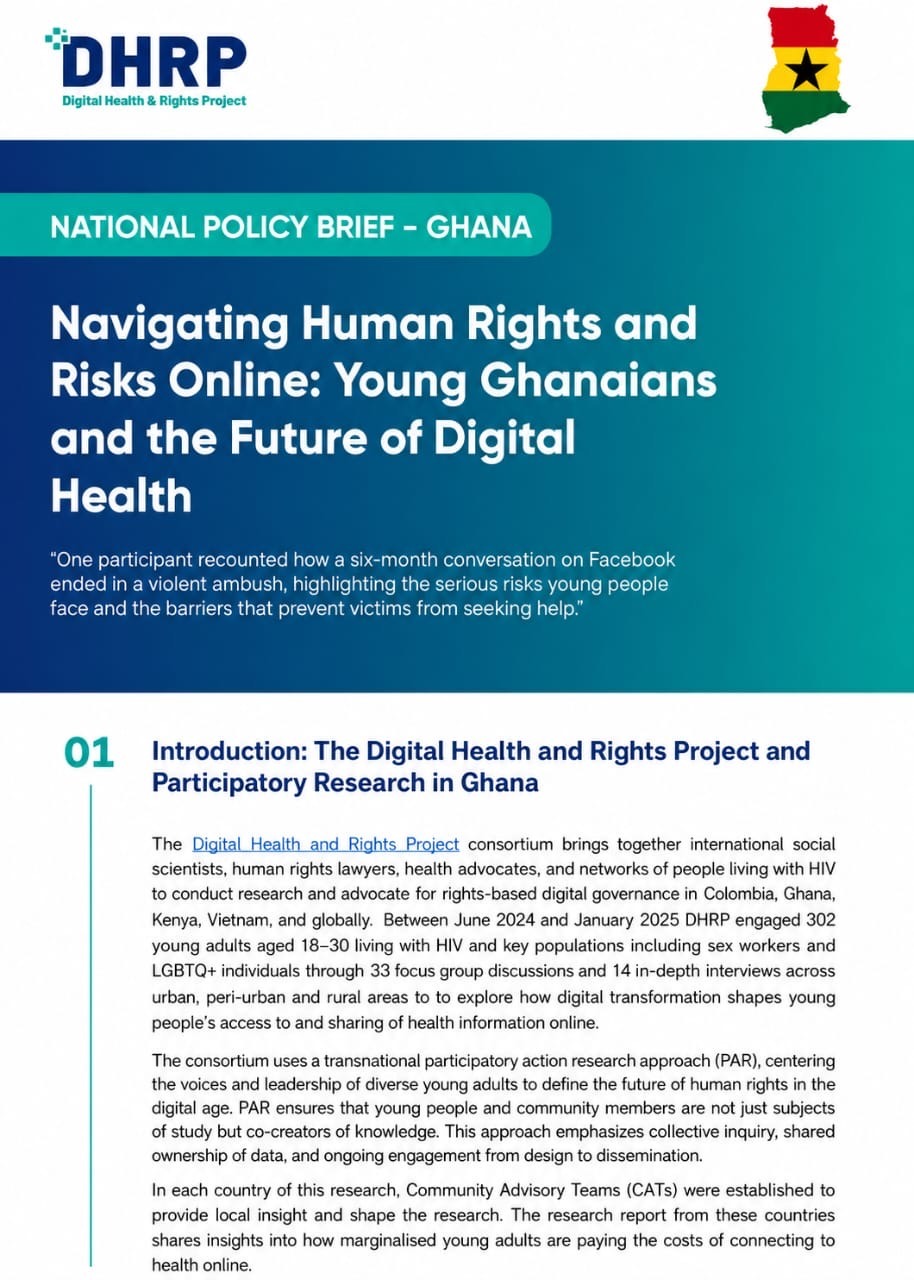
As Ghana accelerates its digital transformation agenda, a new national policy brief by the Digital Health and Rights Project (DHRP) is raising urgent questions about whether the country is adequately protecting the very people driving that transformation its youth.

The Ghana National Policy Brief – Digital Health and Rights Project (DHRP), backed by extensive research across four countries Ghana, Kenya, Colombia and Vietnam paints a complex picture: one where young people are increasingly relying on digital platforms for health information and services, yet are simultaneously exposed to rising risks including online abuse, data privacy violations, misinformation and systemic exclusion.

At the heart of the report is a stark warning — Ghana’s digital health ecosystem is expanding faster than its legal, regulatory and social protections.
A Digital Lifeline Under Threat

For many young Ghanaians, digital platforms have become a lifeline for accessing health information, especially on sensitive issues such as HIV, sexual and reproductive health, and mental wellbeing.

“Digital health is supporting access, particularly for young people dealing with stigmatized conditions,” explained Alberta Nadutey, a researcher on the project. “Many prefer going online rather than visiting physical health facilities because of stigma.”

However, this shift to digital spaces comes with hidden costs.

The report identifies what researchers describe as the “cost of connection” — not just in financial terms, but also in social and psychological risks. Data affordability remains a major barrier, forcing some young people to choose between buying internet data and basic necessities like food.

Beyond cost, stigma continues to shape digital behaviour. According to Nadutey, fear of exposure discourages many from seeking health information online.

“Someone living with HIV may avoid searching for information online because they fear their search history could be accessed,” she said. “That fear of stigma is real, and it limits access to potentially life-saving information.”

Normalising Online Abuse

Perhaps one of the most alarming findings in the policy brief is the growing normalisation of technology-facilitated abuse.

Young people particularly those advocating for health issues or belonging to marginalised groups face daily harassment online, including insults, cyberbullying and targeted attacks.

“What we found, even beyond what we set out to study, was how normalised online abuse has become,” Nadutey noted. “People are insulted simply for sharing health information or for who they are.”

For individuals living with HIV, the abuse can be particularly harsh. Even those working as advocates are not spared.

“Someone can be providing education on HIV prevention and still be insulted — told they deserve the disease,” she added.

The report also highlights how stigma intersects with identity. Sexual minorities, for instance, face heightened abuse in digital spaces, especially within contexts where their identities are criminalised or heavily stigmatised.

Despite these challenges, the research found that young people are demonstrating resilience — continuing to seek and share health information online, often supporting peers in the process.

The Digital Divide: Geography and Gender

While digital health services are expanding, access remains uneven.

The policy brief underscores a persistent digital divide, particularly between urban and rural communities, and between men and women.

“In urban areas, more young people are online, although affordability is still an issue,” Nadutey explained. “But as you move to rural areas, access declines significantly — and it becomes even more difficult for young women.”

Cultural norms further complicate access. In some communities, women are discouraged or even prevented from owning smartphones.

“We encountered cases where husbands did not see the need for their wives to use smartphones,” she said.

In parts of northern Ghana, simply owning a smartphone can attract suspicion.

“Young people are sometimes labelled as engaging in illegal activities just because they have smartphones,” Nadutey added.

These layered barriers economic, cultural and infrastructural risk excluding entire groups from the benefits of digital health innovations.

Privacy at Risk in a Data-Driven Era

As more young people turn to digital platforms for health services, concerns about data privacy are intensifying.

The policy brief warns that Ghana lacks comprehensive safeguards to protect sensitive health data online. Digital footprints including search histories and social media activity can inadvertently reveal personal health information.

“It’s not always about voluntarily disclosing your status,” Nadutey explained. “People leave digital traces, and others can use those to make assumptions or expose them.”

The report calls for stronger data protection measures and clearer regulations governing how health data is collected, stored and used by digital platforms.

While Ghana has made strides in data protection legislation, researchers argue that enforcement and awareness remain weak, particularly in the context of emerging digital health tools.

Fragmented Governance and Policy Gaps

A central theme of the policy brief is the lack of coordinated governance around digital health and online safety.

Currently, multiple institutions including the Ministry of Communication, law enforcement agencies and regulatory bodies have overlapping responsibilities, creating confusion about accountability.

“If someone is abused online, where do they go?” Nadutey asked. “Is it a criminal issue? A civil matter? Who handles it?”

This fragmentation, the report argues, leaves victims without clear pathways for redress.

Richard Agodzo, Youth Coordinator for the Digital Health and Rights Project in Ghana, echoed these concerns, pointing to broader systemic failures.

“The youth are online in large numbers, sharing information and engaging actively, but the systems to protect them are not keeping up,” he said.

According to Agodzo, one of the key drivers of online abuse is the mismatch between rapid technological advancement and outdated policy frameworks

“We are still working with policies that were developed years ago, yet technology has evolved drastically,” he noted. “This is now an AI-driven world, and our regulations have not caught up.”

Youth Voices Missing in Policy Spaces

A major critique in the policy brief is the lack of meaningful youth participation in digital governance. Agodzo argues that policies affecting young people are often designed without their input.

“Were young people at the table when these policies were created?” he asked. “If not, how can those policies truly reflect their realities?”

He emphasised that without youth involvement, policies risk becoming outdated almost immediately.

To address this gap, the DHRP has actively involved young people through Community Advisory Teams, digital empowerment workshops and advocacy initiatives aimed at amplifying youth voices.

Misinformation and the Rise of AI

The report also highlights growing concerns about health misinformation, particularly in the age of artificial intelligence. Agodzo warned that AI-generated content is making it easier for false information to spread.

“You have situations where AI claims there is a cure for HIV, which contradicts global health evidence,” he said. “Young people may not always be able to distinguish between accurate and misleading information.”

This poses significant risks, especially in a country where HIV prevalence remains relatively high among young people.

To counter this, the policy brief recommends the development of verified digital health platforms and toolkits that provide accurate, accessible information.

From Online Abuse to Real-World Harm

One of the more troubling insights from the research is the potential for online abuse to escalate into physical harm.

Agodzo warned that digital conflicts can spill into real-life violence if left unchecked.

“Online arguments may seem harmless, but they can escalate,” he said. “We have seen how digital hostility can translate into real-world tensions.”

He pointed to the lack of specialised legal frameworks to address such cases, noting that digital abuse is often treated like traditional forms of abuse without considering its unique dynamics.

“Do we even have lawyers or judges who specialise in digital rights and online abuse?” he asked. “These are gaps we must address.”

Policy Recommendations: A Roadmap for Change

The Ghana National Policy Brief outlines several key recommendations aimed at strengthening digital health governance and protecting young people:

Expand affordable internet access through zero-rated platforms and public Wi-Fi initiatives.

Strengthen data protection laws and enforcement, particularly for health-related data.

Develop clear reporting and response mechanisms for technology-facilitated abuse.

Promote digital literacy, equipping young people with skills to navigate online spaces safely.

Ensure meaningful youth participation in policy development and digital governance.

Enhance inter-agency coordination to eliminate regulatory fragmentation.

Address misinformation through verified digital health platforms and partnerships.

Advocacy and Next Steps

The DHRP is already taking steps to translate research into action.

According to Agodzo, the team plans to engage key stakeholders, including the Ministry of Communication, Digital Technology and Innovation, to present their findings and recommendations.

“We are moving beyond research,” he said. “The goal is to influence policy and ensure implementation.”

The project is also collaborating with civil society organisations and leveraging social media advocacy to raise awareness and push for accountability.

As Ghana continues its push toward digitalisation, the findings of the DHRP policy brief serve as a timely reminder that innovation must be matched with protection.

Digital health has the potential to transform healthcare access, particularly for young people. But without robust safeguards, it could also deepen inequalities and expose users to new forms of harm.

“We cannot talk about digitalisation without talking about human rights. It’s not just about access it’s about safety, dignity and protection,” Nadutey emphasised.

For Ghana, the challenge now is clear: build a digital future that is not only innovative, but also inclusive, secure and rights-based.

Because in the race toward digital transformation, leaving young people unprotected is a risk the country cannot afford to take.


For more news, join The Chronicle Newspaper channel on WhatsApp: https://whatsapp.com/channel/0029VbBSs55E50UqNPvSOm2z

Newcastle returned to winning ways against Brighton

0
Anthony Gordon, Newcastle Utd

Newcastle United handed manager Eddie Howe a timely boost as they returned to winning ways against Brighton.

Although the head coach felt the support of those above him at the club’s annual summit at Matfen Hall in Northumberland this week, he also faced some “difficult questions” following a torrid run of nine defeats in 12 in the league.

Howe needed a victory and, with chairman Yasir Al-Rumayyan and minority owner Jamie Reuben both watching on from the directors’ box, his side delivered against in-form Brighton.

Newcastle were given a helping hand for their opener to settle one or two nerves after Brighton goalkeeper Bart Verbruggen rushed out of his goal to close down Jacob Murphy down the right.

Verbruggen clipped Murphy, in the process, but the forward quickly got back to his feet to cross the ball into the box for team-mate William Osula to head into an empty net.

The hosts doubled their lead midway through the first half when Burn nodded home from Bruno Guimaraes’ corner kick.

However, this Brighton side had not previously tasted defeat since 4 March for a reason, and they came roaring back.

Newcastle goalkeeper Nick Pope looked a little relieved to see the ball cannon off the post after Brighton midfielder Jack Hinshelwood blocked his attempted clearance in the first half.

Hinshelwood found a way through in the second half, though, after playing a smart one-two with Danny Welbeck, before finishing expertly past Pope from inside the box.

Newcastle have thrown away the most points (25) from winning positions in the Premier League this season, but they managed to hold out this time after Pope made a fine save late on to keep out substitute Charalampos Kostoulas’ overhead kick.

Credit: bbc.com

Barcelona in hard-fought win at Osasuna

0
Robert Lewandowski, Barcelona

Barcelona moved to the brink of retaining the LaLiga title after Robert Lewandowski and Ferran Torres struck late in a 2-1 victory at Osasuna on ​Saturday.

With four games remaining, Barca top the table on 88 points. For ​much of a slow-burning encounter at El Sadar, however, it was Osasuna who looked the greater ​threat.

Barca goalkeeper Joan Garcia proved the difference, producing a string of fine saves to keep the visitors afloat. ‌Ante ⁠Budimir struck the post from close range in the 35th minute after bursting into the box on the counter attack, then curled an effort towards the bottom corner two minutes later that Garcia tipped away with the faintest touch.

The keeper was at it again in the 69th minute denying Ruben Garcia from the ​edge of the ⁠area as Osasuna pressed on in pursuit of European qualification. The hosts are 10th on 42 points, just two behind sixth-placed Celta Vigo.

With frustration ​mounting among the home support, Barcelona delivered a clinical late blow.

In the 81st minute ⁠Rashford floated a precise cross from the right into the middle, where Lewandowski jumped above his marker to nod past Herrera.

Five minutes later Lopez threaded a clever through ball behind the defence for ⁠Torres, who ​raced clear and slotted low beyond the keeper in a ​composed one-on-one finish.

Garcia pulled one back with a close-range header two minutes later, but Osasuna’s rally came too late as Barca ​moved to within touching distance of back-to-back league titles.

Credit: egypttoday.com


Kobbie Mainoo seals United’s Champions League qualification

0
Mbuemo and Gakpo in a battle for the ball

Kobbie Mainoo celebrated his new contract by scoring the winner that swept Manchester United back into the Champions League as they clinched a five-goal thriller against Liverpool at Old Trafford.

United led 2-0 at the break thanks to early goals from Matheus Cunha and Benjamin Sesko.

However, Liverpool turned the contest on its head immediately after half-time as Dominik Szoboszlai and Cody Gakpo capitalised on errors to level.

But in a frenzied finish, Liverpool failed to clear Luke Shaw’s cross and the ball fell kindly for Mainoo on the edge of the area and he crashed a first-time effort into the bottom corner.

It came three days after Mainoo signed a new five-year contract at United – in a season when he did not start a league game under former boss Ruben Amorim.

In a game missed by Sir Alex Ferguson, who was taken from the ground in an ambulance as a precaution after feeling unwell, the victory confirmed United’s return to Europe’s elite club competition after a two-year absence and means Liverpool still need four points to confirm their spot.

Almost as important in meetings between England’s two most successful clubs, this win gave united bragging rights thanks to their first league double over Liverpool since 2015-16.

That can only strengthen Michael Carrick’s claim to be appointed head coach on a permanent basis.

Credit: bbc

Arsenal comfortably beat Fulham at Emirates Stadium

0
Viktor Gyökeres, Arsenal

Arsenal moved six points clear at the top of the Premier League with Bukayo Saka playing a starring role and Viktor Gyokeres taking his season’s goal tally to 21 as they comfortably beat Fulham at Emirates Stadium.

Mikel Arteta’s men took the chance to pile the pressure on title rivals Manchester City who have played two games fewer than the Gunners and are not in action until Monday when they visit Everton.

Arsenal went ahead in the ninth minute when Saka, making his first start since March after an Achilles injury, easily beat Raul Jimenez down the right and picked out Gyokeres to tap in from close range for his 20th goal of the campaign.

The Swedish striker then turned provider five minutes before the break when he slipped a pass into Saka and the England winger curled a quality low finish past Fulham keeper Bernd Leno at his near post.

Gyokeres then claimed his second on the night when he headed home Leandro Trossard’s cross to wrap up the three points in first-half stoppage time.

The Gunners almost added a fourth when Riccardo Calafiori headed on to the crossbar, with the Italian having had an earlier strike ruled out for offside.

Having made five changes to his starting line-up, Arteta was also able to take off Saka at half-time and rest other key players as focus moved to Arsenal’s Champions League semi-final second-leg tie against Atletico Madrid on Tuesday. The game is finely poised at 1-1 for the return leg at Emirates Stadium.

Credit: bbc.com

Jesus’ mother never lived in the Volta Region – Museums and Monuments Board

0

The Ghana Museums and Monuments Board (GMMB) has officially debunked claims that the Virgin Mary, mother of Jesus Christ, once lived in the Volta Region, while issuing an apology to Prof. Wazi Apoh over the false attribution of the statement to him.

The clarification follows widespread public reaction to a viral video in which a tour guide at the Ho Regional Museum told Ghanaian vlogger Goshers and his Zambian companion, Lilian Chipeso, that Mary migrated to Ghana and lived in the Volta Region for 40 years after the death and resurrection of Jesus.

In a statement dated April 30, 2026, the Board said it had taken note of “a false statement made by a Security Officer acting as a tour guide at the Ho Regional Museum regarding the Virgin Mary living in the Volta Region for forty years, which was wrongly attributed to you, Prof. Wazi Apoh.”

According to the Board, Prof. Apoh has never made such a claim in any forum, including his academic publications.

“The claim attributed to him is therefore unfounded and misleading,” the statement stressed.

The GMMB said it had moved swiftly to retract the statement and prevent further spread of the misinformation.

“GMMB wishes to retract the said statement in its entirety and extend its sincere apologies to Prof. Wazi Apoh for the misattribution,” it stated.

The Board further urged individuals and institutions who may have circulated the claim to withdraw and remove such content.

“Institutions and individuals who may have shared or published the said statement are accordingly urged to retract and remove such content to prevent further spread of the misinformation,” it noted.

The statement concluded with an unreserved apology to the academic for any inconvenience or reputational damage caused.

For more news, join The Chronicle Newspaper channel on WhatsApp: https://whatsapp.com/channel/0029VbBSs55E50UqNPvSOm2z

Mahama grants ‘amnesty’ to 300 police Chief Inspectors

0
President John Mahama

President John Dramani Mahama on Friday May 1, 2026, granted ‘amnesty’ to three hundred (300) Chief Inspectors of Police who obtained between 50-52% percent in the recently held Police College entry exams to enter the academy.

The President issued the ‘fiat’ at Odumase Krobo in the Lower Manya Krobo Municipality of the Eastern Region during the commissioning of a new Divisional Police Headquarters.
Seven thousand, one hundred and thirty-three (7,133)Police Chief Inspectors on Sunday April 12, 2026, took part in a competitive examination for entry to the Ghana Police College as Cadet Officers, and subsequent promotion to the rank of Assistant Superintendent of Police (ASP).

The body which conducted the exams set 53% as the cutoff mark.
According to President Mahama, out of the over seven thousand (7,000+) that took part, seven hundred (700) who obtained 53% and above were shortlisted to enter the Police College.

His intervention for the three hundred has been hailed by Police personnel as unprecedented, no wonder, reports from the various police barracks across the country indicate open jubilation deep into the night after his speech.
Entry to the Academy is so competitive with four hundred (400) Undercadets and one hundred (100) Special Recommendation for exhibiting valour and exemplary in the discharge of their duties already on standby for call-up.

The Inspector General of Police (IGP) Mr Christian Tetteh Yohuno whose tenure is witnessing this unprecedented ‘amnesty’ in an exclusive interview states that, due to the number, the administration is working out a modality to absorb the cadets in between two and three batches.

Speaking at the function, he expressed the Police Administration’s gratitude for supporting their operation with armoured vehicles.
He cited a recent incident in which his men in the armoured cars came under heavy firing only to be saved by the impenetrable plates


For more news, join The Chronicle Newspaper channel on WhatsApp: https://whatsapp.com/channel/0029VbBSs55E50UqNPvSOm2z

49 Suspected Illegal Miners Arrested After Armed Attack on NAIMOS Team in Western Region

0

A major anti-illegal mining operation in the Western Region has led to the arrest of 49 suspected illegal miners following an armed ambush on a National Anti-Illegal Mining Operations Secretariat (NAIMOS) taskforce team stationed in Nzema East.

The incident occurred on Tuesday, April 28, 2026, when a NAIMOS operations team came under gunfire from suspected illegal miners actively operating within the Ghana Rubber Estates Limited (GREL) plantation.

According to NAIMOS, the assailants fired multiple rounds from pump-action weapons at one of the taskforce’s Zonda pickup vehicles. The operatives, however, executed a tactical withdrawal without sustaining casualties.
The attack triggered an immediate intelligence-led operation to identify the perpetrators and recover the weapons used.

Acting on credible intelligence, NAIMOS launched a coordinated cordon-and-search operation in the early hours of Thursday at Adiewoso and surrounding communities in the Ahanta West District.

The dawn swoop, conducted within the GREL plantation enclave, resulted in the arrest of 49 suspects and the recovery of a pump-action firearm. Operatives also seized more than GH¢226,000 in cash believed to be proceeds from illegal mining activities.
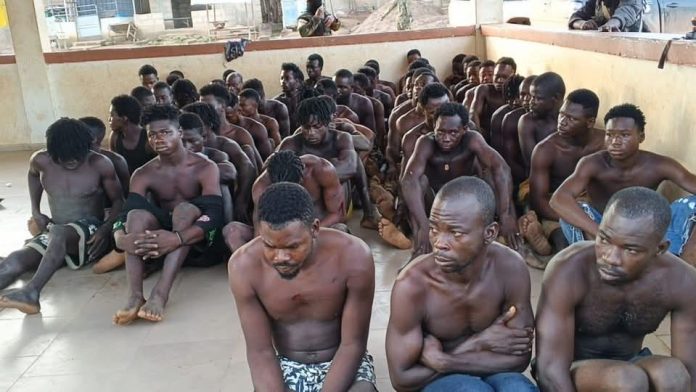
In total, 114 individuals were initially apprehended and taken to the Adiewoso Community Centre for screening, identification and interrogation.

Following verification, 49 persons were positively identified as suspected illegal miners. Eight others were confirmed as casual workers of GREL, while 12 were identified as senior high school students. The remaining detainees, made up of artisans and other local residents, were released after being cleared of any direct involvement.
NAIMOS further disclosed that three of the suspects are foreign nationals — Abdul Karim from Niger, and Nash Ishaku and Eliyasu Sie, both from Burkina Faso.

Additional items recovered during the operation included GH¢140,000 discovered in a Toyota Raize belonging to one Daniel Avoka, as well as GH¢86,710 and two containers of small ball-like substances wrapped in paper and suspected to be gold, found in a white Toyota Hilux.

The owner of the Hilux, Ebenezer Cobbinah, was arrested and is assisting with ongoing investigations.
Operatives also confiscated quantities of substances suspected to be Indian hemp, together with cartons of cigarettes believed to be linked to the illegal mining operation.
A joint team made up of GREL management and officers from the Agona Ahanta Police Command participated in the exercise to help distinguish legitimate plantation workers from suspected illegal miners.

All verified GREL employees were released, while the 49 suspects have been handed over to the Agona Divisional Police Command for further investigations and possible prosecution.

NAIMOS described the operation as a clear demonstration of its resolve to clamp down on illegal mining activities, particularly within legally acquired concessions.
The Secretariat stressed that acts of armed resistance or intimidation would not deter its operatives from enforcing the law and protecting Ghana’s natural resources.
“NAIMOS remains committed to safeguarding the nation’s productive lands and ensuring all offenders are brought to justice,” the statement said.

The cedi gained 40.7% against the dollar in 2025

0
Dr Johnson Pandit Asiama Governor of BoG

The Bank of Ghana says the Ghana cedi appreciated by 40.7 per cent against the US dollar in 2025, a development that had significant accounting effects on its financial statements.

According to the Bank, the appreciation of the cedi reduced the cedi value of foreign-currency-denominated assets held on its books, resulting in valuation losses.

The central bank explained that it holds substantial foreign assets, including Special Drawing Rights (SDRs) from the International Monetary Fund, foreign securities such as government bonds and deposits, monetary gold, and other foreign balances.

It said when the cedi strengthens, these assets are worth less in local currency terms, leading to accounting charges.

For 2025, the Bank reported:

A profit and loss charge of GH¢5.5 billion, and
An other comprehensive income (OCI) charge of GH¢23.6 billion,

bringing the total impact to GH¢29.1 billion.

The Bank noted that this reflects a reversal of gains recorded in 2024, when the weakening of the cedi increased the value of foreign assets in local currency terms.

It recorded in 2024:

A profit and loss gain of GH¢2.2 billion, and
An OCI gain of GH¢10.5 billion,

which together added GH¢12.7 billion to equity.

The central bank said these changes are accounting entries and do not represent cash movements or losses of underlying assets.

It added that as exchange rates stabilise, the valuation effects are expected to normalise.

The Ghanaian Chronicle