Home Blog Page 109

GH¢44bn BoG Loss Misleading – Majority

0
Bank of Ghana headoffice

The Majority Caucus in Parliament has strongly defended the Bank of Ghana’s 2025 audited financial statements, rejecting allegations by the Minority that the central bank manipulated its accounts, concealed losses and pursued misguided monetary policies that worsened the country’s economic situation.

In a statement issued on Monday, May 4, 2026 by the MP for Sagnarigu and a Member of the Finance Committee, Atta Issah, the Majority accused the Minority of misinterpreting technical accounting data and central banking practices, warning that such claims risk misleading the public and undermining confidence in critical state institutions.

According to the Majority, the Minority’s assertion that the Bank of Ghana is “policy insolvent” due to its reliance on a GH¢9.6 billion gain from gold sales is fundamentally flawed.

The caucus argued that gains from gold transactions are a legitimate part of reserve management and are standard practice among central banks worldwide.

“The Bank is not speculating in gold, but prudently rebalancing its reserves to ensure liquidity and macroeconomic stability in a challenging environment,” the statement said, adding that non‑recurring income does not make such gains illegitimate.

The Majority also dismissed claims that the Bank rushed to sell half of its gold reserves to hide financial distress, noting that the audited accounts show no evidence of distress sales and that Ghana continues to pursue policies aimed at increasing gold reserves through domestic purchases.

On the widely cited figure of a “true loss” of up to GH¢44 billion, the Majority said the Minority had combined accounting categories that are internationally treated as separate.

It explained that the officially reported loss for 2025 stands at GH¢15.63 billion, as audited, while other comprehensive income largely reflects unrealised, non‑cash valuation changes driven by exchange rate movements and asset price fluctuations.

“These valuation effects are not operating losses and cannot be added to profit or loss under any recognised accounting framework,” the statement said, describing the Minority’s calculations as methodologically flawed and misleading.

Addressing concerns about the Bank’s negative equity position, which rose to about GH¢93 billion, the Majority acknowledged the figure, but stressed that central banks are not commercial entities and can operate effectively with negative equity due to statutory backing and sovereign support.

It attributed the increase to cumulative effects of debt restructuring, exchange rate revaluations, and policy measures taken to stabilise the economy during and after the recent crisis.

The Majority further rejected suggestions that the Bank’s accounts were improperly prepared outside International Financial Reporting Standards (IFRS).

It clarified that the financial statements follow a legally mandated accounting framework under the Bank of Ghana Act, which modifies IFRS treatment for certain monetary policy items.

The Caucus emphasised that the external auditors issued an unmodified opinion, confirming that the statements fairly present the Bank’s financial position within the stated framework.

On monetary policy, the Majority defended the GH¢16.7 billion cost incurred from open market operations in 2025, describing it as the unavoidable cost of disinflation in a high‑interest‑rate environment.

“When inflation is high, sterilising excess liquidity is expensive. That cost is not a policy failure but the price of restoring stability”, the statement noted.

It also challenged claims that the abolition of the dynamic Cash Reserve Ratio and the cedi equivalent reserving requirement led to higher costs, arguing that these regulatory tools are blunt, distortionary and unsuitable for sustained liquidity management during a disinflation phase.

Market‑based instruments, the Caucus said, offer greater precision, transparency, and policy credibility.

Responding to accusations that interest payments to banks amounted to a wealth transfer from the public to private institutions, the Majority maintained that such payments are the normal mechanism through which monetary policy operates, not discretionary handouts.

It added that without aggressive liquidity control, inflation would have remained elevated, eroding purchasing power and worsening economic hardship.

While acknowledging the difficult living conditions facing many Ghanaians, the Majority insisted that macroeconomic stabilisation is a necessary first step toward recovery.

“You cannot have sustainable jobs, affordable credit, and business growth without  first stabilising inflation and the exchange rate,” the statement said, pointing to declining inflation and currency stability as signs that the foundation for recovery is being laid.

The Majority accused the Minority of selective reading and political framing, urging the public to rely on the audited accounts and established economic principles rather than alarmist interpretations.

“The issue here is not transparency. It is interpretation. That interpretation must be grounded in facts, not politics,” the Majority asserted.

By Stephen Larbi
World Bank lauds Mahama’s health policies

0

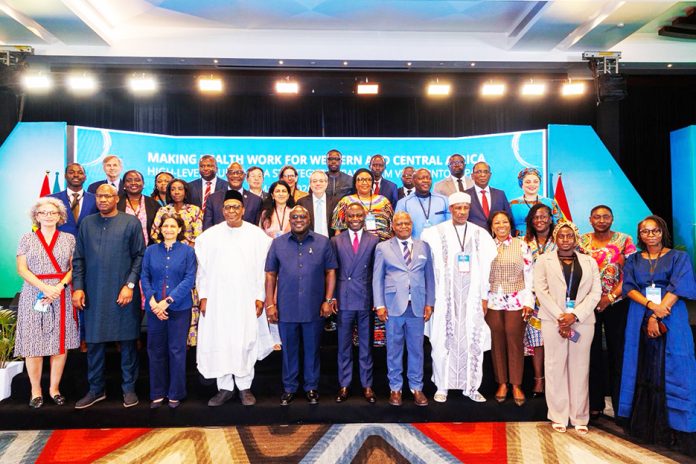
The World Bank has launched its “Fit to Prosper” strategy aimed at strengthening health systems and driving job creation across West and Central Africa, as countries in the region face mounting pressure from rising disease burdens and constrained financing.

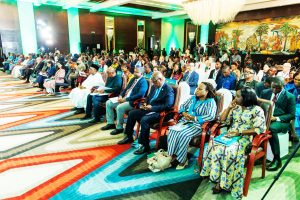
The strategy was unveiled at a high-level event in Accra, hosted at the Mövenpick Ambassador Hotel, and attended by ministers of health and finance, development partners and regional stakeholders.

Opening the event, the Minister for Health, Kwabena Mintah Akandoh, described the strategy as timely, noting that the region’s health challenges from communicable diseases and malnutrition to rising non-communicable diseases and climate-related risks—require coordinated and forward-looking solutions. He stressed that no country can build a strong economy on a weak health system and called for sustained investments in accessible, affordable and quality healthcare.

He highlighted key government interventions, including the Free Primary Healthcare initiative and the Ghana Medical Trust Fund (MahamaCares), aimed at reducing financial barriers and strengthening the continuum of care.

Delivering welcome remarks, World Bank Division Director, Robert Taliercio praised Ghana’s leadership in health sector reforms and its role in shaping regional dialogue. He pointed to Ghana’s progress in reducing childhood stunting and improving health outcomes as evidence that sustained investments in health deliver measurable results.

He also commended President John Dramani Mahama’s “Accra Reset” initiative, describing it as a strong signal of political commitment to reshaping global health financing and strengthening African ownership of development priorities.

In remarks delivered on behalf of the Presidency, the Chief of Staff emphasised that health must be seen as a core economic strategy, stressing that a healthy population is essential for productivity, innovation and resilience.

She noted that the World Bank’s regional health portfolio—spanning over 20 countries with billions of dollars in financing—has contributed significantly to improving maternal and child health outcomes and strengthening pandemic preparedness across the region.

The Chief of Staff further highlighted Ghana’s own efforts to strengthen its health system, including reforms to boost domestic financing, the uncapping of the National Health Insurance Levy, and the rollout of the Free Primary Healthcare initiative. She also announced plans to launch a Country Compact with the World Bank to align resources and reforms under a unified national vision.

She underscored the importance of regional cooperation, noting that health security cannot be achieved by countries acting alone, and called for stronger collaboration in disease surveillance, emergency response and local manufacturing of essential health products.

The “Fit to Prosper” strategy seeks to help countries prioritise high-impact health investments within constrained fiscal space, while advancing job creation and economic growth. It aligns with broader efforts to achieve Universal Health Coverage and support local production of essential medicines under the Africa Initiative for Medical Access and Manufacturing.

Participants at the event stressed the need for effective implementation, accountability and sustained commitment to ensure the strategy delivers tangible improvements in people’s lives.


For more news, join The Chronicle Newspaper channel on WhatsApp: https://whatsapp.com/channel/0029VbBSs55E50UqNPvSOm2z

Stanbic Bank Donates 50 Laptops to support KNUST VC’s initiative

0
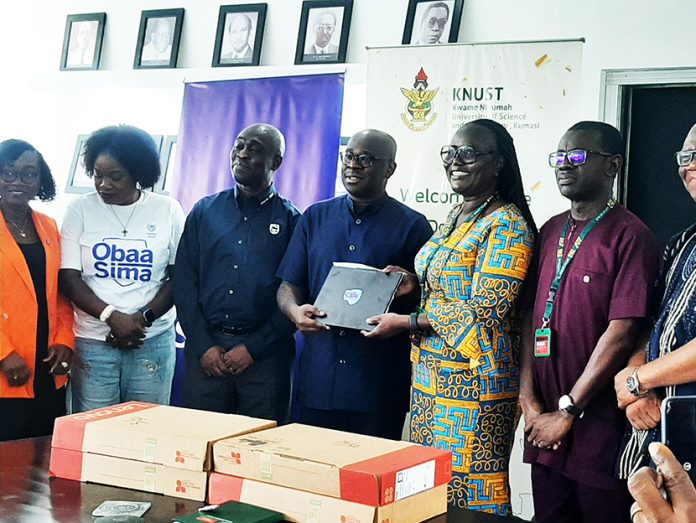
KNUST Vice-Chancellor receiving the donation from Stanbic MD

Stanbic Bank Ghana has donated 50 laptops to the Kwame Nkrumah University of Science and Technology (KNUST) in support of the Vice-Chancellor’s ‘Support One Needy Student with One Laptop’ (SONSOL) initiative.

The gesture reflects the Bank’s unwavering commitment to driving Ghana’s growth by investing in the development of Human capital, particularly young people.

The presentation brings to 400, the total number of laptops donated by the bank to KNUST, since the initiative was introduced in 2020, directly supporting students in advancing their academic pursuits and bringing their aspirations closer to reality.

The contributions underscore Stanbic’s belief that empowering youth with the right tools and skills is essential to building a resilient and prosperous future.

Mr Kwamina Asomaning, Managing-Director, Stanbic Bank Ghana, disclosed that any good agenda in a country would happen when you have the right set of institutions, such as KNUST, that is focused on developing  the human resource base of the country to become its very best, which falls squarely within the Bank’s purpose as a group, hence the donation.

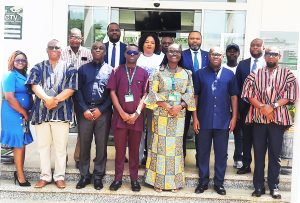
Group picture of management of Stanbic Bank and KNUST officials

He disclosed that the world had become a lot more digital and its transitioning requires a more digital interface, noting that as one thinks about growth, one has to think about how to equip the human resource to be able to deal with a world that is increasingly becoming more digital, based on the needs of its people.

To him, STEM education agenda fits in, for which Stanbic is privileged to be part of the SONSOL initiative.

Touching on the Obaasima initiative by the bank, the Managing-Director explained that it looks at providing better access to women as it relates to finance and business facilitation and service, as well recognise that women are quite a marginalised group when it comes to STEM education.

He disclosed that 40 of the 50 laptops donated will go to female students as a means of bridging the gap in STEM education, stressing that the Bank goes beyond just providing computers.

He noted that the provision of computers alone without making effort cannot bridge the gap between academia and industry, which ends up producing students who are not fit for the workplace. This, according to him, is the reason why his outfit has embarked on a number of initiatives to bring students over for internships, and thereafter their graduation, a few of them come and undertake their national service with Stanbic.

Receiving the donations, Prof. Mrs. Rita Akosua Dickson, Vice-Chancellor, KNUST disclosed that Stanbic are always there to support, noting that Stanbic has been part of the successful journey of KNUST in churning, nourishing, and training the brains, the hearts, and the hands of these young people.

The VC commended Stanbic for the vision of supporting SONSO and noted that it is not just donating or giving tools to bridge the digital divide, which is “very cardinal” to KNUST, as a science and technology university, but for the support that these students receive, which changes the stories of students.

From Oswald P. Freiku, Kumasi


For more news, join The Chronicle Newspaper channel on WhatsApp: https://whatsapp.com/channel/0029VbBSs55E50UqNPvSOm2z

The Chronicle Eastern Regional correspondent honoured for Excellence in Journalism, et al

0
Mr. Isaac Akwetey-Okunor receiving his award from a member of the Diamond excellence awards.

In a glowing recognition of distinguished service to journalism and national development, the Eastern Regional Correspondent of The Chronicle, Mr. Isaac Akwetey-Okunor, has been honoured with a prestigious Pure Diamond Award at the 5th Edition of the Diamond Excellence Awards, in acknowledgment of his immense contribution to societal transformation through impactful journalism.

The honour, presented during a colourful ceremony on May 1, 2026 at Birim, in the Eastern Region, placed Mr. Akwetey-Okunor among a select group of exceptional Ghanaians whose work continues to influence communities, shape public discourse and inspire national progress.

At the heart of the recognition was a powerful citation celebrating his steadfast commitment to truth, ethical journalism and developmental reporting.

The citation read;

“For your remarkable contributions to journalism and the pursuit of truth, your insightful reporting and editorial leadership at The Chronicle have played a vital role in informing our communities and upholding the excellence of the Fourth Estate.”

The citation further acknowledged his role as a voice for marginalised communities and a journalist whose work consistently champions social development, accountability and national transformation.

With over two decades of active journalism practice since 2005, Mr. Isaac Akwetey-Okunor has carved a respected niche in Ghana’s media landscape as a developmental journalist, whose reporting goes beyond headlines to influence policy, shape attitudes and advocate practical solutions to national challenges.

Known widely for his incisive coverage of politics, agriculture, rural development, youth empowerment and public policy, his journalism has consistently reflected a deep commitment to social progress.

Unlike conventional reportage that merely highlights problems, Mr. Akwetey-Okunor’s work has often focused on solutions journalism, bringing national attention to opportunities in agriculture, youth employment and sustainable development.

His reporting has strongly promoted the modernisation of agriculture in Ghana, challenging the long-held notion that farming is a last resort occupation. Through numerous articles, analyses and feature stories, he has consistently advocated that agriculture should be viewed as a viable business venture, a source of wealth creation and a strategic pathway for youth employment.

He has particularly championed initiatives such as school farm competitions and university-led agricultural entrepreneurship programmes as transformative models capable of changing perceptions among graduates and repositioning farming as a profitable enterprise.

Champion of Youth Empowerment and Social Transformation

Beyond the newsroom, Mr. Akwetey-Okunor has distinguished himself as an educator and mentor.

As a lecturer at All Nations University, he has contributed significantly to shaping young minds, particularly in communication, leadership and national development discourse.

His academic and leadership credentials are equally noteworthy. He previously served as secretary of the Graduate Students Association of Ghana chapter at All Nations University, where he demonstrated organisational leadership and advocacy on issues affecting graduate students and academic advancement.

As a committed member of the Ghana Journalists Association, he has upheld professional standards and contributed meaningfully to the advancement of journalism in Ghana.

Through his writings and community engagements, he has become a recognisable voice advocating rural transformation, youth inclusion and sustainable economic empowerment.

“I Never Knew My Little Contribution Was Being Watched”

Receiving the award, a visibly humbled Mr. Akwetey-Okunor described the recognition as both surprising and deeply touching.

According to him, although he has received honours in the past, the Diamond recognition carried a unique emotional significance because it reflected society’s appreciation of sincere service often rendered quietly and without expectation of reward.

He remarked that he never imagined that his “widow’s mite” toward societal development was being keenly observed, adding that the honour has renewed his commitment to responsible journalism and service to humanity.

He expressed profound gratitude to the organisers, particularly Daniel Opoku Walker, for identifying and celebrating individuals whose contributions continue to positively shape Ghanaian society.

Mr. Akwetey-Okunor also used the platform to send a strong message to fellow journalists, urging practitioners in the media fraternity to approach their work with integrity, caution and a sense of responsibility.

“Journalists must be guided and circumspect in the discharge of their duties. We may never know who is watching, whose life is being impacted, or how our work may one day be remembered. Let us uphold truth, fairness, and professionalism at all times,” he advised.

Diamond Excellence Awards: Celebrating Ghana’s Changemakers

The Diamond Excellence Awards, an initiative of Danny’s Entertainment, has over the years grown into one of Ghana’s notable recognition platforms for honoring individuals and institutions whose dedication, innovation, and excellence are making meaningful impacts in society.

Under the leadership of CEO, Daniel Opoku Walker, the awards continue to spotlight achievers in sectors including media, business, arts, entrepreneurship, traditional leadership, and community development.

This year’s ceremony featured notable honourees from across Ghana’s professional and social landscape, including distinguished media personalities, business executives, civil society leaders, and grassroots changemakers.

The event also featured performances by celebrated Ghanaian artists, including Jack Alolome, adding cultural vibrancy to an evening dedicated to honoring excellence.

Mr Isaac Akwetey dedicated the award to the management, staff and colleagues at “your authoritative” newspaper, The Chronicle, most especially the Managing Editor, Mr. Emmanuel Akli and the late Mr Richard Kofi Attinkah.

Israeli Embassy celebrates Israel’s 78th Indece Day in Accra

0
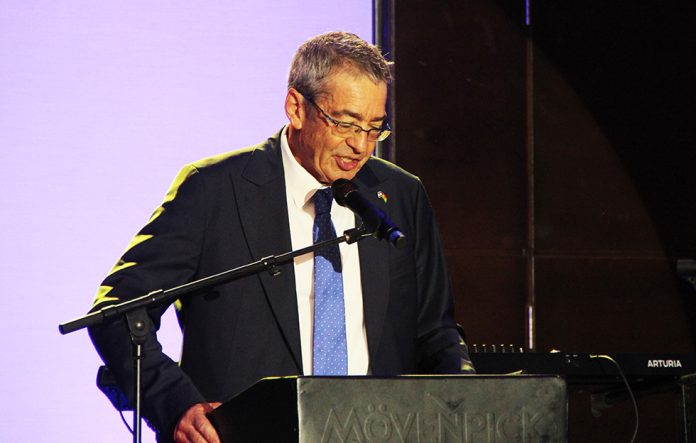
Israel’s Ambassador to Ghana, H.E. Roey Gilad, addressing the event in Accra.

Israel’s Ambassador to Ghana, H.E. Roey Gilad, has warned that the growing extremist threat in the Sahel mirrors the security challenges confronting the Middle East, stressing that no country can defeat terrorism alone.

Speaking at Israel’s 78th Independence Anniversary celebration in Accra, Ambassador Gilad said armed groups operating in Mali and the wider Sahel posed dangers similar to Hamas and Hezbollah.

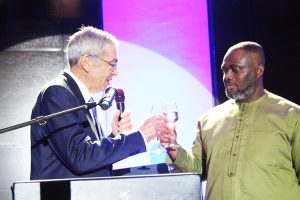
Israel’s Ambassador to Ghana, H.E. Roey Gilad, shares a toast with the Minister for Works, Housing and Water Resources, Hon. Kenneth Adjei, who represented President

“The situation in the Sahel is not much different than the situation in the Middle East,” he said, adding “JNIM and Al-Qaida are not different than Hamas and Hezbollah, as was evident only a few days ago in Mali. No state can meet such a challenge alone and a coalition of the willing is essential.”

His remarks come amid growing concern over insecurity in West Africa’s Sahel region, where countries such as Mali, Burkina Faso and Niger continue to battle insurgent groups linked to extremist ideologies. Ghanaian security experts have also warned about possible spill over threats to coastal states, including Ghana.

By drawing comparisons between the two regions, the envoy placed the Sahel crisis within a wider global security context, arguing that terrorism has become an international challenge requiring coordinated responses.

Participants hold Israeli flags and sit attentively during proceedings at the 78th Independence Anniversary of Israel in Accra, expressing solidarity and support

Ambassador Gilad, who also serves as Israel’s ambassador to Liberia and Sierra Leone, said Israel continues to face serious regional threats, citing Iran and allied armed groups in Lebanon, Gaza and Yemen. According to him, these tensions have shaped Israel’s security priorities in recent years.

The ambassador also referred to the October 7, 2023 Hamas attacks and the hostage crisis that followed. He disclosed that on January 26, 2026 Israel recovered the body of Sergeant Major Ran Gvili, whom he described as the last among 251 Israelis abducted during the attacks.

According to him, 166 of those abducted returned alive, while 85 were returned dead. He said although that chapter had closed, Israel still face difficult national wounds and political debates over its future.

He noted that Israel would hold general elections in October, this year, describing democracy as the means through which nations determine their future.

Despite the security concerns, Ambassador Gilad ended on a hopeful note, saying peace remains central to Israel’s national values.

He said Israel was currently engaged in talks with Lebanon and remained interested in peaceful relations with its neighbours, including the Palestinians.

He, however, argued that the disarmament of Hamas was necessary for normal life to return to Gaza.

The Israeli envoy also praised Ghana’s contribution to international peacekeeping, particularly the role of Ghanaian soldiers serving under the United Nations Interim Force in Lebanon (UNIFIL).

He said Israel deeply appreciated Ghana’s long-standing service in helping to maintain peace and security in southern Lebanon.

Beyond security matters, Ambassador Gilad highlighted the historic ties between Ghana and Israel. He recalled that Israel opened its embassy in Accra in 1956, one year before Ghana attained independence, making it the first Israeli embassy in Sub-Saharan Africa.

He said relations between the two countries had grown from early cooperation in agriculture to new sectors such as cybersecurity, fintech, defence, energy and infrastructure.

The ambassador also referenced bilateral political consultations held in Jerusalem in January, this year, attended by Ghanaian officials including Deputy Foreign Affairs Minister James Quayson and Deputy Agriculture Minister John Dumelo.

Representing President John Dramani Mahama at the event, the Minister for Works and Housing, Kenneth Gilbert Adjei congratulated Israel on its 78th anniversary and praised the country’s resilience, innovation and democratic tradition.

He described Ghana and Israel as long-standing partners whose relations were built on mutual respect, shared values and practical cooperation.

According to him, Ghana sees strong potential for Israeli investment and expertise in flagship programmes such as the 24-hour economy policy, the Big Push infrastructure agenda and digital transformation efforts.

He also identified agriculture, health, education and innovation as key areas for future collaboration between the two countries.

The anniversary reception was attended by members of the diplomatic corps, the Israeli community in Ghana, and invited Ghanaian guests.

The occasion was marked by music and entertainment performances by Tania Vinokur, an international violinist, singer and performer known for blending diverse cultural influences.


For more news, join The Chronicle Newspaper channel on WhatsApp: https://whatsapp.com/channel/0029VbBSs55E50UqNPvSOm2z

Mahama advances 24-hour economy vision with ground-breaking market at Asesewa

0
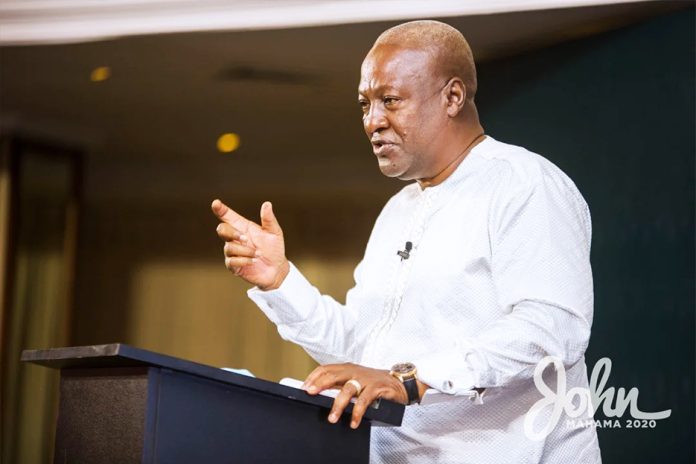
President John Dramani Mahama

President John Dramani Mahama has cut sod for the construction of a state-of-the-art 24-hour economy model market at Asesewa, a landmark project expected to restore the town’s historic prominence as one of Ghana’s vibrant commercial centres while opening a new chapter of economic opportunity for traders, farmers, and small-scale enterprises.

The groundbreaking ceremony, held on Friday, marked the fulfillment of a major campaign promise under the President’s broader economic transformation agenda, which seeks to stimulate district-level commerce, expand local enterprise, and create sustainable jobs through strategic infrastructure investment.

The Asesewa market project forms part of a nationwide initiative to construct 261 ultramodern district-level markets across the country, an ambitious programme designed to decentralize economic growth, strengthen local supply chains, and position communities as engines of national development under Ghana’s 24-hour economy policy.

Addressing a large gathering of traditional leaders, traders, residents, and government officials at the ceremony, President Mahama reflected on Asesewa’s proud commercial heritage, describing the town as a historic trading center whose growth has been constrained by years of inadequate market infrastructure.

Historically, Asesewa has been a market town for many years, but over time, the infrastructure has not kept pace, affecting its growth,” the President stated.

He explained that the construction of the ultramodern market is intended not only to improve trading conditions, but also to reposition Asesewa as a thriving economic hub capable of attracting investment, increasing commerce, and stimulating surrounding local economies.

President Mahama stressed that the 24-hour market concept is central to his government’s broader economic vision, one that aims to unlock productivity beyond traditional business hours, encourage continuous economic activity, and create employment opportunities for thousands of Ghanaians, particularly women and youth engaged in trade and agribusiness.

“This initiative is about more than building markets. It is about building opportunity, creating jobs, and transforming local economies into centres of productivity and prosperity,” he emphasized.

The planned Asesewa market complex is designed as a modern integrated commercial enclave equipped with world-class facilities to support large-scale trading, storage, transportation, security, and social welfare services.

According to project details, the facility will include 100 lockable stores and 150 open trading stalls, providing secure and accessible spaces for traders dealing in food items, textiles, household goods, and agricultural produce.

It will also feature 36 modern washrooms fitted with improved sanitary amenities, addressing long-standing hygiene concerns often associated with traditional market spaces.

In a move to strengthen security and emergency preparedness, the market complex will include an on-site police post and fire station, ensuring rapid response to security threats, fire outbreaks, and other emergencies.

Recognizing the crucial role women play in local commerce, government has also incorporated social support infrastructure into the project. A daycare center will provide childcare support for market women, while an on-site pharmacy and health clinic staffed by professionals will improve access to healthcare services for traders and patrons.

A dedicated Women’s Bank is also expected to operate within the market complex, aimed at improving access to credit, financial literacy, and business support services for women entrepreneurs, many of whom remain excluded from formal financing systems despite their central role in Ghana’s informal economy.

The facility will further boast 10 warehouses for bulk storage, a meat processing and sales shop, two cold stores for perishable goods, and a restaurant with food courts to enhance convenience for traders and visitors.

In addition, plans include a shopping mall with six guest rooms, creating opportunities for business lodging and commercial expansion.

Provision has also been made for a livestock trading area, a market manager’s office, and a modern lorry terminal to improve transportation logistics, reduce congestion, and facilitate the smooth movement of goods and passengers.

For residents of Asesewa and surrounding communities, the project represents more than a market redevelopment initiative—it is widely seen as a catalyst for economic revival, urban renewal, and inclusive growth.

With construction now set to begin, many are hopeful that Asesewa will soon reclaim its historic identity as a bustling centre of trade, this time powered by modern infrastructure, expanded opportunity, and a bold vision for a 24-hour economy.


For more news, join The Chronicle Newspaper channel on WhatsApp: https://whatsapp.com/channel/0029VbBSs55E50UqNPvSOm2z

Koforidua Mayor tours BECE centres

0
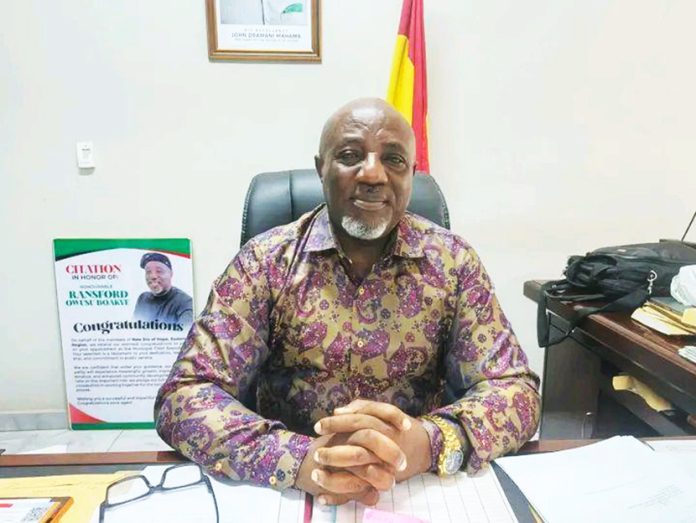
Mr. Ransford Owusu Boakye, Mayor of Koforidua

Candidates sitting for this year’s Basic Education Certificate Examination (BECE) across the Eastern Region have received a significant morale boost, following a motivational tour of selected examination centers in Koforidua by Mr Ransford Owusu Boakye, the mayor, of Koforidua.

The high-profile visit, aimed at encouraging candidates and monitoring the smooth conduct of the nationwide examination took the ministerial delegation to four major centers in Koforidua namely Koforidua Secondary Technical School, New Juaben Senior High School, Pentecost Senior High School and Oti Boateng Senior High School, where warm interactions with candidates, teachers, invigilators and examination officials underscored the government’s continued commitment to quality education and credible examinations.

At each center, the mayor addressed candidates, many of whom were visibly anxious, but optimistic as they prepared to write papers that will shape the next stage of their academic journey.

In a message filled with hope and reassurance, he urged the students to remain calm, focused and confident, reminding them that the BECE represents far more than an academic assessment; it is a gateway to future opportunities.

“You have prepared for this moment for years. This is your opportunity to demonstrate what you have learned. Stay focused, avoid fear, and give your very best. Success comes to those who prepare well and believe in themselves,” he told the candidates.

His presence was met with excitement and appreciation from students, many of whom said the visit gave them renewed confidence and inspiration at crucial moment.

Several candidates described the encouragement as timely, saying it helped reduce anxiety and strengthened their resolve to perform well.

One candidate remarked: “Seeing leaders come here personally to encourage us makes us feel important. It gives us confidence that we can succeed.”

Commitment to Free, Fair and Credible Examinations

Beyond motivating students, Mr Boakye held discussions with supervisors, invigilators, and teachers on the need to uphold the highest standards of professionalism, fairness and vigilance throughout the examination period.

He commended examination officials for their dedication and stressed that the integrity of Ghana’s educational system depends largely on transparency, discipline and strict compliance with examination regulations.

“Teachers and invigilators remain the backbone of our educational system. Their commitment to fairness, discipline, and proper supervision preserves the credibility of our examinations and safeguards the future of our children,” he noted.

He also emphasized the importance of maintaining an examination environment which is free from malpractice, intimidation or irregularities, urging all stakeholders to work together to protect the sanctity of the BECE.

Stakeholders Praise Visit

Education stakeholders welcomed the mayor’s presence, describing it as a practical demonstration of leadership’s interest in the welfare and academic progress of young people.

Teachers at the centres said such visits not only motivate candidates, but also reassure educators that their efforts are recognised and valued.

“When students see leaders personally come to encourage them, it motivates them to take their studies seriously. It tells them their future matters and that society believes in them.”

Okere to hold investment forum to drive economic growth

0
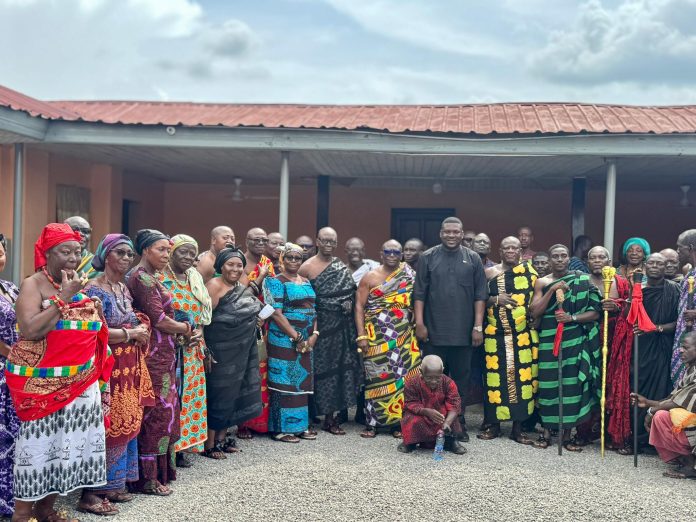
The Member of Parliament (MP) for Okere in the Akuapem Ridge of the Eastern Region, Hon. Daniel Nana Addo-Kenneth (in black) with the traditional leaders in a group photograph after the meeting

The Member of Parliament (MP) for Okere in the Eastern Region, Daniel Nana Addo-Kenneth, has initiated stakeholder consultations with traditional authorities on a strategic roadmap toward hosting the maiden Okere Stakeholders Investment Forum, a flagship initiative aimed at attracting investors, stimulating enterprise and creating sustainable jobs for the youth.

The initiative is largely described by constituents as a significant step towards unlocking the economic potentials of the Okere.

The high-level engagement, held on Saturday, at the Adukrom Palace, brought together chiefs and queen mothers from the seven major traditional areas within the constituency, in what many observers described as a historic gathering, focused squarely on economic transformation.

Traditional leaders representing Abiriw, Dawu, Awukugua, Adukrom, Apirede, Aseseeso and Abonse attended the meeting, signaling a united front by the traditional leadership towards a common development vision for Okere.

At the heart of the deliberations was a singular, urgent and transformative question: “How do we bring Investors to Okere to create jobs?”

That question framed a day of intense dialogue, strategic planning, and collective commitment toward building a future in which the youth of Okere can find meaningful employment and entrepreneurial opportunities within their own communities rather than seeking uncertain prospects elsewhere.

The gathering reflected a growing recognition that development can no longer be left to the government alone, but must emerge from strong partnerships between traditional leadership, elected representatives, private investors, and local communities.

For Daniel Nana Addo-Kenneth, the investment forum is envisioned not merely as an event but as a practical economic vehicle to connect Okere’s untapped resources, peaceful environment, and strategic location with domestic and international investment capital.

Roadmap for the Maiden Investment Forum

One major outcome of the meeting was the agreement to convene a special follow-up meeting dedicated solely to finalizing the roadmap for the Maiden Okere Stakeholders Investment Forum, which is expected to become a defining platform for showcasing the constituency’s economic potential.

Key pillars discussed as part of the proposed investment framework include Litigation-Free Lands for Development where Traditional authorities are expected to work closely with local leadership to identify and dedicate peaceful, litigation-free acres of land suitable for industrial projects, commercial farming, agro-processing facilities, and manufacturing enterprises.

This is expected to remove one of the biggest barriers to investment—land acquisition uncertainty, and send a strong signal that Okere is investment-ready.

The constituency also plans to identify and package bankable projects in sectors such as agriculture, tourism, agro-processing, real estate, renewable energy, and rural industrialization for presentation to potential investors.

Rather than waiting passively for investment interest, Okere intends to proactively build commercially viable proposals capable of attracting serious financing.

Perhaps the strongest pillar of the initiative is its jobs-first approach.

Under the emerging framework, every investment partnership is expected to prioritise skills training for local youth, direct job creation, support for entrepreneurship, value-chain opportunities for farmers, artisans and traders and long-term economic empowerment rather than short-term gains.

Okere Has What Investors Are Looking For

Daniel Nana Addo-Kenneth emphasised that Okere possesses key advantages many investors actively seek like peace, social stability, available land, improving infrastructure and a ready youthful workforce.

According to him, while traditional leaders are providing leadership on land and community support, his role as a Member of Parliament is to leverage policy advocacy, strategic facilitation and investor engagement to channel capital into the constituency.

“Okere has the peace and physical infrastructure investors beg for. My job is to bring the investors to meet that peace,” he indicated.

This statement captures what is increasingly becoming known as the Okere Jobs Compact, a development formula built on collaboration between traditional authority and political leadership for economic transformation.

A notable theme that emerged from the meeting was inclusiveness. Leaders were emphatic that the proposed forum must not become an elite gathering reserved for politicians, executives and corporate figures, but rather a people-centered platform designed to solve real economic challenges confronting ordinary residents.

The vision is for investment to benefit the farmer who needs guaranteed markets and fair prices for produce, the SHS graduate who needs practical employment opportunities and the artisan who seeks regular contracts and skills upgrading.

The rest are the trader who needs capital expansion and stronger supply chains and the entrepreneur who requires access to partnerships, financing and mentorship.


For more news, join The Chronicle Newspaper channel on WhatsApp: https://whatsapp.com/channel/0029VbBSs55E50UqNPvSOm2z

Arsenal, Atletico Madrid lock horns at the Emirates Stadium

0
Bukayo Saka, Arsenal

Budapest dreams will be realised for either Arsenal or Atletico Madrid on Tuesday evening, when the two Champions League hopefuls lock horns in the second leg of their semi-final at the Emirates Stadium.

Last week’s first leg – a tale of three penalties – ended in a 1-1 stalemate in the Spanish capital, putting Mikel Arteta‘s men at a marginal advantage ahead of their biggest European game in two decades.

Winning, drawing or even losing by a narrow scoreline would have been acceptable for Arsenal at the Metropolitano Stadium last week, so a stalemate was a fine result at face value, although there was a palpable sense of Gunners frustration at full time.

Julian Alvarez, Atletico Madrid

Yet to suffer defeat in the 2025-26 Champions League, Arsenal will set a new club record for their longest unbeaten streak in the competition (14 matches) if they can end their 20-year exile from the final, and recent European and domestic exploits suggest that Arteta’s men can do just that.

Another trophyless season awaits if Simeone’s men cannot correct their Emirates errors.

Atletico have already suffered Copa del Rey final heartbreak at the hands of Real Sociedad and have little on the line domestically, having already secured a top-four finish in La Liga.

Faced with an Atletico side renowned for a leaky defence away from home, having conceded at least twice in seven of their last 10 games on the road, Arteta’s revitalised attack can fire the Gunners into the Champions League final.

Credit: .sportsmole.co.uk

GPL Match Day 31 shakes up title race, as heavyweights stumble

0
Hearts of Oak players celebrating a goal

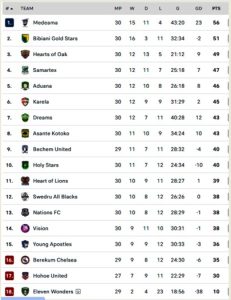
Match day 31 of the Ghana Premier League may ultimately be remembered as the point where the title race began to slip out of reach for the chasing pack, as a combination of dropped points, inconsistent performances and shifting momentum created a clear separation at the top.

Match day 31 exposed underlying weaknesses in contention particularly in consistency and defensive stability, while reinforcing how crucial efficiency and game management have become in the closing stages of the season, where margins are increasingly defined not just by results, but by control and composure.  
Medeama 2-0 Bibiani Gold Stars

All eyes were on the top-of-the-table clash and Medeama SC rose to the occasion with a performance full of authority and composure to defeat Bibiani Gold Stars. From the opening whistle, Medeama showed intent, pressing high and controlling possession in midfield. Their ability to dictate the tempo prevented Gold Stars from settling into any rhythm. The home side’s attacking movement caused constant problems, with their forwards finding pockets of space between the lines.

Razak Sanou, Bibiani Gold Stars

The breakthrough came after sustained pressure, as Medeama capitalized on a defensive lapse to take the lead. Once ahead, they managed the game intelligently, maintaining control while limiting Gold Stars to very few clear-cut chances. A second goal in the latter stages effectively sealed the contest, sending the home crowd into celebration.

For Gold Stars, the defeat is a major setback. Their defensive fragility was once again exposed, and their inability to respond in big matches raises serious concerns. With this result, Medeama extended their lead at the top to eight points, placing them firmly in command of the title race with only a few games remaining.

Dreams FC 2-0 Asante Kotoko

Dreams FC continued their impressive late-season resurgence with a confident and well-deserved victory over Asante Kotoko, a result that further deepens Kotoko’s struggles. Dreams began the game with energy and purpose, pressing aggressively and forcing Kotoko into errors.

Their attacking play was fluid, with quick passing combinations stretching the Kotoko defense. The opening goal came as a reward for their dominance, following a well-worked move that exposed gaps in Kotoko’s backline.

Kotoko attempted to respond but lacked cohesion in their play. Their midfield struggled to link up effectively with the attack, and their forward line appeared isolated for long periods. Defensive lapses continued to plague them, and Dreams capitalized again to double their advantage.

The second half saw Kotoko enjoy slightly more possession, but they failed to convert it into meaningful chances. Dreams, meanwhile, remained organized and disciplined, comfortably seeing out the game.

Karela United 2-1 Young Apostles

In a tightly contested encounter, Karela United secured a vital 2-1 victory over Young Apostles, boosting their position in the standings while deepening their opponents’ relegation worries. Karela started strongly, using their home advantage to apply early pressure. Their attacking intent paid off with the opening goal, which came from a well-executed move that caught the Young Apostles defense off guard. The hosts looked confident and in control for much of the first half.

However, Young Apostles showed resilience and responded with determination, finding an equalizer that brought them back into the contest. The goal shifted momentum briefly, as they pushed forward in search of a second.

Samartex 3-1 Holy Stars

Samartex delivered one of the standout performances of the round, defeating Holy Stars 3-1 in a match that highlighted their growing confidence and attacking prowess.

Samartex asserted control early, dominating possession and dictating play with crisp passing and intelligent movement. Their attacking players combined effectively, creating multiple opportunities and eventually breaking the deadlock with a well-taken goal.

The home side continued to press and doubled their lead with another clinical finish, leaving Holy Stars struggling to cope with the intensity. Although Holy Stars managed to pull one back and briefly threaten a comeback, Samartex quickly restored their two-goal cushion with a third strike.

Nations FC 0-1 Hearts of Oak

Hearts of Oak secured a narrow but crucial away victory against Nations FC, demonstrating their trademark defensive discipline.

The match was closely contested, with both sides showing caution in the early stages. Nations FC looked organized and attempted to control possession, while Hearts focused on maintaining a solid defensive structure.

The decisive moment came when Hearts capitalized on a rare opportunity, scoring the only goal of the match. From that point, they shifted into a more defensive approach, relying on their well-drilled backline to protect their lead.

Aduana FC 0-0 Heart of Lions

Aduana’s clash with Heart of Lions ended in a goalless stalemate, a result that reflects a game low on attacking quality but high on tactical discipline.

Table

Aduana FC enjoyed more possession and looked the more proactive side, attempting to break down a compact Heart of Lions defense. However, their attacking play lacked the creativity and precision needed to unlock the opposition.

By Jesse Otoo

The Ghanaian Chronicle