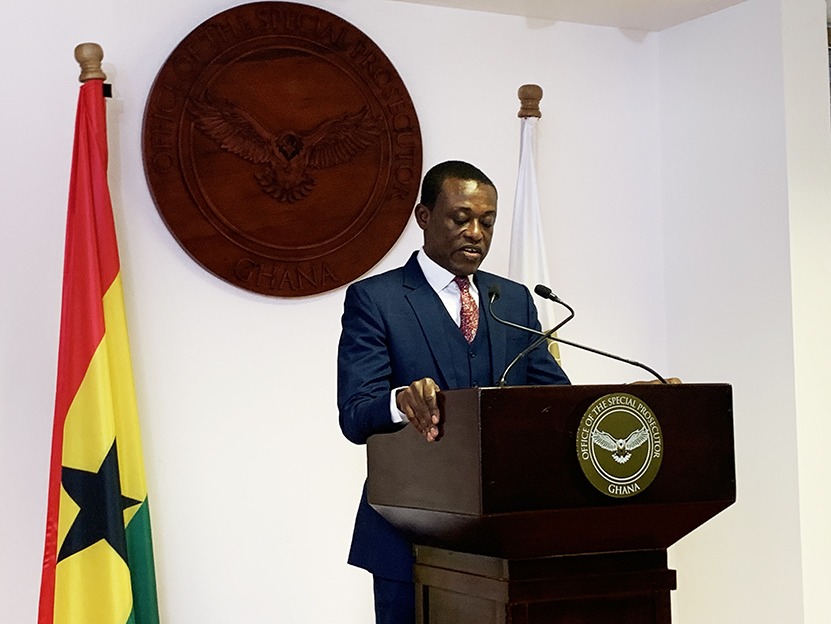
“We will show no fear or favour. We will remain resolute in the lawful discharge of our mandate.”
That was the emphatic declaration by the Special Prosecutor, Kissi Agyebeng, yesterday, as he announced what he described as the “rebirth” of the Office of the Special Prosecutor (OSP), following the Supreme Court’s landmark decision affirming the constitutionality of the Office’s prosecutorial powers.
Addressing journalists at a news conference in Accra, Mr Agyebeng said the OSP would rigorously investigate corruption cases, vigorously prosecute offences where evidence establishes wrongdoing, actively recover illicit assets and intensify efforts to prevent corruption. He said the declaration marked a renewed phase in the Office’s operations after months of legal uncertainty that had stalled its prosecutorial activities.
Supreme Court ruling
The renewed confidence of the OSP follows the Supreme Court’s July 29, 2026 ruling in the case brought by private legal practitioner, Noah Ephraem Tetteh Adamtey, who had challenged the constitutionality of the independent prosecutorial powers granted to the OSP under the Office of the Special Prosecutor Act, 2017 (Act 959).
Adamtey argued that Article 88 of the 1992 Constitution vested prosecutorial authority exclusively in the Attorney-General and that Parliament exceeded its powers by creating an independent anti-corruption prosecution body without a constitutional amendment.
During the proceedings, the Attorney-General supported the constitutional challenge. However, the Supreme Court unanimously upheld the validity of the OSP Act, affirming that the Office possesses constitutional prosecutorial authority while maintaining that the Attorney-General retains the ultimate constitutional power to discontinue prosecutions initiated by the OSP through a nolleprosequi.
Refile pending major cases
The ruling also preserved the validity of previous prosecutions, convictions and freezing orders undertaken by the OSP.
Mr Agyebeng said the Supreme Court’s decision had brought clarity to Ghana’s anti-corruption architecture and restored the Office’s ability to fully execute its mandate after an earlier High Court decision had thrown its operations into uncertainty.
According to him, the OSP had reviewed all cases that were under investigation and trial during the period of legal disruption and had uncovered additional evidence in some matters while identifying more persons connected to ongoing investigations.
“We will refile some of the pending major cases based on our discoveries,” he disclosed, noting that corruption investigations often require extensive forensic analysis, intelligence gathering and cooperation across jurisdictions before prosecutions can be successfully mounted.
The Special Prosecutor also renewed his call for stronger anti-corruption legislation, advocating lifestyle audits and non-conviction-based asset recovery powers for institutions such as the OSP and the Economic and Organised Crime Office (EOCO).
He argued that where a person’s wealth substantially exceeds his or her legitimate income, the unexplained portion should be liable to confiscation through civil proceedings, provided the legal threshold is satisfied by a competent court. He further proposed a reverse-onus provision requiring individuals with disproportionate assets to demonstrate legitimate sources of income.
Turning to the Ghanaian dimension of the bribery case involving former Tema Oil Refinery Managing Director, Asante Kwaku Berko, Mr Agyebeng said the OSP’s investigations were continuing despite the public silence surrounding the matter.
Dr Kwabena Donkor
He named former Power Minister, Dr Kwabena Donkor and four others as persons of interest, but cautioned journalists and the public against equating that classification with criminal guilt.
“A person of interest is not necessarily a suspect,” he stressed, adding that neither identification as a person of interest nor as a suspect constitutes criminal culpability until guilt is established by a court of competent jurisdiction.
Mr Agyebeng urged investigative, intelligence and prosecutorial institutions to collaborate rather than compete, insisting that effective cooperation remained essential to Ghana’s fight against corruption.