Another weekend in Ghana means another road trip—this time my cohort woke up bright and early to travel a couple hours east to the Ada area in Greater-Accra, where we enjoyed a day outside in the sun.
We started the day at the Nkyinkyim Museum, where we explored beautiful representations of African history. The museum has been active since 2006 and has continued to educate people globally through installations that discuss the legacy of colonialism in Africa.
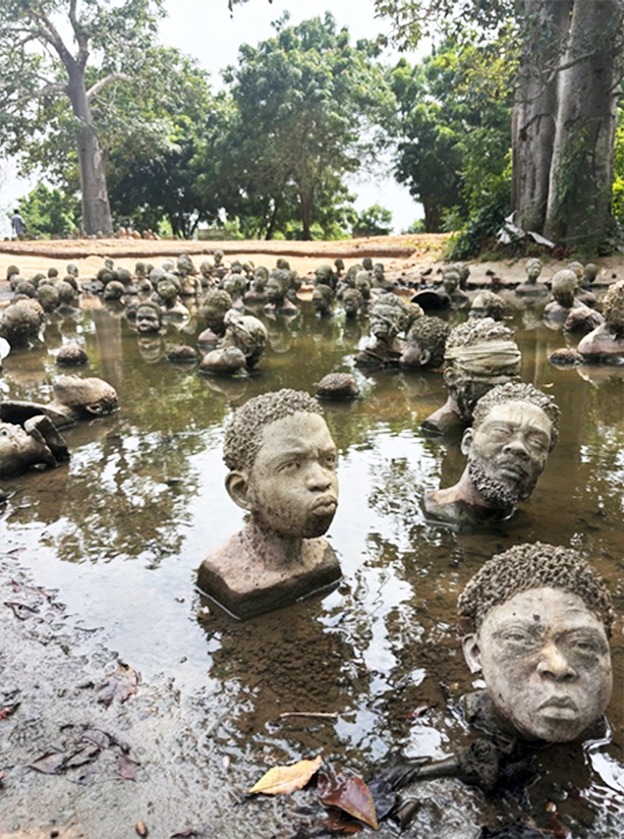
After walking through an impressive tunnel of bamboo, we approached the portion of the museum where we were prompted to remove our shoes in order to respect the space. We walked through the Sacred Area, sand already stuck between our toes, admiring the installation. Within the Sacred Area were hundreds of sculpted African heads and busts, each one unique in their appearance. Some were on dry land, appearing to be stuck in the sand, while there were a number sinking in the water. Their expressions were haunting; many were blinded, whether by a blindfold or their eyes were simply closed. They were filled with an evident sense of sorrow, or grief.
These sculptures, placed in the museum in 2013 by artist Kwame Akoto-Bamfo, tell a story of the trans-Atlantic slave exploitation, and preserve the history of the lives lost during. There are often rituals and rites performed to honor the space and the spirits that reside there.
After putting my shoes back on in the least graceful way possible, we continued the tour, where we approached “The History Wall.” The cement wall had multiple pieces of art on it, including a wall inscribed with picket signs that read “George Floyd,” and “BLM.”
This was a pleasant surprise. George Floyd was a black American who was killed by a police officer in 2020, and his unjust death led to another wave in the Black Lives Matter movement that triggered thousands of protests across the U.S. and internationally. Seeing Floyd’s name etched into a museum thousands of kilometers away from where he died was a reminder of how intertwined black American struggles are with African struggles, and how the fight for justice is never ending. I can’t help but wonder why George Floyd was an international topic, but the 1,816 black Americans killed by police since his death haven’t made the same news, national nor international—according to a non-profit called Mapping Police Violence.
After an enjoyable morning at Nkyinkyim Museum, our group drove south to the coast and ate lunch by the beach. I was delighted to have sobolo, a drink I’ve come to thoroughly enjoy, and I finally got to try fufu. I loved it—I’ve wasted most of my trip procrastinating trying it, I now need to eat as much fufu as possible to make up for lost time!
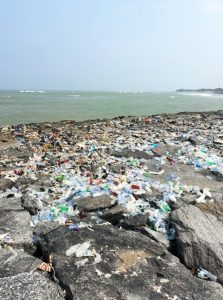
We had time to relax after the hearty lunch, so I decided to walk on the beach. The beach was not much of a beach, rather a coastal sea breaker made of large, multicolored stones meant to protect the nearby resort from the waves. As a fan of beach critters, I was excited to spend my time observing the cracks to look for crabs, starfish, and a multitude of bugs.
Where bugs should have been, there were broken bottles. Where crabs should’ve been crawling, there were plastic wrappers. Where I was hoping to see seaweed was discarded clothing, soaked with salt water. I have never seen so much trash on a coastline before.
There wasn’t a single area I walked by that wasn’t contaminated by plastic or glass, waiting to be swallowed by the ocean. The trash that made it bobbed along the green sea, surfing the waves helplessly. Where the waves met the rocks, I finally saw a little black crab. It was sitting in a plastic cup.
Needless to say, I was frustrated by this sight. I have seen plenty of trash in Accra, molded to the crevices of the busy roads. Seeing it intentionally discarded in an area I assumed all humans knew to protect was a different story. I’d say it was a culture shock, but I know the government has made efforts to improve the cleanliness of Ghana, including the recent nationwide clean-up exercise.
I can only hope efforts continue to keep the environment clean, for the sake of both humans and other ecosystems. I would encourage policymakers to highlight the need for more communal cleaning days so the efforts to clean become a more lasting legacy than the beach that I visited this weekend.
By Liz Mitchell