
The Monetary Policy Committee (MPC) of the Bank of Ghana (BoG) has unanimously maintained the Monetary Policy Rate at 14 per cent, citing broadly balanced risks to inflation and economic growth despite a recent increase in headline inflation.
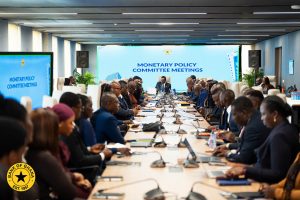
The decision was taken at the 132nd regular meeting of the MPC held from September 23 to 24, 2026, to assess recent economic developments and risks to the outlook for inflation and growth.
Announcing the decision at a press briefing in Accra yesterday, the Governor of the Bank of Ghana and Chairman of the MPC, Dr Johnson Asiama said the Committee’s decision reflected both the resilience of the domestic economy and emerging risks from higher energy prices, global supply-chain disruptions and geopolitical tensions.
“Based on these considerations, the Monetary Policy Committee viewed the balance of risks to inflation and growth as broadly balanced,” he said. The Committee noted that Ghana’s economy continued to record strong activity in the first half of the year, although growth in the second quarter moderated compared with the same period in 2025.
Real Gross Domestic Product (GDP) growth stood at six per cent in the second quarter of 2026, compared with 6.6 per cent recorded in the corresponding quarter of 2025.
The growth was driven mainly by the services and industry sectors, while non-oil GDP growth stood at 5.4 per cent, compared with 8.5 per cent during the same period last year. The Composite Index of Economic Activity (CIEA), however, recorded stronger growth, increasing by 14.9 per cent year-on-year in July 2026, compared with 6.1 per cent in July 2025.
The Governor attributed the improvement to stronger credit to the private sector, increased international trade activity and higher consumption of goods and services. Consumer and business confidence surveys conducted in August also showed positive sentiments, which the MPC said reflected optimism about economic growth prospects amid a relatively stable macroeconomic environment.
Inflation pressures
Despite the positive economic indicators, inflation increased in August, with headline inflation rising to five per cent from 4.6 per cent in July. The increase was driven mainly by non-food inflation, which rose to 6.8 per cent from 6.1 per cent.
The Governor said the increase in non-food inflation was largely associated with the pass-through effects of upward adjustments in utility tariffs and elevated crude oil prices. Food inflation, however, declined marginally from 3.1 per cent to three per cent, supported by improved food supply conditions.
Headline inflation nevertheless remained below the lower bound of the BoG’s medium-term target range of 8 per cent, plus or minus two percentage points. The Bank’s core inflation measure, which excludes energy and utility prices, also eased slightly to 4.2 per cent in August from 4.3 per cent in July.
The Governor said inflation expectations among consumers, businesses and the banking sector had also declined, suggesting that underlying inflationary pressures were continuing to moderate. “Despite this, all the inflation expectations and core inflation measures eased, indicating a moderation in underlying inflation,” he said.
Global risks
The MPC expressed concern about developments in the global economy that could put additional pressure on domestic inflation.
According to the Governor, global economic activity remained resilient during the first half of 2026, supported largely by strong investment in artificial intelligence and less severe energy shocks than earlier anticipated. The International Monetary Fund’s global growth projection for 2026 remained at three per cent.
However, geopolitical tensions, higher energy prices and global supply-chain constraints remained key risks to the outlook. Crude oil prices were currently slightly above US$100 per barrel, while expectations of a strong El Niño event in the final quarter of the year could create further uncertainty around food prices.
The Governor said several major central banks had also begun raising their policy rates in response to persistent inflation, with such actions likely to increase global yields and tighten financing conditions for emerging and frontier economies.
For Ghana, the MPC identified upward revisions to utility tariffs, rising ex-pump petroleum prices and possible increases in transport fares as risks to the inflation outlook. A stronger US dollar, particularly following higher US interest rates, as well as possible spill overs from global supply-chain disruptions, were also identified as upside risks.
On the other hand, continued fiscal consolidation, improved food supply conditions and exchange-rate stability were identified as factors that could help contain inflation.
Credit conditions improve
The Committee also noted improvements in domestic financial conditions, with interest rates on government short-term instruments and average bank lending rates declining.
The 91-day Treasury Bill rate fell to 5.4 per cent in August 2026 from 10.3 per cent a year earlier. The average lending rate in the banking sector also declined to 15.9 per cent from 24.2 per cent over the same period.
The Governor said the lower interest-rate environment, an easing credit stance by banks and increased demand for credit had contributed to stronger private sector lending.
Private sector credit growth increased to 35.5 per cent in August 2026, compared with 13.3 per cent in August 2025.In real terms, private sector credit growth stood at 29 per cent, compared with 1.7 per cent during the same period last year. “Private sector credit growth, for example, rebounded to 35.5% in August 2026, from 13.3% in August 2025,” the Governor said.
Fiscal and external position
On the fiscal front, provisional data for the first seven months of 2026 showed improvements in revenue mobilisation, alongside constrained government spending.
The overall fiscal deficit on a commitment basis stood at GH¢3.5 billion, equivalent to 0.2 per cent of GDP, compared with the budget target of GH¢31 billion, representing 1.9 per cent of GDP.
The primary balance recorded a surplus of 1.4 per cent of GDP, exceeding the target surplus of 0.2 per cent. Public debt stood at 45.9 per cent of GDP at the end of July 2026, compared with 44.7 per cent at the end of December 2025.
The external sector also recorded a strong performance during the first eight months of the year. The trade surplus increased to US$8.85 billion in the year to August, from US$6.69 billion over the same period in 2025.
Exports increased to US$22.4 billion from US$17.9 billion, supported by gold, cocoa and crude oil receipts.Gross international reserves stood at US$12 billion as of September 22, equivalent to 4.5 months of import cover.
The Governor said the MPC considered the domestic growth outlook broadly positive, provided the economy was not hit by significant spillovers from global supply-chain disruptions and weather-related shocks affecting agricultural inputs. The MPC therefore unanimously maintained the Monetary Policy Rate at 14 per cent. The next MPC meeting is scheduled for November 16 to 18, 2026.
BoG announces new Cedi Heritage Series
Meanwhile, the Bank of Ghana announced plans to introduce a new series of Ghana Cedi banknotes known as the Heritage Series. The Governor said the new notes were being introduced as the existing designs had been in circulation for more than two decades, while technology, security standards and currency circulation patterns had evolved.
“Periodic modernization of our banknotes is, therefore, imperative in order to ensure that they remain secure, durable, and responsive to the changing needs of the economy,” he said.
The new banknotes will feature enhanced security features, improved durability and modern designs intended to reflect Ghana’s heritage and aspirations. The Governor stressed that the introduction of the new series would not invalidate existing Ghana Cedi notes.
The new Heritage Series will co-circulate with existing banknotes, meaning members of the public will not be required to rush to exchange or withdraw their current notes. The new series is scheduled to be officially launched on November 3, 2026, at the Bank Square in Accra.
The Governor also urged the public, businesses, traders and financial institutions to handle banknotes properly and avoid crumpling, writing on, stapling or using them for decorative purposes. “The integrity of our currency is not the responsibility of the Bank of Ghana alone. It is a shared national responsibility,” he said.