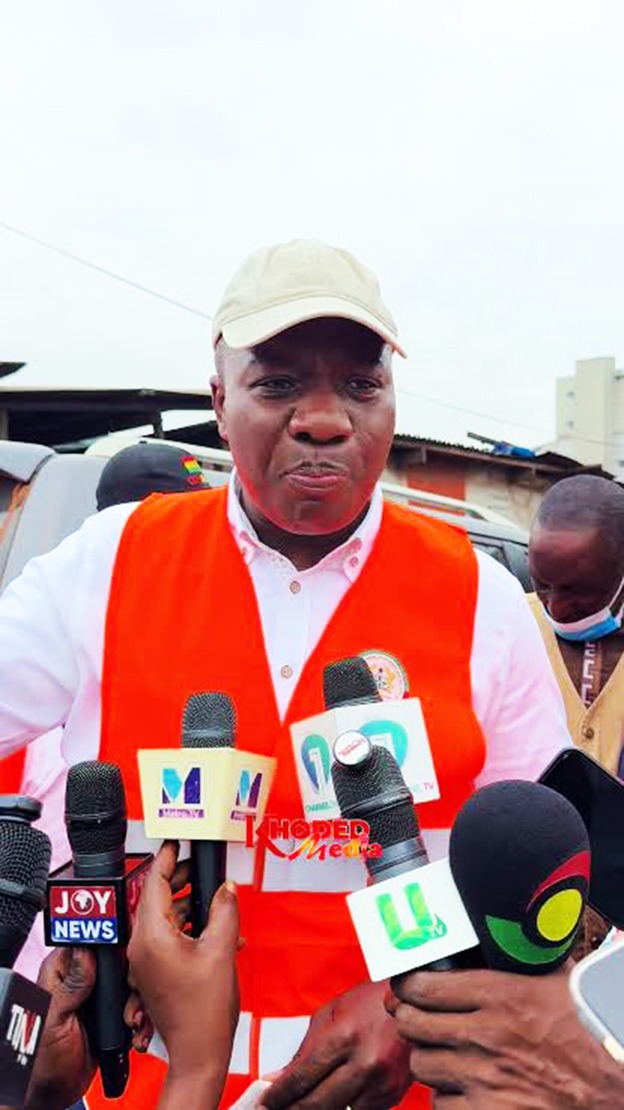
The Minister of Local Government, Chieftaincy and Religious Affairs, Mahama Ayariga, has declared a crackdown on sanitation indiscipline in Accra, warning that his tenure at the ministry will not be comfortable for polluters and defaulters of property rate.
The immediate past Majority Leader and Member of Parliament (MP) for Bawku Central gave the warning on Tuesday, September 1, 2026 during a working tour of key waste management installations in the Greater Accra Region.
The sites inspected included the ARICORP waste treatment plant, the Achimota waste transfer center, the Kpone landfill site and the Accra Recycling and Compost Plant at Adjen Kotoku- facilities that form the backbone of Accra’s solid waste collection and treatment chain.
Ayariga said the capital’s waste management crisis can be solved if Metropolitan, Municipal and District Assemblies (MMDAs) aggressively collect their Internally Generated Funds (IGF) and enforce the polluter-pay principle.
“If everybody is paying what they are supposed to pay; if we collected the property rate, if we collected the market fee, if we collected all the rates, I am convinced that problems like that will not be beyond our capacity,” he said at one of the sites.
He argued that factories, businesses and residents in Accra must pay for the waste they generate instead of relying on the District Assemblies Common Fund.
“The waste should not be paid from the Common Fund. The Common Fund is to be distributed to the rest of the country.
“So you cannot choose to come and live in Accra then the Common Fund that is supposed to come to me in Nadowli will be used to pay for your lifestyle in Accra,” he stated.
“If you are living in Accra, pay for the waste you are generating. If you have a factory here and the factory is generating waste, it will be unfair not to be accountable for the waste you have generated,” he added.
Ayariga’s tour comes at a time when Greater Accra is facing a major sanitation emergency, evident at the sites he visited.
Ghana generates about 4,400 tonnes of solid waste daily and about 1.6 million tonnes annually, with an average collection rate of just 80 percent, according to the Ministry of Local Government, Chieftaincy and Religious Affairs.
The crisis is most visible at the Kpone landfill site, one of the locations on the Minister’s tour, which has exceeded its design airspace. Built for 16 metres, it is now operating beyond 24 metres and was described earlier this year by officials as “sitting on a sanitation time bomb.”
Of the six waste transfer stations that previously served as intermediate hubs for consolidating waste from tricycles (aboboyaa) and small trucks, only two are currently operational, Jamestown and one other, after four were shut down due to lack of funding.
The Achimota waste transfer center, which the Minister also inspected, is one of the strategic facilities expected to be revived to reduce pressure on Jamestown, which alone receives waste from about 800 of the estimated 4,000 tricycle collectors operating daily.
Stakeholders at a high-level dialogue on June 8, 2026 at the Kempinski Hotel, Accra, warned that the region risks reversing two decades of sanitation gains due to persistent funding gaps.
The Ministry of Health in June also warned that uncollected waste and overflowing landfills are worsening flood risks and could trigger public health emergencies.
At the private sector-led facilities, ARICORP and the Accra Recycling and Compost Plant at Adjen Kotoku, the Minister assessed their treatment capacity and recycling operations and stressed that sustainable financing and payment of debts owed to private waste companies are critical to keep them running.
Ayariga noted that industries in Accra attract large populations from the hinterland in search of jobs, increasing pressure on the city’s sanitation systems.
He said businesses benefiting from hosting the national capital must contribute to keeping the city clean.
He disclosed that the government will soon launch a campaign against poor sanitation, which he described as a “war against indiscipline.”
“It is indiscipline not to pay the rate you are supposed to pay,” he said, while admitting that Assemblies must also make it easy for people to pay and account for monies collected by fixing roads, greening the city, improving waste management and providing security and basic amenities.
“I can assure you that my tenure as Minister of Local Government is not going to be an easy one. I don’t want to be popular. If I want to be popular, then I want to be popular for making people uncomfortable for doing the wrong things. If you do the wrong thing, my job is to make you uncomfortable doing the wrong thing,” Mr. Ayariga declared.
“We are in a hurry to get things done right,” he added.
By: Stephen Larbi
For more news, join The Chronicle Newspaper channel on WhatsApp: https://whatsapp.com/channel/0029VbBSs55E50UqNPvSOm2z