Leadership and membership of the Ghana Leather and Footwear Manufacturers Association (GLFMA) have expressed their dismay over high import duties at the ports and called on the government to take action to protect the industry.
They have also complained about the massive influence of cheaper imported footwear from China, which is threatening the survival of Ghana’s leather and footwear industry. GLFMA is the premier national body founded to represent the unified interests of Ghana’s leather industry, with a vision to become a leading continental hub for premium leather craftsmanship and manufacture.
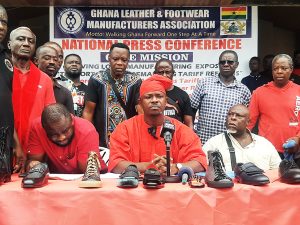
Mr. Gilbert Akwasi Ntim, President of GLFMA, indicated at a news conference last Tuesday that the footwear industry in Ghana was facing deliberate, systematic economic sabotage. He explained that when members of GLFMA import basic raw inputs, such as synthetic rubber sheets and off-cut scrap leathers, a standard 10% duty is levied on them.
He stressed that this is a “deception” because, after the ICUMS system compounds the aforementioned duty with VAT, NHIL, GETFund, and other levies, they are compelled to pay a staggering 36.1% total tax before they could clear these raw materials.
The President also noted the increasing takeover of the industry by foreign products, citing data from the Ghana Statistical Service and UN Comtrade, which indicate that over 70% of footwear sold in Ghana from 2024 to 2025 was imported from China, with import values exceeding US$40 million. However, Ghana’s footwear exports remain below US$1 million, even though the country’s local footwear industry has the capacity to employ thousands but continues to struggle.
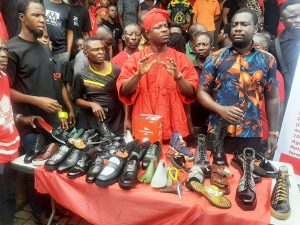
Mr. Ntim indicated that the situation is not just a “business issue” but a national economic concern, which must be addressed by the government to avert decline in the sector.
He emphasized that GLFMA seeks fairness, protection, and partnership, noting that the industry has the capacity to create jobs, reduce imports, and contribute significantly to national economic growth.
Highlighting the economic and social impact of the named challenges, the President of the association indicated that the growing import imbalance poses a serious threat to Ghana’s local industry and employment base.
He explained that it has wiped out the market share for Ghana-made footwear by over 30% in the past decade and has pushed many local producers out of business, especially artisans in Kumasi, Accra, and Takoradi. It has as well reduced youth employment opportunities, particularly among vocational graduates trained in shoe and leather work, creating a US$40 million annual trade deficit in the footwear sector alone.
Mr. Ntim noted that imported Chinese shoes are often cheaper, mostly of low durability and poor quality, providing little long-term value to consumers compared to Ghanaian-made footwear, built from genuine leather and local craftsmanship. He indicated that despite producing durable and high-quality footwear, Ghanaian manufacturers cannot compete with the low-cost, mass-produced imports flooding the market.
“GLFMA is not against international trade; however, trade must be fair and must not destroy local industries,” the industry President argued.
To urgently intervene and support the local leather and footwear industry, Mr. Ntim called for urgent intervention and support by ensuring tariff equality, where there is increased tariff on finished synthetic and leather goods from outside the AfCFTA zone, and mandatory local procurement, so that security agencies and school sandals are sourced 100% from certified local manufacturers.
He also suggested the implementation of zero percent import duty to reduce duties on raw materials and affordable financing, the launch of a national “Buy Ghana Made Footwear” campaign, and stopping the misclassification of finished shoes as raw materials at the ports, among others.
Mr. Ntim indicated that GLFMA supports “fair and open” trade but will not stand idle while Ghana’s local shoe industry is weakened by uncontrolled dumping of low-cost imports. He stressed that if measures are not taken, GLFMA will reconsider its participation in government trade promotion activities.
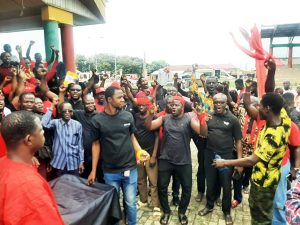
It will rather engage the media to highlight the plight of local producers and also consider peaceful demonstrations to defend Ghanaian jobs and production capacity.
From Oswald P. Freiku, Kumasi
For more news, join The Chronicle Newspaper channel on WhatsApp: https://whatsapp.com/channel/0029VbBSs55E50UqNPvSOm2z