Nepal’s Prime Minister Balen Shah has repeatedly called for his country to be treated as an equal by its powerful neighbours. His first visit to the Indian capital, Delhi, put that approach to the test, as both sides sought to reset a relationship strained by years of friction.
The contrast between the two leaders was striking.
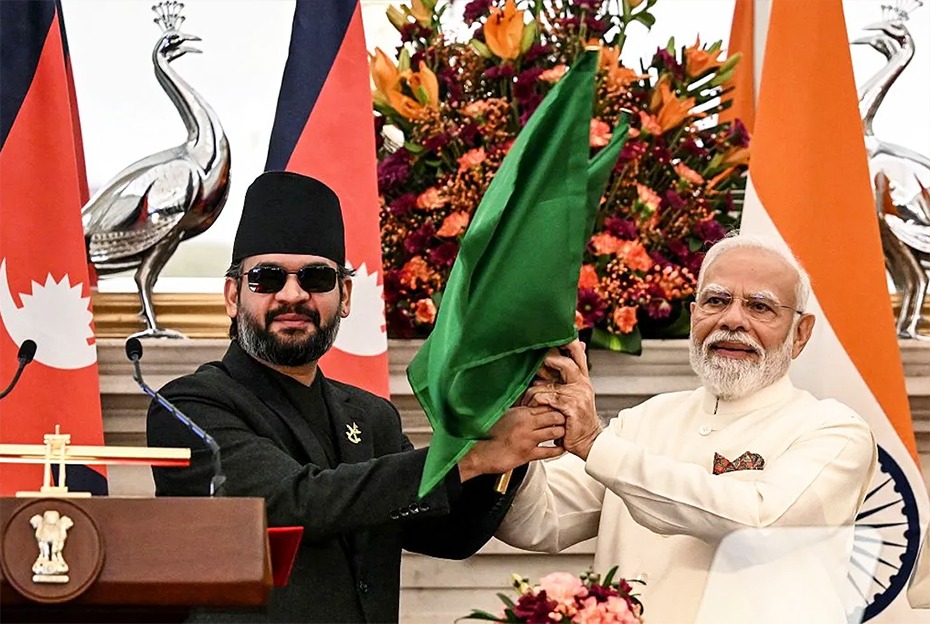
Shah, 36, wearing his trademark black suit and sunglasses, stood beside Prime Minister Narendra Modi, 76, dressed in white. Shah rose to power after a wave of Gen Z-led protests toppled his predecessor.
Modi, meanwhile, is serving a third term and has recently faced student-led protests in India.
Yet, the two leaders seemed determined to project warmer relations. They exchanged gifts, inspected a military guard of honour and jointly flagged off a new cross-border train service.
For Nepal, the stakes were about far more than repairing diplomatic ties.
The two countries announced a series of agreements covering trade, hydropower, transport and education for Nepali youths.
India, more crucially, unveiled a $1.6bn (£1.22bn) support package as Nepal recovers from devastating floods earlier this year.
The floods killed more than 1,400 people, with thousands still missing. Shah’s government has faced criticism over support for families which lost homes and loved ones.
The country faces a huge reconstruction challenge. The government estimates rebuilding could cost as much as $4.8bn. Addressing the UN General Assembly in September, Shah warned that when climate disasters devastate poorer countries, “the answer cannot simply be another mega-loan”.
Modi pledged nearly $1.6bn in Indian support. Most of it will come as a line of credit for energy projects, alongside about $400m in grants for reconstruction and infrastructure.
Credit: bbc.com