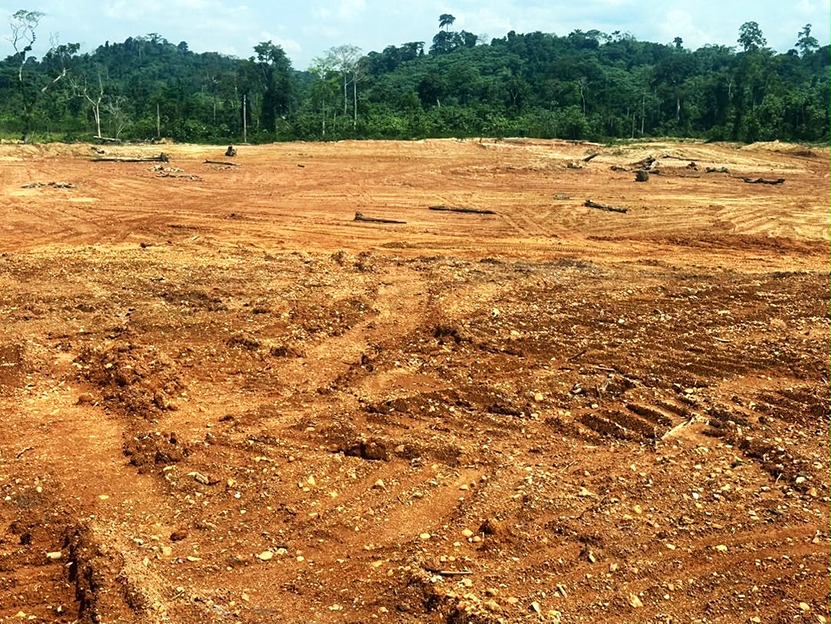
The Ghana Gold Board (GoldBod), in collaboration with the Ghana Armed Forces, has reclaimed 50 hectares of degraded land in the Tano-Nimiri Forest Reserve in a major intervention aimed at reversing the environmental destruction caused by illegal mining.
The first phase of the reclamation project, undertaken by the military’s 14 Engineer Brigade, has been completed, with the reclaimed land formally handed over to GoldBod for onward transfer to the Forestry Commission for reforestation and long-term ecological restoration.
The project, initiated by GoldBod as part of its Corporate Social Responsibility (CSR) commitments, involved the filling of abandoned mining pits, stabilisation of degraded land, reconstruction of access infrastructure and establishment of a Forward Operating Base to support the protection of the forest reserve.
Speaking at the handover ceremony on behalf of GoldBod’s Chief Executive Officer, Sammy Gyamfi, the Deputy Director of Mining Operations, James German, described the intervention as evidence of what could be achieved through collaboration among state institutions in addressing environmental degradation.
He said the transformation of the forest compartment following the engineering works demonstrated the importance of combining technical expertise, institutional cooperation and a shared commitment to environmental protection.
Mr German stressed that responsible mining must go beyond regulatory compliance to include practical measures that protect natural resources and ensure lasting benefits for the country.
In a technical presentation, the Commander of the 14 Engineer Brigade, Brigadier General Richard Kinney, disclosed that the military identified 10 major abandoned mining pits in Forest Reserve Compartment 161, alongside several smaller excavations. Some of the pits, which contained stagnant water, were approximately 20 feet deep and between 30 and 50 metres wide.
He said the reclamation involved dewatering and filling the pits, reshaping the landscape, stabilising waterlogged soil and restoring natural drainage systems to minimise erosion.
The Brigade also reopened watercourses obstructed by illegal mining activities to facilitate the movement of accumulated water and restore natural water flow.
Brigadier General Kinney said the exercise faced significant logistical challenges, particularly following flooding that damaged eight bridges along the access route to the project site.
The Brigade subsequently reconstructed all eight bridges and cleared and extended most sections of the 13.6-kilometre access road to facilitate the movement of personnel, materials and heavy-duty equipment.
Despite persistent rainfall and difficult ground conditions, he said the officers and soldiers remained committed to completing the assignment within the envisaged timeframe.
Beyond the reclamation works, the project included the establishment of a Forward Operating Base comprising 10 prefabricated containers designed to accommodate 10 Forestry Commission personnel.
The facility has been equipped with a borehole, solar-powered electricity, washrooms, a kitchen and other essential amenities to support personnel stationed at the remote forest location. A chain-link fence has also been installed around the facility to provide an initial layer of security.
Brigadier General Kinney said the presence of Forestry Commission personnel would be critical to preventing renewed illegal mining and protecting the reclaimed land.
He warned that without sustained monitoring, patrols and effective enforcement, the investment made in restoring the 50 hectares could be undermined by fresh encroachment.
Mr German disclosed that the arrangement with the Forestry Commission covered a 10-year period to ensure sustained ecological restoration and monitoring.
He said the Commission would undertake tree planting and other restoration activities, emphasising that the success of the project should be measured not only by the hectares reclaimed, but also by the survival of planted trees, stability of the landscape and eventual recovery of the forest ecosystem.
He commended the 14 Engineer Brigade for its technical contribution and acknowledged the support of the Ministry of Defence, Forestry Commission, regulatory agencies, Samatex, traditional authorities and surrounding communities.
The Tano-Nimiri intervention is expected to provide a framework for closer institutional collaboration in restoring forest reserves degraded by illegal mining, while strengthening efforts to protect Ghana’s natural resources.
For more news, join The Chronicle Newspaper channel on WhatsApp: https://whatsapp.com/channel/0029VbBSs55E50UqNPvSOm2z