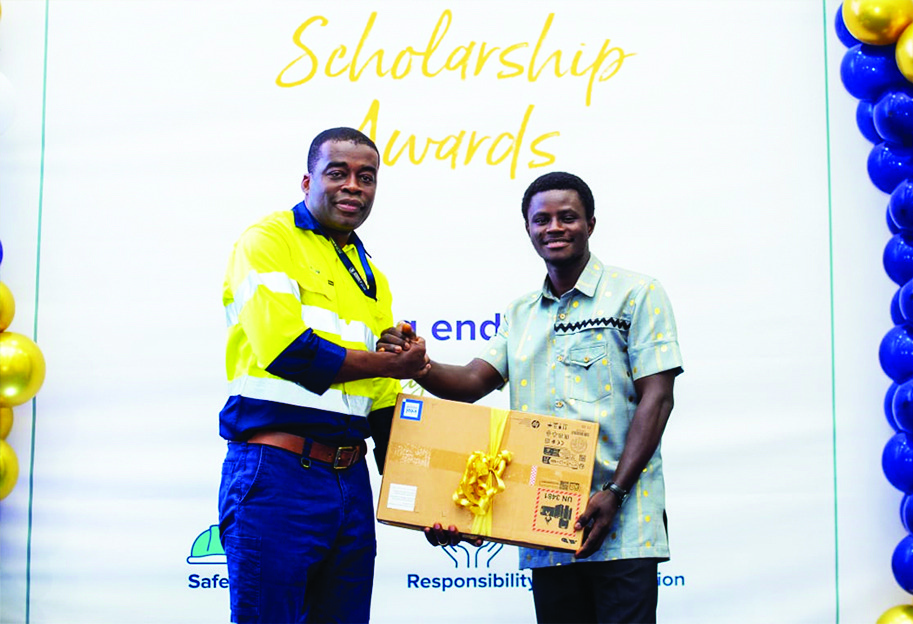
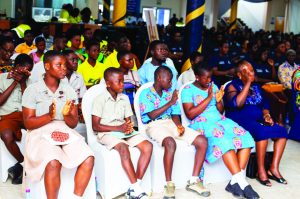
For many parents gathered at the Akoon Club House in Tarkwa on Thursday, the moment their children’s names were called one after another to receive scholarship awards was more than a ceremony—it was a moment of pride, relief and renewed hope.
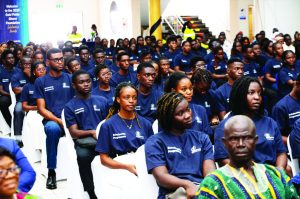
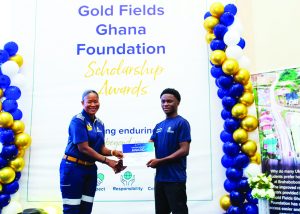
As the young beneficiaries walked forward to formally join the Gold Fields Ghana Foundation scholarship family, parents watched with visible satisfaction, knowing that a significant financial burden associated with their wards’ tertiary education had been lifted.
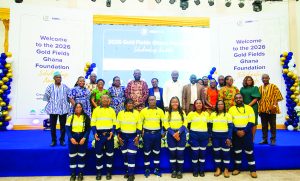
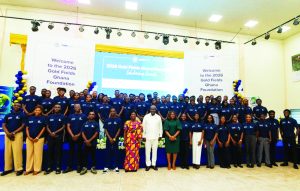
A total of 150 tertiary students, including 86 females, have been awarded scholarships by the Gold Fields Ghana Foundation, with each beneficiary guaranteed support for the next four years of tertiary education.

The package provides GH¢9,500 annually towards school fees and accommodation, together with a GH¢1,000 stipend, giving each beneficiary an annual support package of GH¢10,500.
But for one former beneficiary, George Kwame Afenyo, the significance of the scholarship went far beyond the figures.
Speaking at the ceremony, Mr Afenyo offered an emotional account of how the Foundation’s support helped him pursue the education he had once feared might remain beyond his reach.
He recalled a period after secondary school when he desperately wanted to continue his education but lacked the financial means to do so.
At one point, he said, he went to a work site hoping to earn money to support his education, only to encounter an explosion involving dynamite.
The frightening experience, he said, made him realise that he could not continue putting himself in such difficult circumstances.
He subsequently moved from place to place, taking whatever work he could find to make ends meet, while holding on to his dream of becoming a renowned accountant.
His admission to a tertiary institution eventually became a reality, but the cost of admission and other educational expenses presented another major obstacle.
“I had the admission, but I did not have the financial means to take advantage of the opportunity,” he recounted.
Then came the announcement that changed the course of his life.
He heard on community radio about the Gold Fields Ghana Foundation scholarship, applied and was eventually selected.
For him, the award was more than financial assistance.
“It was not merely a scholarship. It was a blessing. It was an opportunity. It was a second chance,” he said.
Looking back, Mr Afenyo said his experience had taught him that sometimes all a person needed to change the course of his or her life was one opportunity.
His testimony also gave a deeply personal dimension to the ongoing public discussion about the future of Gold Fields’ mining operations in Tarkwa.
“For people like me, this is not simply a conversation about a company or a lease.
It is about the opportunities that have been created in the lives that have been touched through the Foundation’s interventions,” he said.
He appealed for the continuation of programmes that support education and create opportunities for young people in mining communities.
The Vice President, Community Relations of Gold Fields Ghana Limited, Dr Celestine Allotey, said the scholarship programme reflected the company’s conviction that education was central to the sustainable development of its host communities.
She said that since the programme was introduced in 2005, a total of 3,092 students had benefited from the Gold Fields Ghana Foundation scholarship.
According to her, past beneficiaries had gone on to become doctors, engineers, lawyers, teachers, entrepreneurs and professionals in various fields.
Among them are Prof. Ishamel Quaicoe of the University of Mines and Technology, Dr Grace Nyarko, an optometrist at the Presbyterian Hospital-Agogo, Mr Ebenezer Asmah, a Metallurgy Superintendent at Heath Gold Fields, and Dr Noah Kofi Essel of Tarkwa Municipal Hospital.
Dr Allotey said the Foundation’s educational interventions extended beyond scholarships to the provision of classroom blocks and furniture, potable water, a smart laboratory and innovation centre, reading materials and additional learning opportunities.
She disclosed that more than 40,000 learning materials had been distributed to children in the company’s host communities.
She said 50 of the 150 new scholarship beneficiaries had received their basic education in schools within Gold Fields’ host communities outside the greater Tarkwa area, describing this as a source of pride for the Foundation.
“The classroom blocks that Gold Fields provided in Awudua, Brahabobom, Huniso, Pepesa, Samahu, New Atuabo, Abekoase and Tebe are churning out students to feed the scholarship programme,” she said.
Dr Allotey also announced the introduction of a “Lecture Hall to Workplace” series during vacation periods to equip beneficiaries with practical skills and prepare them for the world of work.
The Sustainability Manager of Gold Fields Ghana, Nana Kwabena Siaw, urged the beneficiaries to recognise that the opportunity came with responsibility.
He encouraged them to remain focused, disciplined and committed to academic excellence while maintaining high standards of integrity.
Nana Siaw said past beneficiaries were making meaningful contributions as doctors, engineers, miners, consultants and professionals in different sectors.
The Vice Chancellor of the University of Mines and Technology, Prof. Bernard Kumi Boateng, meanwhile, praised Gold Fields for its community interventions and urged the company to deepen its educational footprint.
He disclosed that following discussions on the need to transform classrooms into smart learning environments, Gold Fields had expressed willingness to provide smart boards to the university in phases.
Prof. Kumi Boateng also challenged the mining company to consider constructing a faculty block at UMaT, estimated at US$1.5 million, as part of its enduring legacy.
He argued that while mining activities would eventually cease, educational institutions would remain and continue shaping generations long after the minerals had been extracted.
He described Gold Fields Ghana as representing “the gold standard” for corporate community engagement in Ghana, citing its infrastructure investments, livelihood programmes, local employment and community partnerships.
For the 150 beneficiaries, however, the ceremony was ultimately about opportunity.
And perhaps no one captured that meaning more poignantly than the former beneficiary whose own journey from financial hardship, uncertainty and a dangerous work environment to tertiary education and a professional career demonstrated the transformative power of a helping hand.
As Mr Afenyo put it, sometimes all a person needs to change the course of a life is one opportunity.
For more news, join The Chronicle Newspaper channel on WhatsApp: https://whatsapp.com/channel/0029VbBSs55E50UqNPvSOm2z