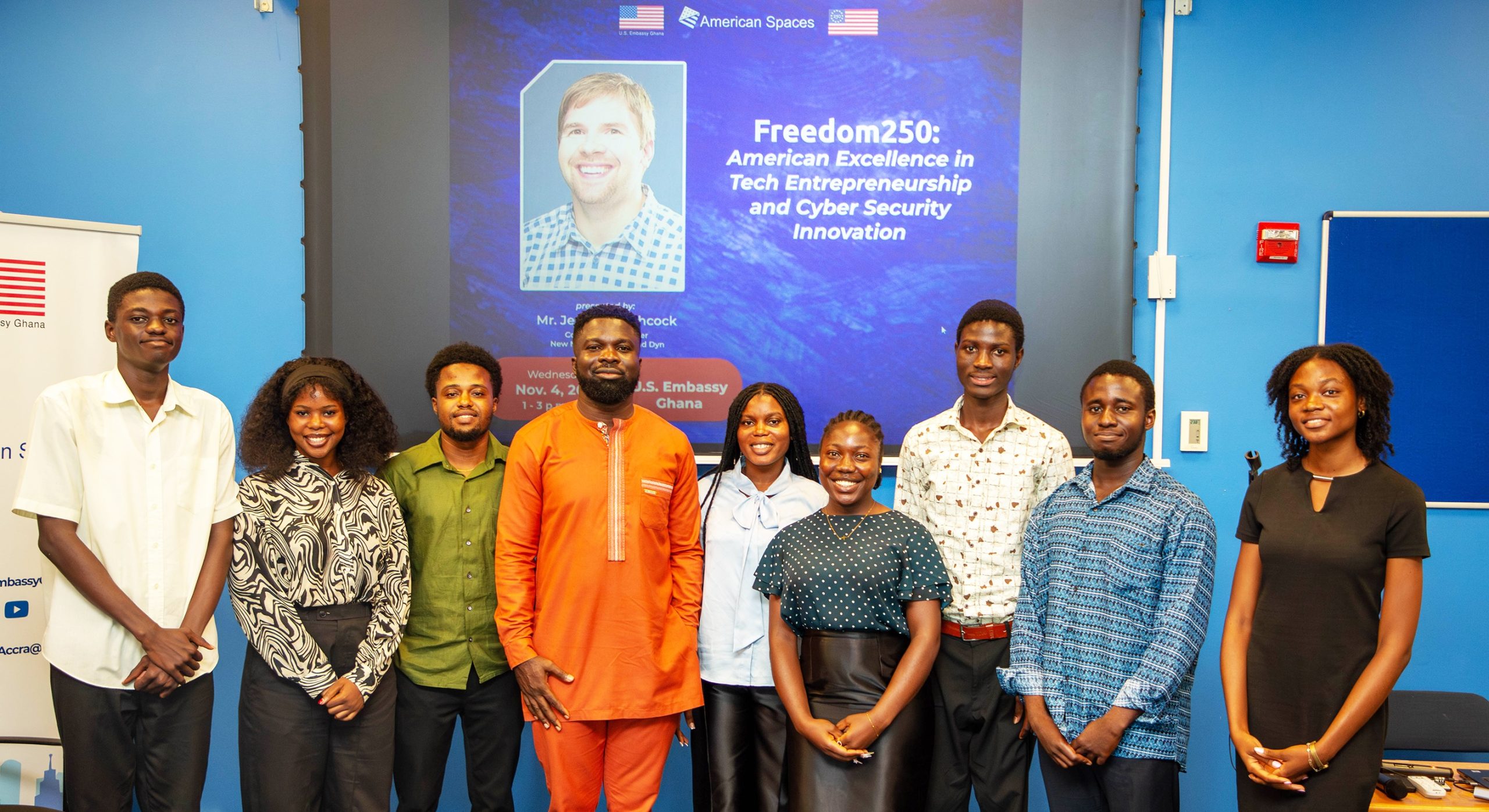
Ghanaian university students have been challenged to identify everyday problems and develop innovative technology solutions that can be transformed into sustainable businesses.
Jeremy Hitchcock, co-founder of Technology Company, Dyn and partner at New North Ventures, said successful entrepreneurship often began with recognising a problem and developing a practical solution that could create value for society.

He gave the advice during a virtual address at a technology and entrepreneurship forum organised by the United States Embassy in Accra as part of activities marking the 250th anniversary of the United States of America.
The programme, dubbed Freedom250: America Excellence in Tech Entrepreneurship and Cybersecurity Innovation, brought together university students, technology entrepreneurs and other stakeholders to discuss innovation, business development, artificial intelligence (AI) and cybersecurity.
Mr Hitchcock encouraged aspiring entrepreneurs to focus on solving genuine problems rather than pursuing innovation for its own sake.
Drawing on his entrepreneurial experience, he explained how developing technology solutions to address internet infrastructure and reliability challenges could create significant business opportunities.
He outlined four considerations for evaluating business ideas: the actual demand for the product, the benefits relative to its cost, the suitability of the approach to current technological trends and the level of competition.
He stressed that an innovative idea must address a genuine need, offer benefits that justify its cost and be accessible to its intended users.
Cybersecurity And Infrastructure Reliability
Mr Hitchcock also highlighted the importance of cybersecurity and reliable digital infrastructure, explaining that technology services were often taken for granted until they stopped working.He cited the Domain Name System (DNS), which helps direct internet users to websites, as an essential component of reliable online services.
He said the financial implications of service interruptions, particularly for major online businesses, reinforced the need to make reliability an integral part of technology products.
He also discussed the October 21 distributed denial-of-service (DDoS) attack, which demonstrated how compromised internet-connected devices could be mobilised to overwhelm websites and disrupt online services.
According to him, connected devices, including security cameras and other smart appliances, could become security vulnerabilities when compromised and made to perform activities beyond their intended functions.
He advocated stronger security measures to monitor communication between connected devices and restrict suspicious network activities.
AI Presents Opportunities And Risks
On artificial intelligence, Mr Hitchcock encouraged participants to understand the technology and explore practical ways of applying it in their businesses and professional activities.
He explained that AI systems, particularly chat-based tools, were effective at processing large volumes of information and identifying patterns to generate responses.
However, he cautioned that the same capabilities could be exploited by malicious actors to develop more sophisticated cyberattacks.He, therefore, urged individuals and organisations to explore AI’s potential in strengthening cybersecurity while remaining conscious of its associated risks.
He also encouraged students to remain curious and use AI as a tool to support their thinking and learning rather than depend on it entirely.
Cybersecurity Awareness Essential
A digital marketing and transformation strategist, Cherubim Mawuli Amenyedor, in an interview with The Chronicle, described cybersecurity as an increasingly important subject for Ghana and the wider African continent.
He said the growing dependence on digital platforms, particularly for financial transactions, made cybersecurity awareness essential for individuals, businesses and institutions.
Mr Amenyedor identified phishing, which involves using deceptive messages or websites to obtain sensitive information, as one of the threats internet users must guard against.
He advised users to avoid clicking suspicious links, connecting indiscriminately to unfamiliar Wi-Fi networks and downloading files from untrusted websites. He also called for continuous cybersecurity education and training, stressing that organisations could be vulnerable if employees failed to observe basic security practices.
Mr Amenyedor said the discussion was particularly relevant to Ghana because of the widespread adoption of mobile money, which had also exposed users to digital fraud and other cybersecurity threats.
He urged students to take advantage of AI and emerging technologies to expand their knowledge, acquire practical skills and explore opportunities in the technology industry.
For more news, join The Chronicle Newspaper channel on WhatsApp: https://whatsapp.com/channel/0029VbBSs55E50UqNPvSOm2z