Open Knowledge Ghana has called for digital platforms to be designed to accommodate persons with disabilities, saying the free flow of information has little value if people cannot independently access and use it.
The organisation’s Director, Joris Darlington Quarshie, said digital accessibility must be considered an essential part of the open-knowledge movement and not treated as an additional feature to be incorporated at the final stage of developing digital products.
He said while open knowledge promotes the free use, sharing and redistribution of information, research and data, the principle could not be fully achieved if websites, applications, software and electronic documents remained inaccessible to people with disabilities.
“Openness without accessibility is an incomplete promise,” he said.
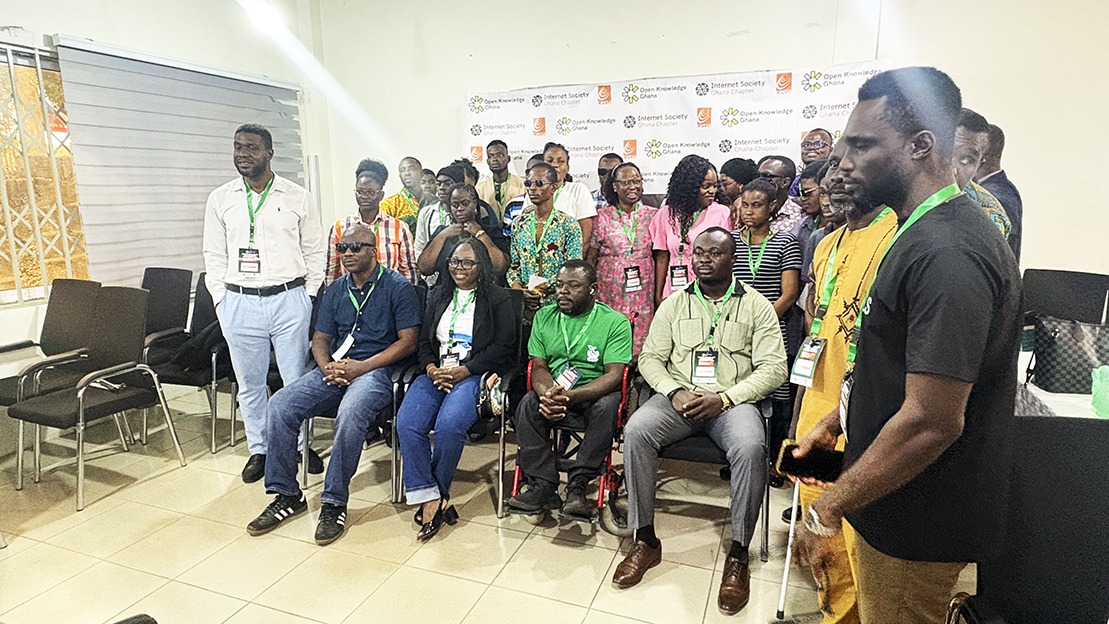
Mr Quarshie made the call at a digital accessibility training workshop for persons with disabilities in Accra, organised by Open Knowledge Ghana in collaboration with the Internet Society Ghana Chapter and CIPESA.
The workshop brought together web developers and persons with different impairments to explore barriers to digital access and provide practical training on assistive technologies and accessible digital design.
Mr Quarshie said digital accessibility involved designing websites, mobile applications, software and electronic documents so they could be navigated and used by people with visual, hearing, motor or cognitive impairments.
He questioned the value of an open-source database if a screen reader could not access its information or a digital platform could not be navigated using a keyboard.
According to him, accessibility should not be reduced to a checklist or something considered only during the final stages of development.
“Accessibility is not a niche. It is a fundamental human right. It is a practice of empathy in engineering, ensuring that no one is left stranded on the wrong side of the digital divide,” he said.
He said the training would examine accessibility standards, practical approaches, best practices and challenges to help stakeholders build digital environments that could be used by everyone.
The President of the Internet Society Ghana Chapter, Dr. Maud Ajele Ashomelu, supported the call, saying persons with disabilities must be involved from the beginning of the development of websites, mobile applications and other digital platforms.
She said developers should not wait until a platform had been completed before attempting to introduce accessibility features, as persons with disabilities could identify barriers that developers might otherwise overlook.
“We want to make sure that they are engaged from the beginning,” she said.
Dr. Ashomelu said accessibility requirements differed depending on a person’s impairment, citing the need for magnification features for persons with visual impairments and transcription for deaf users to access video content.
She also called for persons with disabilities to be considered in policies guiding Ghana’s digital transformation.
“Our interest is to make sure that everybody is involved. We want everybody to be part, everybody to be connected,” she said, describing internet access as a fundamental human right.
Inaccessible platforms hinder basic services
For Ephraim Urakatete, an Assistive Technology Facilitator and technology coordinator who is visually impaired, the consequences of inaccessible digital platforms are already being experienced by persons with disabilities.
He said inaccessible mobile applications and websites could prevent persons with disabilities from independently carrying out basic transactions.
Mr Urakatete said some financial institutions’ mobile applications were not sufficiently accessible, making it difficult for him to send money independently.
He also cited difficulties encountered on government websites when attempting to complete registrations.
He explained that visually impaired users relied on assistive technologies such as TalkBack, which provides audio feedback to enable users to navigate smartphones, as well as keyboard navigation.
However, he said these tools could only work effectively when websites and applications were designed to accommodate them.
“I might not be able to use the mouse, but then I also have the chance to use the keyboard alone to access that information. But if the platform is not made in a way that I can do that, it becomes a problem for me,” he said.
Mr Urakatete said the problem could go beyond inconvenience and result in emotional frustration, particularly when users needed to perform urgent tasks.
He cited instances where a person could spend between 30 minutes and an hour trying to purchase airtime through an application because of accessibility barriers.
He welcomed the workshop, saying it created an opportunity for developers and persons with disabilities to interact directly and understand each other’s needs.
He said such collaboration could help developers incorporate accessibility requirements from the beginning rather than attempting to correct problems after development.
‘You have been excluded’
Another visually impaired participant, Joseph Seyina Susu, said poorly configured websites could prevent screen-reader users from completing tasks that sighted users could perform easily.
He explained that when a website was properly configured, speech software could read information on the screen, allowing a visually impaired user to navigate it independently.
However, some websites failed to make essential features accessible, he said.
Mr Susu cited online forms where a visually impaired user could complete all the required fields but could not locate or activate the “submit” button using assistive technology.
“You have been excluded,” he said.
He said widespread implementation of digital accessibility across websites and applications in Ghana could give persons with disabilities access to information and services on an equal footing with other citizens.
“As a visually impaired person, the world is huge and it’s at our disposal if only the right things are done,” Mr Susu said.
He said ensuring that digital platforms were properly configured would make it easier for persons with disabilities to access information, complete online transactions and participate fully in Ghana’s increasingly digital society.