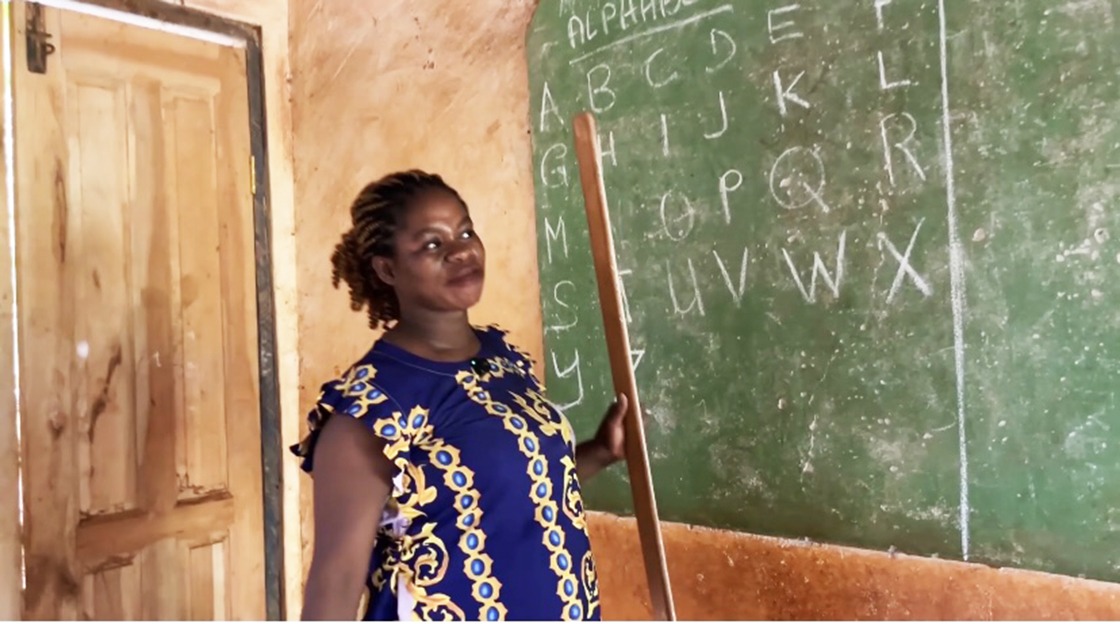
A pregnant teacher at Desreagya D/A Basic School in the Atwima Mponua District of the Ashanti Region, Mrs Emilia Asantewaa, is battling difficult working and living conditions as she struggles to teach five classes in a single classroom.
With only three functioning classrooms available at the school, Mrs Asantewaa has been compelled to combine Kindergarten One (KG1) to Primary Three in a classroom originally designated for Junior High School (JHS) One.
The situation requires her to divide the chalkboard into four sections to accommodate pupils at different stages of learning, while moving between the sections to deliver lessons.
The challenges are not limited to her classroom. Other teachers also have to combine classes because of the shortage of functioning classrooms and inadequate teaching staff.
Pupils from Primary Four to Primary Six are taught together in the JHS Two classroom by one teacher, while the three JHS classes are also combined in a single classroom.
The arrangement has resulted in overcrowding, with pupils having to share limited classroom space as teachers struggle to attend to the different groups.
For Mrs Asantewaa, who has taught in the community for the past four years, the situation makes her daily responsibilities particularly demanding.
Dilapidated Structures
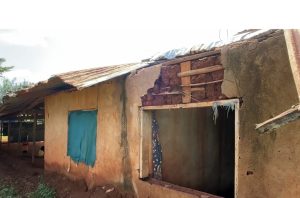
The school’s infrastructure challenges are further compounded by the condition of its buildings. A block originally intended to serve as teachers’ accommodation has deteriorated considerably, with cracks developing in its walls and raising concerns about its structural safety.
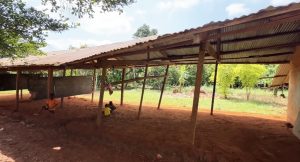
A thatched pavilion, which was intended to provide additional classroom space for pupils, is equally unsuitable for teaching and learning. The makeshift structure has no cemented floor or block walls, leaving pupils exposed to the elements and without adequate protection from unfavourable weather conditions.
The poor state of the facilities has left the school struggling to provide a safe and conducive learning environment for its pupils.
Beyond the challenges at school, Mrs Asantewaa also has to contend with difficult living conditions.
The pregnant teacher, who lives in the community with her daughter, occupies a deteriorating mud structure serving as teachers’ quarters.
She said the roof leaks whenever it rains, sometimes forcing her to wake up in the middle of the night to mop water from the room.
She is particularly worried about a weakened section of the building, which she fears could collapse at any time and leave her without accommodation.
Mrs Asantewaa also recounted an incident in which a snake entered her room without her knowledge. To prevent snakes and other animals from entering through openings beneath the doors, she and her daughter have resorted to placing pieces of cloth around them.
MCE Explains
When contacted by The Chronicle, the Municipal Chief Executive (MCE) for Atwima Mponua, Mr Ibrahim Ishaq, attributed the combination of classes primarily to inadequate teaching staff. He explained that the school had classrooms, but lacked sufficient teachers to handle the various classes separately.
Mr Ishaq said the Assembly had constructed a classroom block at the school before he assumed office.
He acknowledged the competing educational infrastructure needs across the district, which has approximately 140 schools spread across 400 communities and said the Assembly was addressing them based on available resources.
He gave an assurance that Desreagya would be considered under the Assembly’s planned classroom construction programme by next year.On the teachers’ accommodation, the MCE said discussions were ongoing with the community to find a solution.
He explained that the Assembly was prepared to provide building materials, including cement, while the community would contribute towards constructing decent accommodation for teachers.
Teacher retention challenge
Mr Ishaq further identified the movement of teachers from rural communities as a major challenge affecting education delivery in the district.
He said some teachers posted to remote communities sought transfers after two or three years, leaving schools struggling with staffing shortages.
To encourage teachers to remain in underserved communities, he said the Assembly had introduced motivational packages for those who had served in remote areas for extended periods.
He disclosed that some teachers who had remained in such communities for considerable periods received incentives last year.
He acknowledged that some teachers had genuine reasons for seeking transfers but said the Assembly was exploring measures to encourage them to remain at their posts.