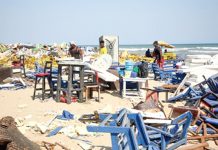
The devastating floods that swept through parts of Greater Accra and other communities in southern Ghana after Monday’s torrential rains have left a trail of destruction, claiming at least 12 lives, displacing 38,802 people and leaving seven others missing.
Briefing Parliament on Tuesday, 30 June, 2026 the Minister for the Interior, Mohammed Muntaka Mubarak, disclosed that 7,761 households had been displaced across 18 metropolitan and municipal assemblies, making the disaster one of the country’s worst in recent years. He revealed that the 169 millimetres of rainfall recorded on June 29 was the fourth-highest single-day rainfall Ghana has experienced since 1995.
Communities including Ga East, Ledzokuku, Ayawaso Central, Korle Klottey, Tema, Weija-Gbawe, Adenta, Ga South and several others suffered extensive flooding, with thousands forced from their homes and businesses disrupted.
In response, President John Dramani Mahama directed the immediate release of GH¢300 million from the Contingency Fund to support relief and flood mitigation efforts. Of the amount, GH¢150 million has been earmarked for emergency assistance to flood victims, while the remaining GH¢150 million will finance measures aimed at preventing future flooding.
The President also ordered the deployment of personnel from the Ghana Armed Forces and the Ghana Police Service to assist the National Disaster Management Organisation (NADMO) and other emergency agencies in rescue and relief operations.
The announcement by President John Dramani Mahama releasing GH¢300 million from the Contingency Fund is a welcome intervention at a time when thousands of Ghanaians are facing unimaginable hardship.
For families who have lost loved ones, homes, businesses and every possession they worked years to acquire, government assistance cannot come soon enough.But beyond the announcement lies the real test, thus, implementation.
History has taught us that disaster relief can sometimes become clouded by politics, favouritism and bureaucracy. This must not happen. Every cedi allocated for relief must reach those who genuinely need it, regardless of their political affiliation, religion, ethnicity or social status. Floodwaters did not discriminate between supporters of one political party and another; therefore, relief must not discriminate either.
The President spoke passionately about integrity, accountability and moral transformation. Those words must now guide every official entrusted with distributing the relief items and funds. No official should sit on resources meant for victims while families sleep in schools, churches or on verandas. Delays can cost lives just as surely as the floodwaters did.
Equally important is transparency. The public deserves to know how the GH¢150 million earmarked for relief is being spent, who the beneficiaries are and how the distribution process is being monitored. Openness will inspire confidence and prevent allegations of partisan allocation or misuse.
Government should publish a comprehensive list of beneficiaries, clearly indicating the names of communities, households or individuals who receive assistance and the nature of the support each beneficiary receives, whether cash, food items, building materials or other relief supplies. Such openness will not only reassure the public that the assistance is reaching the intended victims but will also discourage favouritism, political patronage and the diversion of relief resources.
The remaining GH¢150 million intended for flood mitigation must also not disappear into endless studies and paperwork. Ghanaians expect visible action, desilting drains, enforcing building regulations, improving drainage infrastructure and tackling indiscriminate development on waterways. Unless these long-standing issues are addressed, the nation will continue counting lives and rebuilding communities after every heavy rainfall.
Government must also recognise that the rainy season is far from over. Weather forecasts continue to predict more rains, making it imperative to move vulnerable residents from flood-prone communities to safe temporary shelters before another tragedy strikes. Waiting until another disaster unfolds would amount to reacting instead of preventing.
We also call on Parliament to exercise its constitutional oversight responsibility over the entire GH¢300 million intervention. Members of Parliament, irrespective of political affiliation, must ensure that every pesewa is accounted for and that both the GH¢150 million earmarked for emergency relief and the GH¢150 million allocated for flood mitigation are spent strictly for their intended purposes.
Parliamentary committees should demand periodic reports from the implementing agencies, while the Auditor-General and other accountability institutions should closely monitor the utilisation of the funds. At a time when thousands of Ghanaians have lost everything, there must be no room for waste, abuse or corruption.
Today, thousands of Ghanaians are depending on the State not merely for promises but for protection, shelter and hope.
The victims have lost enough already. They should not also lose confidence that their government will stand with them in their darkest hour. Let compassion prevail over politics, urgency over bureaucracy and service over self-interest.
For more news, join The Chronicle Newspaper channel on WhatsApp: https://whatsapp.com/channel/0029VbBSs55E50UqNPvSOm2z