Walk into any market, street corner, or university campus at lunchtime in Ghana, and the scene is identical. From steaming hot waakye and jollof to freshly fried fish, our favorite local delicacies are served the same way: piping hot, wrapped in a bright white, feather-light Expanded Polystyrene (EPS) box. Better known to all of us as Styrofoam or a takeaway box.
It is convenient. It is cheap. But it is carrying a hidden, permanent cost that our environment and our children cannot afford to pay.
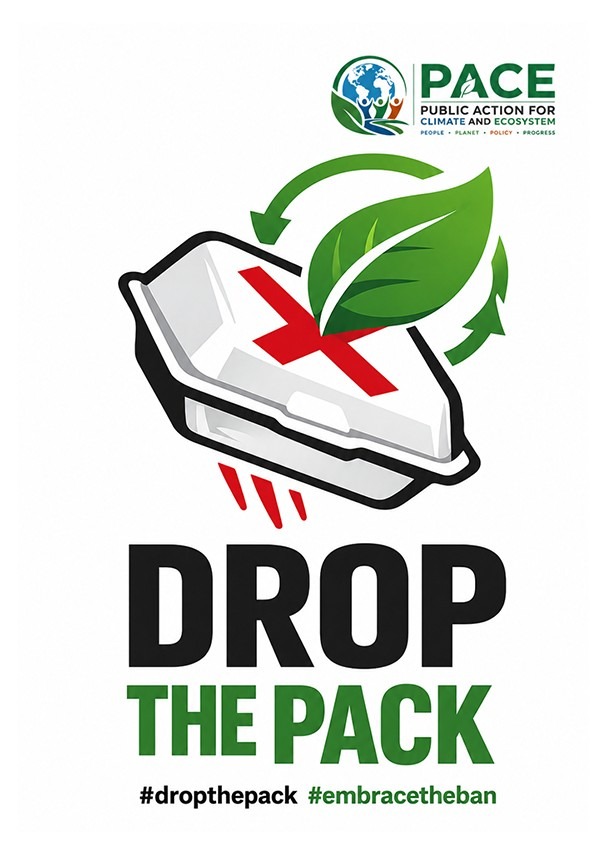
The Government of Ghana has announced that by 2027, Styrofoam packaging will be banned nationwide as part of its effort to reduce plastic pollution. With the clock ticking, a student-led social change movement, Public Action for Climate and Ecosystem (PACE), has launched a nationwide wake-up call titled the “DROP THE PACK” Campaign.
Our message is simple, bold, and urgent: “Your lunch box outlives your grandchildren. Choose better.”
The 500-Year Ecological Crisis
The convenience of a Styrofoam container lasts roughly twenty minutes, the time it takes to finish a meal. Yet, that very same box will persist in Ghana’s ecosystem for over 500 years. Because Styrofoam does not biodegrade, it merely breaks down into microplastics, choking our drainage systems, fueling floods in Accra, Kumasi, and other cities, and polluting our ocean waters.
When marine life consumes microplastics, those particles move up the food chain and ultimately reach us, creating serious long-term health risks. Furthermore, serving boiling food in Styrofoam releases toxic chemicals like styrene, which have been linked to long-term health complications. We are quite literally poisoning our bodies and our soil for temporary convenience.
The Alternatives Exist Right Now
The most common pushback to the upcoming 2027 ban from local food vendors is cost and accessibility. But the “DROP THE PACK” campaign is proving that an eco-friendly Ghana is not only possible; it is already within reach. Ghana is rich in indigenous, sustainable alternatives that can seamlessly replace toxic plastics.
One option is biodegradable paper packaging, which offers clean and sturdy containment for dry and semi‑wet foods. Another is a return to tradition, where waakye and other meals were beautifully served in plantain or banana leaves; embracing these organic materials would support local farmers, add a distinct traditional flavor, and leave zero footprint on the earth.
A further alternative is the reusable revolution, where consumers adopt the simple habit of carrying their own reusable glass, steel, or heavy‑duty lunch boxes to the vendor. Together, these suggested practices show that Ghana has practical solutions ready to move beyond Styrofoam and plastics toward a cleaner, greener future.
While eco-packaging currently carries a 20% to 35% cost differential compared to Styrofoam, the gap closes drastically as demand increases. More importantly, the cost of clearing clogged gutters, treating plastic-induced illnesses, and managing environmental degradation far outweighs a few extra pesewas on a food container.
A Multi-Channel Movement for National Awakening
Transitioning Ghana away from Styrofoam cannot happen overnight through top-down legislation alone; it requires a deep, grassroots behavioral shift. This is why the 55-day “DROP THE PACK” campaign bridges the gap between digital advocacy and traditional Ghanaian community structures.
Online, PACE is using its digital spaces to make environmental consciousness trendy for Gen Z through educational deep dives like “The Foam Files” and “The 2027 Countdown.” Offline, PACE will take the conversation directly to the hearts of local trade by organizing community durbars, partnering with local radio, and holding town-hall engagements with Market Association Queens to ensure that everyday vendors at Makola, Madina, Kejetia, or any other market are not left behind. Vendors who commit to the transition will be designated as “PACE Champions,” receiving visible branding to attract an increasingly eco-conscious consumer base.
The Time to Pivot is Today
The year 2027 is not a distant date; it is a fast-approaching reality. We cannot afford to wait until the ban takes effect to scramble for solutions.
Policy makers must subsidize the importation and production of eco-friendly raw materials. Industrial manufacturers must pivot their factories toward biodegradable alternatives. Most importantly, you and I must make a conscious choice every single day at the food stall and fast-food joints.
The next time you buy your lunch, look at the container. Remember that your choices shape the landscape of tomorrow. Let us honor our culinary heritage without destroying our environment.
Let us all come together to DropthePack and EmbracetheBan.
By Public Action for Climate and Ecosystem (PACE).
A student-led social movement by MA Development Communication students, University of Media, Arts and Communication – UniMAC IJ, undertaken in fulfillment of Communication for Social Change.
For more news, join The Chronicle Newspaper channel on WhatsApp: https://whatsapp.com/channel/0029VbBSs55E50UqNPvSOm2z