The Bank of Ghana (BoG) has intensified its financial literacy campaign among senior high school students in the Western Region, with the objective of equipping young people with the knowledge and skills needed to make sound financial decisions and protect themselves against financial fraud.
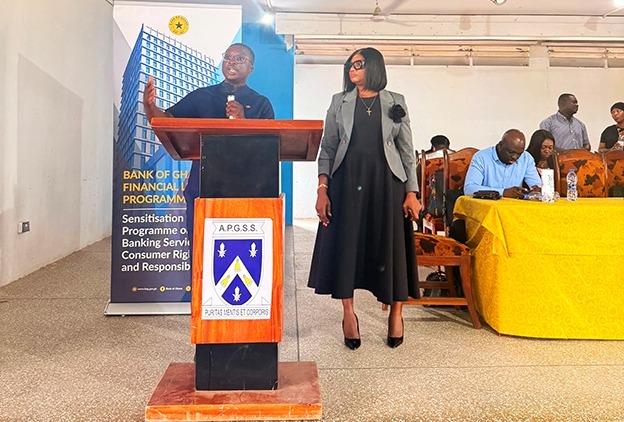
The initiative, which was led by Mr. Godfred Cudjoe, and Florence Addo-Quaye of the Financial Stability Department of the Bank of Ghana and covered selected second-cycle institutions in the region, forms part of the central bank’s broader public education campaign to deepen financial inclusion and promote responsible financial behaviour among Ghanaians.
In an interview during the programme at Archbishop Porter Girls’ Senior High School, Mr. Godfred Cudjoe said the central bank decided to extend the campaign to senior high schools after successfully educating market women and the general public through radio, television and social media.
According to him, the objective is to “catch them young” by exposing students to basic financial concepts that will help them make informed financial decisions while enabling them to educate their parents and guardians.
“We want the same knowledge with the kids. Once they go home, they’ll be able to explain some of the things to their parents and they themselves will be able to make sound financial decisions,” he said.

Mr. Cudjoe disclosed that the exercise is currently being undertaken in two regions, with about 10 schools selected in the Western Region, including Archbishop Porter Girls’ Senior High School.
He said students were taken through a wide range of topics, including responsible savings and investment, their rights and responsibilities as customers of financial institutions, how to identify Bank of Ghana-licensed financial institutions, safeguarding personal banking information and passwords, complaint handling procedures and how to identify warning signs of financial fraud.
The participants were also educated on dormant accounts and unclaimed balances, with officials explaining the importance of keeping bank accounts active through regular transactions to prevent them from becoming dormant.
As part of efforts to promote responsible borrowing, the students received lessons on credit management, the responsibilities of guarantors and the risks associated with digital or mobile loans.
Mr. Cudjoe urged the students to educate their parents on the importance of repaying digital loans, warning that failure to honour such obligations could have long-term consequences on their financial records and future access to credit.
The programme also featured practical demonstrations on how to distinguish genuine Ghana cedi notes from counterfeit currency by identifying the security features embedded in banknotes.
Students were further educated on the proper handling of the cedi and advised against practices such as spraying banknotes at social events or mishandling them in ways that damage the national currency.
The outreach also sought to correct widespread misconceptions surrounding the nomination of a next of kin when opening a bank account.
Mr. Cudjoe explained that a next of kin does not automatically inherit the funds in an account upon the account holder’s death, but merely serves as a contact person whom the bank can reach if it is unable to locate the customer.
He noted that misunderstanding the role of a next of kin has often led to unnecessary disputes among family members, stressing the need for the public to appreciate the distinction.
Teachers who participated in the programme were also sensitised on financial literacy to enhance their understanding of financial transactions and enable them to reinforce the lessons among students.
The exercise covered several schools, including Archbishop Porter Girls’ Senior High School, Ghana Secondary Technical School (GSTS), Mpohor Senior High School, Adiembra Senior High School, Methodist Senior High School, Takoradi Senior High School and Amenfiman Senior High School.
The Bank of Ghana expressed confidence that introducing financial literacy at the second-cycle level would help nurture a generation of financially responsible citizens capable of making informed financial choices while contributing to a more inclusive and resilient financial sector.
For more news, join The Chronicle Newspaper channel on WhatsApp: https://whatsapp.com/channel/0029VbBSs55E50UqNPvSOm2z