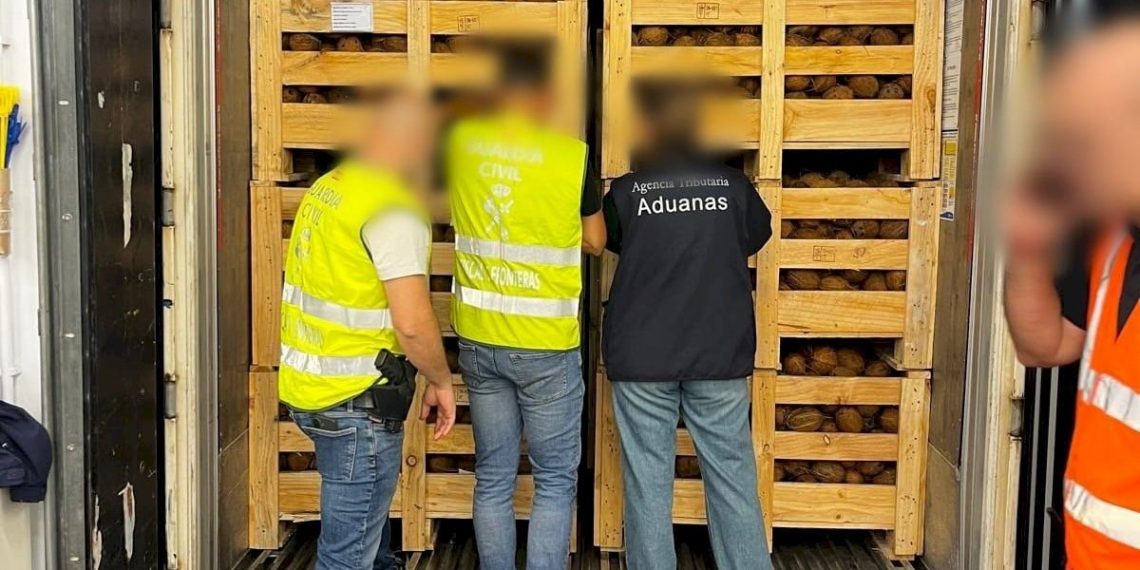
Ghana has once again come under the international spotlight over cocaine trafficking after Spanish authorities intercepted 2,600 kilogrammes of the narcotic concealed in two shipping containers loaded at the Port of Tema.
The seizure, announced by Spain’s Tax Agency (Agencia Tributaria) on November 11, 2026, involved containers declared to be carrying coconuts in wooden crates.
According to the Spanish authorities, the containers were loaded at Tema Port on August 2, 2026, and arrived at the Port of Valencia in Spain on August 22, 2026.
A subsequent inspection uncovered 2,600 kilogrammes of cocaine concealed beneath false bottoms in the wooden crates used to transport the declared cargo.
The operation was conducted by the Spanish Tax Agency in collaboration with the Guardia Civil, Spain’s law enforcement agency.
Two men were subsequently arrested in Viator, in the province of Almería, in connection with the importation and unloading of the consignment.
Questions over Tema shipment
The seizure raises fresh questions about the possible exploitation of Ghana’s maritime export routes by international drug trafficking networks and the effectiveness of cargo screening at the country’s ports.
Of particular concern is how a shipment containing such a substantial quantity of suspected cocaine could have left Tema Port concealed in containers declared to be carrying agricultural produce.
The Spanish authorities’ announcement, however, does not establish where the cocaine originated or whether it was loaded into the containers in Ghana.
The fact that the containers were loaded at Tema identifies Ghana as the departure point of the shipment, but does not, by itself, establish Ghana as the source of the narcotic.
Ghanaian authorities face questions
The development places the spotlight on Ghana’s maritime security and drug enforcement institutions, particularly the Narcotics Control Commission (NACOC), the Ghana Ports and Harbours Authority (GPHA) and the Customs Division of the Ghana Revenue Authority.
Their responses would be crucial in establishing whether the containers underwent the required inspections before departure, the parties responsible for the shipment and whether Ghanaian authorities have commenced investigations into the incident.
It also raises questions about the extent of intelligence-sharing between Ghanaian and Spanish law enforcement agencies in tracking suspicious consignments moving through international shipping routes.
Growing international scrutiny
The latest seizure adds to concerns about cocaine trafficking through international maritime supply chains, where traffickers exploit legitimate commercial shipments to move illicit drugs across borders.
The use of agricultural produce as declared cargo also highlights the challenges facing customs and law enforcement agencies in identifying concealed narcotics without unnecessarily disrupting legitimate trade.
For Ghana, the latest interception presents another opportunity for the relevant authorities to demonstrate the effectiveness of the country’s port security and anti-narcotics enforcement systems.
The Spanish Tax Agency has not indicated in its announcement whether Ghanaian authorities have been formally notified or whether a joint investigation has been initiated.
The Chronicle will continue to follow developments surrounding the seizure and seek responses from the relevant Ghanaian authorities.
Source: Spain’s Tax Agency (Agencia Tributaria), November 11, 2026.
For more news, join The Chronicle Newspaper channel on WhatsApp: https://whatsapp.com/channel/0029VbBSs55E50UqNPvSOm2z