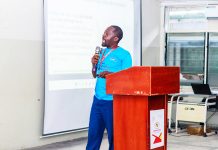
Former Ghanaian Vice President Dr. Mahamudu Bawumia fired a bold warning to African leaders and policymakers on Saturday, declaring that the continent stands at a defining crossroads with artificial intelligence — and that missing this moment would be a historic failure the continent simply cannot afford.
Speaking at the prestigious London School of Economics and Political Science during the LSE Africa Summit 2026, Dr. Bawumia delivered a sweeping address on the theme ‘Artificial Intelligence and Uniting Borders,’ calling on African governments to act with urgency, boldness, and continental solidarity in the face of a rapidly accelerating global digital revolution.
“Digitalization is no longer at the periphery,” Dr. Bawumia told the gathering of policymakers, scholars, innovators, and students. “It is front and center. It is a necessity for survival and prosperity in the
21st century.”
Three Revolutions. Three Missed Opportunities
Drawing on history to sharpen his argument, the former Vice President delivered a sobering audit of Africa’s relationship with industrial progress. The continent, he noted, was largely absent from the first industrial revolution — the age of steam and mechanized production. It missed the second, when electricity powered mass production and the assembly line rewired the global economy. And when computers ushered in the third industrial revolution, Africa again failed to ride the wave.
“We are now in the fourth industrial revolution,” he said, “where technologies have come together in a global network to create the internet — the greatest machine ever created by mankind — and using that to energise tools and equipment to make them smart.”
That fourth revolution, he argued, is unlike anything before it. Artificial intelligence and the Internet of Things have opened up what he described as “amazing possibilities with no end in sight.” The window, he warned, is open — but it will not stay open forever.
‘Africa Does Not Lack Talent’
In remarks that drew evident attention from the audience, Dr. Bawumia pushed back firmly against any suggestion that Africa’s historical absence from industrial progress reflected a deficit of human capacity.
“Africa does not lack talent,” he said pointedly. “What we lack is deliberateness, leadership, and investment to create the ecosystems where innovations and innovators thrive.” He attributed the continent’s lag over the past century squarely to inadequate investment in research and development and a persistent failure by governments to build the enabling environments that allow innovators to flourish at home rather than abroad.
A Call for Bold, Cooperative Action
Bawumia urged African policymakers to draw a clear lesson from both the continent’s own painful history and from the trajectories of nations that have successfully industrialised: when something qualitatively new arrives, the response must be swift, decisive — and united.
“The key lesson is the awareness of the importance to recognise when something qualitatively new is going on, and the will to face what’s new — to act boldly, decisively, yet cooperatively,” he said.
That emphasis on cooperation carried particular weight against the backdrop of his speech’s theme. Artificial intelligence, he implied, is not a technology that any single African nation can master in isolation.Its potential on the continent will depend on shared infrastructure, cross-border data policy, and collective political will.
‘Embrace It, Don’t Fear It’
Closing his address, Dr. Bawumia delivered what amounted to a direct charge to every policymaker in the room.“We cannot afford to be left behind this time,” he said. “We should embrace the technology and not be intimidated by it.”
The LSE Africa Summit, now in its latest edition, has become one of the foremost platforms for debating the continent’s economic and political future. Saturday’s address by the former Vice President was among its most pointed — a speech that used the lessons of three lost revolutions to make the case that Africa’s engagement with artificial intelligence is not a matter of aspiration.
It is a matter of survival.
For more news, join The Chronicle Newspaper channel on WhatsApp: https://whatsapp.com/channel/0029VbBSs55E50UqNPvSOm2z