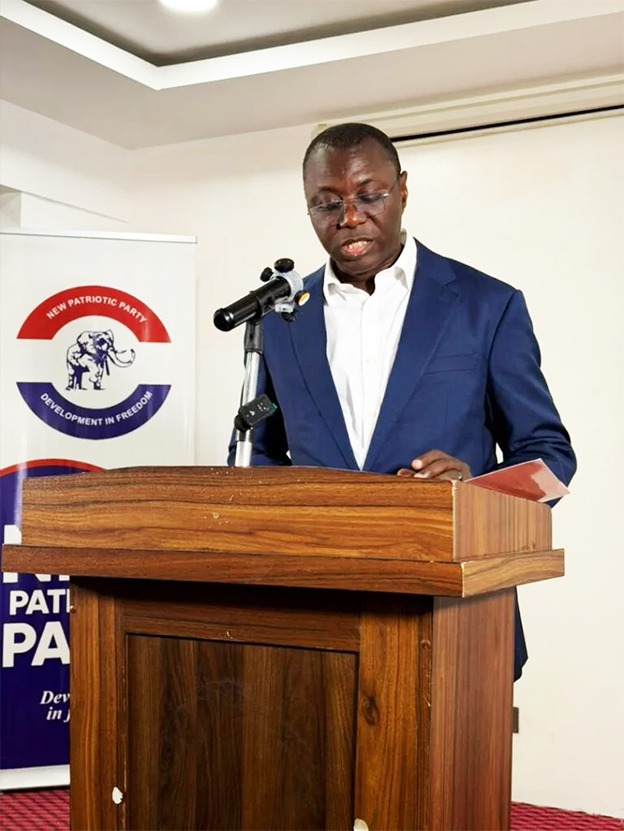
Former Finance Minister and New Patriotic Party (NPP) Policy Coordinating Committee member on Finance and Economy, Dr. Mohammed Amin Adam, has accused the government of failing to account for about US$150 million in tax revenue, that he says Ghana lost in 2025 as a result of the abolition of a withholding tax on unprocessed gold from the small-scale mining sector.
“Government scrapped 1.5% withholding tax on unprocessed small-scale gold. For 2025, it amounted in revenue terms to $150 million revenue for Ghana. We did not get that revenue because of Gold Board’s operations. That is a loss that hasn’t been accounted for,” Dr. Amin Adam said.
He said the foregone revenue should be considered an additional cost arising from the government’s gold purchasing operations, arguing that it had not been captured in the calculation of the programme’s losses.
Dr. Amin Adam further said that when the foregone tax revenue was added to the US$1.7 billion in trading losses associated with the programme, the total cost to the country in 2025 approached US$1.9 billion.
“So if you add the foregone tax revenue to the trading losses of $1.7bn, the total cost to the country in that single year approaches $1.9bn,” he said.
The former minister made the claims at an NPP press conference on Tuesday, September 1, 2026 where he presented an extensive analysis of the government’s gold purchasing programme and questioned the accuracy and transparency of the financial figures being reported by state institutions.
Three different accounts
Dr. Amin Adam said three official sources had provided significantly different figures for the financial outcome of the same programme.
He cited a GH¢5.45 billion surplus reported by GoldBod, a GH¢9.05 billion net loss contained in the Bank of Ghana’s audited accounts and a GH¢22 billion programme loss identified by the International Monetary Fund (IMF).
He questioned the wide gap between the figures and sought to explain what he described as the accounting differences behind them.
According to his analysis, two items account for almost GH¢13 billion of the difference between the IMF’s GH¢22 billion loss and the Bank of Ghana’s GH¢9.05 billion figure.
The first was a GH¢5 billion transfer from the government’s main treasury or Consolidated Fund, which he said the Finance Minister had described as a recapitalisation bond.
The second was GH¢7.99 billion in paper gains on gold that had been booked as income. “Once you take these two items out, the figure comes down to GH¢9.01 billion, which is almost exactly the GH¢9.05 billion that Bank of Ghana reported,” he said.
The remaining difference, he said, was approximately GH¢40 million and arose from currency conversion.
Dr. Amin Adam questioned why the Bank of Ghana had reported GH¢9.05 billion instead of the IMF’s GH¢22 billion figure without providing what he considered an adequate explanation for the difference.
GoldBod’s GH¢5.45bn surplus
The former Finance Minister also challenged the composition of GoldBod’s reported GH¢5.45 billion surplus.
He said GH¢4.54 billion, representing 81.7% of the reported surplus, was a government capital injection credited around December 30, 2025.
In his assessment, the amount should have been treated as capital rather than revenue. He said the remaining GH¢909.9 million included approximately GH¢827 million in GoldBod fee income, much of which he said came from service charges paid by the Bank of Ghana for the same gold purchasing programme.
The former minister, therefore, questioned whether the reported surplus could be regarded as evidence of strong underlying operational performance.
‘Paper’ gains
Dr. Amin Adam also criticised the treatment of gold valuation gains in the Bank of Ghana’s 2025 financial statements.
He said the central bank recorded a GH¢9.57 billion gain on gold sales, with a substantial portion represented by the GH¢7.99 billion accounting gain he described as a reclassification or unrealised paper gain.
He argued that excluding that gain would substantially change the central bank’s reported financial position.
According to his calculations, the Bank of Ghana’s reported positive solvency position of approximately GH¢5.5 billion would instead become a negative GH¢2.09 billion.
He also said total equity would deteriorate from negative GH¢61.32 billion to negative GH¢96.28 billion, equivalent to about 6.7 per cent of Ghana’s Gross Domestic Product.
Dr. Amin Adam said the distinction between accounting gains and actual cash gains was critical to understanding the programme’s financial performance.
He rejected the suggestion that the losses could be explained merely as valuation effects, arguing that some of the costs represented actual cash losses.
Gold trading costs
The former minister identified three major costs associated with the transactions: exchange-rate differences, discounts offered to foreign buyers, and handling, service and assay fees.
He cited an October 2025 transaction in which gold was sold at approximately US$3,919 per ounce, compared with a world average of about US$4,054 per ounce. That represented a discount of approximately 3.3 per cent.
At the volume of gold traded in 2025, he estimated that the discount amounted to roughly US$450 million annually. He also cited a 0.5 per cent service fee and a 0.258 per cent assay fee.
According to the figures presented by Dr. Amin Adam, the IMF calculated the combined cost of the programme at 14.5 per cent of its value in 2025, although the cost was expected to fall to 5.4 per cent under a new arrangement.
Gold prices surged
Dr. Amin Adam said the losses were particularly concerning because they occurred at a time when international gold prices had risen sharply.
He said gold prices increased by 62.9 per cent in 2025, from an average of approximately US$2,395 per ounce to US$3,441 per ounce.
Despite the substantial increase, he said the IMF estimated that the programme lost approximately 17 per cent of the value of the raw gold sold by the Bank of Ghana.
He questioned how Ghana could have incurred such substantial losses from a gold programme during a period of significant appreciation in the international price of the commodity.
Physical gold reserves declined
The former minister also challenged the argument that the programme had resulted in a significant accumulation of physical gold reserves.
He said Ghana’s physical gold reserves declined from 30.5 tonnes at the end of 2024 to 18.6 tonnes at the end of 2025, representing a fall of 11.9 tonnes.
Although the value of the gold reserves increased, Dr. Amin Adam attributed the increase primarily to the rise in international gold prices rather than an accumulation of physical gold.
He said gold accounted for only 1.3 per cent of the US$4.716 billion increase in Ghana’s international reserves, with the remaining 98.7 per cent coming from other sources.
Gold programme as FX intervention
Dr. Amin Adam further argued that the gold purchasing programme effectively operated as a foreign-exchange intervention mechanism.
He cited IMF figures showing that the programme generated approximately US$10.9 billion in foreign-exchange inflows, while the Bank of Ghana sold approximately US$10.6 billion back into the local currency market.
In his view, this meant the programme was not simply about accumulating gold reserves but was also being used to generate foreign exchange for intervention in the domestic market.
He argued that the government was therefore buying gold at a loss while using the foreign exchange generated from the transactions to support the cedi.
Transparency concerns
The former minister also raised concerns about the transparency of GoldBod’s gold trading operations.
He said approximately 103.8 tonnes of gold sourced from small-scale miners were exported in 2025, with 98.8 per cent going to two destinations.
He questioned why GoldBod had not publicly disclosed the names of the companies buying its gold and raised concerns about the absence of quarterly reports which, according to his presentation, were required under Section 42.
He also cited an IMF estimate that approximately US$11.4 billion worth of gold from small-scale mining was smuggled out of Ghana between 2019 and 2024, and questioned whether the current system had done enough to address the longstanding problem of gold smuggling.
Tax exemptions and public financing
Dr. Amin Adam also questioned the level of public financial support and tax concessions granted to GoldBod.
He said the government provided GoldBod with a GH¢4.54 billion revolving fund, while the institution was also exempted from tax under Section 21 of the GoldBod Act.
As a result, he said, GoldBod did not pay income tax or dividends to the state. He further questioned why the Bank of Ghana financed GoldBod on an interest-free basis and why the cost of such financing was not reflected in GoldBod’s expenses.
For Dr. Amin Adam, the controversy goes beyond the differences between GoldBod’s reported surplus, the Bank of Ghana’s reported loss and the IMF’s assessment.
He argued that the true economic cost of the programme should include the direct trading losses, government capital injections, accounting treatment of gold gains, transaction costs, tax revenue forgone, financing arrangements and changes in Ghana’s physical gold reserves.