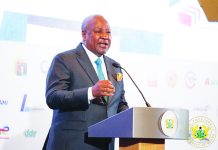
Speaker of Parliament, Alban Sumana Kingsford Bagbin, has opened an important national conversation by proposing constitutional amendments to give traditional and religious leaders a role in Ghana’s parliamentary process.
The proposal, made during the National Development Conference, organised by the Church of Pentecost, deserves careful consideration not because it is without difficulty, but because it raises fundamental questions about the shape of Ghana’s democracy.
Mr Bagbin argued that involving traditional and religious leaders could help reduce excessive partisanship in Parliament and foster greater national unity. The Chronicle believes the proposal merits serious public debate.
The Speaker is no ordinary commentator on parliamentary affairs. Having served in Parliament for over three decades and now presiding over the House, he speaks from considerable experience. The Chronicle has disagreed with some of his decisions in the past, including on matters relating to the Office of the Special Prosecutor, but we believe his latest proposal should be judged on its merits rather than dismissed on the strength of past disagreements.
Ghana’s parliamentary democracy has matured considerably since the Fourth Republic began in 1993. Parliament has passed hundreds of laws, approved national budgets, scrutinised government expenditure and exercised oversight of the Executive — achievements that have contributed materially to the country’s democratic stability.
Yet we are of the view that Parliament has also grown increasingly polarised. Important national questions are too often settled along rigid party lines, with the numerical strength of the Majority or Minority determining outcomes rather than broad national consensus. This is not unique to Ghana, but the trend has become more pronounced here and has, at times, eroded public confidence in the institution.
It is against this backdrop that The Chronicle believes Mr.Bagbin’s proposal deserves attention. Traditional authorities remain custodians of Ghana’s customs, culture and communal values. Religious leaders continue to exercise considerable moral influence over millions of citizens.
Both groups have, at various points in Ghana’s history, helped mediate conflict, promote social cohesion and encourage peaceful coexistence. Their experience in consensus-building could enrich national discussion on matters of far-reaching consequence.
The Chronicle does not, however, believe these leaders should become legislators or exercise voting power in Parliament. The Constitution is unequivocal that legislative authority is vested in Parliament, whose members derive their mandate through election. Any reform that weakens this principle would be difficult to justify.
A more defensible path would be to explore whether traditional and religious leaders could serve in a structured advisory capacity on matters of national importance — a consultative mechanism that allows Parliament to draw on broader perspectives while preserving the constitutional authority of elected representatives.
Even this narrower proposal raises legitimate questions that cannot be waved aside. Who would represent the various traditional councils? Which religious bodies would qualify and on what basis? How would minority faiths and citizens of no faith, be accommodated?
How would political neutrality be guaranteed once such leaders are drawn into a parliamentary process? These are not incidental details. Any constitutional amendment must be built on principles of equality, inclusiveness and democratic accountability and these questions should be resolved through open debate before any amendment is drafted, not left to be settled afterward.
Democratic institutions are not static, in Ghana or elsewhere; constitutional systems evolve to reflect changing societal needs while safeguarding democratic values. Ghana should not reject reform simply because it departs from existing practice — but neither should reform, however framed, be allowed to dilute the principle that political power derives from the will of the people.
Whether or not Mr Bagbin’s proposal is ultimately adopted, it has done the country a service by prompting reflection on how Parliament might become more deliberative, more inclusive, and less constrained by partisan considerations. The Chronicle urges constitutional experts, Parliament, traditional authorities, religious bodies, civil society and the wider public to examine the proposal with open minds — and should reform proceed, to pursue it with one overriding objective: strengthening democratic governance while preserving the supremacy of the Constitution and the will of the people.
We maintained that carefully designed an advisory role for respected traditional and religious leaders could enrich parliamentary deliberation without compromising the democratic mandate of elected MPs. That possibility alone makes Mr Bagbin’s proposal worth serious national consideration.
For more news, join The Chronicle Newspaper channel on WhatsApp: https://whatsapp.com/channel/0029VbBSs55E50UqNPvSOm2z