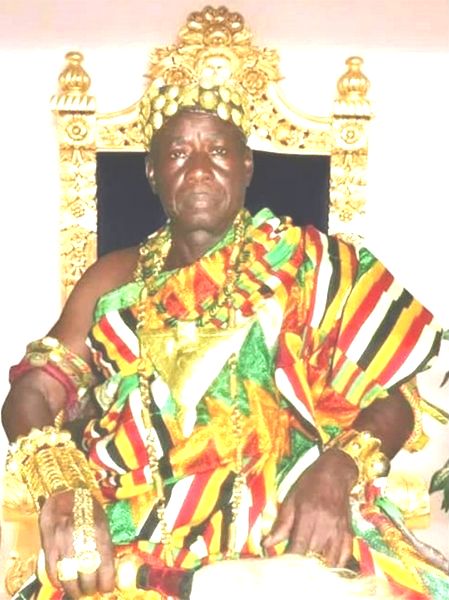
Okofrobour Obeng Nuako III, the Chief of Dunkwa-on-Offin in the Central Region, has revealed that the original inhabitants of Dunkwa migrated from a village called Maase, which was situated between Adanse and Amansie in the Ashanti region.
Dunkwa, the capital of the Upper Denkyira East Municipality is bordered by the Offin River and various highlands and shares boundaries with Ayanfuri, Meredane, Kodiakyem, Agyempaboa, Bibianiha School Park, Pokukrom, Miles 4 and Frimponmaa River.
The Dunkwa enclave is characterized by a mix of stool lands, family lands and alienation holders. Though Maase no longer exists, it remains a significant part of the identity of the Dunkwa people and their ancestral story, Nana Nuako told The Chronicle in an interview.
Giving a comprehensive account of the true origins of the people of Dunkwa, the chief
narrated that in earlier times, the chiefs and elders of Maase frequently travelled to Obuasi Anyinam for farming activities and with time decided to migrate permanently.
Upon reaching Offin River, the Maase leaders and their people crossed to the other side and established a settlement which they named Offinso. He said soon it was discovered that portions of the land were already occupied by the Aowin people, leading to a fierce battle for territory in which the Maase warriors prevailed, defeating the Aowins to take full control of the land.
The Chief identified the leaders who spearheaded this historic migration as Nana Obeng Nuako, Chief of Maase, and Nana Amo Kusi Yiadom, Chief of Meradan who together, led their people into the area that eventually developed into present day Dunkwa.
He said after some days of settlement, Nana Amo Kusi Yiadom advised Nana Obeng Nuako that their new location was too close to enemy territories and posed serious security risks as a result of which he chose to migrate further inland with his people, eventually establishing a new community named Meredane (Time changes).
Okofrobour Obeng Nuako III emphasised that these historical accounts form the foundation of Dunkwa’s identity—highlighting the resilience, courage, and determination of their ancestors.
Dunkwa/Denkyira relationship
The Chief further explained that during the battles between the Maase settlers and the Aowin people, Denkyira was not involved. The conflict was strictly between the Maase people and the Aowins. He revealed that during that period, the Denkyira people were based at Dwokwaa (Jukwa). It was only in the 1940s that the then Denkyirahene, Nana Owusu Bore II, visited Dunkwa and admired the community.
The Denkyirahene subsequently approached the then Dunkwahene, Nana Kwaku Ofori, to request a place to settle.
After consultations, the Dunkwahene and his elders agreed to offer the Denkyirahene a settlement area that would not be too close to the main Dunkwa Township. They allocated a land known as New Dunkwa, which is where the current Denkyira palace stands today.
Nana Obeng Nuako said before the completion of the Denkyira palace, Nana Owusu Bore II and his entourage were hosted in the palace of the Dunkwahene—a gesture symbolizing unity, hospitality, and alliance.
Okofrobour Obeng Nuako III noted that it was only after the death of Nana Kwaku Ofori that the Denkyirahene changed the name of the area from New Dunkwa to Abankesieso.
He stressed that in spite of the change, official land records still identify the area by its original name, New Dunkwa, which is collaborated by the site plan.
He added that Dunkwa embraced the Denkyira people because they needed allies who could support them in times of war emphasising that historically, Dunkwa was never part of Denkyira but rather, Dunkwa welcomed Denkyira for the sake of mutual assistance against potential enemy attacks.
The Dunkwahene noted that the Dunkwa/Denkyira relationship was peaceful even after Nana Owusu Bore II abdicated his throne. According to him, Nana Owusu Bore II first visited the Dunkwa palace to present himself to the then Dunkwahene, after which he proceeded to Abuakwa to also inform the Chief of Abuakwa about his abdication.
Dunkwa/Denkyira chieftaincy dispute
Okofrobour Obeng Nuako III explained that peaceful relations between Dunkwa and Denkyira continued until the late Denkyirahene, Odeefuo Boamponsem II, summoned him about a year after his enstoolment as Dunkwahene.
According to Nana Obeng Nuako, the Denkyirahene requested that Dunkwa allows their half-siblings—children of the same father but a different mother—to be part of the Dunkwa stool which request was rejected by the Dunkwahene and his elders stating that by tradition, rival children cannot inherit another woman’s stool and that only descendants from the stool mother’s lineage are eligible to inherit that particular stool.
After Dunkwahene refused the request, the then Denkyirahene, Odeefuo Boamponsem II, attempted to destool him. This dispute ended in court when the Cape Coast High Court ruled in his favour, affirming his rightful position as Dunkwahene. Unsatisfied with the ruling, Denkyirahene appealed the case at the Court of Appeal, which also upheld the High Court’s decision and ruled again in favour of Dunkwahene. Both the Cape Coast High Court and Court of Appeal declared that the Denkyirahene has no “basis or authority” to destool the Dunkwahene.
Dunkwa Stool lands
Okofrobour Obeng Nuako III emphasized that Dunkwa is a stool land belonging to the Dunkwahene and not Denkyira and reiterated the claim that Dunkwa has never been part of Denkyira State.
He explained that lands in Dunkwa (Dunkwa-on-Offin, Central Region) are classified as Stool Lands and are held in trust by the Dunkwa Stool. The allodial title and custodian rights over these lands are traditionally vested in the Dunkwahene (the Chief of Dunkwa) acting in consultation with his principal elders.
The chief said Dunkwa stool lands are administered under the following structure: (a) The Dunkwahene (Custodian) emphasising that the current Dunkwahene, (Okofrobour Obeng Nuako III), holds administrative authority over Dunkwa stool lands, managing them on behalf of the people.
Under customary law and the Ghana Land Act, the chief is responsible for land allocations and ensuring proper use, including land reclamation after mining activities.
(b) The Denkyira Traditional Council: Dunkwa-on-Offin falls within the broader Denkyira Kingdom. While the traditional authority lies with the Denkyirahene (currently Odeefuo Boa Amponsem IV), the Dunkwahene manages the local stool lands and community affairs.
(c) Government Oversight: While the State does not own stool lands, the Office of the Administrator of Stool Lands manages the collection and disbursement of land revenues and royalties generated within the district. Okofrobour Obeng Nuako III stressed that Dunkwa-on-Offin is autonomous and owes “no allegiance” to any Paramout Chief.
Okofrobour Obeng Nuako III indicated that like Twifo Hemang and Twifo Atti-Morkwa, Dunkwa owes no allegiance to the Denkyirahene stressing that Dunkwa has left the Denkyira Traditional Council and currently working to attain paramountcy status.
As a result, the Dunkwahene has reiterated his position that he owes no allegiance to any Paramount Chief, indicating that though he swore to the Denkyirahene upon his enstoolment, it was out of courtesy for helping Regents to rule Dunkwa after the demise of Nana Kwaku Ofori.
He noted that his position explains why it is the Dunkwahene’s consent that is sought for and not that of the Denkyirahene when one wants to acquire a land in the Dunkwa enclave, citing the Ghana Railways acquiring their lands from the Dunkwahene.
“Denkyirahene’s signature on a document regarding Dunkwa Stool lands serve as a mere witness, nothing more or less”, the Dunkwahene emphasised.
He said Dunkwa-on-Offin stool lands are primarily held in trust by the Dunkwahene and sub-chiefs within the Upper Denkyira East Municipal District of the Central Region, serving as vital resources for local development and traditional administration.