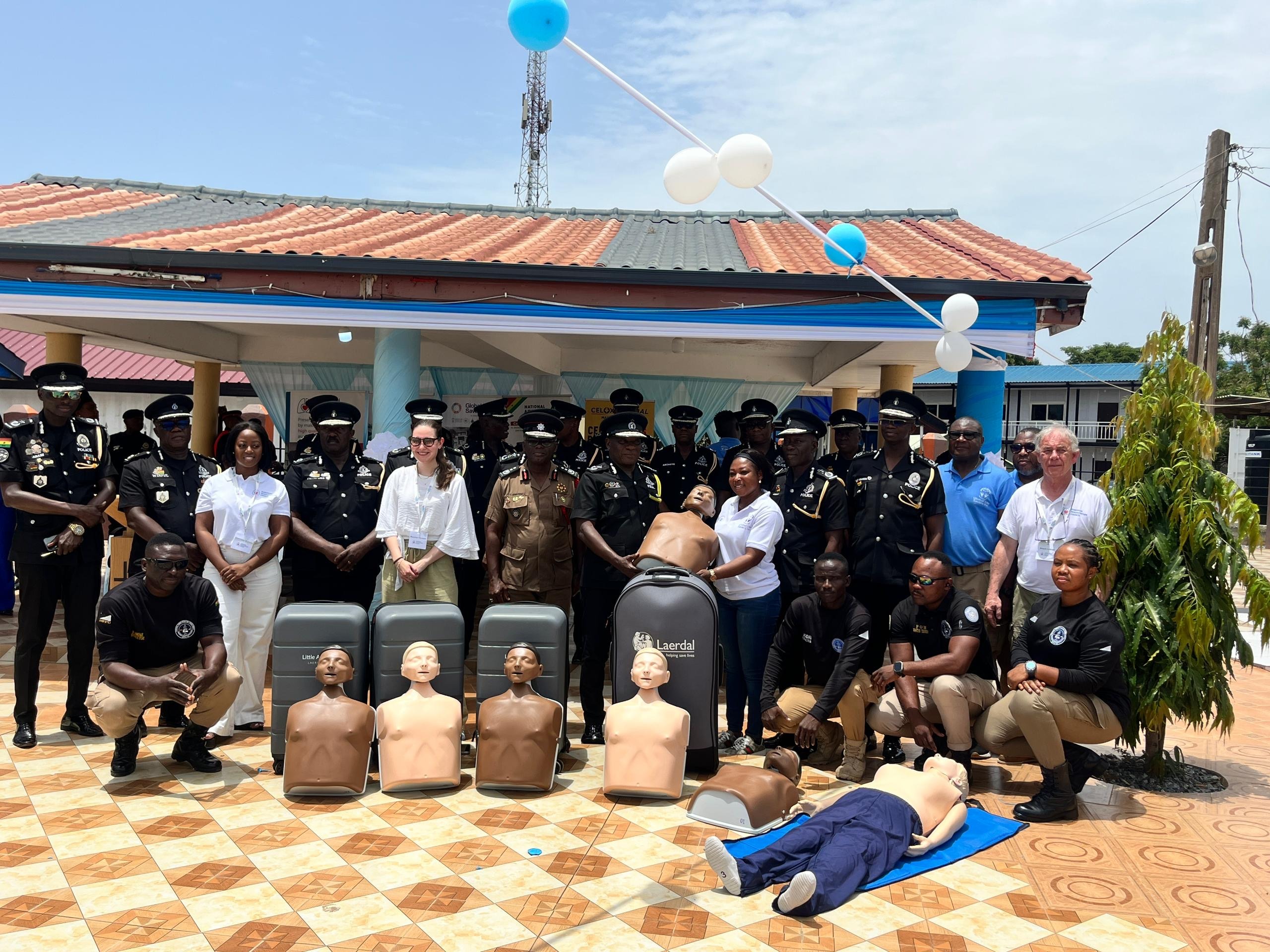
The Ghana Police Service has taken a significant step toward redefining the modern police officer, not merely as a law enforcement agent, but as a first responder capable of preserving life.
At the closing ceremony of a two-day Train-the-Trainer workshop on emergency medical response, held at the Police Depot in Tesano, Accra, every Speaker who took the podium told the same story of collaboration, of urgency and of a Ghana in which no life is lost, for want of a trained hand nearby.
Dr. Selina Okyere, representative of Global Lifesavers, Inc., was the first to set the tone. Expressing appreciation for the trust that made the partnership possible, she was quick to frame the programme’s significance in terms that went beyond institutional capacity-building.
“This initiative goes beyond training. It is about lifesaving,” she said, noting that the curriculum spanning CPR, first aid, and tactical emergency care was designed to equip officers to act decisively whether on active duty or within the communities they patrol.
She acknowledged the structural credibility the ERC’s involvement lent to the exercise, stating that its “guidance and international standard support will ensure that the training delivers global best practices,” and assured all present of Global Lifesavers’ commitment to delivering “high-quality, sustainable training that will have a lasting impact.”
The National Ambulance Service aligned itself fully with that position. In a goodwill message delivered on behalf of its CEO, Dr. George Kojo Owusu, the Service described the programme as a demonstration of “the power of collaboration, bringing together institutions with a shared purpose to protect lives.”
Commending the High Command of the Ghana Police Service for its commitment to public safety, the message affirmed that “the skills acquired and partnerships forged during the period will undoubtedly enhance our readiness to respond swiftly and effectively in critical moments,” and reaffirmed the Service’s “unwavering commitment to working hand-in-hand with the police service and all stakeholders to build a safe Ghana.”
Mazarines Tyssens, representing the European Resuscitation Council, offered perhaps the most direct moral articulation of what the workshop stood for. Dispensing with institutional formality, she grounded the ERC’s involvement in a principle as simple as it was far-reaching: “Every life is valuable, and wherever you live does not mean that you should be limited.”
Her vision, she made clear, extended well beyond the police service. The ultimate goal, she said, was a Ghana in which every citizen — not just every officer — could perform CPR.
The IGP’s Charge
It fell to Inspector-General of Police Mr. Christian Tetteh on his part praised the facilitators and partners for training officers who would themselves go on to train others, and congratulated the participants for their discipline and active engagement throughout the two days.
But he was equally candid about the operational reality that made the programme not merely worthwhile but necessary.
“In our line of duty, we are often the first to arrive at accident scenes, during emergencies, and in moments of crisis. In those critical moments, what we do or fail to do can make all the difference. That is why emergency medical response is not an added skill. It is an essential one.”
Addressing the newly certified instructors directly, the IGP was unambiguous about the responsibility they now carried.
“You are no longer just trainees. You are trainers, and indeed ambassadors of this critical skill within the Ghana Police Service.
“The baton has now been handed over to you. I encourage you to carry it with diligence, integrity, and a spirit of excellence.”
He backed those words with a concrete pledge: the administration would provide the logistics, equipment, and support systems necessary to ensure that what was learned at Tesano could be effectively applied in the field.
His vision, he stated, was to progressively extend the training to every officer within the Ghana Police Service.
“This is how we build a modern police service – one that is professional, responsive, and deeply committed to the safety and well-being of both our officers and the citizens we serve.”
He closed with a caution as much as a charge: “Training such as this must not be seen as an event, but as part of an ongoing journey towards professionalism and service excellence.”
For more news, join The Chronicle Newspaper channel on WhatsApp: https://whatsapp.com/channel/0029VbBSs55E50UqNPvSOm2z